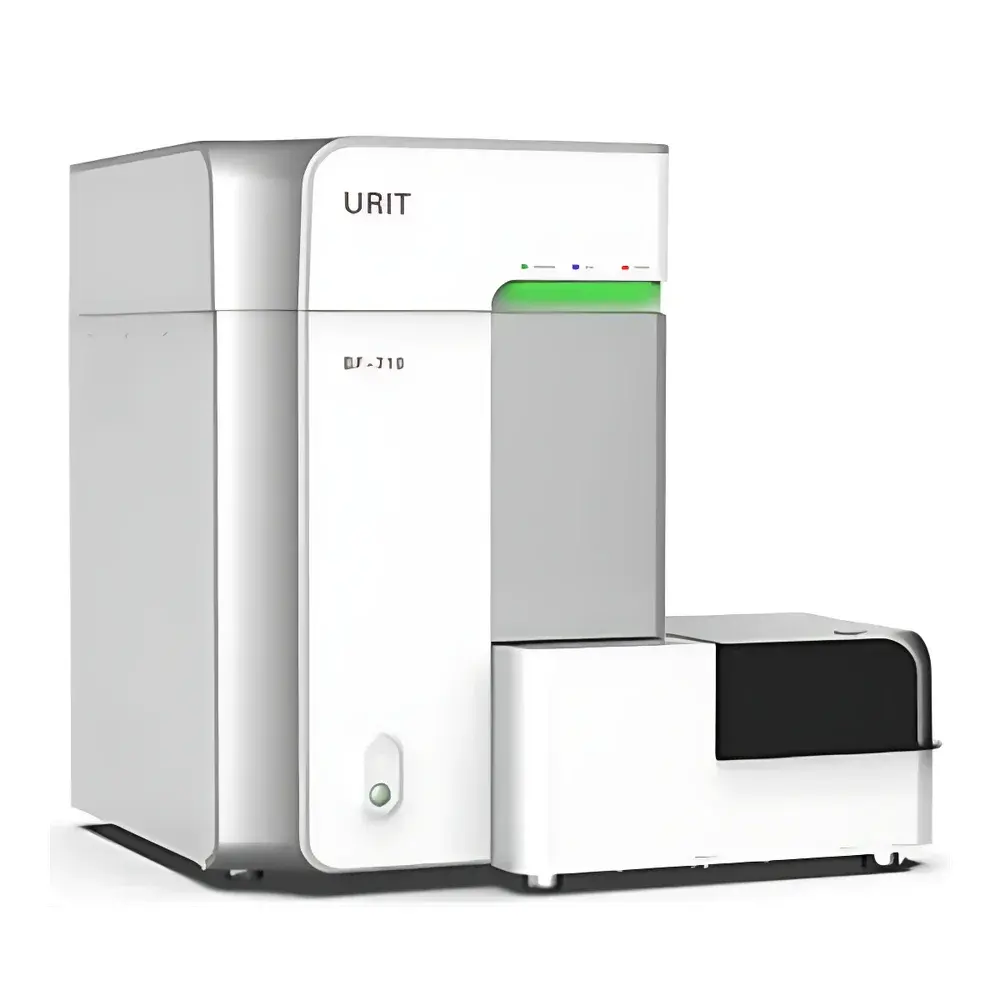
URIT BF-710 Dual-Laser Flow Cytometer
| Brand | URIT |
|---|---|
| Origin | Guangxi, China |
| Manufacturer Type | Original Equipment Manufacturer (OEM) |
| Regional Classification | Domestic (PRC) |
| Model | BF-710 |
| Pricing | Upon Request |
Overview
The URIT BF-710 is a benchtop dual-laser flow cytometer engineered for high-throughput, multi-parametric analysis of suspended cells and particles in life science research, clinical immunology, and quality control laboratories. It operates on the principle of hydrodynamic focusing combined with laser-induced fluorescence and light scatter detection. Two independently aligned lasers—typically a 488 nm blue solid-state laser and a 638 nm red diode laser—enable simultaneous excitation of fluorophores across distinct emission spectra. Forward scatter (FSC) and side scatter (SSC) signals provide morphological information (e.g., cell size and granularity), while up to eight fluorescence parameters are acquired per event using configurable optical filters and high-sensitivity photomultiplier tubes (PMTs). The system supports quantitative immunophenotyping, cell cycle analysis, apoptosis assessment, intracellular cytokine staining, and rare-event detection at acquisition rates exceeding 10,000 events per second under standard operating conditions.
Key Features
- Dual-laser optical architecture with independent alignment and power stabilization for reproducible excitation across multiple fluorochrome panels
- Configurable fluorescence detection: selectable 4-color, 6-color, or 8-color configurations via interchangeable filter sets and PMT voltage optimization
- Multi-modal sample introduction: single-tube aspiration, 40-position rack-based loading, or automated microplate handling (compatible with 48-well and 96-well formats)
- Real-time visual monitoring of sample aspiration through integrated transparent flow cell window and onboard camera feed
- Integrated vortex mixing module ensures homogeneous suspension prior to injection, minimizing sedimentation artifacts during acquisition
- Fully automated fluidic workflow: programmable auto-sampling, post-run nozzle flushing, sheath fluid priming, and waste evacuation with pressure-sensor feedback
- Embedded data logging engine records instrument status, voltage settings, laser output, and acquisition timestamps in compliance with GLP traceability requirements
Sample Compatibility & Compliance
The BF-710 accommodates a broad range of biological suspensions including peripheral blood mononuclear cells (PBMCs), whole blood lysates, cultured adherent and suspension cell lines, yeast, bacteria, and synthetic microparticles (0.5–50 µm diameter). Sample volumes range from 50 µL to 1 mL per acquisition. All fluidic pathways are constructed from medical-grade PEEK and borosilicate glass to resist chemical degradation and minimize nonspecific binding. The system conforms to IEC 61010-1:2010 for laboratory equipment safety and incorporates electromagnetic compatibility (EMC) shielding per EN 61326-1. While not FDA 510(k)-cleared, its software architecture supports audit trail generation, user access levels, and electronic signature capability—features aligned with 21 CFR Part 11 readiness for regulated environments when deployed with validated SOPs.
Software & Data Management
The BF-710 is operated via URIT FlowSuite™ — a bilingual (English/Chinese) desktop application built on a .NET framework with SQLite backend. Core functionalities include real-time histogram and dot plot visualization, Boolean gating hierarchy, compensation matrix calculation using single-stain controls, and batch processing of plate-based experiments. Quality control routines include daily setup verification using CS&T (Cytometer Setup and Tracking) beads, automatic PMT voltage adjustment, and CV-based performance trending. Reports are exportable in PDF, CSV, and FCS 3.1 format; templates cover common assays such as CD4/CD8 T-cell enumeration, cell cycle phase distribution (PI staining), and Annexin V/7-AAD apoptosis staging. Data files retain full metadata—including instrument configuration, operator ID, date/time stamps, and calibration history—for retrospective analysis and regulatory review.
Applications
- Immunophenotyping of hematopoietic lineages in clinical hematology and transplant monitoring
- Functional immune profiling: intracellular IFN-γ, IL-2, TNF-α detection following antigen stimulation
- Cell proliferation tracking using CFSE or CellTrace Violet dilution kinetics
- Stem cell characterization via surface marker co-expression (e.g., CD34+/CD45−/CD117+)
- Microbial viability assessment using SYTO9/propidium iodide dual staining
- Exosome and extracellular vesicle enumeration and phenotyping (with appropriate size-calibration standards)
- High-content screening in drug discovery pipelines requiring multiplexed readouts
FAQ
What laser wavelengths are integrated into the BF-710 platform?
The system includes a 488 nm blue laser and a 638 nm red laser, both with thermoelectric cooling and real-time power monitoring.
Is the instrument compatible with third-party reagents and antibodies?
Yes—BF-710 accepts all commercially available fluorochrome-conjugated antibodies and viability dyes validated for flow cytometry, provided spectral overlap is compensated during setup.
Does the software support LIMS integration?
FlowSuite™ provides configurable CSV export and ODBC-compliant database connectivity for custom LIMS interfacing; API documentation is available under NDA.
Can the BF-710 perform absolute counting without reference beads?
Absolute quantification requires volumetric counting mode with calibrated sheath flow rate and optional fluorescent counting beads (e.g., TruCount or Flow-Count); bead-free estimation is not supported.
What maintenance protocols are recommended for long-term stability?
Daily decontamination of fluidics with 10% bleach followed by ethanol rinse, quarterly PMT gain validation, and annual optical alignment verification using alignment beads are advised per URIT Technical Bulletin FT-021.
Related Products