
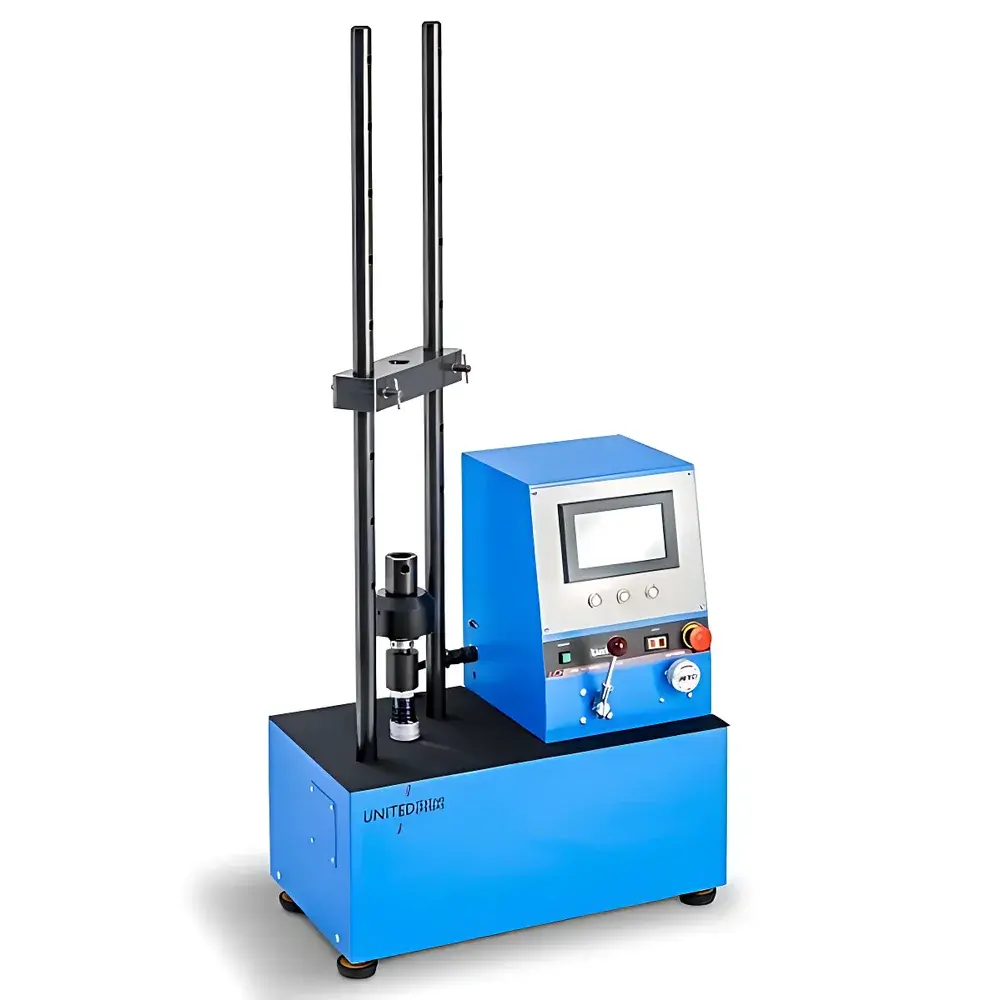
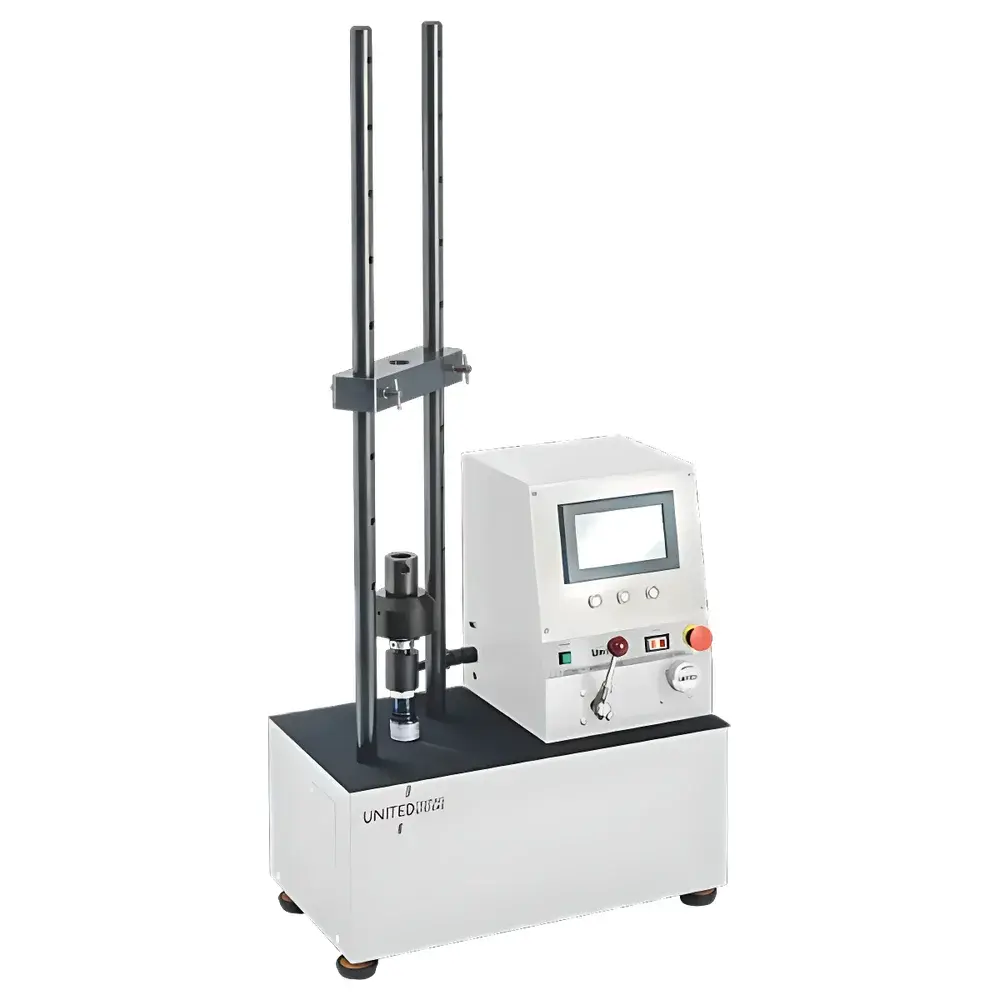
UTS LCH Speedy Portable Hydraulic Tensile Testing Machine
| Brand | UTS |
|---|---|
| Origin | USA |
| Model | LCH Speedy |
| Type | Hydraulic Tensile Testing Machine |
| Max Test Load | 50–300 kN |
| Load Range | 50–300 kN (Full Scale) |
| Load Accuracy | ±0.5% of reading |
| Crosshead Travel | 762 mm |
| Power Supply | 120 V / 60 Hz / 20 A or 240 V / 50 Hz / 10 A |
| Net Weight | 72.6 kg |
| Dimensions (W×D×H) | 584 × 1067 × 305 mm |
| Actuator Stroke | 121 mm |
| Load Cell Options | 1, 5, 10, 50, 100, 150, 300 kN (interchangeable) |
| Interface | RS-232C |
| Peak Load Capture | Yes |
| Overload Protection | Integrated |
| Jog Preload System | Yes |
| Display Resolution | 0.45 kg (1 lb) |
| Frame Stiffness | Engineered for high-rigidity in-line loading configuration |
Overview
The UTS LCH Speedy Portable Hydraulic Tensile Testing Machine is a compact, benchtop-mounted, hydraulically actuated system engineered for rapid, repeatable mechanical testing in production environments and quality control laboratories. It operates on the principle of controlled quasi-static uniaxial loading—applying force at a defined rate while measuring load and displacement—to evaluate tensile strength, shear strength, peel resistance, bond integrity, and structural durability of assembled joints and materials. Its design emphasizes operational robustness, ease of integration into manufacturing cells (e.g., near resistance spot welding stations), and compliance with standardized test protocols used across automotive, aerospace, and electronics assembly industries. Unlike servo-electric systems optimized for high-speed dynamic profiling, the LCH Speedy prioritizes mechanical stability, thermal drift resistance, and long-term calibration retention—critical attributes for in-line weld validation where measurement consistency across shifts and operators is non-negotiable.
Key Features
- Hydraulic actuation with integrated pressure regulation ensures smooth, vibration-damped force application—ideal for brittle fracture analysis and interface failure mode identification in spot welds and adhesive bonds.
- Modular interchangeable load cells (1–300 kN) enable seamless adaptation to diverse test requirements—from fine-wire tensile evaluation to heavy-gauge steel joint verification—without recalibration overhead.
- High-rigidity dual-column frame minimizes deflection under load, maintaining axial alignment within ISO 7500-1 Class 1 tolerances during extended duty cycles.
- Digital load display with 1 lb (0.45 kg) resolution and real-time load-rate indication supports immediate operator feedback during manual or semi-automated test execution.
- Integrated overload protection circuitry and mechanical stop limits prevent damage to load cells and fixtures during accidental over-travel or specimen rupture.
- JOG pre-load function allows precise specimen engagement prior to test initiation—essential for eliminating slack in flexible substrates (e.g., harnesses, gaskets) and ensuring zero-baseline force registration.
- RS-232C serial interface enables direct data logging to external PCs or LIMS platforms; compatible with basic ASCII-based acquisition scripts and legacy QC software stacks.
Sample Compatibility & Compliance
The LCH Speedy accommodates a broad spectrum of specimen geometries and joint configurations—including lap-shear weld coupons (per ASTM D1876), peel specimens (ASTM D903), tensile bars (ASTM D638, ASTM E8), compression blocks (ASTM D695), and fastener pull-out assemblies. Its open-throat design and adjustable crosshead height (762 mm vertical travel) support testing of large-format components such as battery module interconnects, HVAC duct flanges, and composite panel fasteners. The system meets mechanical accuracy requirements outlined in ASTM E4 (Standard Practices for Force Verification of Testing Machines) and ISO 7500-1 (Metallic Materials — Calibration of Force-Testing Machines). While not inherently 21 CFR Part 11 compliant out-of-the-box, its deterministic analog signal path and traceable load cell calibration certificates support GLP/GMP audit readiness when paired with validated data capture procedures.
Software & Data Management
The LCH Speedy operates without proprietary software—leveraging hardware-level digital signal processing for real-time load readout and peak-hold capture. All measurement data are transmitted via RS-232C using ASCII-formatted strings containing timestamped load values, peak load, and test status flags. This architecture eliminates dependency on vendor-specific drivers or operating system updates, enhancing long-term maintainability in regulated facilities. Users may integrate output directly into Excel-based SPC dashboards, LabVIEW DAQ environments, or custom Python scripts for automated pass/fail logic based on predefined thresholds (e.g., minimum acceptable RSW shear strength per AIAG CQI-15). Calibration reports include NIST-traceable uncertainty budgets aligned with ISO/IEC 17025 guidelines.
Applications
- Resistance Spot Weld (RSW) quality assurance in automotive body-in-white and battery pack assembly lines.
- Adhesive bond strength verification for structural bonding of aluminum and composites in aerospace subassemblies.
- Tensile and shear evaluation of brazed, soldered, and riveted joints in electronic enclosures and powertrain housings.
- Mechanical validation of wire harness crimps, terminal pulls, and connector retention forces per USCAR-21 and GMW3172.
- Peel and cleavage testing of laminated safety glass interlayers and polymer film coatings.
- Compression testing of foam gaskets, elastomeric seals, and thermal interface materials.
- Creep and stress-relaxation screening of thermoplastic fasteners and molded polymer clips.
FAQ
What standards does the LCH Speedy support for RSW testing?
It is routinely deployed for lap-shear testing per ASTM D1876 and ISO 14273, with fixture geometry and specimen preparation aligned to AWS D8.9 and VW 60319 specifications.
Can the system perform cyclic or fatigue testing?
No—the LCH Speedy is designed exclusively for quasi-static monotonic loading; it lacks closed-loop strain or displacement control required for fatigue protocols.
Is calibration traceable to national standards?
Yes—each load cell ships with a certificate of calibration traceable to NIST, including uncertainty values at multiple points across its range.
How is specimen alignment ensured during testing?
The machine’s rigid frame and precision-ground guide rods maintain <0.1° angular deviation under full load; optional self-aligning grips (sold separately) further reduce bending moments in off-axis specimens.
What maintenance is required for hydraulic operation?
Annual fluid inspection and filter replacement per UTS Maintenance Bulletin MB-LCH-02; no scheduled seal replacement is required within first 5 years of typical industrial use.



