
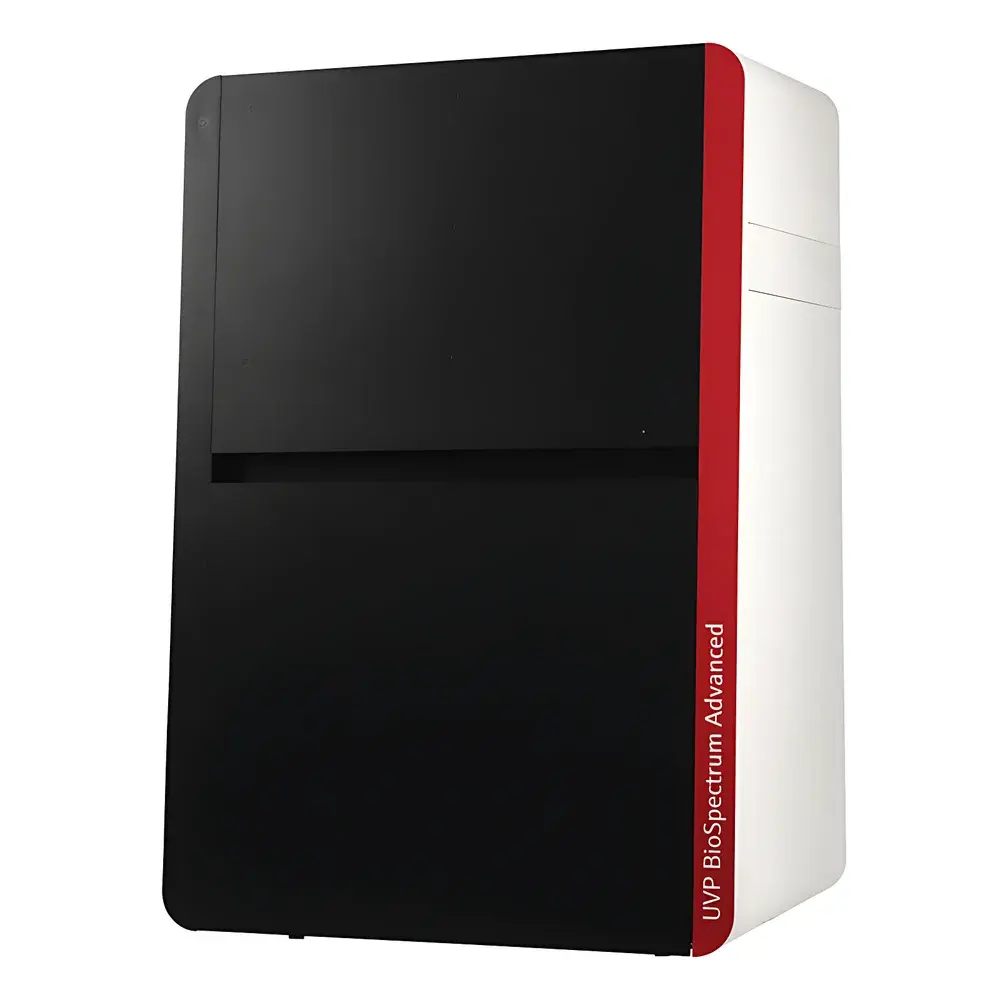
UVP Biospectrum Advanced 900 Small Animal In Vivo Imaging System
| Brand | Analytik Jena |
|---|---|
| Origin | USA |
| Manufacturer | Analytik Jena GmbH (Germany) |
| Model | UVP Biospectrum Advanced 900 |
| Imaging Modality | Optical Bioluminescence & Fluorescence Imaging |
| Spectral Sensitivity Range | 405–810 nm |
| Field of View | 33.5 cm × 32 cm |
| Maximum Simultaneous Samples | 10 mice |
| Detector | −100 °C Cooled Back-Illuminated CCD |
| Lens | Fixed-focus f/0.95 lens |
| Integrated Temperature-Controlled Stage | Yes |
| Onboard Isoflurane Anesthesia Delivery | Yes |
| Software Compliance | FDA 21 CFR Part 11, Audit Trail, Electronic Signatures |
| Filter Customization | User-selectable excitation/emission filter sets |
Overview
The UVP Biospectrum Advanced 900 Small Animal In Vivo Imaging System is a high-sensitivity, modular optical imaging platform engineered for quantitative bioluminescence and fluorescence detection in live animal models. Designed around a scientific-grade, thermoelectrically cooled (−100 °C) back-illuminated CCD sensor and an ultra-fast f/0.95 fixed-focus lens, the system achieves exceptional photon capture efficiency and signal-to-noise ratio—critical for low-light bioluminescent assays such as luciferase reporter studies. Its dual-modal architecture supports both endogenous bioluminescence (e.g., firefly, Renilla, NanoLuc) and exogenous fluorescence imaging across a broad spectral range (405–810 nm), enabling longitudinal monitoring of biological processes—including tumor progression, immune cell trafficking, gene expression dynamics, and pharmacokinetic distribution—without euthanasia or tissue extraction.
Key Features
- Deep-cooled (−100 °C) back-illuminated CCD detector with <1 e⁻/pixel/sec dark current, optimized for ultra-low-light bioluminescence quantification
- High-power tunable laser excitation source covering UV to NIR (405–810 nm), delivering narrow bandwidth (<5 nm FWHM) and stable irradiance for reproducible fluorescence excitation
- Large-format imaging chamber with 33.5 cm × 32 cm field of view—accommodating up to 10 adult mice simultaneously on a temperature-regulated stage (maintains 37 °C ± 0.5 °C)
- Integrated isoflurane anesthesia delivery system with real-time vapor concentration monitoring and exhaust scavenging—eliminating manual transfer and minimizing physiological stress
- Modular filter wheel supporting user-defined excitation/emission combinations; optional custom filter sets available for novel fluorophores (e.g., IRDye 800CW, Cy7.5, mCherry variants)
- FDA 21 CFR Part 11-compliant acquisition software with role-based access control, electronic signatures, immutable audit trails, and ALCOA+ data integrity framework
Sample Compatibility & Compliance
The Biospectrum Advanced 900 supports diverse preclinical specimens including murine models (C57BL/6, BALB/c, nude, NSG), zebrafish larvae, plant seedlings, and ex vivo tissues. Its open-stage design permits rapid reconfiguration for alternative sample formats—such as multiwell plates for cell-based luminescence assays or gel cassettes for Western blot imaging. All hardware and firmware comply with IEC 61000-6-3 (EMC) and IEC 61010-1 (safety). The system meets GLP/GMP-aligned validation requirements for nonclinical laboratory studies per OECD Test Guidelines and ISO/IEC 17025 documentation standards. Regulatory documentation packages—including IQ/OQ/PQ protocols, calibration certificates, and traceable sensor characterization reports—are provided upon request.
Software & Data Management
Acquisition and analysis are performed using UVP VisionWorks LS software—a validated, Windows-based platform supporting automated multi-timepoint imaging, region-of-interest (ROI) quantification, background subtraction algorithms (rolling ball, morphological), and kinetic curve generation. Raw image data (16-bit TIFF) are stored with embedded metadata (exposure time, binning, filter ID, anesthesia status, operator ID). The software enforces data provenance through timestamped audit logs, version-controlled processing pipelines, and export to standardized formats (MIAME-compliant XML, CSV, PDF reports). Integration with LIMS and ELN systems is supported via secure REST API and DICOM-SR extensions.
Applications
- Oncology: Longitudinal tracking of orthotopic/tumor xenograft growth, metastasis, and therapeutic response using luciferase-labeled cell lines or fluorescently tagged antibodies
- Immunology: In vivo visualization of adoptively transferred T cells, macrophage infiltration, or cytokine reporter activity in autoimmune or infection models
- Gene Therapy & Transgenics: Validation of promoter activity, Cre-lox recombination efficiency, and shRNA knockdown kinetics in live animals
- Drug Development: PK/PD correlation of near-infrared dye-conjugated therapeutics, biodistribution profiling, and dose-response modeling
- Plant Biology: Monitoring pathogen-induced ROS bursts, promoter-driven GFP expression in Arabidopsis, or root nodule symbiosis in legumes
- Environmental Toxicology: Quantifying oxidative stress responses (e.g., Nrf2-luciferase) in zebrafish embryos exposed to nanomaterials or pollutants
FAQ
Does the system support spectral unmixing for multiplexed fluorescence imaging?
Yes—the VisionWorks LS software includes linear unmixing algorithms compatible with user-defined reference spectra, enabling simultaneous quantification of ≥3 spectrally overlapping fluorophores (e.g., FITC, TRITC, Cy5) within a single acquisition.
Can the imaging chamber be sterilized for repeated use in SPF facilities?
The stainless-steel interior surface and removable acrylic lid are compatible with 70% ethanol, hydrogen peroxide vapor (HPV), and UV-C (254 nm) decontamination protocols. Full cleaning validation reports are available under NDA.
Is remote operation supported for BSL-2 or ABSL-2 laboratories?
The system operates over secured LAN/WAN with TLS 1.2 encryption; remote desktop access is permitted only via institutional VPN with two-factor authentication and session logging.
What validation documentation is included for regulatory submissions?
Standard delivery includes IQ/OQ documentation, CCD quantum efficiency curves, lens MTF charts, temperature uniformity maps, and software validation summary per GAMP5 Category 4 guidelines.
How is phototoxicity minimized during repeated fluorescence imaging sessions?
The system implements automatic exposure optimization, laser power ramping, and real-time dosimetry calculation based on irradiance (W/cm²), exposure duration, and spectral weighting factors per ISO 15004-2.



