VACUUBRAND VACUU·SELECT Vacuum Controller
| Brand | VACUUBRAND® |
|---|---|
| Origin | Germany |
| Model | VACUU·SELECT |
| Control Range | Down to 10⁻³ mbar |
| Control Methods | Two-Point (Solenoid Valve) & VARIO® Variable-Speed Drive |
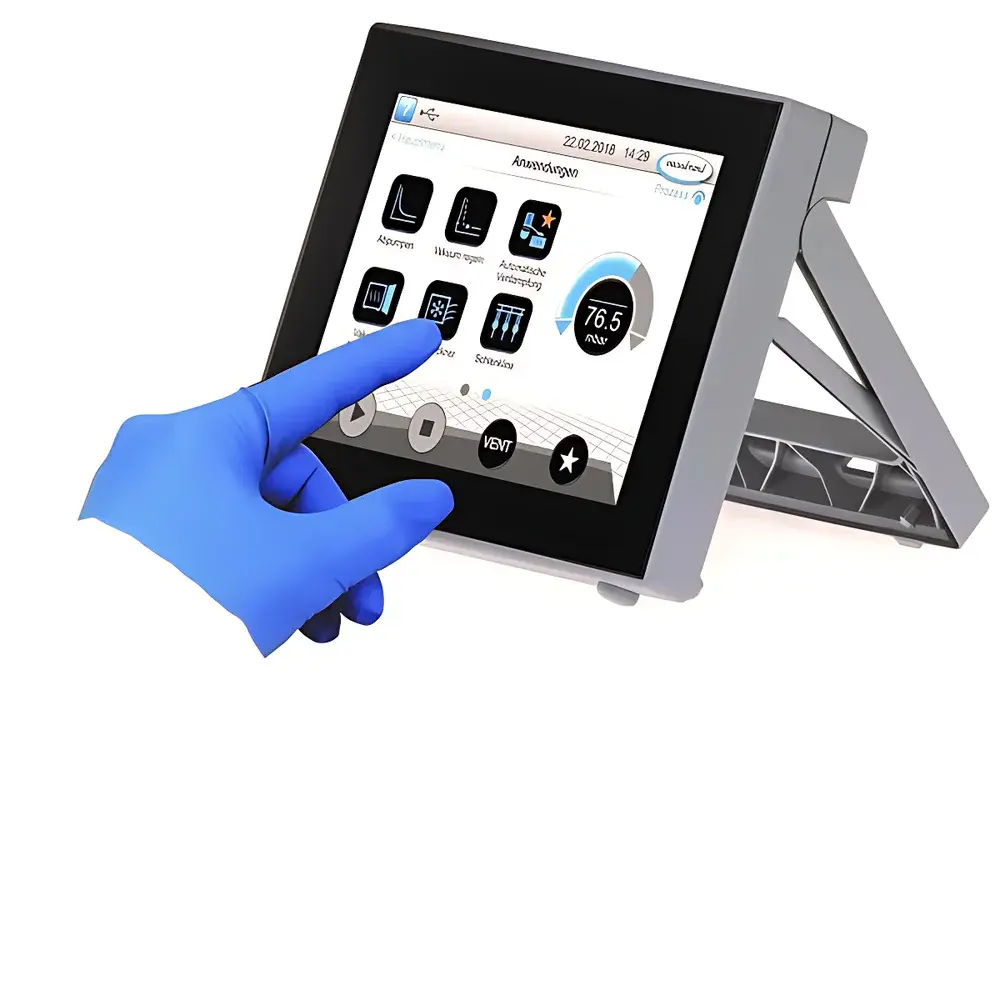
| Display | Capacitive Touchscreen Interface |
| Language Support | 14 Languages |
| Material Compatibility | Chemically Resistant (PTFE, FKM, PP, Borosilicate Glass) |
| Compliance | CE, RoHS, ISO 9001 Certified |
| Application Scope | Laboratory Vacuum Networks, Rotary Evaporation, Freeze Drying, Schlenk Line Operations, Chemical Distillation |
Overview
The VACUUBRAND VACUU·SELECT Vacuum Controller is an engineered precision instrument designed for stable, reproducible, and application-specific vacuum regulation in modern chemical and life science laboratories. Based on fundamental principles of pressure feedback control—utilizing integrated piezoresistive or capacitance-based pressure transducers—the system continuously monitors absolute or relative pressure within the vacuum line and dynamically adjusts either solenoid valve duty cycles (two-point control) or motor speed via VARIO® variable-frequency drive technology. Unlike manual vacuum regulation, which introduces operator-dependent variability and process drift, the VACUU·SELECT delivers closed-loop control with sub-mbar resolution and response times optimized for volatile solvent evaporation, sensitive sample drying, and inert-atmosphere manipulation. Its architecture supports both standalone operation and seamless integration into distributed lab vacuum networks, making it suitable for environments requiring GLP-compliant documentation, multi-user access, and audit-ready process logging.
Key Features
- Capacitive touchscreen interface with intuitive drag-and-drop workflow editor—enabling rapid configuration of custom vacuum profiles without programming knowledge
- Dual-mode control architecture: selectable two-point (solenoid-based) or VARIO® continuous-speed regulation for zero-pressure overshoot and minimal process disturbance
- Chemically inert wetted materials—including PTFE-sealed valves, FKM diaphragms, polypropylene housings, and borosilicate glass pressure sensors—ensuring long-term compatibility with aggressive solvents (e.g., acetone, chloroform, THF, concentrated acids)
- Full glove-compatible touch responsiveness—tested under standard laboratory nitrile and latex safety gloves per EN 374-2
- 14-language UI support (including English, German, French, Spanish, Chinese, Japanese, Korean, Russian, Portuguese, Italian, Dutch, Swedish, Polish, Turkish) with context-sensitive on-screen help text
- Modular mounting options: benchtop, wall-mount, fume hood-integrated, or rack-mounted configurations compatible with standard 19″ lab infrastructure
- Real-time pressure trend visualization with configurable sampling intervals (100 ms to 60 s) and local data buffering (up to 10,000 data points)
Sample Compatibility & Compliance
The VACUU·SELECT is validated for use across a broad spectrum of vacuum-sensitive applications involving organic, aqueous, and corrosive media. All fluid-path components comply with USP Class VI biocompatibility standards and meet DIN EN ISO 8536-4 requirements for pharmaceutical-grade vacuum systems. The controller conforms to IEC 61000-6-3 (EMC emission) and IEC 61000-6-2 (immunity), and carries CE marking under the EU Machinery Directive 2006/42/EC and Pressure Equipment Directive 2014/68/EU (PED). It supports 21 CFR Part 11–compliant electronic recordkeeping when paired with VACUUBRAND’s optional PC software (VACUU·VIEW), enabling user authentication, audit trails, and electronic signatures for regulated QC/QA workflows.
Software & Data Management
The VACUU·SELECT operates autonomously but integrates with VACUUBRAND’s VACUU·VIEW PC software (Windows/macOS) for advanced data export (CSV, PDF), remote monitoring, and batch report generation. Software features include time-stamped pressure log export, comparative profile overlay, alarm history filtering, and customizable export templates aligned with internal SOPs or external regulatory submissions. Local storage retains up to 72 hours of high-resolution pressure data even during network outages. Firmware updates are delivered via USB or Ethernet and include version-locked cryptographic signing to ensure integrity and traceability—critical for ISO/IEC 17025-accredited laboratories.
Applications
- Rotary evaporation with programmable pressure ramps to prevent bumping and foaming during low-boiling-point solvent removal
- Freeze-drying (lyophilization) cycle optimization using precise hold-and-ramp sequences at 10⁻²–10⁻³ mbar
- Schlenk line inert-gas purging and vacuum-transfer protocols with repeatable endpoint detection
- Short-path distillation and fractional crystallization under controlled sub-atmospheric conditions
- Centralized vacuum network management—controlling multiple pumps and users across shared lab infrastructure while maintaining individual pressure setpoints and usage logs
- In-process monitoring for GMP-compliant API synthesis where vacuum stability directly impacts reaction kinetics and impurity profiles
FAQ
What pressure range does the VACUU·SELECT support?
It regulates absolute pressure from atmospheric (1013 mbar) down to 1 × 10⁻³ mbar, depending on connected pump performance and system leak rate.
Can the VACUU·SELECT replace manual vacuum control in existing setups?
Yes—it is fully retrofittable to legacy vacuum pumps (including non-VACUUBRAND models) via standard NPT or BSP connections and optional adapter kits.
Is VARIO® control compatible with all VACUUBRAND pumps?
VARIO® mode requires a VARIO®-enabled pump (e.g., RC 6, PC 3001 VARIO®); two-point control works with any chemically compatible vacuum pump equipped with solenoid valve input.
How is calibration maintained over time?
The unit includes factory-calibrated pressure sensors traceable to PTB (Physikalisch-Technische Bundesanstalt); field recalibration is supported via VACUU·VIEW using certified reference gauges.
Does the device support networked deployment across multiple labs?
Yes—via Ethernet (TCP/IP) or optional Wi-Fi module, enabling centralized supervision, firmware push updates, and synchronized alarm notifications across institutional vacuum infrastructures.