
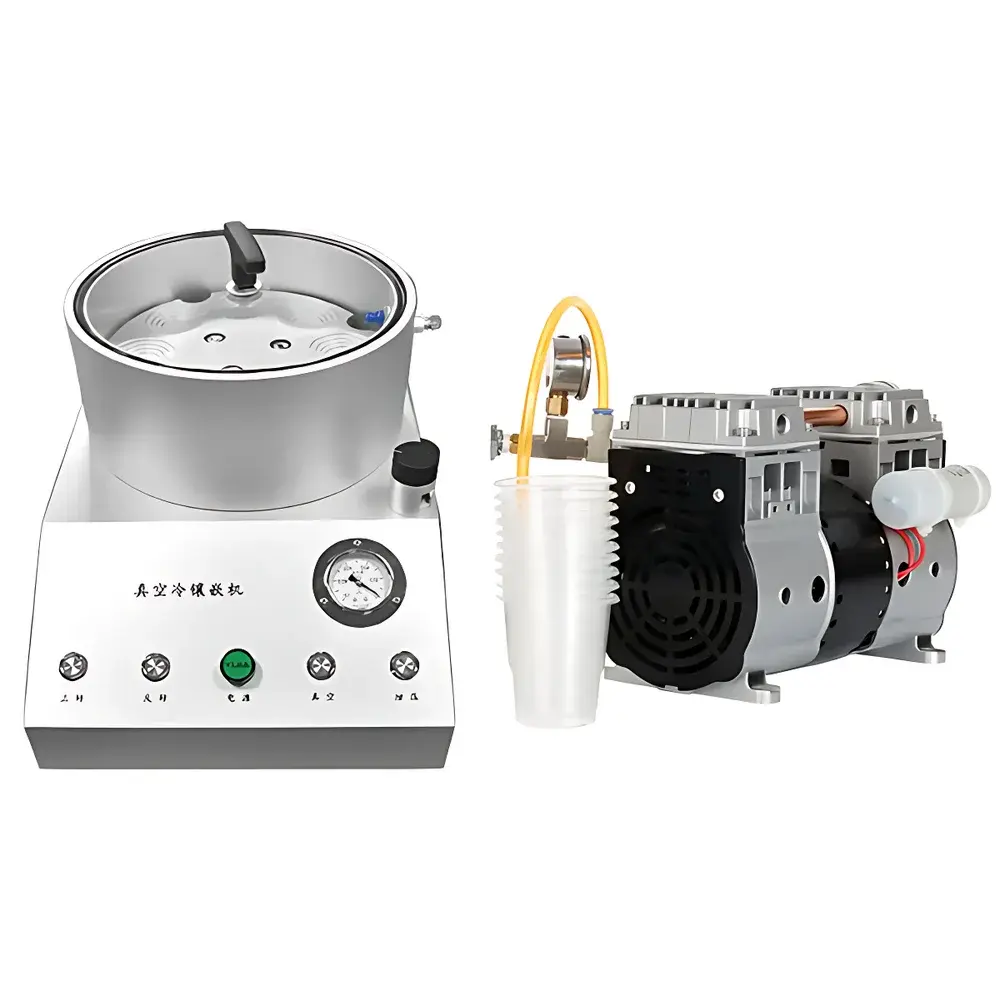
Vacuum Cold Mounting Press Q-290/W-290 by WEIYEE
| Brand | WEIYEE |
|---|---|
| Model | Q-290 / W-290 |
| Mounting Type | Cold Mounting Press |
| Vacuum Level | –0.098 MPa |
| Platen Diameter | Φ270 mm |
| Power Supply | 220 V AC |
| Origin | Guangdong, China |
| Equipment Category | Cold Mounting Press for Specimen Preparation |
Overview
The WEIYEE Q-290/W-290 Vacuum Cold Mounting Press is an engineered solution for high-integrity, void-free encapsulation of delicate or heat-sensitive specimens in thermosetting resins—such as epoxy, acrylic, and polyester—without thermal degradation. Unlike hot mounting systems that rely on elevated temperature and pressure, this unit employs a dual-stage vacuum-assisted impregnation process to evacuate air from porous microstructures (e.g., composites, ceramics, soft metals, biological tissues, and electronic components) prior to resin infiltration. The system achieves a stable ultimate vacuum level of –0.098 MPa (equivalent to ~20 mbar absolute), enabling complete resin penetration into sub-micron interstices while preserving dimensional stability and interfacial fidelity. Designed for routine use in metallurgical laboratories, failure analysis centers, and QC/QA departments, the press supports standardized specimen preparation compliant with ASTM E3, ISO 14577, and EN 1071-3 for subsequent metallographic grinding, polishing, and microscopic evaluation.
Key Features
- Vacuum chamber with integrated oil-lubricated rotary vane pump, pre-wired for 220 V AC operation and equipped with vacuum gauge and manual release valve
- Large-format mounting platen (Φ270 mm) accommodating standard 25–50 mm diameter molds, including split-ring, cylindrical, and rectangular cold-mounting dies
- Robust cast-aluminum frame with reinforced vacuum-sealed lid and EPDM gasket for long-term leak integrity and cycle repeatability
- No-heating design eliminates thermal stress, phase transformation, or edge rounding in low-melting-point alloys (e.g., solder joints, Zn-Al die-castings), polymers, and mineralogical samples
- Modular resin cup holder and adjustable mold support tray facilitate rapid setup and cross-contamination control between batches
- Compliance-ready mechanical controls—no embedded firmware or network interface—ensuring traceability under GLP/GMP environments where software validation is not required
Sample Compatibility & Compliance
The Q-290/W-290 is validated for embedding heterogeneous materials exhibiting high porosity, low thermal tolerance, or volatile constituents—including sintered powders, fiber-reinforced composites, PCB cross-sections, corrosion products, and friable geological specimens. Its vacuum profile meets the minimum evacuation requirements specified in ASTM E3 Annex A2 for cold mounting of non-metallic inclusions and brittle fracture surfaces. All wetted components are chemically resistant to common mounting resins and cleaning solvents (e.g., acetone, ethanol, methyl ethyl ketone). The unit does not incorporate electrical heating elements or programmable logic controllers; therefore, it falls outside the scope of IEC 61000-6-3 EMC emission standards for industrial equipment, simplifying facility integration in regulated laboratory spaces.
Software & Data Management
This is a fully mechanical, analog-operated cold mounting press with no digital interface, onboard memory, or data logging capability. All operational parameters—including vacuum hold time, resin volume, and cure duration—are manually recorded per batch using laboratory notebooks or LIMS-integrated paper-based SOPs. The absence of firmware or connectivity aligns with FDA 21 CFR Part 11 requirements for systems where electronic records are not generated, eliminating the need for audit trail configuration, user access controls, or electronic signature validation. Maintenance logs and calibration verifications (e.g., vacuum gauge zero-check against reference manometer) are documented offline in accordance with ISO/IEC 17025 Clause 7.7.
Applications
- Preparation of void-free mounts for SEM/EDS analysis of porous catalyst substrates and battery electrode cross-sections
- Embedding of thermally unstable polymer blends prior to cryo-microtomy or AFM topography mapping
- Routine QC mounting of aluminum die-cast automotive components for porosity assessment per ISO 2768
- Failure analysis of wire-bond interconnects and solder fatigue specimens in semiconductor packaging labs
- Geological thin-section preparation where thermal distortion of clay laminations or fluid inclusions must be avoided
- Forensic metallurgy workflows requiring preservation of oxidation states and intergranular corrosion morphology
FAQ
What vacuum level is achievable, and how is it verified?
The system consistently reaches –0.098 MPa (≈20 mbar abs) under ambient conditions. Verification is performed using a calibrated analog Bourdon-tube vacuum gauge mounted directly on the chamber port.
Can the press accommodate custom mold geometries beyond standard diameters?
Yes—the Φ270 mm platen provides ≥30 mm clearance around typical 50 mm molds, permitting use of rectangular or multi-cavity fixtures with appropriate support jigs.
Is resin curing performed inside the press?
No. Resin mixing and initial pour occur externally; the press applies vacuum only during infiltration. Final polymerization occurs in ambient-air ovens or UV chambers per resin manufacturer specifications.
Does the unit require annual recalibration?
The mechanical vacuum gauge should be zero-checked before each shift using atmospheric vent; full recalibration against a NIST-traceable reference is recommended annually or after physical impact.
What maintenance is required for the integrated vacuum pump?
Oil level inspection and change every 500 operating hours; exhaust filter replacement every 1,000 hours; inlet dust filter cleaning after each 10 cycles involving powdered samples.



