
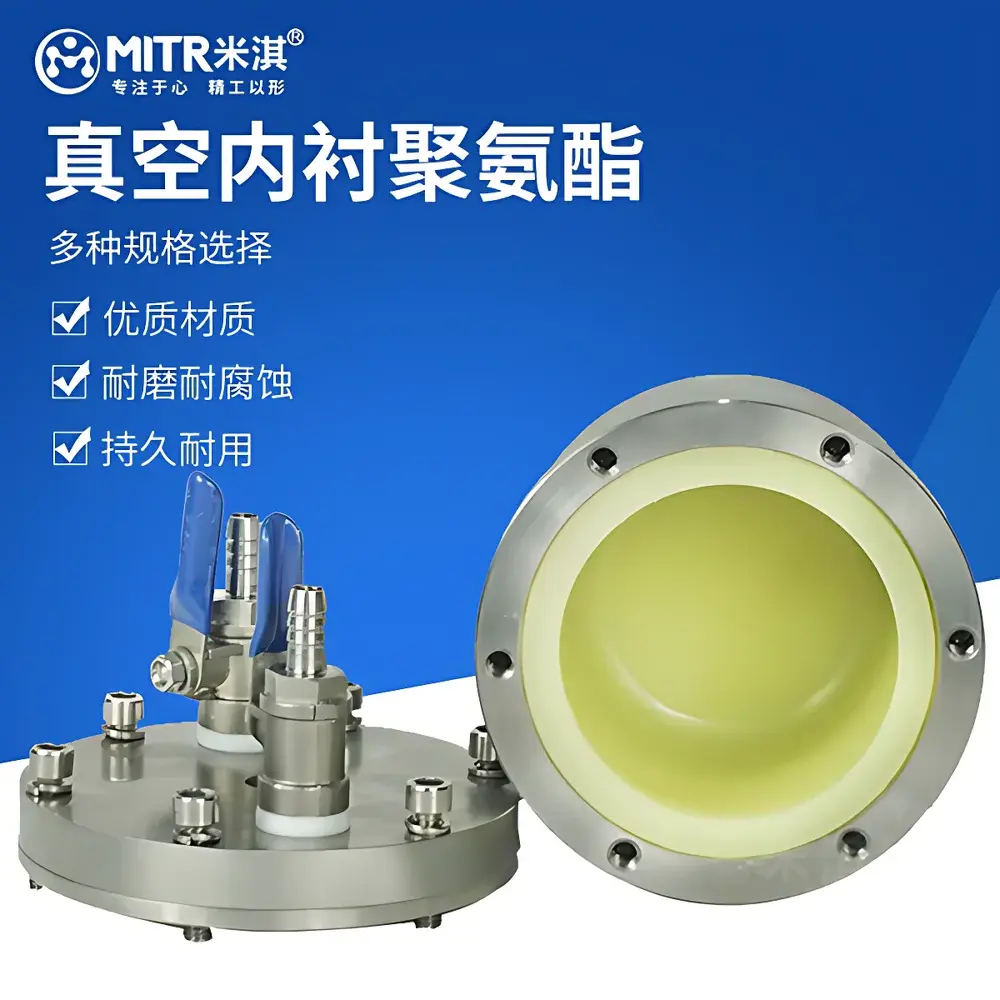
Vacuum-Lined Polyurethane Jar for Planetary Ball Mills
| Brand | MITR |
|---|---|
| Origin | Hunan, China |
| Manufacturer Type | Direct Manufacturer |
| Country of Origin | China |
| Model | Vacuum-Lined Polyurethane Jar |
| Price Range | USD 350 – 560 |
Overview
The MITR Vacuum-Lined Polyurethane Jar is a specialized grinding and mixing vessel engineered for inert-atmosphere processing in planetary ball milling systems. Designed to eliminate oxygen exposure during high-energy mechanical alloying, dispersion, or dry/wet comminution, this jar integrates a robust stainless-steel outer shell with a seamless, abrasion-resistant polyurethane inner liner. The vacuum-tight sealing system—comprising precision-machined flange interfaces, dual-stage elastomeric gaskets, and a dedicated vacuum port with ISO-KF 16 or CF-16 compatible fitting—enables stable operation under sub-atmospheric conditions (down to 10⁻² mbar typical). Its operational principle relies on controlled mechanical energy transfer within an isolated environment, preventing oxidation-sensitive reactions (e.g., Mg, Al, Li-based powders), moisture uptake, or pyrophoric ignition during fine grinding. The jar is dimensionally standardized to interface with common domestic and international planetary ball mill platforms, including MITR’s own PM series and third-party equipment compliant with ISO 8765:2019 mounting specifications.
Key Features
- Stainless-steel structural housing (AISI 304 or optional 316L) providing mechanical rigidity, corrosion resistance, and compatibility with autoclave cleaning protocols.
- Uniformly cast polyurethane liner (Shore A 90–95 hardness) applied via centrifugal casting to ensure thickness consistency (±0.3 mm), eliminating delamination risk under cyclic impact loading.
- Optimized internal geometry featuring large-radius bottom transitions (R ≥ 12 mm) to minimize powder stagnation and improve material turnover efficiency during rotation.
- High-fidelity surface finish: Ra ≤ 0.4 µm on both liner and shell interior, reducing static adhesion and facilitating complete sample recovery post-milling.
- Vacuum integrity verified per ASTM E493–22 (Standard Practice for Leak Testing Vacuum Vessels) using helium mass spectrometry; leakage rate < 5 × 10⁻⁹ mbar·L/s at 0.1 mbar pressure differential.
- Modular lid assembly with integrated pressure relief valve (optional) and calibrated vacuum gauge port for real-time process monitoring.
Sample Compatibility & Compliance
This jar supports processing of reactive metals (e.g., Ti, Zr, rare-earth alloys), battery cathode precursors (NMC, LFP), organic-inorganic hybrids, and pharmaceutical intermediates requiring strict ambient control. It complies with general laboratory safety standards for sealed grinding vessels (ISO 21508:2020 — Safety requirements for ball mills) and is suitable for use in GLP-compliant environments where traceability of atmosphere conditions is required. While not certified to FDA 21 CFR Part 11, the vacuum interface design allows integration with validated data-logging systems supporting audit trails for regulated R&D workflows.
Software & Data Management
As a passive mechanical component, the jar does not incorporate embedded electronics or firmware. However, its vacuum port and flange interface are fully compatible with third-party vacuum controllers (e.g., Pfeiffer Vacuum DuoLine, Edwards nXDS) and digital pressure transducers (e.g., MKS Baratron 627B). When used with MITR’s PM-Series mills equipped with optional IoT modules, vacuum status, cycle count, and cumulative operating time can be logged via RS485/Modbus RTU into LIMS or ELN platforms meeting ALCOA+ data integrity principles.
Applications
- Atmosphere-controlled synthesis of air-sensitive metal hydrides and intermetallics.
- Low-contamination milling of high-purity ceramic powders (Al₂O₃, SiC, YSZ) for sintering feedstock.
- Encapsulated grinding of thermolabile APIs to prevent thermal degradation.
- Homogenization of nanocomposites under argon/nitrogen without nanoparticle agglomeration.
- Preparation of electrode slurries for solid-state batteries where electrolyte decomposition must be avoided.
FAQ
What vacuum level can this jar sustain during continuous milling?
It maintains stable vacuum down to 1×10⁻² mbar under dynamic load when paired with a two-stage rotary vane pump and proper seal maintenance.
Is the polyurethane liner chemically resistant to common solvents like ethanol or NMP?
Yes—the liner exhibits excellent resistance to alcohols, ethers, and aprotic polar solvents per ASTM D543–21 immersion testing; however, prolonged exposure to strong oxidizers (e.g., HNO₃, KMnO₄) is not recommended.
Can this jar be sterilized in an autoclave?
No—polyurethane softens above 120 °C; steam sterilization is incompatible. Dry heat (≤80 °C) or ethanol wipe-down is advised.
Does MITR provide vacuum certification documentation with each unit?
Yes—a factory test report including helium leak test results, dimensional verification, and material certificates (EN 10204 3.1) is supplied with every jar shipment.
Are replacement liners available separately?
Yes—MITR offers OEM polyurethane liner kits with installation jigs and torque-specification tools for field refurbishment.



