
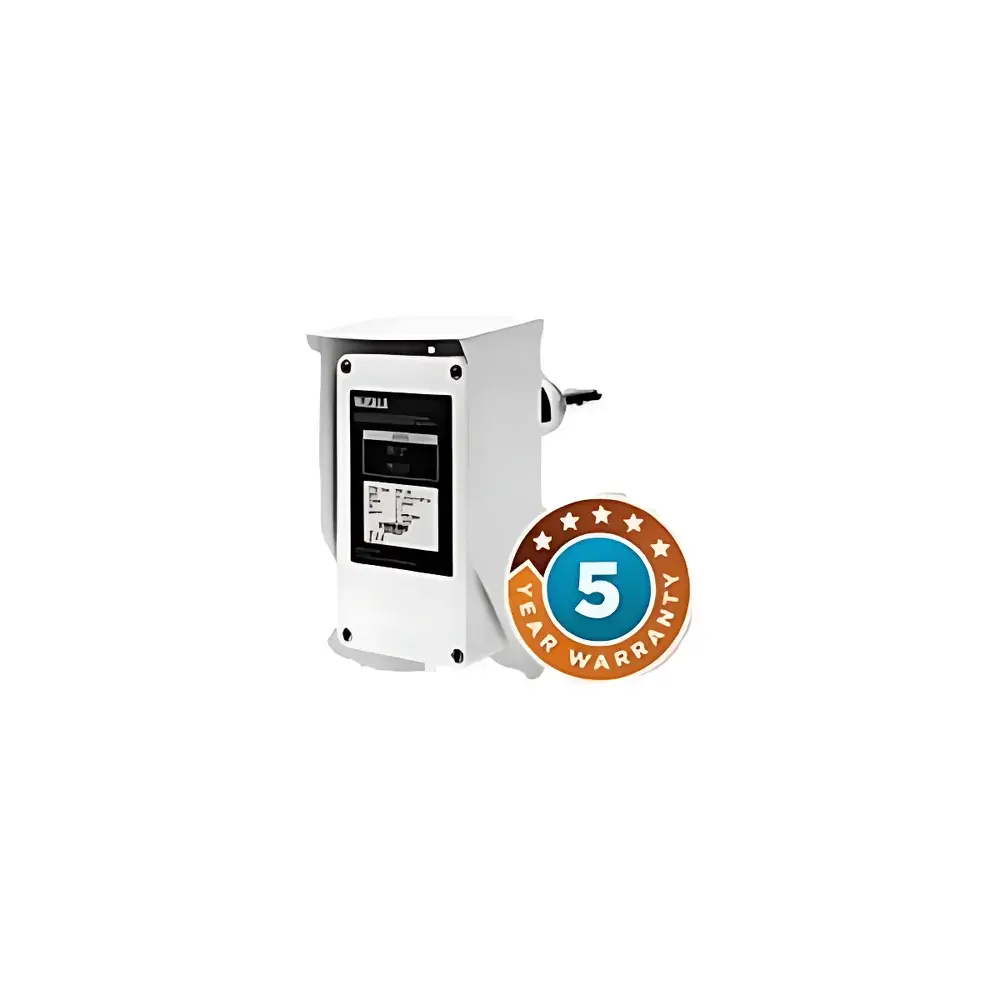
Vaisala MHT410 Transformer Online Gas Monitor
| Brand | Vaisala |
|---|---|
| Origin | Finland |
| Model | MHT410 |
| Measurement Principle | Cavity Ring-Down Spectroscopy (CRDS) |
| Gas Targets | Dissolved Hydrogen (H₂) and Water Activity (a<sub>w</sub>) in Transformer Oil |
| Oil Compatibility | Mineral oil, natural ester, synthetic ester, silicone oil |
| Enclosure Rating | IP66 with rain shield |
| Warranty | 5 years |
| Output Interfaces | 3× isolated 4–20 mA, RS-485 (Modbus RTU, DNP3, ASCII) |
| Compliance | EN 61326-1, CISPR 32/EN 55032 Class B, ISO 6270-1:2017 (C5-M), ISO 9227:2017 (salt spray), ISO 12994-6 (C5 corrosion protection) |
| H₂ Range | 0–5000 ppm<sub>v</sub> in oil |
| H₂ Accuracy | ±10% of reading or ±15 ppm<sub>v</sub> (whichever is greater) |
| H₂ Stability | ±3% of reading/year |
| H₂ Cross-sensitivity | <2% to CO₂, C₂H₂, C₂H₄, CO |
| a<sub>w</sub> Range | 0–1 (0–100 %RS) |
| a<sub>w</sub> Accuracy | ±0.02 (0–90 %RS), ±0.03 (90–100 %RS) |
| a<sub>w</sub> Response Time (90%) | 10 min at +20 °C in still oil |
| Sensor | HUMICAP® 180L2 |
| Power | 4 W typical, up to 12 W (galvanically isolated input) |
Overview
The Vaisala MHT410 Transformer Online Gas Monitor is an industrial-grade, in-oil sensing system engineered for continuous, real-time monitoring of dissolved hydrogen (H₂) and water activity (aw) within power transformer insulation oils. Leveraging cavity ring-down spectroscopy (CRDS) for hydrogen detection and Vaisala’s proprietary HUMICAP® 180L2 capacitive polymer sensor for moisture assessment, the MHT410 delivers metrologically traceable measurements directly inside the oil stream—without requiring oil sampling, extraction, or external gas analysis. Its design adheres to the operational imperatives of high-reliability electrical infrastructure: long-term stability under thermal cycling, immunity to electromagnetic interference, and zero maintenance throughout its service life. The instrument operates continuously across ambient temperatures from −40 °C to +70 °C and is qualified for outdoor deployment on transformers rated up to 765 kV, meeting international standards for corrosion resistance (ISO 12994-6 C5), salt fog exposure (ISO 9227 C5-M), and condensation endurance (ISO 6270-1 C5-M).
Key Features
- Direct-in-oil CRDS-based hydrogen measurement with sub-ppm detection limit (15 ppmv LOD) and minimal cross-sensitivity (<2%) to common hydrocarbon gases (C₂H₂, C₂H₄, CO, CO₂)
- HUMICAP® 180L2 sensor platform for water activity (aw) with ±0.02 accuracy in the critical 0–0.9 aw range and 10-minute 90% response time in static oil at +20 °C
- Full compatibility with all major insulating fluids: mineral oil, natural esters (e.g., FR3™), synthetic esters (e.g., MIDEL™), and silicone oils—enabling retrofit deployment across legacy and next-generation transformer fleets
- Robust mechanical architecture: IP66-rated aluminum housing with integrated rain shield; individually pressure-tested to 10 bar and vacuum-leak tested per 5 bara specification
- Triple isolated 4–20 mA outputs (configurable fault current) plus dual RS-485 interfaces supporting Modbus RTU, DNP3, and ASCII protocols for seamless integration into SCADA, DCS, and condition monitoring systems
- No consumables, no moving parts, no field recalibration required—designed for unattended operation over 15+ years with only a 5-year standard warranty reflecting its proven reliability
Sample Compatibility & Compliance
The MHT410 is validated for direct immersion in dielectric liquids conforming to IEC 60296, ASTM D3487, and IEEE C57.106 specifications. Its wetted materials—including Hastelloy C-276 sensor housing, fluorosilicone O-rings, and PEEK structural components—are chemically inert toward oxidation byproducts (e.g., furans, acids) and stable under prolonged exposure to thermal aging byproducts. Electromagnetic compatibility is certified per EN 61326-1 (industrial environment) and CISPR 32/EN 55032 Class B (DC-powered operation). Corrosion resistance meets ISO 12994-6 C5 (severe industrial/marine) and ISO 9227 C5-M (continuous salt spray), ensuring integrity in coastal substations or polluted urban environments. All units ship with factory-issued calibration certificates covering humidity, hydrogen, and temperature performance, plus individual probe leak test reports.
Software & Data Management
While the MHT410 operates autonomously as a field transducer, it is fully interoperable with Vaisala’s Indigo520 data handling unit—a DIN-rail-mounted interface with local graphical display, SD-card logging, and dual power-over-bus capability. The Indigo520 enables on-site trend visualization, alarm threshold configuration, and firmware updates without requiring network connectivity. For enterprise-level integration, the MHT410 supports audit-trail-capable data export via Modbus TCP gateways compliant with IEC 62443-3-3 security profiles. Raw sensor values (H₂ ppmv, aw, oil temperature) are timestamped with microsecond resolution and stored in non-volatile memory capable of retaining >44 years of default-interval records. When deployed in GxP-regulated utilities, the system can be configured to meet FDA 21 CFR Part 11 requirements through third-party validation packages that document electronic signature workflows and change control procedures.
Applications
- Early detection of incipient faults—including partial discharge (H₂ rise), thermal degradation (>150 °C hot spots), and cellulose insulation aging (rising aw trends)—in power transformers, reactors, and shunt reactors
- Condition-based maintenance (CBM) program support by correlating dissolved gas trends with IEEE C57.104 DGA interpretation guidelines and IEC 60599 fault coding
- Life extension assessment of aging assets through longitudinal aw tracking against IEEE C57.91 moisture equilibrium curves
- Verification of oil reclamation efficacy post-vacuum dehydration or adsorption treatment
- Compliance reporting for ISO 55001 asset management systems and regional grid reliability standards (e.g., NERC TPL-001, ENTSO-E RAC)
FAQ
Does the MHT410 require periodic recalibration?
No. The CRDS optical path and HUMICAP® sensor are factory-calibrated and drift-compensated over temperature and time. No field recalibration is specified or supported.
Can it be installed on energized transformers without oil draining?
Yes. The probe is designed for hot-tap installation using standard transformer valve adapters (e.g., DN20 or 3/4″ NPT), eliminating the need for de-energization or oil loss.
Is hydrogen measurement affected by oil flow rate or turbulence?
No. CRDS detection occurs within a sealed optical cavity independent of bulk oil dynamics. Measurements reflect true dissolved-phase concentration, not transient mass transfer artifacts.
How does the MHT410 handle temperature gradients across large power transformers?
It includes a built-in Pt1000 RTD for simultaneous oil temperature measurement, enabling automatic compensation of H₂ solubility and aw thermodynamic models per IEC 60814 and ASTM D1533 Annex A.
What cybersecurity provisions exist for remote data access?
The device itself has no embedded web server or wireless interface. Secure remote access requires externally provisioned firewalls, VLAN segmentation, and TLS-encrypted gateways—consistent with NIST SP 800-82 and IEC 62443-3-3 implementation guidance.







