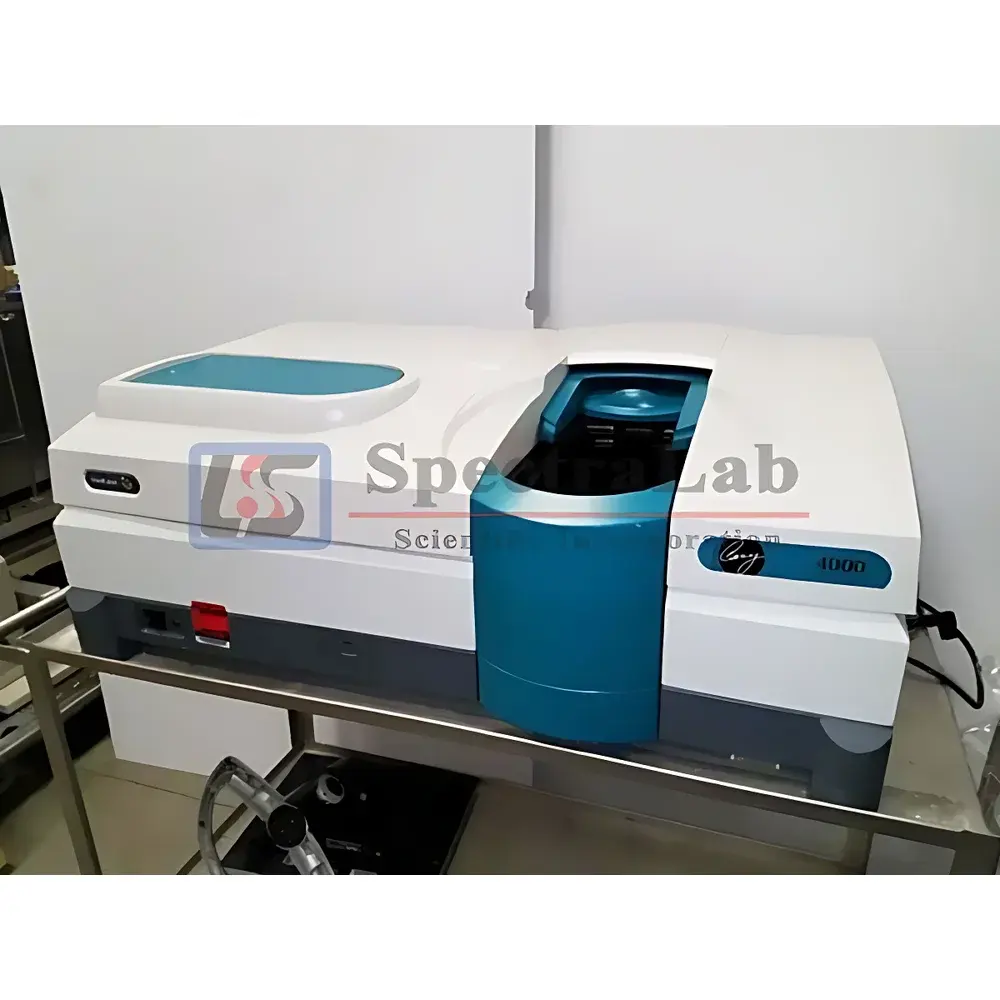
Varian Cary 4000 UV-Vis Spectrophotometer (Refurbished)
| Brand | Varian |
|---|---|
| Origin | USA |
| Model | Cary 4000 |
| Wavelength Range | 175–900 nm |
| Optical Resolution | Adjustable down to 0.01 nm |
| Absorbance Range | Up to 8 Abs (with reference beam attenuator) |
| Software Platform | Cary WinUV (Windows-based, modular architecture) |
| Instrument Age | 3–4 years |
| Warranty | 6 months |
| Configuration | Fully tested refurbished unit with all standard accessories and documentation |
| Compliance | Designed to support GLP/GMP workflows |
Overview
The Varian Cary 4000 UV-Vis Spectrophotometer is a high-performance, double-beam scanning spectrophotometer engineered for precision quantitative and qualitative analysis across research, pharmaceutical quality control, and academic laboratories. Utilizing a dual-monochromator optical design based on the Littrow configuration—complemented by a Schwarzschild condenser system—the instrument delivers exceptional photometric accuracy, low stray light (< 0.00008% at 220 nm), and high signal-to-noise ratio. Its spectral range of 175–900 nm enables reliable detection of deep-UV transitions (e.g., peptide bonds, nucleic acid absorbance) as well as near-IR absorptions (e.g., charge-transfer complexes, solvent effects). The system operates on the principle of Beer–Lambert law-based absorbance measurement, with real-time correction via a dynamically balanced reference beam path. Built with a vibration-isolated cast-aluminum optical base and nitrogen-purged monochromator and sample compartments, the Cary 4000 maintains long-term wavelength stability and photometric reproducibility—critical for regulatory-compliant method validation under ISO 17025, USP , and ASTM E275.
Key Features
- Double-beam optical architecture with independent reference beam attenuation, extending linear dynamic range to 8 Abs without saturation
- Variable spectral bandwidth (0.01–4.0 nm), enabling optimization of resolution versus sensitivity for diverse sample types
- LockDown™ sample compartment with precision mechanical positioning—ensures repeatable accessory alignment and minimizes mechanical drift during multi-step assays
- Integrated nitrogen purge ports for both monochromator and sample chamber, essential for stable deep-UV performance below 200 nm
- Modular accessory compatibility: Peltier-controlled cuvette holders (–10 °C to +100 °C), solid-sample reflectance stages, automated 8-cell changers, flow cells, and total fluorescence accessories
- Rugged mechanical construction featuring shock-absorbing isolation mounts and thermally stable optical bench design
Sample Compatibility & Compliance
The Cary 4000 accommodates standard 10-mm quartz or fused-silica cuvettes, microvolume cells (down to 2 µL), integrating sphere modules for diffuse reflectance, and fiber-optic probes for in-situ measurements. It supports compliance-critical workflows through native integration with WinUV’s optional Bio and Pharma modules—enabling pre-configured SOPs for protein A280 quantitation, DNA/RNA purity assessment (A260/A280, A260/A230), enzyme kinetics, and dissolution testing. When deployed with validated software configurations—including electronic signatures, audit trails, and user-access controls—the system meets requirements for FDA 21 CFR Part 11, EU Annex 11, and ICH Q2(R2) analytical method validation guidelines. All refurbished units undergo full functional verification per Varian’s original factory test protocols, including wavelength accuracy (±0.08 nm), photometric linearity (≤ ±0.002 Abs from 0–3 Abs), and baseline flatness (< ±0.0005 Abs over 190–900 nm).
Software & Data Management
Controlled exclusively by Cary WinUV software—a Windows-native, object-oriented platform—the instrument supports customizable method templates, real-time kinetic plotting, multi-wavelength scanning, and derivative spectroscopy. Data export is native to ASCII, CSV, and JCAMP-DX formats for seamless import into LIMS, ELN, or statistical analysis tools (e.g., JMP, MATLAB, Python pandas). The software architecture permits secure role-based access (Administrator, Analyst, Reviewer), automatic metadata tagging (user ID, timestamp, instrument ID), and encrypted data storage. Optional 21 CFR Part 11 compliance packages include electronic signature capture, change history logging, and immutable audit trails—fully traceable to individual user actions and instrument events.
Applications
- Pharmaceutical QC: Assay of active pharmaceutical ingredients (APIs), excipient compatibility studies, and forced degradation monitoring
- Biotechnology: Protein concentration determination, oligonucleotide purity evaluation, and ligand-binding stoichiometry via titration spectroscopy
- Materials science: Bandgap estimation of nanomaterials, thin-film thickness calculation via interference fringes, and polymer degradation kinetics
- Environmental analysis: Quantification of nitrate, phosphate, and heavy metal chelates in aqueous matrices
- Academic research: Teaching of fundamental spectroscopic principles, quantum yield estimation, and time-resolved absorbance difference spectroscopy
FAQ
Is this unit fully refurbished and tested prior to shipment?
Yes. Each Cary 4000 undergoes comprehensive optical alignment, wavelength calibration, photometric verification, and functional stress testing at SpectraLab Scientific’s ISO 9001-certified refurbishment facility.
Does the 6-month warranty cover both parts and labor?
Yes—the warranty includes on-site or depot-based technical support, replacement of defective components, and labor for repairs attributable to manufacturing or refurbishment defects.
Can the instrument be validated for GMP environments?
Absolutely. We provide IQ/OQ documentation templates, calibration certificates traceable to NIST standards, and optional third-party validation support for cGMP and GLP compliance.
Is WinUV software included, and is it licensed for current Windows OS versions?
Yes—the unit ships with a fully licensed copy of WinUV v6.x or later, validated for Windows 10/11 64-bit platforms and compatible with modern domain authentication protocols.
Are original accessories such as cuvette holders and calibration standards included?
All units include the standard accessory kit: matched quartz cuvettes, holmium oxide and didymium filters for wavelength verification, neutral density filters for photometric calibration, and power/data cables.