
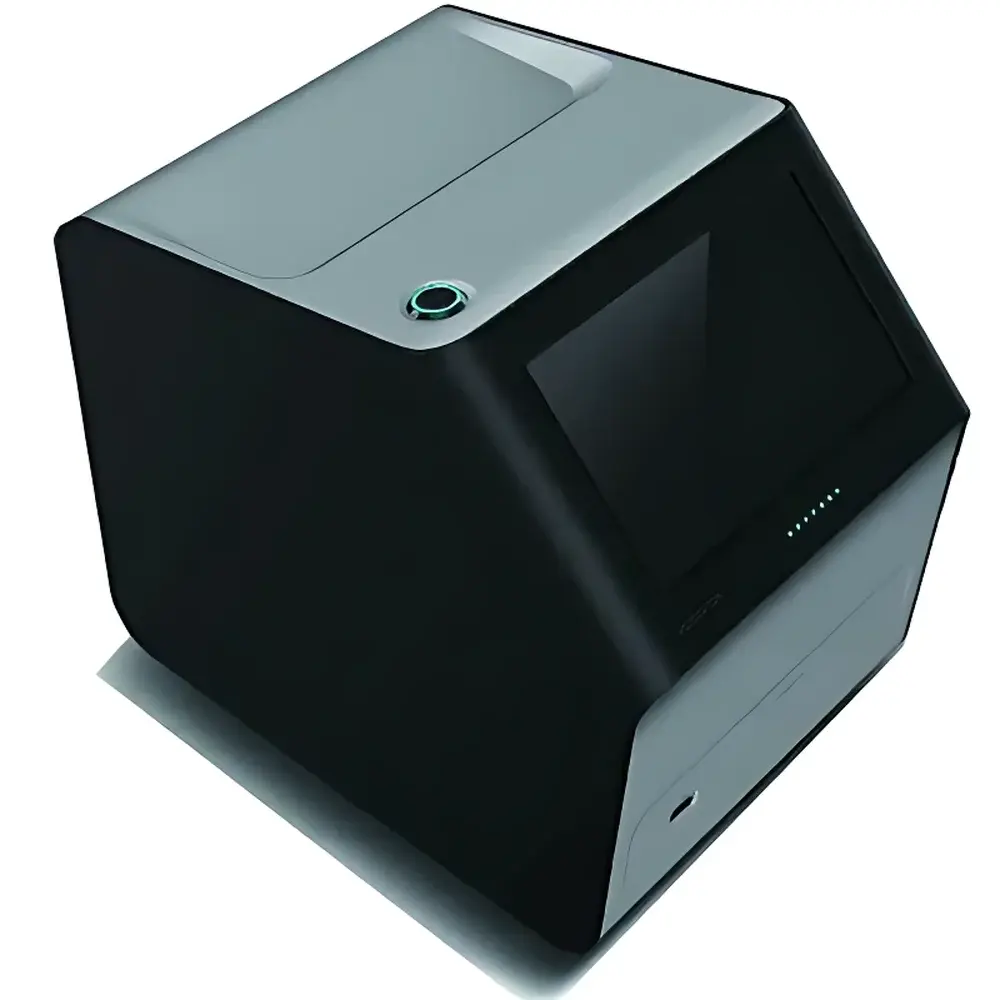
VARTECTOR MPC Film Potential Assessment System for Turbine Lubricants
| Brand | SOLGE |
|---|---|
| Origin | South Korea |
| Model | VARTECTOR |
| Application | ASTM D7843-compliant film potential analysis of phosphate ester fire-resistant hydraulic fluids (EHC systems) |
| Measurement Principle | Reflectance-based colorimetric quantification of deposited insolubles on membrane filters using CIE L*a*b* color space |
| Compliance | Fully aligned with ASTM D7843–21 “Standard Test Method for Quantifying Potential for Insoluble Formation in Phosphate Ester Fluids” |
| Automation Level | Fully automated load control, optical measurement, system verification, and diagnostic reporting |
| Data Output | ΔE, ΔL*, a*, b* values |
Overview
The VARTECTOR MPC Film Potential Assessment System is an engineered laboratory instrument designed specifically for predictive condition monitoring of phosphate ester-based fire-resistant hydraulic fluids used in critical Electro-Hydraulic Control (EHC) systems of steam turbines and gas turbines. It implements the standardized methodology defined in ASTM D7843 to quantify the propensity of such fluids to generate insoluble degradation products—namely, varnish precursors and carbonaceous soot—that adhere to metal surfaces and impair valve response, servo stability, and heat transfer efficiency. Unlike conventional gravimetric or spectroscopic screening tools, VARTECTOR employs reflectance spectrophotometry to measure color shifts on standardized membrane filter patches after controlled fluid filtration and thermal stress simulation. The resulting CIE L*a*b* coordinates (ΔL*, a*, b*) are derived from calibrated spectral data and serve as quantitative indicators of chemical aging pathways: elevated ΔL* correlates strongly with carbon particle deposition (soot), often linked to localized cavitation, micro-bubble collapse, or oxidative fragmentation under high shear; while increased a* and b* values indicate yellow-to-brown chromophore development characteristic of polymerized oxidation byproducts—early-stage varnish films. This dual-parameter interpretation enables root-cause differentiation between mechanical (cavitation-driven sooting) and thermo-oxidative (film-forming) failure modes.
Key Features
- Fully automated ASTM D7843 workflow: integrated filtration, thermal conditioning, membrane drying, and CIE L*a*b* measurement completed within 10 seconds per sample
- Embedded self-verification protocol: automatic optical calibration and hardware integrity check upon power-up, including spectrophotometer linearity validation and motherboard diagnostics
- Real-time visual analytics: high-resolution digital imaging of filter spots synchronized with numerical ΔE, ΔL*, a*, and b* outputs
- Intelligent diagnostic engine: rule-based interpretation applying industry-accepted threshold matrices (e.g., a* > 2.5 = varnish alert; ΔL* > 4.0 = soot risk) with configurable severity levels
- Trend-enabled architecture: device-registered longitudinal tracking of all measured parameters across multiple instruments via secure cloud connector or local network
- Advanced software suite supporting manual validation, reference value assignment, multi-point calibration, and audit-ready data export compliant with GLP documentation requirements
Sample Compatibility & Compliance
The VARTECTOR system is validated exclusively for use with phosphate ester fluids meeting ASTM D4379 specifications, including common formulations such as triaryl phosphates (e.g., Santowax RP, Skydrol LD-4). It accommodates standard 47 mm mixed-cellulose ester (MCE) membranes per ASTM D7843 Annex A1. All operational protocols—including flow rate, pressure differential, filtration time, and post-filtration thermal treatment—are preconfigured to satisfy method reproducibility criteria outlined in ASTM D7843–21 Section 8. The instrument’s firmware and report generation modules support 21 CFR Part 11-compliant electronic signatures and audit trails when deployed in regulated environments. Full traceability is maintained through embedded timestamping, operator ID logging, and immutable parameter archiving.
Software & Data Management
The VARTECTOR Control Software v3.2 provides a Windows-based interface with role-based access control, password-protected configuration settings, and encrypted local database storage capable of retaining over 10,000 test records. Each record includes raw spectral data, processed CIE coordinates, annotated spot images, environmental metadata (temperature, humidity), and diagnostic annotations. Trend analysis tools enable cross-instrument comparison, baseline deviation alerts, and statistical process control (SPC) charting (X-bar/R charts) for key indices. Export formats include CSV, PDF (with embedded digital signature), and XML for integration into CMMS or SAP PM modules. Software updates are delivered via authenticated HTTPS channels with SHA-256 hash verification.
Applications
- Preventive maintenance of turbine EHC systems in power generation plants
- Fluid life extension assessment during oil-in-service monitoring programs
- Root cause analysis following servo valve sticking or actuator lag incidents
- Qualification testing of new phosphate ester batches prior to commissioning
- Supporting ISO 55001-aligned asset management frameworks through objective, repeatable film potential metrics
- Third-party laboratory accreditation under ISO/IEC 17025 for lubricant condition monitoring services
FAQ
Does VARTECTOR require operator intervention during the ASTM D7843 test sequence?
No. Once the sample and membrane are loaded, the system executes full filtration, drying, optical measurement, and reporting without manual steps.
Can VARTECTOR differentiate between varnish and soot on the same filter patch?
Yes. Independent sensitivity to chromatic shift (a*, b*) versus luminance loss (ΔL*) enables orthogonal identification of chemically distinct deposit morphologies.
Is external calibration necessary before daily use?
No. Built-in verification uses NIST-traceable ceramic standards; only annual third-party verification is recommended per ISO/IEC 17025.
What data security measures are implemented in the software?
Role-based authentication, AES-256 encryption of stored data, tamper-evident audit logs, and optional FIPS 140-2 validated cryptographic modules.
Does the system support remote firmware updates?
Yes, via secure TLS 1.3 connection with digital certificate validation and rollback capability.




