
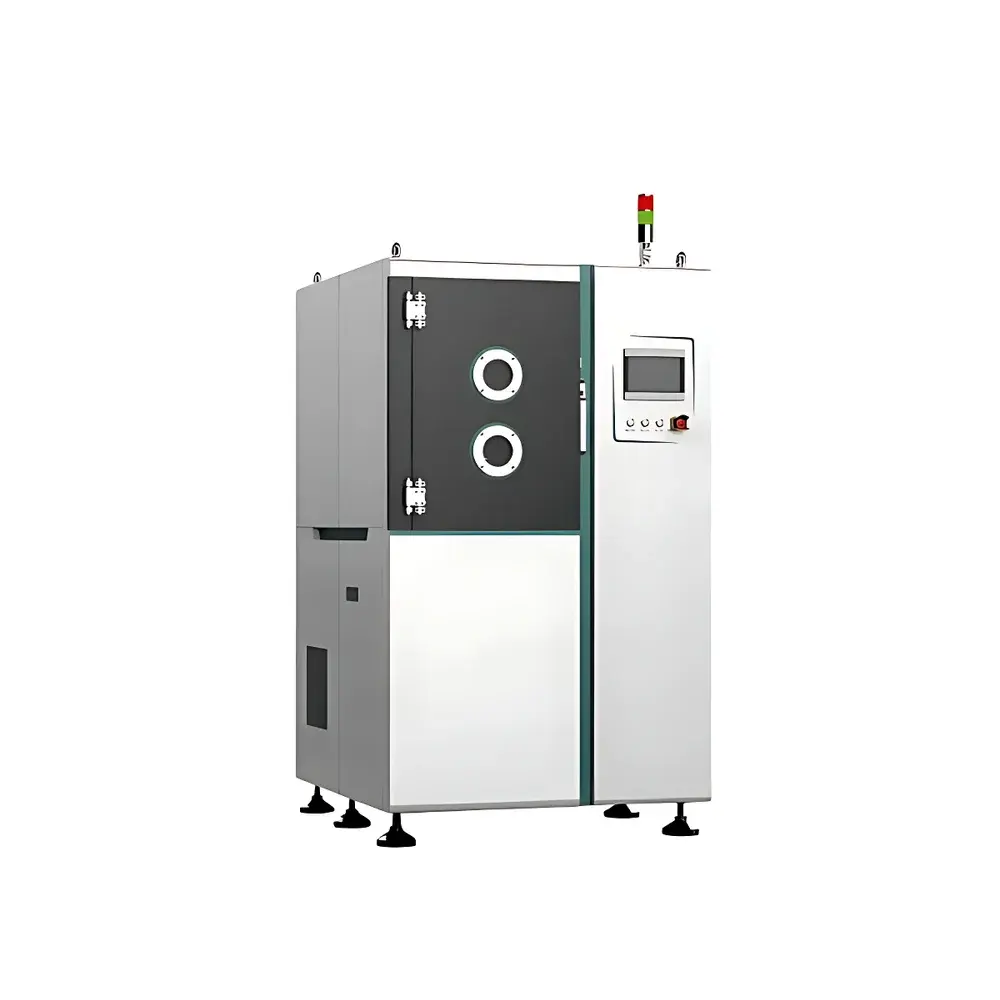
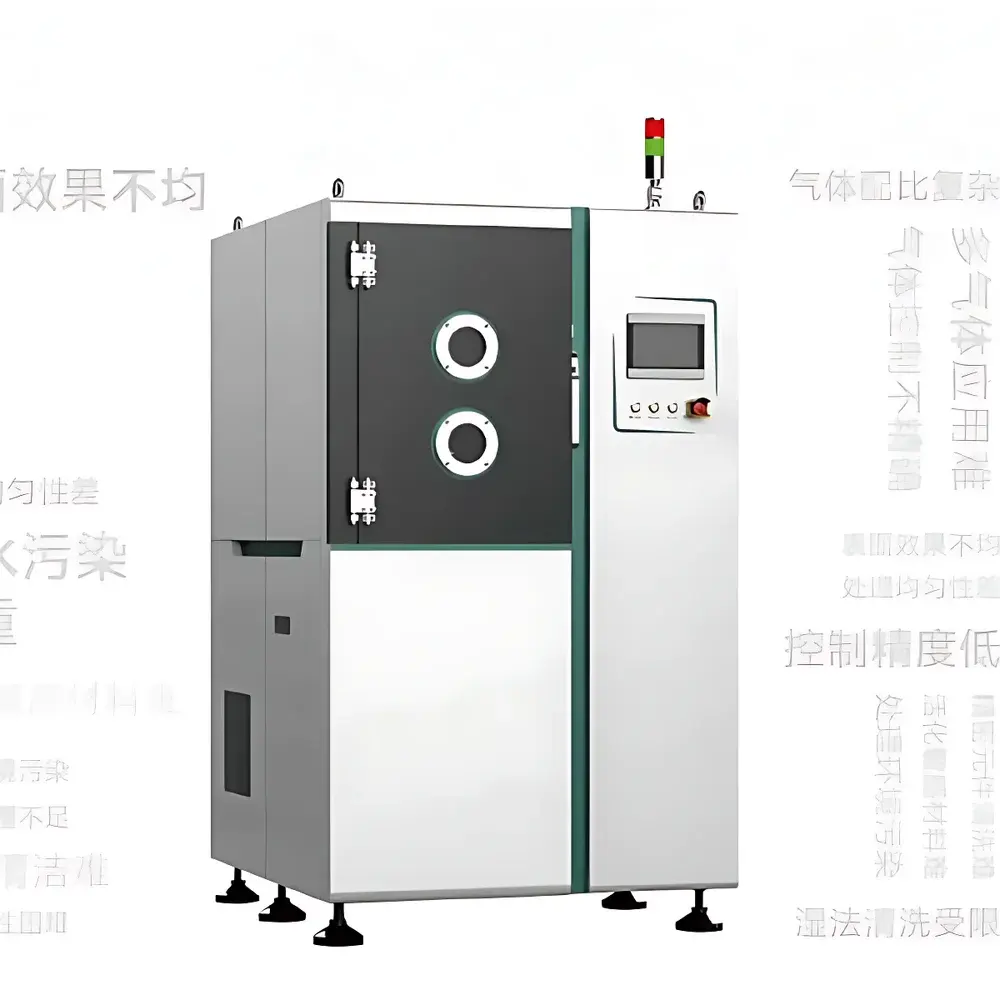
VC Plasma VP-C120 Vacuum Plasma Cleaner
| Brand | VC Plasma |
|---|---|
| Origin | Guangdong, China |
| Model | VP-C120 |
| RF Power Supply | 1000 W / 500 W with Auto-Matching Capacitive RF Generator |
| Rated Power | ≤5 kW |
| Chamber Vacuum Level | ≤6 Pa |
| Operating Temperature | <35 °C (process-dependent) |
| Chamber Rack Modularity | >100 configurable cavity fixture configurations |
| Gas Flow Control | Integrated Mass Flow Controllers (MFCs) for multi-gas compatibility (O₂, Ar, N₂, CF₄, air) |
| Control System | Industrial PLC + HMI touchscreen interface with dual-mode operation (manual/automatic), interlocked mode switching, and role-based user access control |
| Dimensions (W×D×H) | 1030 mm × 1281 mm × 1632 mm (powder-coated steel enclosure) |
Overview
The VC Plasma VP-C120 Vacuum Plasma Cleaner is an industrial-grade, bench-to-production scale plasma surface treatment system engineered for precision activation, cleaning, and functionalization of substrates under controlled low-pressure environments. It operates on the principle of capacitively coupled radio frequency (RF) plasma generation—typically at 13.56 MHz—within a vacuum chamber where process gases (e.g., O₂, Ar, N₂, or mixtures) are ionized to produce reactive species (ions, electrons, radicals, UV photons). These species interact with surface contaminants—including organic residues, oils, oxides, and weak boundary layers—via physical sputtering and chemical etching mechanisms, resulting in sub-nanometer-level decontamination without thermal damage. Designed specifically for laboratories requiring reproducible, non-destructive surface modification prior to bonding, coating, metallization, or microscopy sample preparation, the VP-C120 delivers stable plasma discharge across variable geometries and material classes while maintaining strict thermal management (<35 °C substrate temperature rise under standard operating conditions).
Key Features
- High-integrity vacuum architecture: Patented chamber sealing design achieving ≤6 Pa base pressure, ensuring consistent plasma ignition and process repeatability across extended duty cycles.
- Modular cavity fixture system: Over 100 standardized and customizable rack configurations support diverse sample formats—from microfluidic chips and wafer fragments to 3D-printed polymers and optical lenses—enabling rapid reconfiguration without tooling changes.
- Multi-gas mass flow control: Precision MFCs (semiconductor-grade, ±1% full-scale accuracy) enable independent regulation of up to four process gases, supporting both oxidative (O₂), reductive (H₂/N₂), and fluorocarbon-based (CF₄) chemistries for tailored surface energy modulation.
- Dual-mode intelligent control: Integrated PLC-based automation with 7-inch resistive touchscreen HMI allows seamless transition between manual parameter tuning and fully automated recipe-driven operation; all mode switches are hardware-interlocked to prevent unsafe state transitions.
- Role-based operational security: Three-tier user permission structure (Operator / Technician / Administrator) enforces audit-compliant access to calibration data, system logs, and process parameters—supporting GLP/GMP-aligned workflow documentation requirements.
Sample Compatibility & Compliance
The VP-C120 accommodates rigid and semi-rigid substrates up to 300 mm in diameter or equivalent footprint, including silicon wafers, glass slides, ceramic substrates, stainless steel components, polymeric films (PET, PC, PTFE), and composite laminates. Surface hydrophilicity enhancement—quantified by water contact angle reduction to <10°—is validated per ASTM D7334 (Standard Practice for Surface Energy Determination of Polymer Films and Coatings Using Contact Angle Measurements). The system’s vacuum integrity, RF shielding performance, and electrical safety comply with IEC 61000-6-3 (EMC emission limits) and IEC 61010-1 (Safety Requirements for Electrical Equipment for Measurement, Control, and Laboratory Use). Optional IQ/OQ documentation packages are available to support FDA 21 CFR Part 11–compliant validation protocols.
Software & Data Management
The embedded control firmware records real-time process variables—including chamber pressure, forward/reflected RF power, gas flow rates, and elapsed time—with timestamped logging at 1 Hz resolution. All session data are exportable in CSV format via USB interface; no cloud connectivity or proprietary software installation is required. Audit trails capture operator ID, mode selection, parameter modifications, and emergency stop events—fully traceable for internal quality reviews or regulatory inspection. Firmware updates are performed offline using signed binary files, preserving system integrity during maintenance intervals.
Applications
- Pretreatment of polymer surfaces prior to adhesive bonding or paint application in aerospace and medical device assembly.
- Removal of photoresist residuals and native oxides from semiconductor wafers pre-metallization.
- Enhancement of cell adhesion on tissue culture polystyrene (TCPS) substrates in life science research.
- Cleaning of electron microscopy grids and TEM specimen holders to minimize charging artifacts.
- Surface activation of PDMS microchannels for improved hydrophilicity and protein immobilization efficiency.
- Decontamination of optical components (lenses, mirrors, filters) without solvent exposure or mechanical abrasion.
FAQ
What vacuum level does the VP-C120 achieve, and how is it maintained?
The system achieves and sustains ≤6 Pa using a two-stage rotary vane vacuum pump paired with a leak-tight stainless-steel chamber and elastomer-sealed flanges. A built-in Pirani gauge provides continuous pressure feedback to the PLC for closed-loop pump speed modulation.
Can the VP-C120 operate with corrosive gases such as CF₄ or SF₆?
Yes—the gas delivery path employs electropolished stainless-steel tubing, Viton®-rated MFCs, and alumina-insulated RF electrodes compatible with halogenated chemistries. Optional quartz chamber liners are available for aggressive fluorine-based processes.
Is remote monitoring or integration with LIMS possible?
The VP-C120 does not include Ethernet or RS-485 communication ports by default; however, analog voltage outputs (0–10 V) are provided for external pressure and power monitoring. Custom OEM integration kits with Modbus TCP support can be supplied upon request.
How often does the RF matching network require recalibration?
The auto-matching capacitive network performs real-time impedance compensation during operation and requires no periodic recalibration. Annual verification of reflected power attenuation (<5% at rated load) is recommended as part of preventive maintenance.
Does the system meet ISO 13485 or ISO 9001 requirements for medical device manufacturing?
While the VP-C120 itself is not certified to ISO 13485, its design adheres to key clauses related to equipment qualification (7.5.3), calibration traceability (7.6), and process validation (7.5.2). Full QMS alignment requires site-specific IQ/OQ/PQ execution under qualified personnel supervision.
Related Products



