


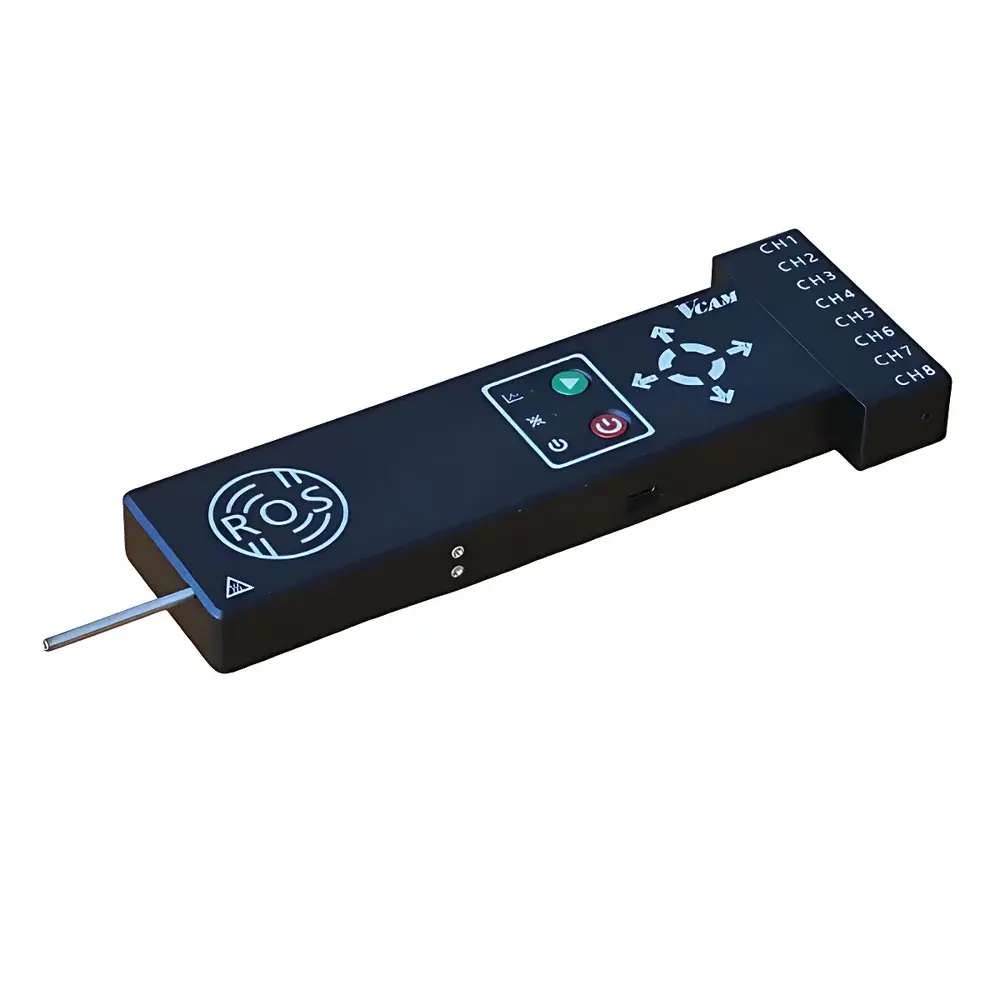
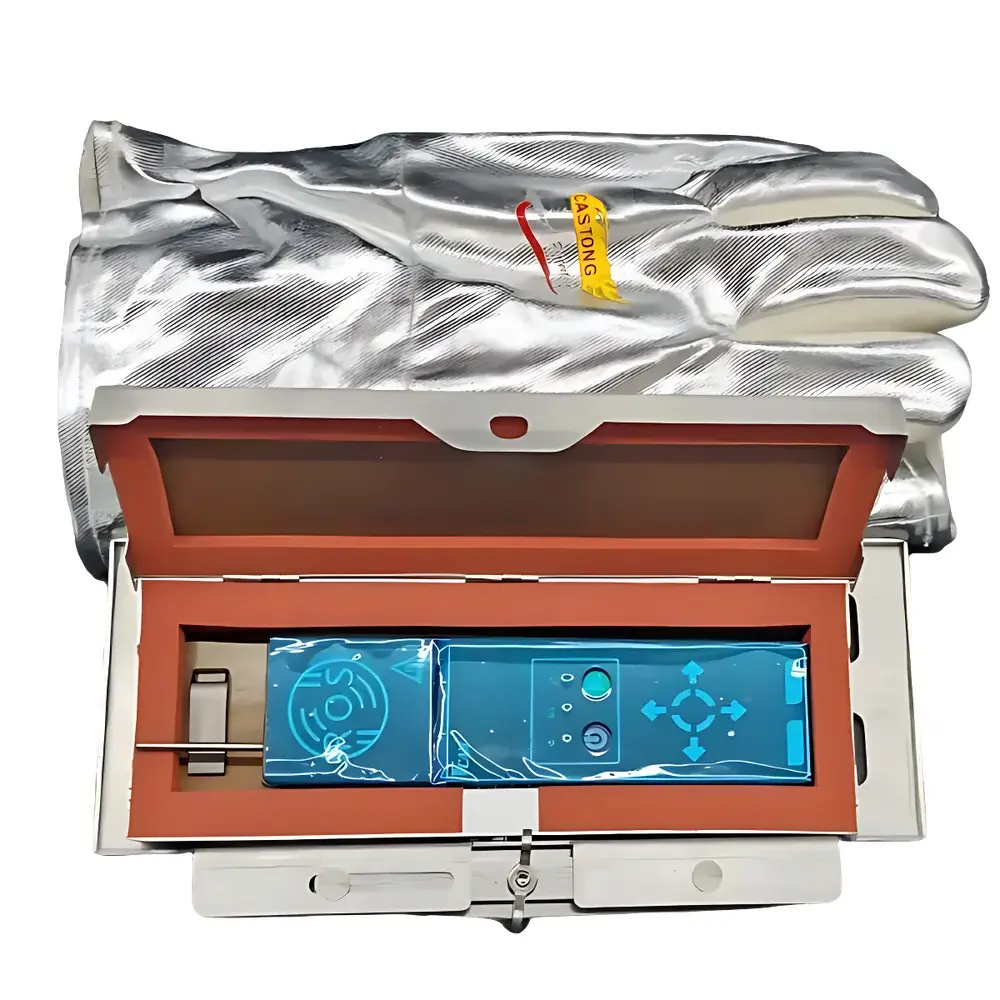
VCAM ROS-1000 Residual Oxygen & Thermal Profiling Monitor for Nitrogen-Atmosphere Reflow Ovens
| Brand | VCAM |
|---|---|
| Model | ROS-1000 |
| Measurement Range (O₂) | 0–4000 ppm |
| Accuracy (O₂) | ±3% FS or ±5 ppm (whichever is greater) |
| Temperature Range | −50 to 700 °C |
| Temp Accuracy | ±0.5 °C |
| Temp Resolution | 0.1 °C |
| Sampling Interval | 0.05–60 s |
| Thermal Insulation | 8 min @ 300 °C / 10 min @ 260 °C |
| Vibration Sensing | Triaxial (X/Y/Z), ±2 g, ±5% accuracy, 1 mg resolution |
| Data Storage | 30 profiles × 20 minutes each |
| Carrier Width Adjustment | 141–310 mm |
| Dimensions (Probe) | 183 × 48 × 21 mm |
| Insulation Box | 242 × 90 × 34 mm |
| Power | USB-C, 5 V/1 A |
| Battery Life | 60 min |
| OS Compatibility | Windows 7 64-bit or later |
Overview
The VCAM ROS-1000 is a purpose-engineered residual oxygen and thermal profiling monitor designed for real-time, high-fidelity process validation in nitrogen-purged reflow ovens used across electronics manufacturing and semiconductor packaging. Operating on electrochemical sensing principles for oxygen detection and calibrated Type-K thermocouple inputs for temperature measurement, the ROS-1000 delivers synchronized, spatially resolved data across the full conveyor path—enabling precise quantification of oxygen ingress, thermal uniformity, and mechanical stability (via triaxial vibration and tilt analysis). Unlike generic gas detectors, the ROS-1000 integrates furnace-specific metrology: its insulated carrier platform maintains sensor integrity during rapid thermal transients, while its sub-second sampling capability (down to 50 ms) captures transient oxygen spikes associated with nitrogen curtain breaches, door openings, or conveyor speed anomalies. The system is engineered for repeatable insertion into standard SMT reflow tunnels, supporting both 2-channel and 8-channel temperature configurations to match oven zoning complexity.
Key Features
- Three-in-one synchronized monitoring: Residual oxygen (0–4000 ppm), multi-point temperature (−50 to 700 °C, ±0.5 °C accuracy), and triaxial mechanical dynamics (vibration + tilt angle)
- High-thermal-resistance carrier with validated insulation performance: 8 minutes at 300 °C and 10 minutes at 260 °C—ensuring sensor protection without active cooling
- Configurable sampling resolution: Adjustable interval from 0.05 s to 60 s, enabling both transient event capture and long-duration trend logging
- Modular hardware architecture: Supports expansion modules for additional thermocouple inputs, analog I/O, or Ethernet-based data streaming
- USB-C powered operation with 60-minute onboard battery life—eliminating external power dependency during profiling runs
- Industrial-grade enclosure rated for repeated thermal cycling; IP65-rated connectors for dust and moisture resistance
Sample Compatibility & Compliance
The ROS-1000 is compatible with all standard tunnel-type nitrogen atmosphere reflow ovens, including those used in Class 3 PCB assembly, flip-chip packaging, and wafer-level underfill processes. Its carrier width adjustment range (141–310 mm) accommodates diverse conveyor belt designs without mechanical modification. From a regulatory standpoint, the instrument supports GLP- and GMP-aligned process validation workflows: raw sensor data—including timestamps, channel identifiers, and calibration metadata—is stored unaltered and exportable in CSV format for audit trails. While not FDA-cleared as a medical device, its measurement traceability aligns with ISO/IEC 17025 laboratory practices when used with NIST-traceable thermocouple calibrators and certified gas standards (e.g., 100 ppm O₂ in N₂). The system meets CE electromagnetic compatibility (EMC) requirements per EN 61326-1 and operates within RoHS-compliant material constraints.
Software & Data Management
The ROS-1000 is operated via Windows-native software (Windows 7 64-bit or newer) that provides real-time visualization of oxygen concentration, temperature gradients, and vibration spectra across all configured zones. Profiles are saved with embedded metadata—including operator ID, oven ID, date/time stamp, and carrier position—and support statistical process control (SPC) calculations (Cp, Cpk, X-bar/R charts) directly within the interface. Data export options include timestamped CSV, PDF reports with annotated thermal/oxygen overlays, and XML for integration into MES or factory analytics platforms (e.g., Siemens Opcenter, Rockwell FactoryTalk). Audit trail functionality records all user actions (e.g., calibration updates, profile deletions), satisfying basic 21 CFR Part 11 requirements for electronic records when deployed with organizational IT controls (e.g., domain authentication, encrypted storage).
Applications
- SMT reflow soldering process qualification and ongoing monitoring—detecting nitrogen leaks that cause oxidation, dewetting, or voiding in solder joints
- Wave soldering inert atmosphere verification, particularly for lead-free alloys sensitive to oxygen-induced dross formation
- Semiconductor die attach and encapsulation oven validation, where sub-100 ppm O₂ thresholds are critical for bond integrity
- Precision metal heat treatment profiling—correlating oxygen partial pressure with surface oxide layer growth kinetics
- High-density HDI and flex-rigid PCB assembly, where localized thermal non-uniformity can induce micro-cracking or delamination
- Root-cause analysis of yield excursions linked to thermal overshoot, cold spots, or unexpected oxygen exposure during ramp/soak phases
FAQ
What oxygen measurement principle does the ROS-1000 use?
The ROS-1000 employs a factory-calibrated electrochemical oxygen sensor with linear response across 0–4000 ppm in nitrogen-rich environments. Sensor output is temperature-compensated using co-located thermocouple readings.
Can the ROS-1000 be used in vacuum or hydrogen atmospheres?
No. The electrochemical sensor is validated only for nitrogen- and air-based inert atmospheres. Exposure to reducing gases (e.g., H₂) or vacuum conditions will damage the sensing element and invalidate calibration.
Is firmware upgradable in the field?
Yes. Firmware updates are delivered via the PC software interface and require no hardware modification. Version history and checksum verification are logged automatically.
How is temperature channel calibration performed?
Users perform two-point dry-block calibration (e.g., at 150 °C and 250 °C) using a reference thermometer traceable to NIST. Offset/gain coefficients are stored per channel in non-volatile memory.
Does the system support automated pass/fail judgment against user-defined limits?
Yes. The software allows definition of zone-specific upper/lower limits for O₂, temperature, and vibration amplitude. Exceedances trigger visual alerts and flag profiles for review.







