
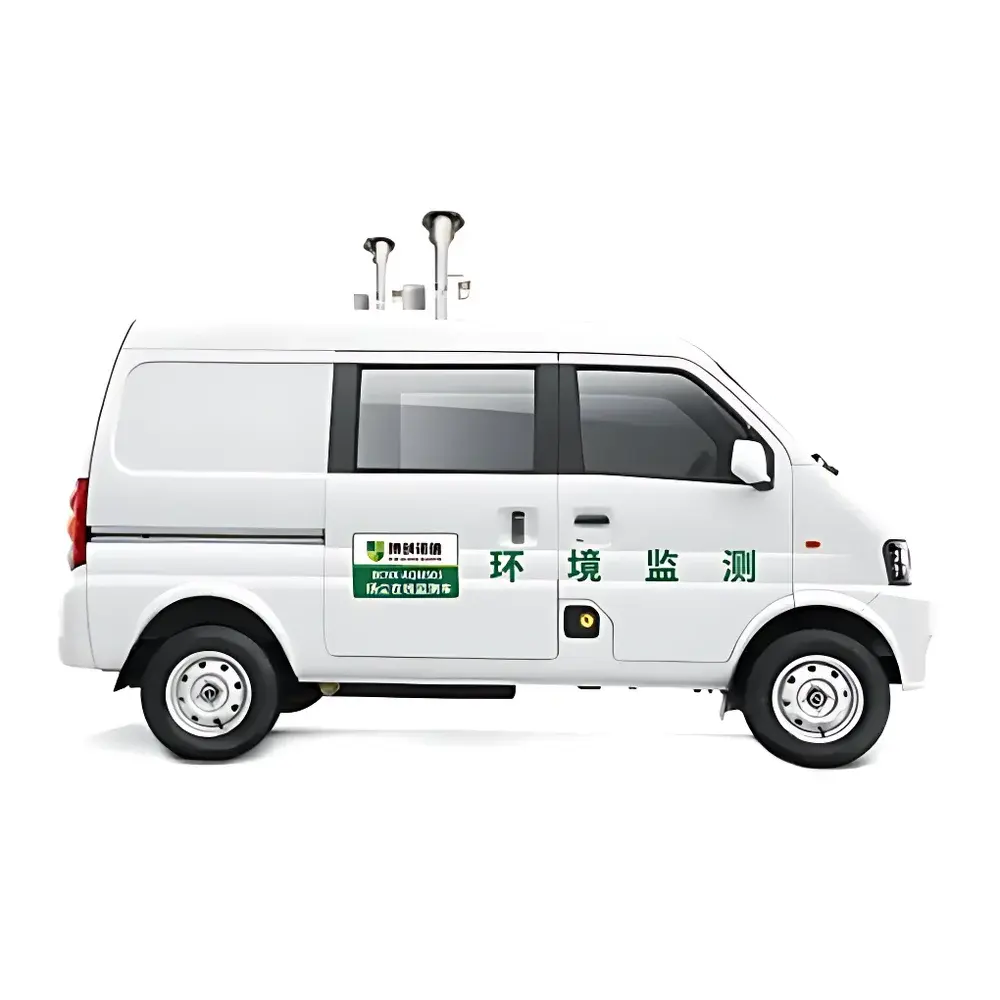
Vehicle-Mounted Air Quality Monitoring Station BCNX-AQ05
| Brand | BCNX |
|---|---|
| Origin | Beijing, China |
| Manufacturer Type | Manufacturer |
| Regional Category | Domestic (China) |
| Model | BCNX-AQ05 |
| Pricing | Available Upon Request |
Overview
The BCNX-AQ05 Vehicle-Mounted Air Quality Monitoring Station is an integrated, mobile environmental monitoring platform engineered for rapid deployment in routine surveillance, emergency response, and dynamic field campaigns. Designed in strict alignment with China’s national ambient air quality standard GB 3095–2012, the system implements multi-sensor fusion architecture to deliver real-time, spatially referenced measurements of key gaseous and particulate pollutants. Unlike stationary reference-grade analyzers, the BCNX-AQ05 employs compact, ruggedized electrochemical sensors (for SO₂, NOₓ, O₃, CO, H₂S), laser scattering photometers (for PM₂.₅ and PM₁₀), and optional aromatic hydrocarbon (BTX) detection modules based on photoionization detection (PID) or metal oxide semiconductor (MOS) principles. All sensor outputs are synchronized with high-accuracy GPS positioning and vehicle-mounted inertial navigation data, enabling geotagged time-series datasets suitable for source attribution, plume tracking, and exposure modeling. The system is mounted within a modified SUV or mid-size van chassis, featuring shock-dampened instrument racks, climate-controlled enclosure (operational range: −20 °C to +50 °C), and IP65-rated external sampling inlets.
Key Features
- Modular, standards-compliant air quality monitoring architecture aligned with GB 3095–2012 and compatible with international regulatory frameworks including EU Directive 2008/50/EC and US EPA equivalency criteria.
- Simultaneous measurement of up to seven regulated pollutants: PM₂.₅, PM₁₀, SO₂, NOₓ (NO + NO₂), O₃, CO, and H₂S — with optional BTX (benzene, toluene, xylene) extension via PID sensor module.
- Integrated meteorological suite (wind speed/direction, temperature, relative humidity, atmospheric pressure) for co-located environmental context and aerosol hygroscopicity correction.
- Onboard GPS/GLONASS dual-mode positioning with sub-5 m CEP accuracy, supporting real-time GIS overlay on embedded touchscreen display and export of KML/GeoJSON for post-processing in QGIS or ArcGIS.
- Automated particulate zero calibration using clean-air purge cycles and dynamic heating control of inlet ducts to mitigate condensation and filter clogging in high-humidity environments.
- Embedded industrial-grade data logger with ≥32 GB internal storage, supporting continuous 1-second resolution logging, remote firmware updates via LTE/4G, and secure TLS 1.2 encrypted data transmission.
- Self-diagnostic subsystem providing real-time status reporting for sensor health, power integrity, communication latency, and thermal management — all accessible via web-based dashboard or local SSH interface.
Sample Compatibility & Compliance
The BCNX-AQ05 is validated for ambient air sampling under variable meteorological conditions and traffic-influenced microenvironments. Its sampling inlets comply with ISO 7708:1995 specifications for inhalable and thoracic fraction separation. Gaseous sensors meet EN 14625:2012 (O₃), EN 14626:2012 (CO), and EN 15447:2008 (NOₓ) performance requirements for indicative measurement. Particulate modules conform to ISO 29463-3:2011 filtration efficiency benchmarks and demonstrate linearity (R² > 0.995) against gravimetric reference methods across 1–500 µg/m³ PM₂.₅ concentration ranges. The system supports audit-ready data integrity through timestamped metadata, sensor calibration logs, and configurable audit trails—enabling compliance with GLP and ISO/IEC 17025 documentation protocols.
Software & Data Management
The BCNX-AQ05 operates on a Linux-based embedded OS running proprietary BCNX AirData™ firmware. Data acquisition, preprocessing (e.g., humidity compensation, cross-sensitivity correction), and visualization occur locally without cloud dependency. The web interface (accessible via HTTPS) provides real-time trend plots, alarm thresholds (configurable per parameter), and CSV/NetCDF export. For enterprise integration, RESTful APIs support ingestion into central platforms such as IBM Envizi, Siemens Desigo CC, or custom SCADA systems. All data records include cryptographic hash signatures and immutable timestamps compliant with ISO/IEC 27001 controls. Optional FDA 21 CFR Part 11–compliant electronic signature module available for regulated environmental QA/QC workflows.
Applications
- Rapid-response environmental incident assessment (e.g., chemical spills, industrial fugitive emissions, wildfire smoke dispersion).
- Mobile source emission profiling along transportation corridors and near-port zones.
- High-resolution urban air quality mapping for epidemiological cohort studies and policy evaluation.
- Compliance verification during construction site dust mitigation and landfill perimeter monitoring.
- Supporting national air quality forecasting models with ground-truth observational inputs at sub-kilometer spatial granularity.
FAQ
Is the BCNX-AQ05 certified for regulatory compliance in non-Chinese jurisdictions?
The system meets technical equivalence benchmarks for indicative monitoring under EU and U.S. frameworks; however, formal type approval (e.g., U.S. EPA FRM/FEM designation or UK MCERTS certification) requires site-specific validation per local authority protocols.
Can the system operate autonomously for extended periods without vehicle engine runtime?
Yes — it integrates a dedicated 24 VDC auxiliary power supply with deep-cycle lithium-iron-phosphate battery backup (72 h nominal runtime at full sensor load).
What maintenance intervals are recommended for field-deployed units?
Sensor recalibration every 90 days; inlet filter replacement every 30 days in high-dust environments; full system functional check every 180 days per BCNX Maintenance Manual Rev. 3.2.
Does the platform support third-party sensor integration?
Yes — the system provides standardized analog (4–20 mA, 0–10 V) and digital (RS-485 Modbus RTU, CAN bus) I/O interfaces for OEM sensor expansion.
Related Products







