
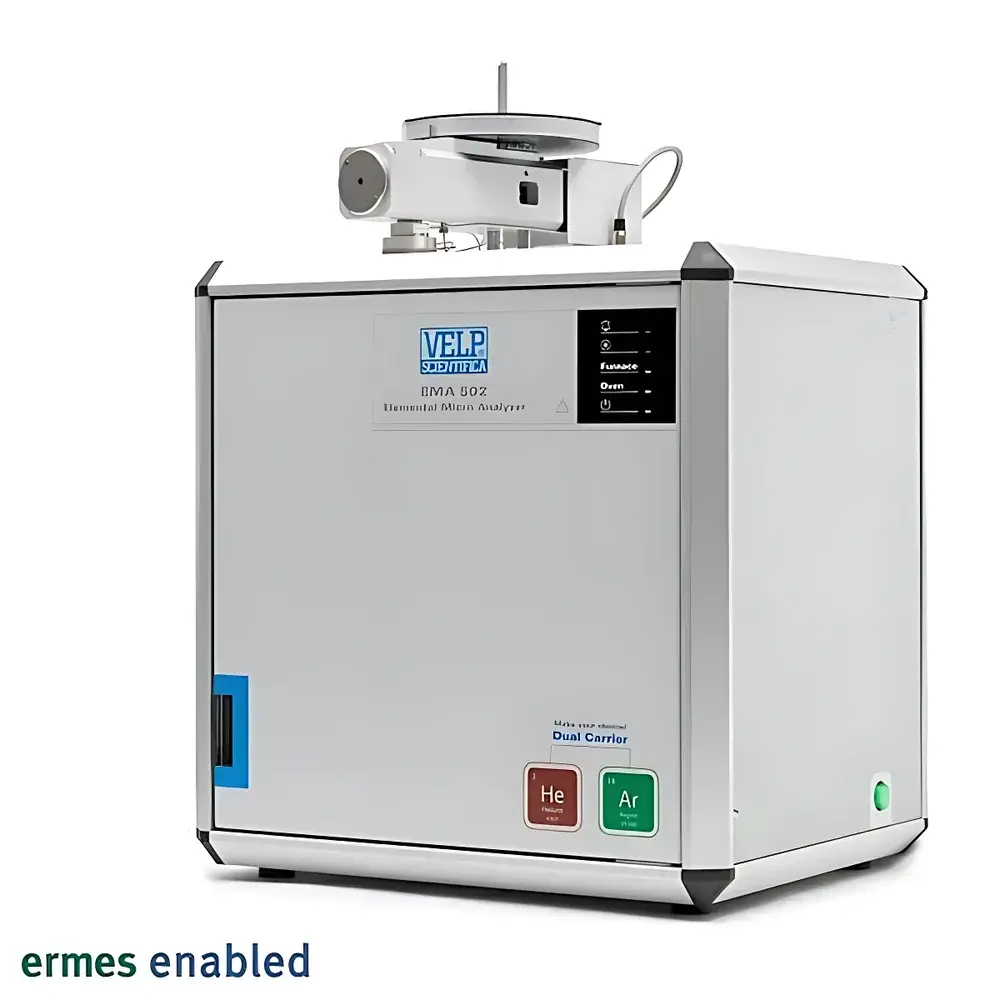
VELP EMA 502 CHNS-O Elemental Analyzer
| Brand | VELP |
|---|---|
| Country of Origin | Italy |
| Instrument Type | Dumas Combustion Analyzer |
| Automation Level | Fully Automated |
| Measurement Range | 5–20 mg sample mass |
| Sample Weight Capacity | up to 100 mg |
| Distillation Time | 6–12 min |
| Repeatability | ≤ 0.2 % RSD (sulfanilic acid) |
| Oxygen Recovery Rate | ≤ 0.2 % |
| Power Consumption | 570 W |
| Dimensions (L×W×H) | 500 × 510 × 410 mm |
Overview
The VELP EMA 502 CHNS-O Elemental Analyzer is a high-precision, fully automated combustion-based instrument engineered for quantitative determination of carbon (C), hydrogen (H), nitrogen (N), sulfur (S), and oxygen (O) in organic and inorganic solid, semi-solid, and liquid samples. It employs high-temperature Dumas combustion—operating at up to 1,150 °C in an oxygen-rich environment—to quantitatively convert analytes into stable gaseous oxides (CO₂, H₂O, NOₓ, SO₂, CO), which are then separated and detected using thermal conductivity detection (TCD). Unlike Kjeldahl-based systems, the EMA 502 eliminates hazardous reagents (e.g., concentrated sulfuric acid, selenium catalysts) and lengthy digestion steps, delivering compliant, reproducible elemental data in under 12 minutes per analysis. Its modular gas-path architecture enables seamless switching between CHNS and O modes without hardware modification—ensuring method flexibility while maintaining traceable calibration integrity across all five elements.
Key Features
- Fully automated operation with integrated microbalance and 117-position autosampler—enabling unattended 24/7/365 operation and direct mass data transfer to EMASoft™ software
- Dual-mode combustion furnace: optimized thermal profiles for CHNS (1,150 °C) and O (1,050 °C) analyses, each validated per ISO 16968, ASTM D5291, and USP <281>
- TCD-based detection system with dual reference cells and real-time baseline correction—achieving ≤ 0.2 % RSD for sulfanilic acid across ≥ 50 consecutive injections
- Self-diagnostic gas management: automatic leak checks, pressure stabilization, and carrier gas (He or Ar) flow optimization via integrated mass flow controllers
- Modular oxidation/reduction zones with proprietary CuO/Pt and NiO catalyst beds—ensuring complete conversion of refractory N- and S-containing compounds (e.g., nitroaromatics, thiophenes)
- Integrated safety architecture: overtemperature cutoff, flame-out detection, CO monitoring, and fail-safe purge sequences compliant with IEC 61010-1
Sample Compatibility & Compliance
The EMA 502 accommodates diverse matrices—including pharmaceutical actives, polymers, petrochemical feedstocks, soil extracts, animal feed, and biofuels—with sample masses ranging from 5 to 20 mg (up to 100 mg for low-concentration C/H/O analysis). Its combustion efficiency exceeds 99.5 % for certified reference materials (CRMs) such as NIST 84g (wheat flour), BCR-414 (sediment), and Leco NCS 123 (coal). Regulatory alignment includes full support for GLP and GMP environments: audit trails, electronic signatures, and user-access controls are enabled via optional 21 CFR Part 11-compliant firmware. All CHNS-O methods adhere to ISO 14852 (O determination), ISO 20135 (N in polymers), and EN 15407 (S in solid biofuels), with documented uncertainty budgets traceable to NMI-certified standards.
Software & Data Management
EMASoft™ v5.x provides comprehensive instrument control, method development, and result validation. Its intuitive interface displays real-time chromatograms, peak integration parameters, and TCD signal stability metrics during analysis. Pre-loaded method templates cover >40 CRMs and industry-specific matrices (e.g., USP monographs for drug substance assay, AOAC 992.23 for protein N). Calibration curves are generated automatically using multi-point linear regression with forced zero-intercept where appropriate; memory effect mitigation is enforced via dynamic blank subtraction and matrix-matched standardization. Data export complies with ASTM E1461 (XML), CSV, and PDF formats—fully compatible with LIMS integration via OPC UA or RESTful API. Optional Ermes Cloud connectivity enables remote instrument health monitoring, predictive maintenance alerts, and cross-site method synchronization.
Applications
- Pharmaceutical QC: verification of elemental composition in APIs per ICH Q5C, residual solvent screening, and excipient purity assessment
- Materials science: stoichiometric validation of MOFs, conductive polymers, and battery cathode precursors (e.g., LiCoO₂, NMC)
- Environmental testing: total organic carbon (TOC) and total nitrogen (TN) in wastewater sludge per EPA Method 445.1
- Fuel certification: sulfur content in diesel (ASTM D5453) and oxygenates in gasoline (ASTM D5599)
- Agricultural research: protein estimation in cereals (AOAC 984.13), fertilizer N-efficiency studies, and soil organic matter profiling
FAQ
What combustion principle does the EMA 502 use for oxygen determination?
It employs pyrolytic reduction in a graphite furnace under vacuum, converting oxygen to CO, followed by catalytic oxidation to CO₂ and TCD quantification—fully compliant with ISO 14852.
Can the EMA 502 analyze volatile liquid samples without loss?
Yes—using sealed tin capsules with double-fold crimping and optional cryogenic trapping, enabling precise analysis of solvents, oils, and low-boiling organics.
Is method validation support available for regulatory submissions?
VELP provides IQ/OQ/PQ documentation packages, CRM traceability reports, and 21 CFR Part 11 validation protocols upon request.
How is carryover minimized between high- and low-concentration samples?
Automated high-temperature furnace cleaning cycles (≥ 1,200 °C), programmable blank injections, and adaptive integration windows eliminate memory effects.
Does Ermes Cloud require on-premise IT infrastructure?
No—Ermes operates as a secure SaaS platform hosted on AWS EU-central-1, with TLS 1.3 encryption and GDPR-compliant data residency options.
Related Products






