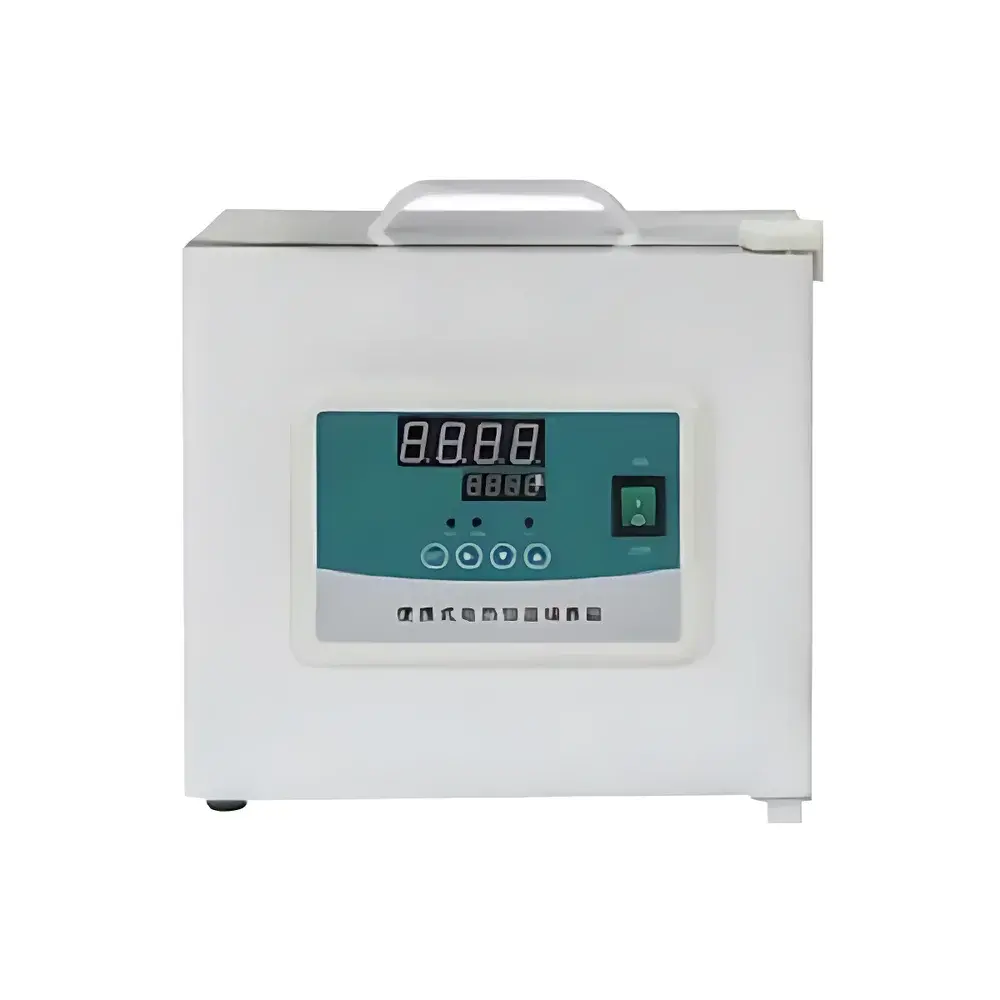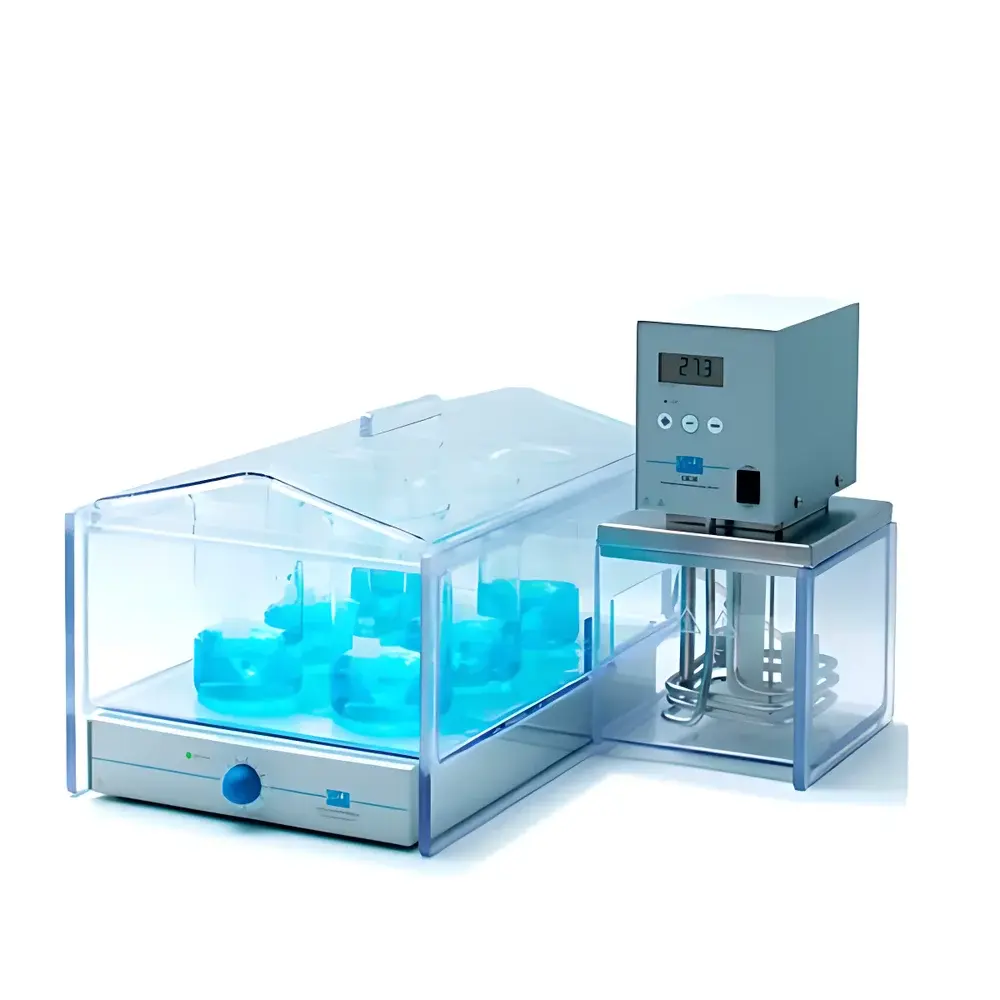
VELP GDE Enzymatic Digestion System
| Brand | VELP |
|---|---|
| Origin | Italy |
| Model | GDE |
| Heating Power | 900 W |
| Temperature Range | Ambient to 105 °C |
| Temperature Accuracy | ±0.2 °C |
| Water Bath Chamber | Transparent Polycarbonate (Max Temp: 105 °C) |
| Dimensions (W×H×D) | 413 × 295 × 410 mm |
| Weight | 6.2 kg |
| Water Requirement | Deionized Water Recommended |
| Stirring | Integrated Magnetic Stirrer |
Overview
The VELP GDE Enzymatic Digestion System is a precision-engineered benchtop instrument designed for standardized, thermally controlled enzymatic hydrolysis of food and biological samples—specifically optimized for total dietary fiber (TDF) analysis in compliance with AOAC Official Method 991.43 and AACC Method 32-05. It operates on the principle of controlled thermal incubation combined with continuous magnetic agitation to ensure uniform enzyme–substrate interaction under strictly defined time–temperature profiles. Unlike generic water baths, the GDE integrates real-time temperature feedback control, programmable timing, and chemical-resistant polycarbonate construction to eliminate thermal gradients, prevent localized overheating, and maintain enzymatic activity integrity throughout multi-step digestion protocols. Its architecture supports reproducible sample processing across laboratories engaged in nutritional labeling, regulatory compliance testing, and method validation under GLP or ISO/IEC 17025 frameworks.
Key Features
- High-stability temperature control system with ±0.2 °C accuracy across the full range (ambient to 105 °C), validated via internal Pt100 sensor and digital PID regulation.
- Integrated magnetic stirrer with adjustable speed, ensuring homogeneous suspension of solid–liquid reaction mixtures without mechanical wear or contamination risk.
- Transparent, autoclavable-grade polycarbonate water bath chamber resistant to thermal shock and chemical degradation—enabling direct visual monitoring of digestion progress and sample integrity.
- Digital timer with up to 99 hours 59 minutes programmability, supporting unattended operation for extended digestion cycles (e.g., α-amylase + protease + amyloglucosidase sequential steps).
- Deionized water compatibility eliminates scale formation, minimizing maintenance intervals and preserving long-term calibration stability.
- Ergonomic footprint (413 × 295 × 410 mm) and lightweight design (6.2 kg) facilitate integration into crowded analytical workspaces and routine QC labs.
Sample Compatibility & Compliance
The GDE accommodates standard digestion vessels—including glass test tubes (16–25 mm diameter), conical flasks, and custom reaction vials—compatible with AOAC-recommended sample sizes (0.5–1.0 g dry weight). Its temperature profile fidelity ensures consistent activation of key enzymes: pancreatin (pH 7.5–8.0, 37 °C), thermostable α-amylase (95–100 °C), and amyloglucosidase (60 °C). The system meets essential requirements for method traceability under FDA 21 CFR Part 11 when paired with compliant data logging software, and its operational parameters align with ISO 5725 (accuracy and precision of measurement methods) and ISO 17025 clause 7.2.2 (validation of non-standard methods). No external cooling is required; passive heat dissipation maintains safe surface temperatures during prolonged operation.
Software & Data Management
While the GDE operates as a standalone hardware platform with intuitive front-panel controls, it is fully compatible with VELP’s optional PC-based data acquisition module (GDE-Link), enabling timestamped temperature and timer event logging. Exported CSV files support audit-ready reporting for regulatory submissions. All recorded parameters—including setpoint, actual bath temperature, elapsed time, and stirrer status—are stored with operator ID and session metadata, satisfying GLP documentation standards for traceability and reanalysis. The system does not require network connectivity for basic operation, reducing cybersecurity exposure while retaining full compliance readiness.
Applications
- Total, soluble, and insoluble dietary fiber quantification per AOAC 991.43, 985.29, and 2009.01.
- Protein hydrolysis for amino acid analysis using proteolytic enzyme cocktails (e.g., trypsin/chymotrypsin at 37 °C).
- Starch digestion kinetics studies under physiologically relevant thermal conditions.
- Preparation of enzymatically digested reference materials for inter-laboratory proficiency testing.
- Method development and validation for novel fiber sources (e.g., resistant starches, prebiotic polysaccharides).
FAQ
Does the GDE support multi-step temperature ramping?
No—the GDE maintains a single user-defined setpoint per run. Multi-temperature protocols require manual stage switching or external scheduling via GDE-Link software.
Is the polycarbonate bath suitable for organic solvent use?
No—only aqueous solutions are permitted. Organic solvents (e.g., ethanol, acetone) may cause stress cracking or haze formation in polycarbonate.
Can I calibrate the temperature sensor in-house?
Yes—using a NIST-traceable reference thermometer and following VELP’s documented calibration procedure (included in the technical manual), users may perform field verification and offset adjustment.
What maintenance is required beyond regular cleaning?
Annual verification of temperature uniformity (per ISO/IEC 17025 Annex A.3) and stirrer torque consistency is recommended; no consumables or service contracts are mandatory.
Is the GDE compatible with USP <711> dissolution testing?
No—it is not configured for dissolution apparatus coupling or paddle/basket motion; it serves exclusively as a static enzymatic digestion bath.
Related Products