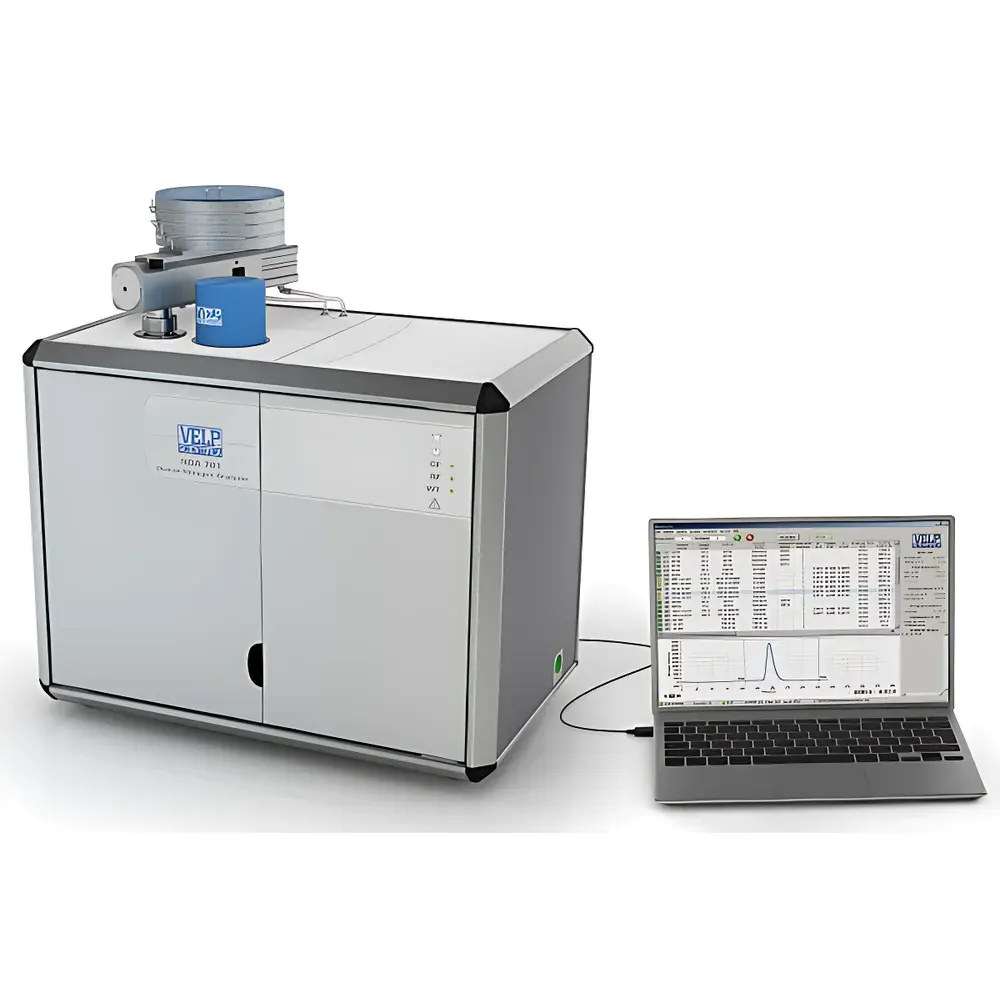
VELP NDA702 Dumas Nitrogen Analyzer
| Brand | VELP |
|---|---|
| Origin | Italy |
| Model | NDA702 |
| Detection Principle | High-Temperature Combustion (Dumas Method) |
| Carrier Gases | Helium and Argon (switchable without hardware/software modification) |
| Analysis Time | ~3–4 min per sample |
| Automation Level | Fully Automated, Unattended Operation |
| Compliance | GLP-compliant architecture, TEMS™ certified design |
| Sample Forms | Solid and liquid matrices |
| Reagent Requirement | None (dry chemistry method) |
Overview
The VELP NDA702 Dumas Nitrogen Analyzer is a high-performance, fully automated combustion-based instrument engineered for precise and reproducible total nitrogen and crude protein quantification in agricultural, food, feed, and environmental laboratories. It implements the standardized Dumas combustion method (ISO 16634-1:2021, AOAC 992.15, EN ISO 16634-2:2016), wherein samples are flash-combusted at >1,100 °C in an oxygen-rich environment, converting all organic and inorganic nitrogen into molecular nitrogen (N₂). The resulting gas stream is purified, dried, and quantified via high-sensitivity thermal conductivity detection (TCD), delivering trace-level accuracy without reliance on wet chemical reagents or catalysts.
Unlike Kjeldahl digestion—requiring concentrated acids, extended heating cycles, and hazardous fumes—the NDA702 operates as a dry chemistry platform. Its robust ceramic combustion tube, integrated ash trap, and dual-stage gas purification system ensure long-term stability and minimal maintenance across heterogeneous sample types, including cereals, oilseeds, meat meals, dairy powders, soils, and liquid fertilizers.
Key Features
- Fully switchable carrier gas system: Seamless transition between helium and argon without hardware swaps or firmware updates—enabling method flexibility for diverse matrix challenges and regulatory alignment (e.g., argon for high-ash samples per AOAC guidelines).
- TEMS™-certified architecture: Engineered to minimize energy consumption, footprint, analysis time, and operational cost—validated against VELP’s proprietary Total Efficiency Management Standard.
- Unattended batch operation: Integrated autosampler supports up to 40 positions with programmable delay ignition, auto-calibration, and real-time system diagnostics.
- No chemical reagents required: Eliminates sulfuric acid, sodium hydroxide, boric acid, and catalysts—reducing lab safety risks, waste disposal burden, and consumables inventory.
- Low residue generation: Ash retention efficiency >99.8%; <5 mg residual ash per 1 g sample typical—compatible with GLP audit requirements for waste traceability.
- Intuitive DUMASoft software: Multilingual interface (EN/DE/FR/ES/IT) with embedded calibration curve management, automatic dilution factor application, and one-click report export (PDF/CSV/XLSX).
Sample Compatibility & Compliance
The NDA702 accommodates solid (0.05–1.0 g) and liquid (0.1–2.0 mL) samples across broad moisture (≤15%), fat (≤30%), and ash (≤12%) ranges. Its adaptive combustion protocol dynamically adjusts oxygen flow and dwell time based on sample mass and elemental composition—ensuring complete nitrogen liberation even from recalcitrant matrices such as lignocellulosic biomass or mineral-rich soils. The system conforms to ISO/IEC 17025:2017 documentation practices and supports full 21 CFR Part 11 compliance when deployed with validated DUMASoft configurations—including electronic signatures, audit trails, and user-access tiering. All hardware components meet CE marking requirements and IEC 61010-1 safety standards for laboratory equipment.
Software & Data Management
DUMASoft provides a secure, role-based desktop environment supporting method validation, uncertainty calculation (per ISO/IEC 17025 Annex A.3), and trend analysis across calibration history. Raw chromatograms, TCD response curves, and combustion efficiency metrics (CO₂ recovery, H₂O removal efficiency) are archived with timestamps and operator IDs. Data export complies with LIMS integration protocols (ODBC, ASTM E1384, HL7-compatible metadata tagging). Audit trail logs record all parameter changes, calibration events, and result modifications—retained for ≥10 years per GLP archive policies.
Applications
- Agricultural QA/QC: Crude protein determination in grains, legumes, silage, and compound feed per EU Regulation (EC) No 152/2009.
- Food & Beverage: Label-compliant protein reporting for dairy, plant-based alternatives, and infant formula under Codex Alimentarius standards.
- Environmental Testing: Total Kjeldahl Nitrogen (TKN)-equivalent measurement in sludge, compost, and wastewater biosolids (EPA Method 351.2 equivalent).
- Research Laboratories: Nitrogen balance studies, fertilizer efficacy trials, and metabolic tracer analysis using ¹⁵N-enriched samples.
FAQ
Does the NDA702 require routine catalyst replacement?
No—unlike Kjeldahl systems, it uses no catalysts; the ceramic combustion tube and nickel oxide scrubber have service lives exceeding 10,000 analyses.
Can it analyze volatile or low-boiling nitrogen compounds?
Yes—the high-temperature oxidative environment (>1,100 °C) ensures quantitative conversion of nitro-, azo-, and heterocyclic nitrogen forms without loss.
Is method validation support available?
VELP provides IQ/OQ documentation templates, certified reference material (CRM) test protocols (e.g., BCR-68, NIST 8435), and third-party verification services aligned with ISO 17025 scope accreditation.
How is calibration traceability maintained?
Using NIST-traceable ammonium sulfate and ethylenediamine tetraacetic acid (EDTA) CRMs; calibration curves are verified daily with control charts per ISO 8466-1.
Related Products