
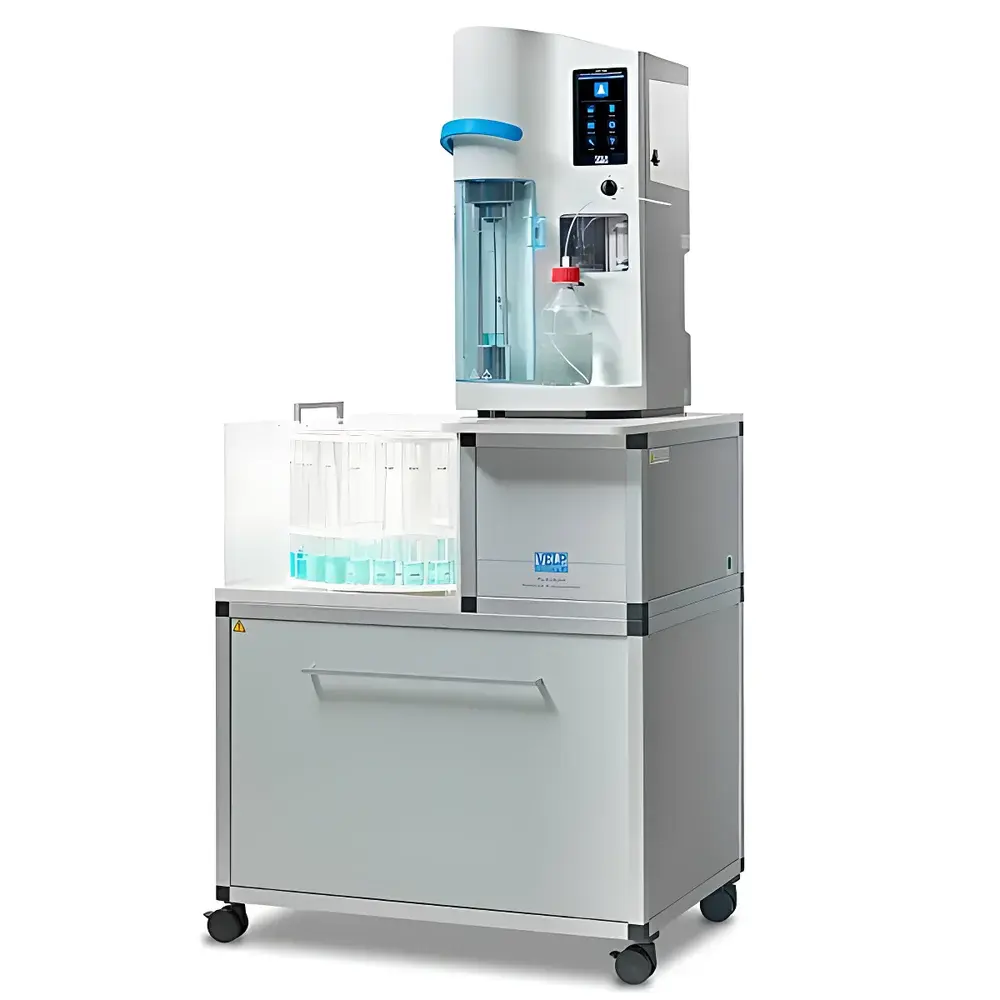
VELP UDK169 with AutoKjel Fully Automated Kjeldahl Nitrogen Determination System
| Brand | VELP |
|---|---|
| Origin | Italy |
| Model | UDK169 and AutoKjel |
| Instrument Type | Kjeldahl Nitrogen Determinator |
| Recovery Rate | ≥99.5% |
| Repeatability | ≤1% |
| Distillation Time (incl. Titration) | 4 min |
| Power Consumption | 2250 W |
| Dimensions (L×W×H) | 830 × 1730 × 416 mm |
| Weight | 171 kg |
| Compliance | ASTM D1144, ISO 8968-1, AOAC 981.10, USP <321>, EN ISO 1871 |
| Software | UDK Control Suite v3.x with GLP-compliant audit trail |
| Connectivity | RS232, USB, optional Ethernet/LAN |
| Sample Throughput | Up to 20 samples per hour (continuous mode) |
| Safety Certifications | CE, IEC 61010-1, IP22 |
Overview
The VELP UDK169 with AutoKjel is a fully integrated, walk-away Kjeldahl nitrogen determination system engineered for precision, regulatory compliance, and unattended operation in high-throughput analytical laboratories. Based on the classical Kjeldahl method—comprising digestion, distillation, and colorimetric titration—the system automates all critical steps from sample introduction to final protein quantification. Its core architecture combines a high-efficiency steam generator with a titanium condenser, ensuring rapid thermal response, consistent steam pressure control (0–100% adjustable), and minimized water consumption during condensation. Designed for routine QC/QA in food, feed, agricultural, pharmaceutical, and environmental testing labs, the UDK169 meets internationally recognized standards including AOAC 981.10, ISO 8968-1 (milk and dairy), EN ISO 1871 (cereals), ASTM D1144 (wastewater), and USP (nitrogen content in pharmaceutical excipients). The system operates under full GLP/GMP-aligned conditions, supporting 21 CFR Part 11–compliant data integrity through secure user authentication, electronic signatures, and immutable audit trails.
Key Features
- Fully automated sample handling via the AutoKjel robotic sampler: accommodates up to 20 digestion tubes (standard 300 mL or optional 100/250 mL formats) with automatic positioning, tube recognition, and collision avoidance.
- Integrated distillation–titration module featuring a built-in photometric colorimetric titrator with dual-wavelength detection (430 nm / 570 nm) for precise endpoint determination of boric acid–ammonia complex formation.
- Programmable reagent delivery system controlling exact volumes of NaOH (0–100 mL, ±0.2 mL accuracy), boric acid (0–50 mL, ±0.1 mL), and dilution water—each dispensed via gravimetrically calibrated peristaltic pumps.
- 6-inch capacitive touchscreen interface running UDK Control Suite v3.x, offering multilingual support (including English, German, French, Spanish, Chinese), guided workflow navigation, and real-time status monitoring of all subsystems.
- Preloaded library of 30 validated standard methods (e.g., AOAC 981.10 for cereals, ISO 8968-1 for milk, EN ISO 1871 for flour) plus 24 customizable method slots for lab-specific optimization.
- Comprehensive safety architecture: interlocked access doors, level sensors for reagent reservoirs and cooling water, temperature-controlled steam chamber, overpressure relief valves, and automatic shutdown upon anomaly detection (e.g., dry-run, tube misalignment, titration failure).
Sample Compatibility & Compliance
The UDK169 supports solid, semi-solid, and liquid matrices across diverse industries—raw materials, finished products, and digested homogenates—provided they have undergone standardized sulfuric acid–catalyst digestion (e.g., using VELP’s DK series digesters). It accepts standard Kjeldahl digestion tubes (300 mL borosilicate glass, tapered neck, ISO 8968-compliant geometry) and integrates seamlessly with third-party digestion systems via digital handshake protocols. All operational parameters—including digestion time, distillation duration, base volume, and titrant concentration—are traceable and modifiable only by authorized users. Full compliance with ISO/IEC 17025 requirements for method validation is enabled through built-in calibration routines for titrant concentration verification, blank correction algorithms, and recovery spike functionality. Data export adheres to LIMS-ready CSV, PDF, and XML formats with embedded metadata (operator ID, timestamp, instrument serial number, method version).
Software & Data Management
UDK Control Suite v3.x serves as the central software platform, providing role-based access control (administrator, analyst, reviewer), electronic signature capability, and configurable audit trail logging compliant with FDA 21 CFR Part 11 and EU Annex 11. Raw titration curves, intermediate values (e.g., blank-corrected ammonia mass, %N conversion), and final protein results are stored locally on encrypted internal storage (≥16 GB) with automatic backup to external USB drives or network shares. Remote diagnostics and firmware updates are supported via secure HTTPS connection. Optional integration with laboratory information management systems (LIMS) is achieved through HL7 or ASTM E1384-compliant messaging interfaces. All reports include mandatory fields required for accreditation bodies: uncertainty estimation per ISO/IEC 17025 Clause 7.6.3, measurement traceability to NIST-traceable standards, and revision-controlled method documentation.
Applications
The UDK169 delivers robust performance in regulated and non-regulated environments requiring accurate total nitrogen quantification: crude protein analysis in animal feed (AOAC 984.13), dairy products (ISO 8968-1), cereal grains (EN ISO 1871), meat and plant-based alternatives; nitrogen content verification in pharmaceutical excipients (USP ); ammoniacal nitrogen determination in wastewater and soil extracts (ASTM D1144, EPA 350.1); and quality control of fertilizers and industrial chemicals. Its repeatability ≤1% RSD and recovery ≥99.5% ensure alignment with ISO 5725-2 precision criteria for collaborative trials. The system is routinely deployed in ISO 17025-accredited labs undergoing biennial proficiency testing under FAPAS or AOAC PT schemes.
FAQ
What digestion systems are compatible with the UDK169?
The UDK169 accepts standard 300 mL Kjeldahl digestion tubes and interfaces with VELP DK series digesters (e.g., DK20, DK6, DK200) via RS232 handshake; third-party digesters may be integrated using custom protocol mapping.
Does the system support dual-wavelength photometric titration?
Yes—the integrated colorimeter uses simultaneous 430 nm and 570 nm detection to compensate for sample turbidity and dye degradation, improving endpoint reproducibility in complex matrices.
Can method parameters be locked to prevent unauthorized changes?
Yes—administrator-defined method templates can be set as read-only, and any modification triggers an electronic signature requirement and audit log entry.
Is remote monitoring and troubleshooting possible?
With optional Ethernet connectivity and VELP Remote Support Module, certified engineers can perform secure remote diagnostics, parameter review, and firmware updates without physical site access.
How is cooling water consumption minimized?
The titanium condenser enables >92% thermal efficiency at flow rates as low as 1.2 L/min, reducing average water usage by ~40% compared to stainless-steel condensers under identical distillation loads.
Related Products







