
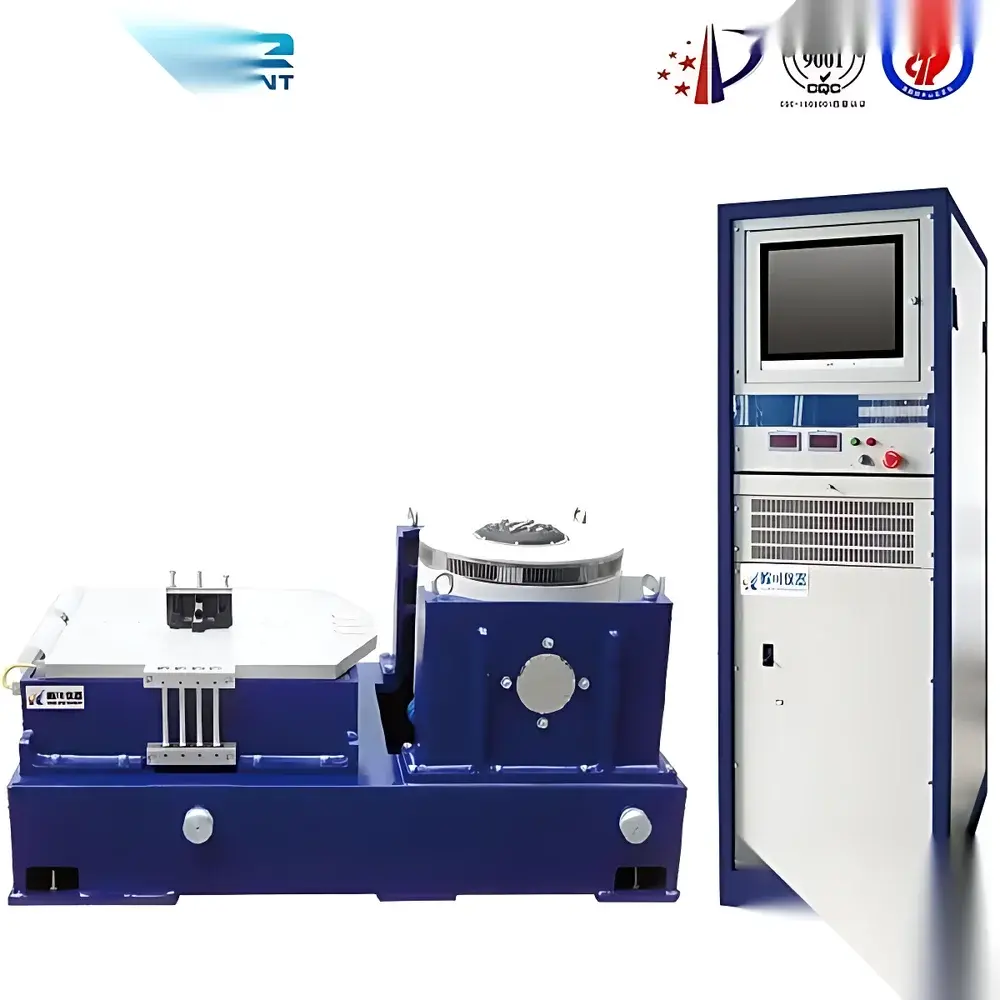
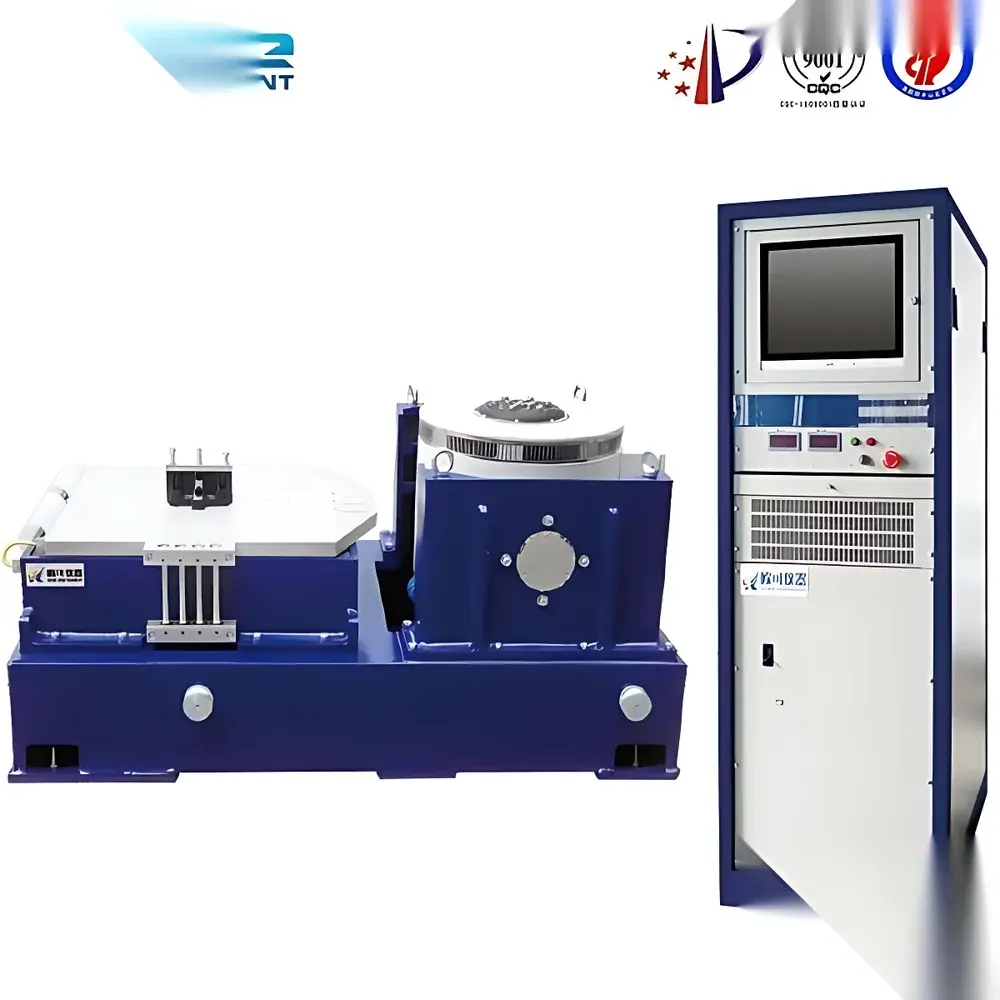
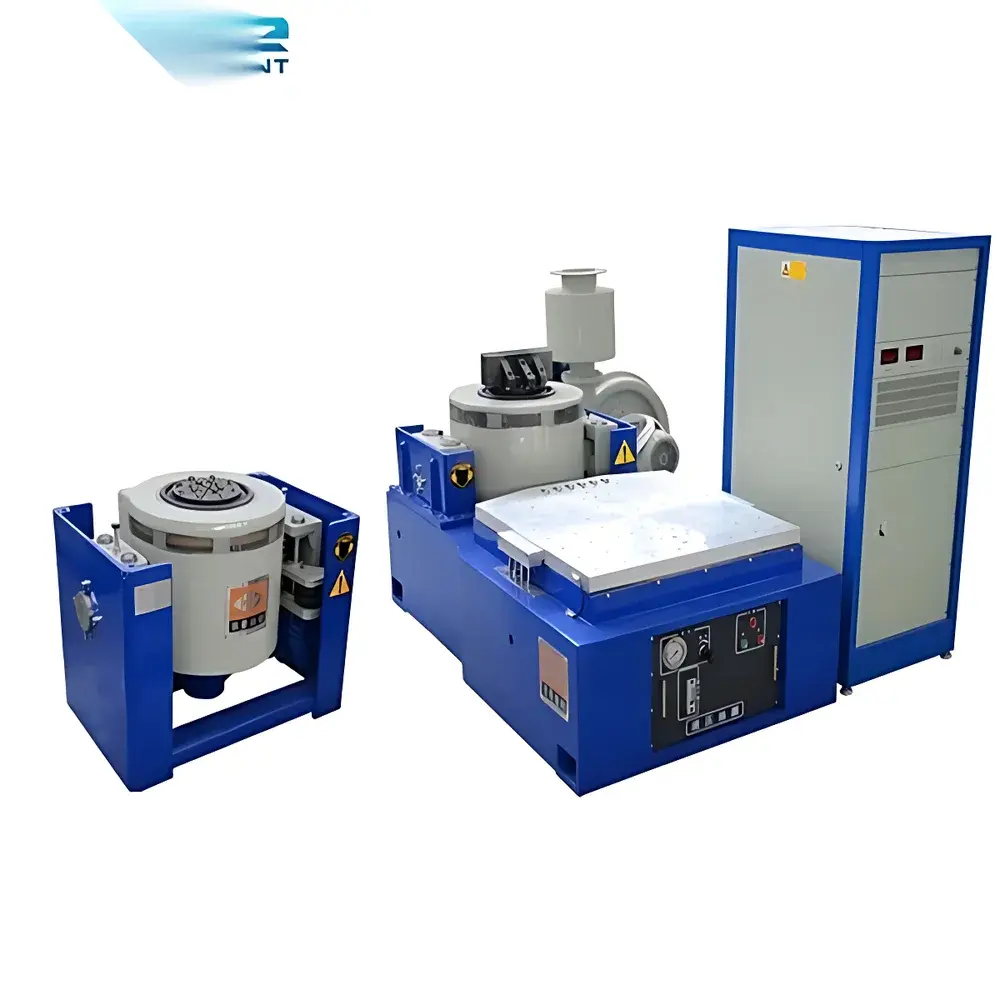
Vertical & Horizontal Dual-Axis Electromagnetic Vibration Shaker System
| Brand | Generic Industrial |
|---|---|
| Origin | Imported |
| Manufacturer Type | Authorized Distributor |
| Price | USD 14,000 (FOB) |
| Max Load Capacity | 100 kg |
| Max Excitation Force | 2200 kgf |
| Frequency Range | 1–600 Hz (0.01 Hz resolution) |
| Power Rating | 3.3 kW |
| Peak-to-Peak Amplitude Range | 0–5.2 mm |
| Peak Acceleration | 22 g |
| Acceleration Formula | aₘₐₓ = 0.002 × f² × D (f in Hz, D in mm p-p) |
| Waveform | Sine (half/full cycle) |
| Time Control | Programmable up to 999,999 s |
| Input Voltage | 220 V AC, 15 A |
| Sweep Modes | Linear/logarithmic, programmable bidirectional sweep with user-defined rate, dwell, and loop count |
| Control Options | Standalone front-panel operation |
| Compliance | Designed per IEC 60068-2-6, ISO 10816-1, and MIL-STD-810H vibration test profiles |
Overview
The Vertical & Horizontal Dual-Axis Electromagnetic Vibration Shaker System is an industrial-grade electrodynamic shaker engineered for precise, repeatable mechanical stress testing across two orthogonal axes—vertical (Z-axis, up/down) and horizontal (X-axis, front/back)—within a single integrated platform. Unlike single-axis or mechanically coupled systems, this shaker employs dual independent electromagnetic actuators with synchronized real-time control logic, enabling true simultaneous or sequential excitation in Z and X directions without cross-axis coupling artifacts. It operates on classical electromagnetic transduction principles: current-driven voice coils interact with high-strength permanent magnetic fields to generate controlled inertial forces compliant with Newton’s second law (F = ma). The system supports full-spectrum vibration test protocols—including sine, swept-sine, random, and transient shock simulations—as defined in international environmental testing standards. Its architecture prioritizes thermal stability, force linearity, and low harmonic distortion (<3% THD at rated output), making it suitable for qualification testing of electronics enclosures, automotive components, aerospace subassemblies, and packaging integrity validation under dynamic loading conditions.
Key Features
- Dual-axis independent actuation: Separate Z- and X-axis electromagnetic drivers with isolated suspension and feedback-controlled force delivery
- Wide dynamic range: 1–600 Hz frequency coverage with 0.01 Hz digital resolution and ±0.1% frequency accuracy over full range
- Programmable motion profiles: Supports discrete axis excitation (Z-only, X-only), biaxial concurrent (Z+X), and programmable sequence modes (e.g., Z→X→Z/X→Z) with user-defined dwell times and transition ramps
- High-force capability: Rated 2200 kgf peak push-pull force at 100 kg payload; maintains >95% force linearity up to 85% of max rating
- Amplitude flexibility: Adjustable peak-to-peak displacement from 0 to 5.2 mm, with automatic amplitude limiting based on frequency-dependent constraints (Dmax = 20 / (0.002 × f²))
- Acceleration fidelity: Achieves up to 22 g peak acceleration; acceleration calculation follows ISO 5344-compliant formulation (a = 0.002 × f² × D)
- Robust thermal management: Forced-air cooling with temperature monitoring and automatic derating above 75°C coil temperature
- Front-panel HMI: 7-inch TFT LCD with touch interface, real-time waveform display, and onboard test memory for up to 100 stored programs
Sample Compatibility & Compliance
This shaker accommodates test specimens up to 100 kg mass and 600 × 600 × 400 mm (W × D × H) footprint using standard 16-mm tapped mounting holes on the table surface. Fixture design must ensure center-of-gravity alignment within ±15 mm of table centerline to minimize overturning moments. The system complies with core mechanical vibration testing requirements outlined in IEC 60068-2-6 (sinusoidal vibration), ISO 10816-1 (vibration severity evaluation), and MIL-STD-810H Method 514.8 (vibration testing for equipment). While not certified for FDA-regulated medical device validation out-of-the-box, its traceable amplitude/acceleration performance and programmable audit trails (when paired with optional PC software) support GLP/GMP-aligned test documentation workflows. Calibration certificates per ISO/IEC 17025 are available upon request through accredited third-party labs.
Software & Data Management
Standalone operation requires no external computer; all test parameters—including frequency, amplitude, acceleration, sweep rate, dwell time, and loop count—are configured directly via the embedded controller. For advanced analysis and regulatory compliance, the optional RS-485 interface enables integration with Windows-based control software (sold separately), supporting real-time waveform streaming, automated pass/fail threshold evaluation, CSV export, PDF report generation, and electronic signature capture. The software architecture supports 21 CFR Part 11-compliant user access control, audit trail logging (with timestamps, operator ID, and parameter change history), and data integrity verification via SHA-256 hashing. Raw sensor data (if equipped with optional accelerometer/strain gauge inputs) is sampled at 10 kHz and timestamped with microsecond precision.
Applications
- Electronics reliability testing: PCB solder joint fatigue assessment, connector retention validation, and MEMS device resonance screening
- Automotive component qualification: Seat rail durability, ECU housing integrity, and battery module mounting stability under road-simulated spectra
- Aerospace hardware screening: Avionics box mounting bracket resonance mapping and fastener loosening detection
- Packaging performance evaluation: ISTA 3A/3E-compliant simulation of truck transport vibration environments
- Research & development: Modal analysis input forcing, damping coefficient estimation, and nonlinear material response characterization under combined axial excitations
FAQ
Does this shaker support true six-degree-of-freedom (6DOF) motion?
No. This model is strictly a dual-axis (Z + X) system. “Six-degree-of-freedom” functionality referenced in marketing materials refers to programmable sequencing across three translational axes—not simultaneous 6DOF actuation. True 6DOF shakers require complex multi-actuator platforms with active feedback compensation and are not covered by this product specification.
Is accelerometer feedback included for closed-loop control?
No. Closed-loop acceleration control requires optional external piezoelectric accelerometers and a dedicated signal conditioning module, which must be purchased separately. The base system operates in open-loop voltage/current mode.
Can the system perform random vibration testing?
No. This unit is optimized for deterministic waveforms only—sine, swept-sine, and fixed-frequency dwell tests. Random vibration capability requires a separate power amplifier, controller, and PSD synthesis software not included in this configuration.
What is the maximum payload for 22 g acceleration at 100 Hz?
At 100 Hz, the theoretical maximum acceleration of 22 g corresponds to a peak-to-peak displacement of 1.0 mm. With the system’s 2200 kgf force rating, the practical maximum payload sustaining 22 g is approximately 100 kg—consistent with its rated capacity. Load mass must be rigidly coupled to avoid resonant amplification or table-mode interference.
Is calibration traceable to NIST or other national metrology institutes?
Yes—calibration services with NIST-traceable reference standards are available through authorized service partners. Certificate includes uncertainty budgets per ISO/IEC 17025 and covers force, displacement, and acceleration channels at multiple frequencies (10, 50, 100, 200, and 400 Hz).



