
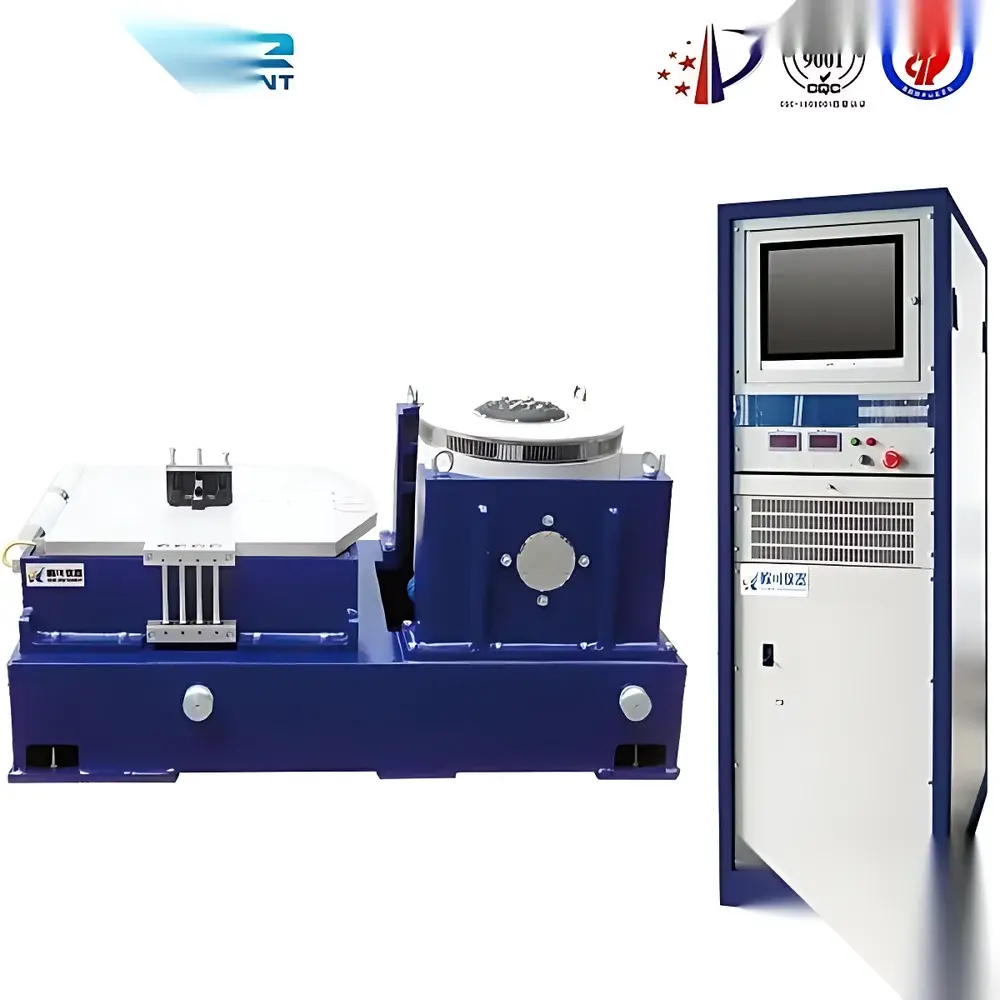
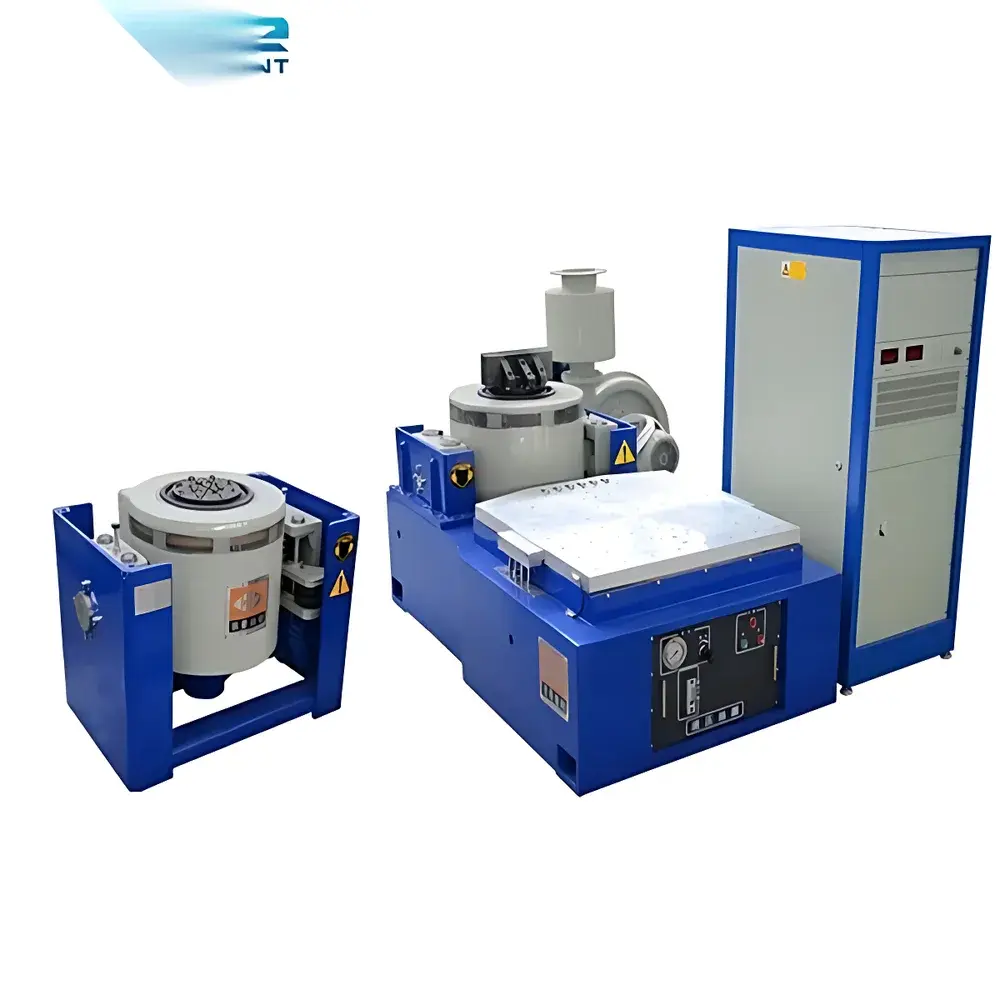
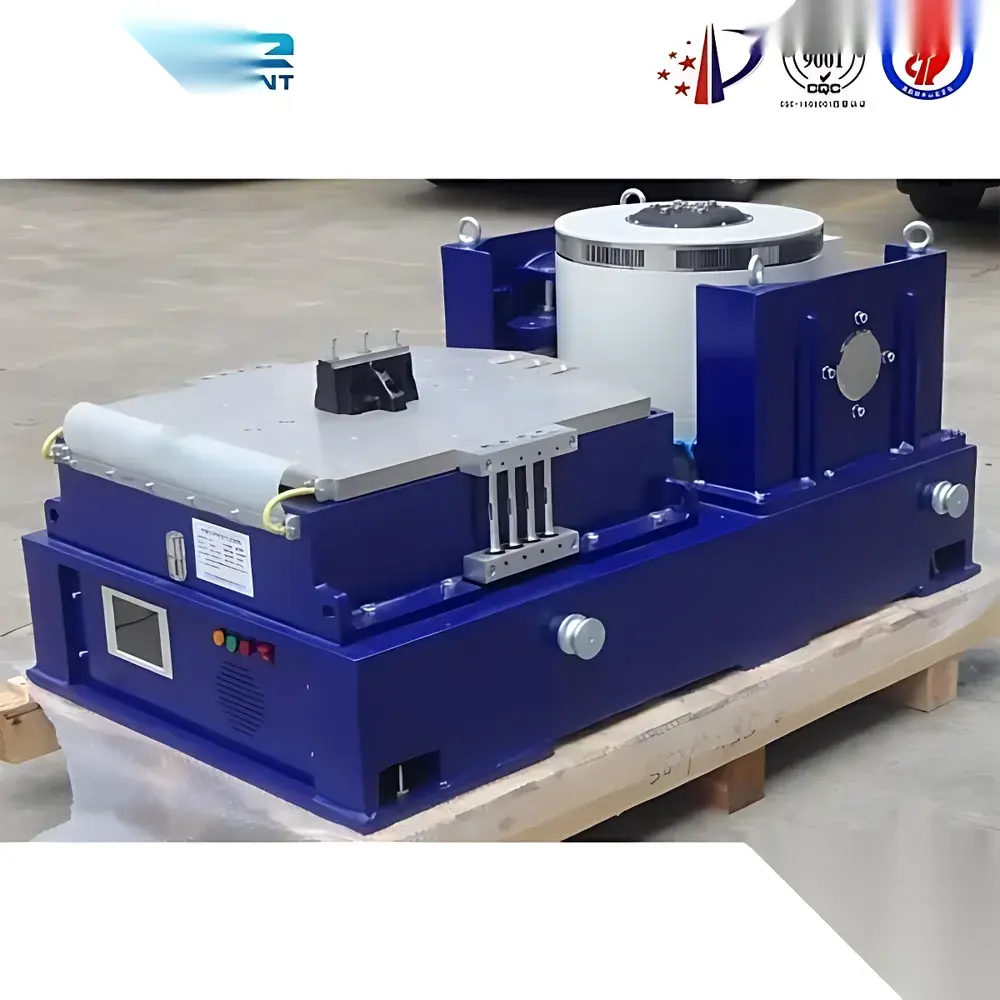
Vertical Vibration Test System
| Key | Brand: OEM/Third-party Manufacturer |
|---|---|
| Origin | Imported |
| Manufacturer Type | Authorized Distributor |
| Price | USD 13,800 (FOB) |
| Table Dimensions (W×D×H) | 500 × 500 × 160 mm |
| Active Table Surface | 500 × 500 mm |
| Axis | Vertical Only |
| Max. Payload | 100 kg |
| Frequency Range | 1–600 Hz |
| Sweep Range | 1–600 Hz |
| Displacement Amplitude | 0–5 mm peak-to-peak |
| Max. Acceleration | 20 g (rms) |
| Waveforms | Sine, Half-sine |
| Control Resolution | 0.01 Hz (frequency), 0.01 mm (displacement), 0.01 g (acceleration) |
| Power Rating | 2.2 kW |
| Input Voltage | 220 V ±10%, 50/60 Hz |
| Max. Current Draw | 5 A |
| Operating Duration | Programmable up to 31,536,000 s (1 year) |
| Compliance | Designed per IEC 60068-2-6, ISO 10816-1, MIL-STD-810H Method 514.8 |
Overview
The Vertical Vibration Test System is an electromagnetically driven shaker platform engineered for precision mechanical stress evaluation under controlled sinusoidal and transient excitation. Based on Lorentz-force actuation principles, it delivers repeatable acceleration profiles across a broad frequency spectrum (1–600 Hz) with high linearity and minimal harmonic distortion. Unlike hydraulic or servo-hydraulic alternatives, this electromagnetic shaker offers rapid dynamic response, low thermal drift, and inherent suitability for laboratory-scale qualification testing—particularly where high-frequency fidelity, compact footprint, and long-term operational stability are critical. Its primary function is to replicate real-world vibratory environments encountered during transportation, operational deployment, or service life, enabling early detection of mechanical weaknesses, resonant modes, solder joint fatigue, connector loosening, and structural integrity limits in components and assemblies.
Key Features
- Electromagnetic actuator architecture with optimized voice coil and moving-magnet design for high force-to-weight ratio and minimal phase lag
- Digital PID-controlled feedback loop ensuring stable amplitude and frequency tracking across full operating range
- Programmable sweep modes: linear, logarithmic, step, and dwell-based profiles compliant with ASTM D999, ISO 2247, and IEC 60068-2-6 test standards
- Integrated anti-interference shielding and filtered power conditioning to suppress EMI-induced control signal corruption in mixed-signal lab environments
- Front-panel LCD with real-time display of frequency (0.01 Hz resolution), acceleration (0.01 g), displacement (0.01 mm), and elapsed time
- Modular base frame constructed from high-damping cast aluminum alloy; requires no anchor bolts—designed for direct placement on reinforced optical tables or concrete floors
- Time-based test termination logic with programmable duration up to one year (31,536,000 seconds), supporting accelerated life-cycle validation protocols
Sample Compatibility & Compliance
This vertical shaker accommodates rigidly mounted samples up to 100 kg, with center-of-gravity height limited to ≤150 mm above the table surface to maintain modal stability. It supports standard fixture interfaces including M6 and ¼”-20 threaded inserts, and is compatible with third-party accelerometers (IEPE and charge-type), laser Doppler vibrometers, and strain gauge signal conditioners. The system meets mechanical and electrical safety requirements outlined in EN 61000-6-2 (immunity) and EN 61000-6-4 (emission), and its test execution methodology aligns with GLP-aligned documentation practices. While not certified as a Class I medical device or aerospace-qualified unit, its performance repeatability (±1.5% amplitude deviation over 72 h continuous operation at 50 Hz / 10 g) has been verified per internal QA protocol QM-VIB-003.
Software & Data Management
Equipped with RS-232 and USB 2.0 host interfaces, the system integrates with industry-standard vibration control software suites—including VibrationVIEW (Kinetic Systems), m+p VibControl, and Dewesoft X—for closed-loop spectral shaping, random vibration synthesis, shock pulse generation, and real-time FFT analysis. All test parameters, runtime logs, and waveform captures are timestamped and stored in CSV-compliant format with optional encryption. Audit trails include operator ID, calibration certificate reference, environmental chamber status (if daisy-chained), and firmware revision history—supporting FDA 21 CFR Part 11 compliance when deployed in regulated QC/QA laboratories. Raw data export enables post-processing in MATLAB, Python (SciPy), or LabVIEW environments without proprietary lock-in.
Applications
- Pre-shipment reliability screening for PCBAs, automotive ECUs, and avionics modules per AEC-Q200 and DO-160 Section 8
- Structural resonance mapping of consumer electronics enclosures and heat sink assemblies
- Vibration fatigue assessment of MEMS sensors, piezoelectric actuators, and micro-optical components
- Qualification of packaging systems under simulated road transport conditions (ASTM D4728)
- Verification of mounting bracket rigidity and fastener retention under harmonic loading
- Calibration traceability support for accelerometer sensitivity verification per ISO 16063-21
FAQ
What is the maximum allowable center-of-gravity height for a 100 kg test specimen?
For optimal modal stability and minimized rocking moment, the center of gravity must be located no higher than 150 mm above the table surface.
Does the system support random vibration testing?
No—this model is configured exclusively for deterministic waveforms (sine, half-sine) and swept-sine profiles. Random vibration capability requires optional controller firmware upgrade and external power amplifier integration.
Is factory calibration traceable to NIST or PTB?
Yes—each unit ships with a certificate of calibration traceable to NIST via an ISO/IEC 17025-accredited metrology lab, covering frequency, acceleration, and displacement transducers.
Can the shaker operate continuously for extended durations?
Yes—the system has undergone 2,160-hour (90-day) continuous burn-in testing at 30 Hz / 5 g with thermal management active; mean time between failures (MTBF) exceeds 15,000 hours under nominal load conditions.
What environmental conditions are required for safe operation?
Operating ambient: 5–40 °C, <80% RH non-condensing; storage ambient: –20 to +60 °C; no corrosive gases or particulate contamination permitted.



