
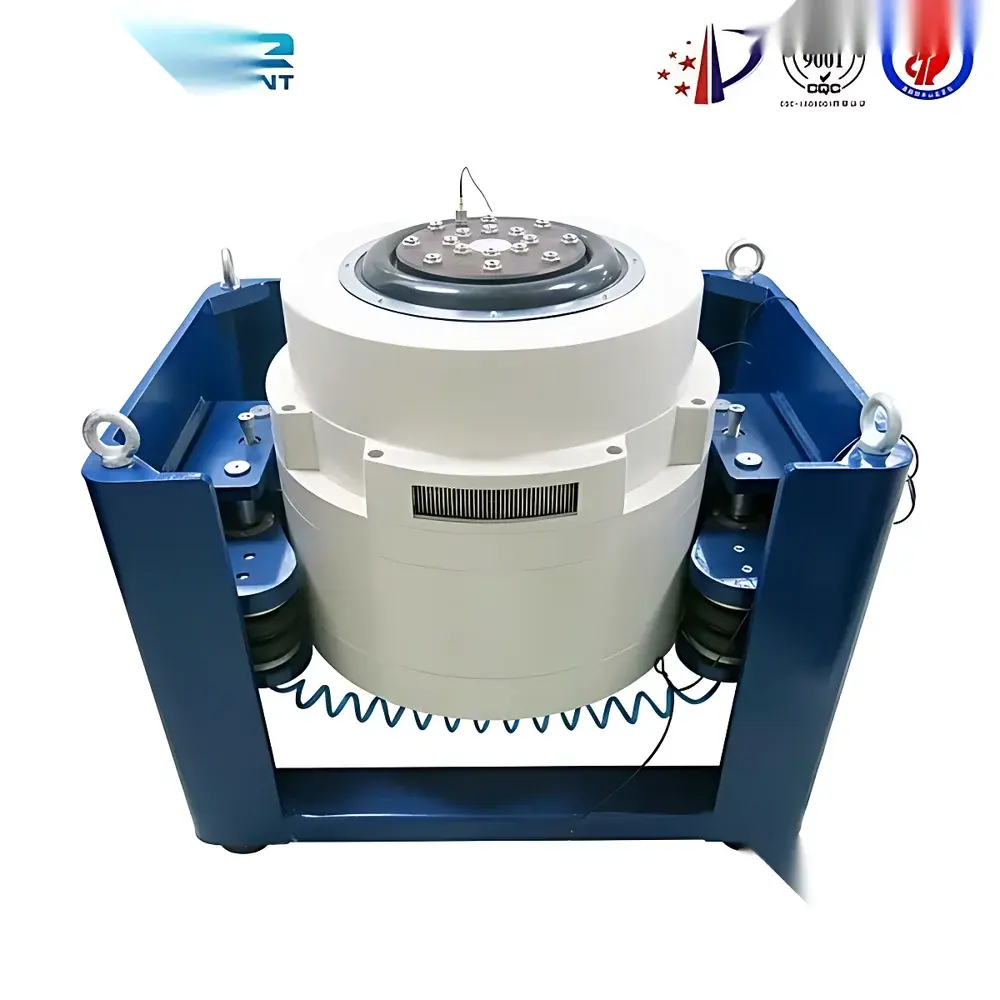
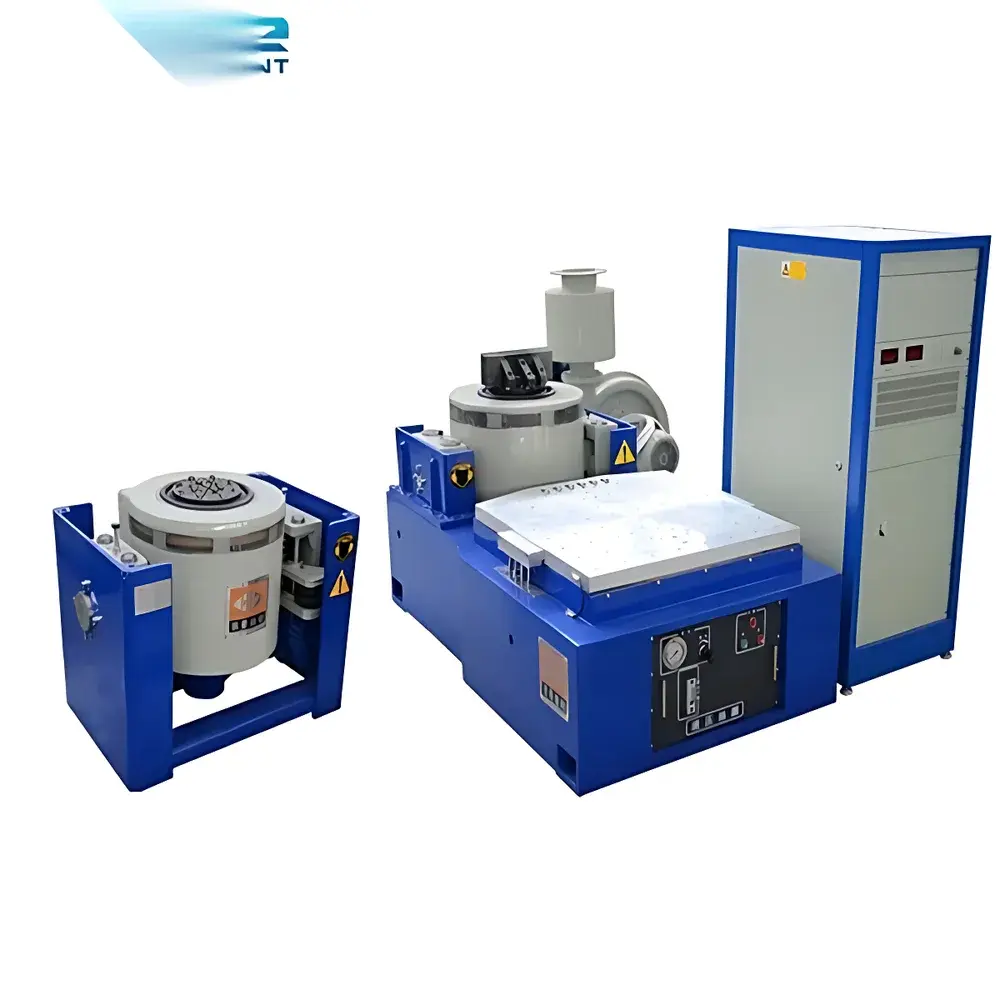
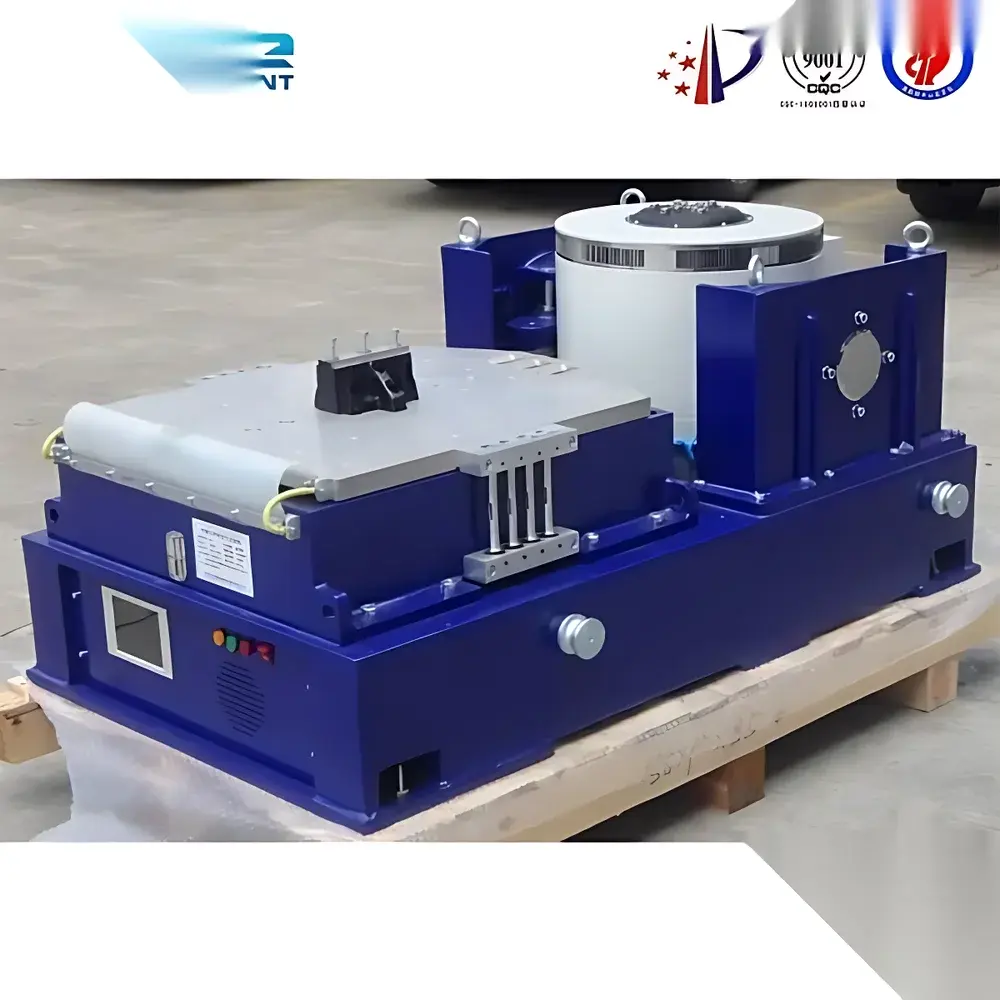
Vertical Vibration Testing System – Customizable Electrodynamic Shaker Platform
| Price | USD 21,500 (FOB origin, ex-works) |
|---|---|
| [Key | Value] |
| 台面尺寸 (Tabletop Dimensions) | 350×350 mm |
| 台体尺寸 (Shaker Body Dimensions) | 500×200×500 mm (vertical) / 500×250×500 mm (horizontal) |
| 振动方向 (Vibration Axes) | Vertical (Z) + Horizontal (X) |
| 频率范围 (Frequency Range) | 1–3000 Hz |
| 频率显示精度 (Frequency Resolution) | ±0.01 Hz |
| 振幅范围 (Peak-to-Peak Displacement) | 0–5 mm adjustable |
| 最大负载 (Maximum Payload) | 75 kg |
| 最大激振力 (Maximum Force Output) | 1500 kgf (≈14.7 kN) |
| 最大加速度 (Maximum Acceleration) | ≤20 g |
| 振动波形 (Waveform Options) | Sine (full/half cycle) |
| 时间设� | 范围 (Test Duration): 0–999,999 s (programmable) |
| 额� | 功率 (Rated Power): 3.8 kW |
| 输入电流 (Input Current) | ≤10 A |
| 电源要求 (Supply Voltage) | 380 V ±20%, 3-phase, 50/60 Hz |
| 加速度计算公� | � (Acceleration Formula): a (g) = 0.002 × f² (Hz²) × D (mm p-p) |
| 工作环境温度 (Operating Ambient Temp) | −10 °C to +60 °C |
| 相对湿度 (Relative Humidity) | ≤95% RH (non-condensing) |
| 推荐操作环境 (Recommended Lab Conditions) | ≤28 °C, well-ventilated |
Overview
The Vertical Vibration Testing System is an electrodynamic shaker platform engineered for precise mechanical stress simulation across aerospace, automotive, electronics, and packaging industries. It operates on the principle of electromagnetic force generation—where a moving coil interacts with a static magnetic field to produce controlled, repeatable vibratory motion in defined axes. This system supports dual-axis excitation (Z-vertical and X-horizontal), enabling coupled or independent axis testing per IEC 60068-2-6, MIL-STD-810H Method 514.8, and ISO 10816-1 vibration severity classification protocols. Its 1–3000 Hz frequency bandwidth accommodates both low-frequency structural resonance assessment and high-frequency component fatigue analysis. The system is not a single fixed-unit device but a configurable platform—offering four standard tabletop sizes (350 mm to 1000 mm square), modular mounting interfaces (25 × M10 threaded holes + 4 × 70-mm hook slots), and scalable force output up to 14.7 kN. Designed for integration into certified test laboratories, it complies with CE machinery directive (2006/42/EC) and meets EMC requirements per EN 61326-1.
Key Features
- Dual-axis electrodynamic actuation: Independent or synchronized Z+X excitation with real-time phase control
- High-fidelity sine waveform generation with full-cycle and half-cycle options for shock-spectrum replication
- 15-segment programmable test sequencing—including sweep, step, logarithmic, and octave-based profiles
- Real-time frequency resolution of ±0.01 Hz and displacement resolution of 0.01 mm (p–p)
- Rugged aluminum-magnesium alloy shaker body with integrated thermal management and forced-air cooling
- Front-panel digital interface with LED display and encoder-based parameter adjustment; optional Ethernet/RS-485 for remote SCADA integration
- Compliance-ready hardware architecture: Supports audit trail logging, user-level access control, and calibration lockout when paired with validated controller firmware
Sample Compatibility & Compliance
The system accommodates payloads from 1 kg to 75 kg across its four tabletop configurations. Mounting flexibility is ensured via standardized M10 threaded arrays and reinforced edge slots compatible with DIN 45126-compliant fixtures. For regulatory alignment, the platform satisfies mechanical safety prerequisites for GLP and GMP environments when operated within specified ambient conditions (≤28 °C, non-condensing humidity). While the base unit does not include built-in data acquisition, it is fully compatible with third-party DAQ systems compliant with IEEE 1451.4 transducer electronic data sheet (TEDS) standards. All electrical subsystems meet IEC 61000-4 immunity requirements for industrial environments. Optional factory calibration certificates traceable to NIST or PTB standards are available upon request.
Software & Data Management
The system operates natively via embedded microcontroller firmware supporting standalone operation without PC dependency. For advanced test orchestration, it integrates with industry-standard software suites including VibrationVIEW (Kinetic Systems), m+p VibControl, or MATLAB® Simulink® via TCP/IP or Modbus RTU protocols. All test logs—including time-stamped frequency, displacement, acceleration, and duration parameters—are stored in CSV-compatible format with UTC timestamps. When deployed in regulated settings (e.g., FDA-regulated medical device validation), optional firmware upgrades enable 21 CFR Part 11 compliance features: electronic signatures, immutable audit trails, and role-based user authentication. Data export supports ISO/IEC 17025 reporting templates and automated PDF certificate generation.
Applications
- Aerospace component qualification per DO-160 Section 8 (vibration) and Section 10 (shock)
- Automotive ECU and sensor durability testing under road-spectrum synthesized waveforms
- Consumer electronics drop-and-vibration correlation studies (e.g., smartphone PCB solder joint integrity)
- Packaging performance validation against ISTA 3A/3E protocols using swept-sine and random vibration profiles
- Structural modal analysis of small-scale assemblies using impact hammer cross-reference
- Accelerated life testing of battery enclosures, connectors, and MEMS devices
FAQ
What tabletop size should I select for my application?
Select based on payload footprint and required modal isolation: 350×350 mm for PCB-level components; 500×500 mm for ECUs or small actuators; 750×750 mm for instrument panels; 1000×1000 mm for full subassemblies or lightweight chassis.
Can this system perform random vibration testing?
No—the base configuration supports only deterministic waveforms (sine, swept-sine, stepped-sine, logarithmic, and octave). Random vibration capability requires optional controller upgrade and external power amplifier integration.
Is calibration certification included?
Factory calibration verification is provided; full ISO/IEC 17025-accredited calibration with uncertainty budget is available as a paid add-on service.
Does the system support multi-axis synchronized control?
Yes—Z and X axes can be phase-locked or independently programmed, though true triaxial (XYZ) operation requires additional shaker modules and master-slave synchronization hardware.
What maintenance intervals are recommended?
Annual inspection of voice coil alignment, suspension integrity, and cooling fan performance is advised; no routine lubrication is required due to brushless electromagnetic design.



