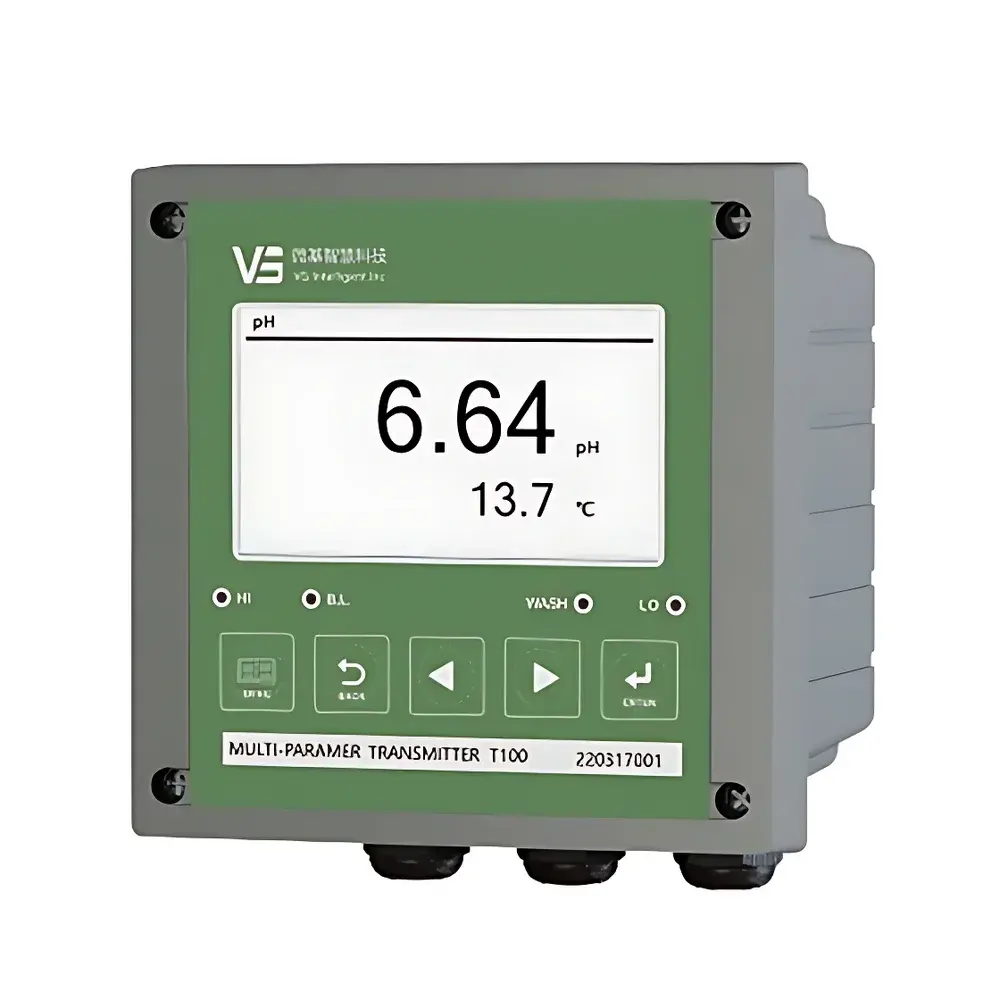
VG Smart Technology T100 Single-Channel Multi-Parameter Transmitter
| Brand | VG Smart Technology |
|---|---|
| Origin | Jiangsu, China |
| Manufacturer Type | Authorized Distributor |
| Product Origin | Domestic (China) |
| Model | T100 |
| Output Signal | 2 × Isolated 4–20 mA (programmable per parameter) |
| Power Supply | 100–240 V AC, 50/60 Hz or 24 V DC (optional) |
| Operating Temperature | −10 to +60 °C |
| Enclosure Rating | IP65 |
| Dimensions (H×W×D) | 144 × 144 × 115 mm |
| Panel Cutout | 138 × 138 mm |
| Mounting | Wall, panel, or pipe mounting |
| Housing Material | ABS |
| Sensor Interface | Digital (auto-recognized pH, ORP, conductivity, salinity sensors) |
| Relay Outputs | 3 programmable relays (for high/low alarms, cleaning control, timer functions) |
| Digital Communication | RS485 with Modbus RTU protocol |
| Auto-Calibration Support | Yes |
| Hot-Swappable Sensors | Yes |
| Display & UI | Dual-language (English/Chinese), guided workflow interface |
Overview
The VG Smart Technology T100 Single-Channel Multi-Parameter Transmitter is an industrial-grade digital process transmitter engineered for continuous, reliable monitoring of critical water and process quality parameters—including pH, oxidation-reduction potential (ORP), electrical conductivity (EC), and salinity—in demanding operational environments. Unlike conventional single-parameter transmitters, the T100 integrates intelligent sensor recognition logic and a unified digital interface to support interchangeable, calibrated digital sensors across multiple electrochemical and conductometric measurement principles. Its architecture follows a modular signal conditioning paradigm: analog sensor signals are digitized at the probe head (where applicable) or within the transmitter’s internal ADC stage, minimizing noise susceptibility and ensuring long-term stability in electrically noisy plants. Designed for integration into centralized SCADA, DCS, or PLC-based control systems, the T100 serves as a deterministic node in regulatory-compliant process monitoring workflows—particularly where real-time parameter correlation (e.g., pH–conductivity interdependence in boiler feedwater or bioreactor broth) is required for automated dosing or alarm escalation.
Key Features
- Single-channel architecture with automatic digital sensor identification—supports plug-and-play deployment of certified pH, ORP, conductivity, and salinity sensors without manual configuration.
- Two fully isolated 4–20 mA analog outputs, each independently assignable to any active measurement parameter; output scaling, damping, and fault behavior (e.g., live-zero, upscale/downscale) are configurable via local menu or Modbus register.
- Three SPDT relay outputs rated for 250 V AC / 5 A resistive load; each relay can be assigned to threshold-based events (high/low limits), maintenance triggers (e.g., scheduled electrode cleaning), or time-delayed actions with user-defined on/off durations.
- Hot-swap capability: sensor replacement or upgrade performed under live power conditions; the transmitter detects new sensor firmware ID and reinitializes calibration coefficients automatically—eliminating process interruption during routine maintenance.
- Dual-language (English/Chinese), icon-assisted UI with contextual prompts and step-by-step calibration guidance—reducing operator dependency and minimizing procedural errors during field commissioning or recalibration.
- Embedded auto-calibration assist function: guides users through multi-point buffer verification, validates slope/asymmetry metrics against ISO 17025-aligned acceptance criteria, and logs deviation trends for internal QA review.
Sample Compatibility & Compliance
The T100 is compatible with industry-standard digital sensors featuring acid-alkali resistant glass or polymer-bodied electrodes (including double-junction pH probes with gel-filled reference systems), platinum or graphite ORP electrodes, and toroidal or electrode-type conductivity cells rated for up to 200 mS/cm full-scale range. Its IP65-rated ABS enclosure meets IEC 60529 requirements for dust-tightness and water jet resistance—validated for wall-mounted use in humid chemical pump rooms, outdoor water intake stations, and fermentation vessel control cabinets. While not intrinsically safe or ATEX-certified, the unit complies with EMC Directive 2014/30/EU (EN 61326-1) and Low Voltage Directive 2014/35/EU (EN 61010-1). It supports audit-ready data handling when integrated with Modbus-enabled historians compliant with FDA 21 CFR Part 11 (electronic signatures, audit trails) and GLP/GMP documentation frameworks.
Software & Data Management
Configuration, calibration, and diagnostic data are managed locally via the front-panel keypad and LCD or remotely via Modbus RTU over RS485. All parameter settings—including relay hysteresis, mA output mapping, temperature compensation algorithms (e.g., NaCl-based for conductivity), and calibration history—are stored in non-volatile memory with timestamped records. The transmitter maintains a cyclic event log (≥500 entries) capturing relay state changes, sensor disconnects, calibration initiations, and communication timeouts—accessible for root-cause analysis during process deviation investigations. When interfaced with enterprise-level MES or LIMS platforms, the T100 enables traceable parameter trending aligned with ISO/IEC 17025 clause 7.7 (result reporting) and ASTM D1125 (standard test methods for electrical conductivity of water).
Applications
- Fermentation bioprocess control: simultaneous pH and conductivity monitoring for nutrient feed optimization and viability tracking in pharmaceutical upstream processing.
- Power plant water chemistry: continuous boiler feedwater and condensate monitoring to prevent corrosion and scale formation per EPRI guidelines and ASME PTC 19.11.
- Municipal drinking water treatment: integrated pH/ORP control for chlorine disinfection efficiency validation and coagulant dosing feedback loops.
- Chemical manufacturing effluent monitoring: salinity-conductivity correlation for brine concentration estimation prior to zero-liquid discharge (ZLD) systems.
- Environmental wastewater compliance: real-time reporting of regulated parameters for EPA NPDES permit adherence and self-monitoring programs.
FAQ
Can the T100 simultaneously measure pH and conductivity from a single sensor port?
No—the T100 is a single-channel transmitter and requires one dedicated digital sensor per measurement type. However, it supports rapid sequential connection of different sensors via its auto-detect interface.
Is the 4–20 mA output intrinsically safe for hazardous area installation?
No—the T100 is not certified for Class I Div 1 or ATEX Zone 0/1 environments. For hazardous locations, install behind a certified safety barrier or use in non-classified zones only.
Does the transmitter support NIST-traceable calibration verification?
Yes—calibration certificates from accredited third-party labs may be linked to sensor serial numbers in the device’s metadata; the built-in calibration log includes timestamps, buffer IDs, measured values, and calculated residuals for traceability.
What is the maximum cable length between the T100 and a digital sensor?
Up to 100 meters using shielded twisted-pair cable (AWG 22–24) with proper grounding at the transmitter end; signal integrity is maintained per RS-485 electrical specifications (ANSI/TIA/EIA-485-A).
How frequently should the auto-calibration function be executed?
Recommended frequency depends on process severity: daily for high-fouling applications (e.g., activated sludge), weekly for stable potable water streams, and per shift in GMP-critical bioreactor operations—aligned with internal SOPs and regulatory expectations.