
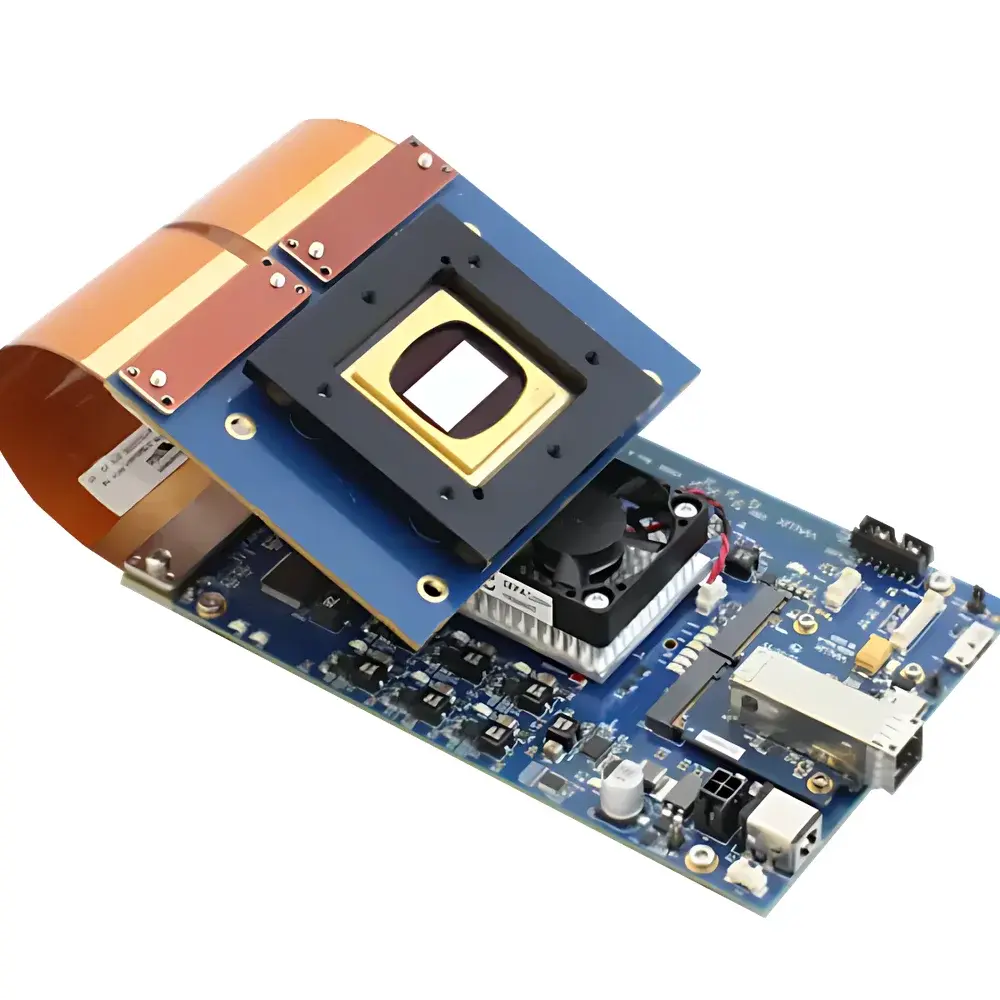
Vialux V-7002 VIS Ultra-High-Speed DMD Spatial Light Modulator (PCIe Interface, Visible Spectrum)
| Brand | Vialux |
|---|---|
| Origin | Germany |
| Interface | PCIe x4 Gen3 |
| Wavelength Range | 400–700 nm |
| Micromirror Array | 1024 × 768 |
| Micromirror Pitch | 13.7 µm |
| Active Area | 14.0 × 10.5 mm² |
| Onboard DDR4 Memory | 16 GB (up to 32 GB optional) |
| Max. 1-bit Frame Rate (PCIe) | ~23,000 fps |
| Max. Switching Rate (1-bit B/W) | 22,727 Hz |
| Control Software | ALP-5.0 |
| Camera Synchronization Support | ViALUX Direct Link Sensor (DLS) API |
| Compliance | Compatible with GLP/GMP-aligned lab workflows, supports audit-trail-capable software integration via ALP-5.0 logging framework |
Overview
The Vialux V-7002 VIS Ultra-High-Speed DMD Spatial Light Modulator is an industrial-grade, FPGA-controlled optical modulation platform engineered for precision wavefront shaping, structured illumination, and high-throughput pattern projection in the visible spectrum (400–700 nm). Based on Texas Instruments’ DLP7000 chipset and DLPC7000 controller architecture, it implements a digital micromirror device (DMD) with a 1024 × 768 XGA resolution array of 13.7 µm aluminum-coated micromirrors. Unlike conventional USB-based SLMs, the V-7002 integrates a dedicated PCIe x4 Gen3 interface and onboard 16 GB DDR4 SDRAM — enabling deterministic, low-latency data streaming directly from host system memory or SSD-backed frame buffers. This architecture eliminates USB bottlenecks and enables sustained throughput exceeding 23,000 binary frames per second under optimized host conditions — a performance benchmark critical for time-resolved applications such as dynamic holography, real-time optical trapping, and high-speed photolithography.
Key Features
- PCIe x4 Gen3 host interface with deterministic latency and DMA-enabled direct memory access
- Onboard 16 GB DDR4 SDRAM (upgradeable to 32 GB), supporting up to 174,762 single-bit frames at full resolution
- DLP7000 + DLPC7000 chipset delivering 22,727 Hz binary switching rate and sub-millisecond mirror settling time
- ALP-5.0 control suite with comprehensive API support for C++, C#, MATLAB, Python, LabVIEW, and .NET environments
- ViALUX Direct Link Sensor (DLS) architecture enabling hardware-synchronized projection and image acquisition within a single FPGA timing domain
- Support for external CMOS sensors (e.g., Sony IMX174/422/536) via configurable camera interface with trigger-in/out and programmable exposure alignment
- Industrial-grade thermal management and EMI-hardened PCB layout certified for continuous-duty operation in laboratory and production environments
Sample Compatibility & Compliance
The V-7002 VIS is designed for integration into ISO/IEC 17025-compliant optical test benches and regulated R&D environments. Its ALP-5.0 software framework supports timestamped frame logging, user-accessible configuration snapshots, and session-level metadata export — features aligned with GLP documentation requirements. While the device itself is not FDA-cleared, its deterministic timing behavior, traceable firmware versioning, and repeatable optical response make it suitable for use in preclinical instrumentation development subject to internal QA protocols. The PCIe interface ensures electromagnetic compatibility per EN 61326-1:2013 for measurement and control equipment. Optical coatings are optimized for broadband antireflection across 400–700 nm, with measured reflectivity >85% at 532 nm and <0.5% RMS wavefront error over the active aperture.
Software & Data Management
ALP-5.0 serves as the foundational control environment, providing both GUI-based rapid prototyping (via EasyProj) and production-ready programmatic access through native DLLs and language-specific wrappers. All APIs expose low-level register-level control of DMD sequence loading, trigger synchronization modes (master/slave), gamma correction LUTs, and bit-depth mapping (1-, 6-, 8-, or 12-bit grayscale). Frame buffering supports segmented memory mapping, allowing partial updates without full array reload. Audit trails record all parameter changes with UTC timestamps, user IDs (when integrated with domain authentication), and SHA-256 checksums of loaded patterns — facilitating 21 CFR Part 11 readiness when deployed with validated IT infrastructure. Raw frame data is stored in vendor-neutral binary formats (e.g., .bin with header metadata) compatible with HDF5 and TIFF-based post-processing pipelines.
Applications
- Dynamic Structured Illumination Microscopy: Enables real-time generation of multi-phase sinusoidal or speckle patterns synchronized to sCMOS readout for SIM and SPIM implementations.
- Maskless Photolithography: Supports grayscale dose modulation and sub-pixel dithering for microfabrication of polymer and photoresist layers with feature sizes down to 5 µm.
- Optogenetics & Neural Stimulation: Delivers spatially encoded, millisecond-precise light pulses to targeted neuronal populations using closed-loop feedback from DLS-integrated cameras.
- 3D Metrology & Fringe Projection: Projects calibrated phase-shifted fringe sequences at >10 kHz for high-speed surface reconstruction in industrial inspection systems.
- Adaptive Optics Calibration: Functions as a programmable aberration generator for Zernike mode testing and wavefront sensor validation in telescope and ophthalmic systems.
- Quantum Optics Experiments: Provides deterministic single-photon path selection and time-bin encoding in entanglement distribution setups requiring picosecond-level jitter control.
FAQ
What is the minimum achievable latency between host command issuance and first mirror flip?
Typical end-to-end latency from PCIe write completion to mirror state change is ≤1.2 ms under ALP-5.0 default settings; this can be reduced to <800 µs via optimized DMA buffer chaining and firmware-tuned timing parameters.
Does the V-7002 support arbitrary grayscale patterns with temporal dithering?
Yes — ALP-5.0 implements programmable bit-plane sequencing with configurable inter-frame delays, enabling precise 6–12 bit grayscale rendering via temporal multiplexing without perceptible flicker.
Can multiple V-7002 units be synchronized in a master-slave configuration?
Yes — the board provides dedicated SYNC_IN/SYNC_OUT TTL lines and supports hardware-triggered frame start alignment with <50 ns jitter across up to 8 units on a single PCIe root complex.
Is ALP-5.0 compatible with real-time operating systems (RTOS) such as QNX or VxWorks?
ALP-5.0 is validated on Windows 10/11 and Linux (Ubuntu 20.04+, kernel 5.4+); RTOS support requires custom driver development and is available under NDA with Vialux engineering consultation.
How is calibration data (e.g., flat-field, gamma, dead-pixel maps) stored and applied?
Calibration LUTs are loaded at runtime via ALP-5.0’s non-volatile memory interface and applied in FPGA logic prior to DMD driver stage — ensuring pixel-level correction without CPU intervention during streaming.





