
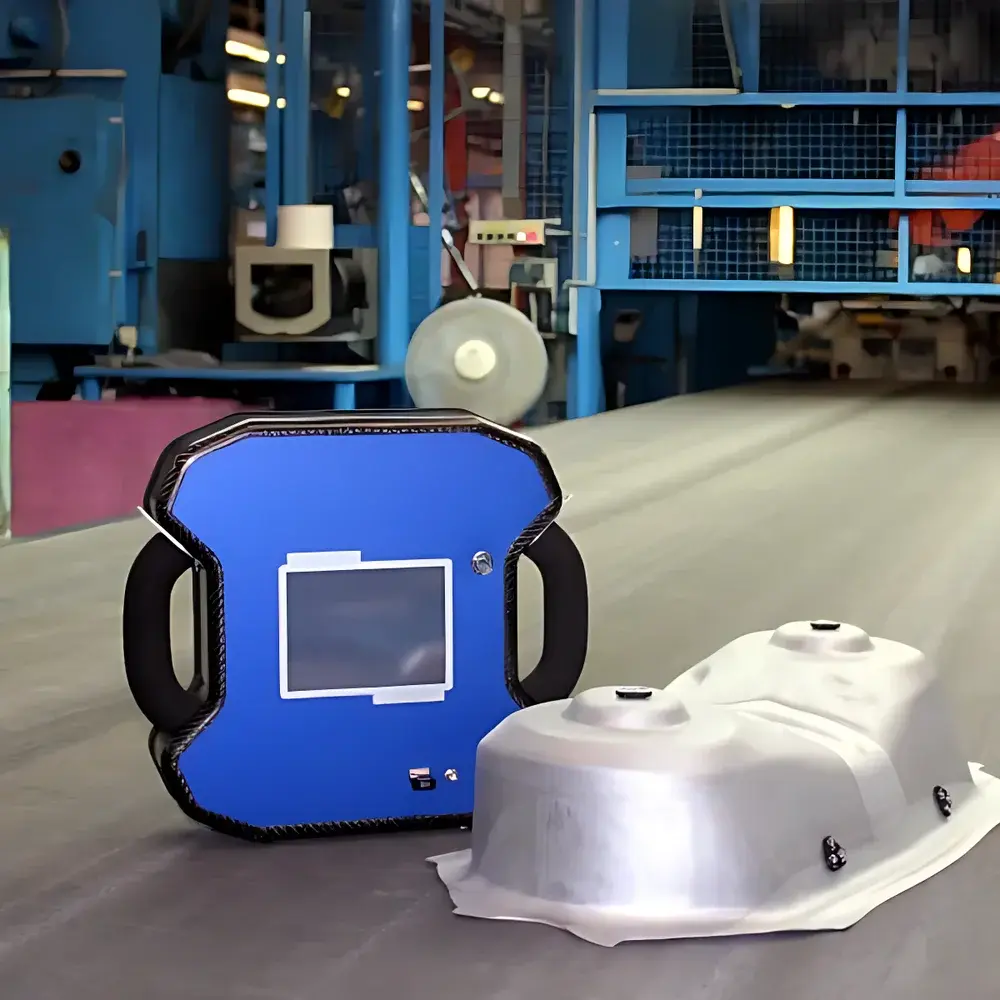
VIALUX comsmart Portable Grid Strain Analyzer
| Brand | VIALUX |
|---|---|
| Origin | Germany |
| Model | comsmart |
| Camera Resolution | 5.7 MP (standard) |
| Measurement Area (single capture) | 390 × 340 mm² |
| Node Processing Speed | 15,000 nodes/min |
| Calibration Time | ~3 min (fully automated) |
| Measurement Duration | 3–5 min per part |
| Strain Range | up to >100% (major/minor/eq. thickness strain) |
| Output Formats | BMP, TIFF, PNG, JPG, VRML, PS, EPS (images) |
| Compliance | Designed for ISO/IEC 17025-aligned QA workflows, supports GLP/GMP audit trails via timestamped metadata and user-logged calibration records |
Overview
The VIALUX comsmart Portable Grid Strain Analyzer is an industrial-grade, field-deployable optical measurement system engineered for full-field 3D surface strain mapping of sheet metal components. It operates on the principle of digital image correlation (DIC) applied to pre-applied square grid patterns—typically electro-etched, painted, or laser-marked onto the specimen surface prior to forming. Following deformation, the system captures high-fidelity stereo images of the distorted grid using four synchronized, rigidly mounted CCD cameras. Through triangulation-based reconstruction and sub-pixel displacement tracking, it computes three-dimensional coordinates for each grid node, enabling direct calculation of major (ε₁), minor (ε₂), equivalent (von Mises), and thickness strain (ε₃) distributions across the entire visible surface—without contact, physical sensors, or post-processing interpolation artifacts. Unlike fixed-station systems, comsmart is explicitly designed for in-situ use at press shops, stamping lines, R&D labs, and supplier audit sites, eliminating the need for part relocation or environmental chamber conditioning.
Key Features
- Four rigidly integrated, synchronized CCD cameras eliminate alignment drift and remove dependency on external reference markers during acquisition.
- Laser-assisted working distance control ensures consistent depth-of-field and minimizes operator-induced focus error across varying part geometries.
- Automated LED illumination with software-controlled exposure time and gain enables robust performance under ambient factory lighting conditions—including variable ceiling height and mixed light sources.
- Patented single-calibration protocol (≈3 minutes) remains valid for extended periods—no recalibration required between successive parts or shifts, provided mechanical integrity of the test head is maintained.
- Standard 5.7 MP resolution with Schneider precision optics delivers 390 × 340 mm² single-capture area; optional 20 MP lens upgrade extends spatial resolution without sacrificing field coverage.
- Real-time node processing at 15,000 nodes per minute enables rapid feedback loops within production validation cycles.
- Integrated stitching algorithm supports seamless expansion beyond native field-of-view—critical for large panels, structural brackets, or Class-A automotive body-in-white components.
Sample Compatibility & Compliance
The comsmart system accommodates specimens ranging from thin-gauge stainless steel (6 mm), including painted, galvanized, anodized, and textured surfaces. Grid pitch is user-selectable (0.5–5.0 mm), allowing optimization for both fine-detail micro-strain analysis and macro-scale formability assessment. The system complies with metrological traceability requirements defined in ISO 10360-8 (coordinate measuring machines) and aligns with ASTM E837 (strain gauge calibration standards) for comparative validation. All measurement metadata—including camera parameters, calibration timestamps, operator ID, ambient temperature logs, and lighting configuration—is embedded in output files to support GLP/GMP documentation and FDA 21 CFR Part 11-compliant audit trails when deployed in regulated manufacturing environments.
Software & Data Management
Running natively on Windows 10/11 platforms, the AutoGrid software suite provides a deterministic, wizard-driven interface requiring no programming knowledge. Core modules include real-time image acquisition control, automatic 3D point cloud generation, strain tensor computation, FLC (Forming Limit Curve) overlay with user-defined material curves, and automated Forming Limit Diagram (FLD) report generation per ISO 12004-2. Export functionality supports direct integration into CAE workflows: ASCII tabular data for custom scripting, native Excel tables for statistical process control (SPC), and industry-standard formats (STL, DXF, LS-DYNA keyword decks) for simulation model correlation. All image exports retain embedded EXIF metadata for forensic traceability; VRML and EPS outputs facilitate inclusion in technical publications and regulatory submissions.
Applications
- Stamping process validation and die tryout verification in Tier-1 automotive supply chains.
- Forming limit analysis for AHSS (Advanced High-Strength Steel), aluminum alloys, and magnesium sheet materials.
- In-line quality assurance of battery enclosure panels, EV chassis components, and aerospace skins.
- Root-cause analysis of springback, wrinkling, and localized necking in complex draw-die operations.
- Material characterization support for constitutive model development in LS-DYNA and AutoForm simulations.
- Supplier qualification audits where portable, repeatable, and auditable strain data is contractually mandated.
FAQ
Does the system require physical reference markers during measurement?
No. The comsmart test head uses intrinsic camera geometry and laser distance feedback—eliminating the need for external scale bars or fiducial targets during acquisition.
Can strain be measured on highly curved or doubly curved surfaces?
Yes. The four-camera architecture provides overlapping fields of view and robust triangulation even on surfaces with local curvature exceeding 90°, such as deep-drawn cups or hemispherical domes.
Is calibration traceable to national standards?
Calibration is performed using NIST-traceable dimensional standards; VIALUX provides certificate documentation upon request for ISO/IEC 17025-accredited laboratories.
What grid application methods are supported?
Electrochemical etching, inkjet printing, laser ablation, and spray-painted grids—all yield metrologically equivalent results when applied per VIALUX’s published surface preparation guidelines.
How is data security and user accountability managed?
The software enforces role-based access control, logs all operator actions with timestamps, and writes immutable metadata to every exported file—meeting baseline requirements for FDA 21 CFR Part 11 and EU Annex 11 compliance.



