
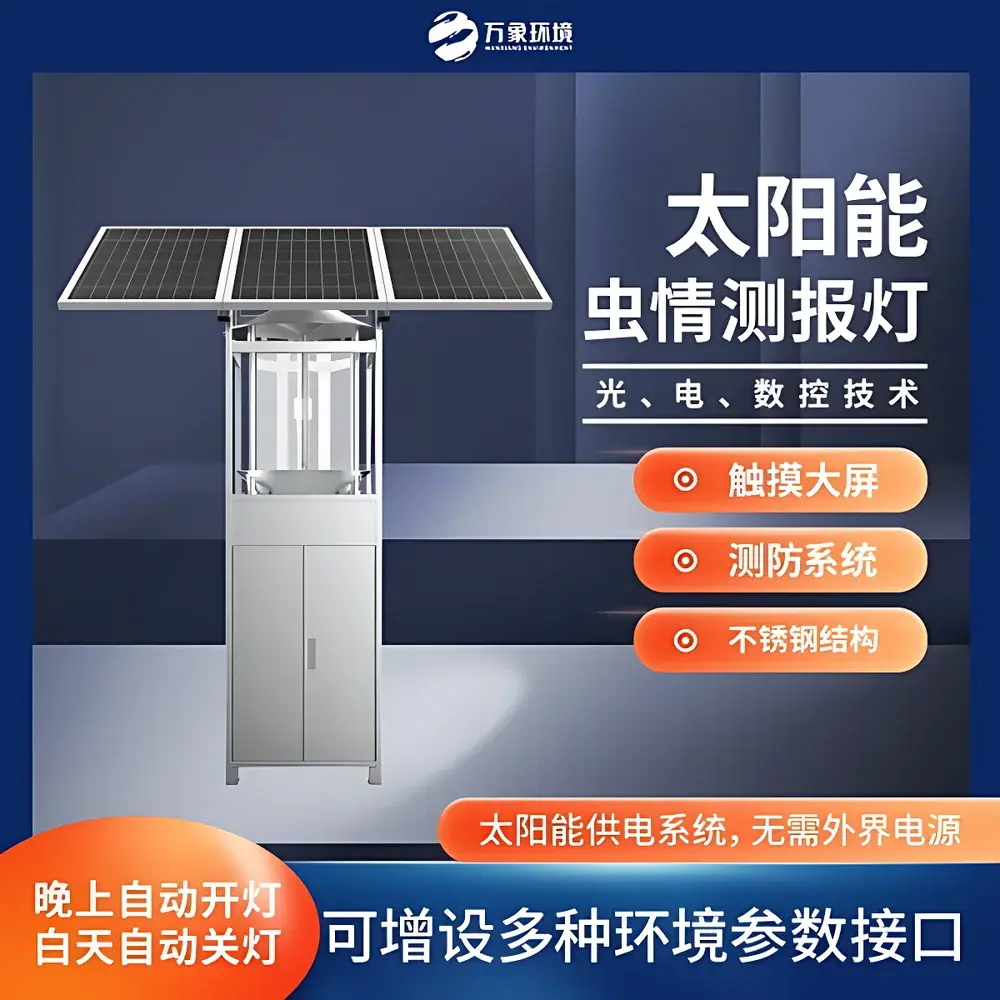
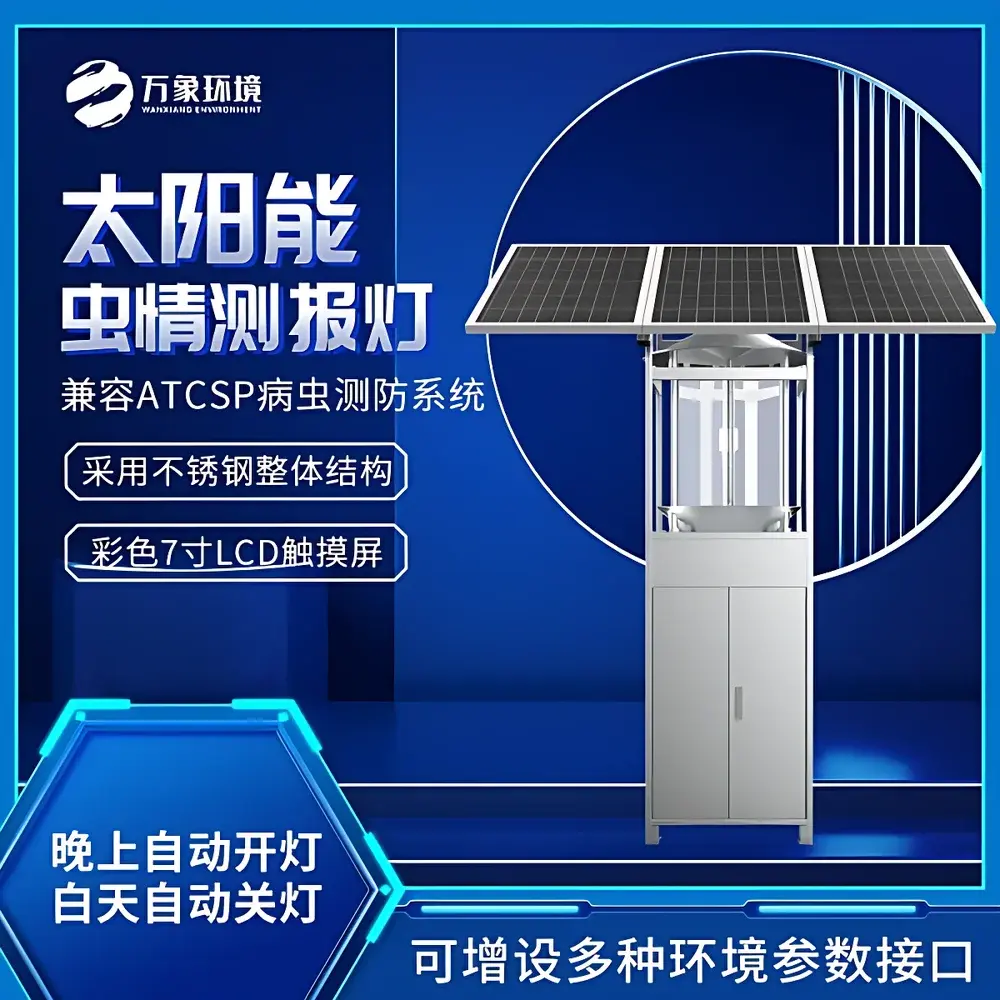
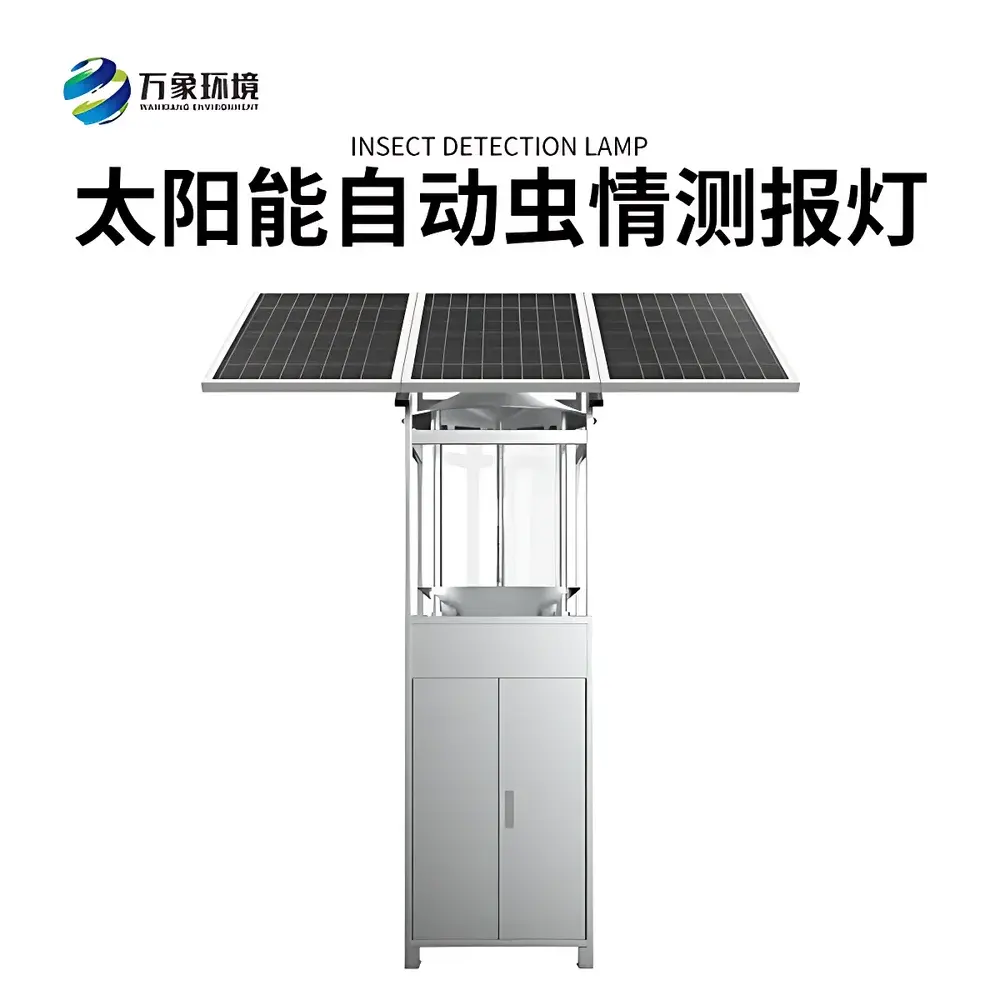
Vientiane Environment WX-CQD3 Solar-Powered Automatic Insect Monitoring and Reporting Lamp
| Brand | Vientiane Environment |
|---|---|
| Origin | Shandong, China |
| Manufacturer Type | Direct Manufacturer |
| Country of Origin | China |
| Model | WX-CQD3 |
| Instrument Category | Pest Surveillance System |
| Compliance | GB/T 24689.1–2009 |
| Construction | Stainless Steel Monocoque Frame |
| Power Supply | 240W Polycrystalline Solar Panel + 12V/200Ah Sealed Lead-Acid Battery |
| Standby Power Consumption | ≤5 W |
| Operational Power | ≤450 W |
| UV Light Source | 20W Blacklight Tube (Peak Wavelength: 365 nm) |
| Insect Killing & Drying Method | Dual-Layer Far-Infrared Heating Chamber (Temp: 85±5°C after 15 min |
| Mortality Rate | ≥98% |
| Specimen Integrity Rate | ≥95% |
| Insect Collection | 8-Position Auto-Rotating Tray (Time-Stamped Segmentation) |
| Weather Resilience | Integrated Rain Diversion System with Drainage Channel |
| Environmental Sensors Interface | Optional Expansion for Anemometer, Hygrothermograph, Pyranometer, Soil Moisture/Temperature, and Rain Gauge |
| Communication | GPRS Data Transmission Module |
| Control Interface | 7-inch Color LCD Touchscreen with LED Time/Temp/RH Display |
| Lightning Protection | Built-in Surge Protection Device (SPD) |
| Dimensions | 650 mm × 650 mm × 2000 mm (L×W×H) |
| Rated Service Life | ≥10 Years |
Overview
The Vientiane Environment WX-CQD3 Solar-Powered Automatic Insect Monitoring and Reporting Lamp is an autonomous, field-deployable entomological surveillance instrument engineered for long-term, unattended operation in agricultural, forestry, horticultural, and quarantine environments. It operates on the principle of phototactic attraction—using narrow-band ultraviolet radiation (365 nm) to lure nocturnal flying insects into a controlled capture zone. Upon entry, insects impact a tripartite acrylic barrier system arranged at 120° angles, directing them into a dual-stage far-infrared (FIR) processing chamber. This chamber thermally immobilizes specimens at 85±5°C within 15 minutes, achieving ≥98% mortality while preserving morphological integrity (≥95% specimen completeness) required for taxonomic identification and population trend analysis. Unlike chemical-based traps, the WX-CQD3 eliminates reliance on toxic agents, supporting integrated pest management (IPM) frameworks and GLP-aligned data collection protocols.
Key Features
- Fully solar-powered architecture with 240W polycrystalline PV panel and 12V/200Ah maintenance-free battery, enabling continuous operation across remote or off-grid deployment sites.
- Dual-layer far-infrared heating system with programmable dwell time ensures consistent thermal kill and desiccation without charring or fragmentation—critical for subsequent microscopic or DNA-based species verification.
- 8-position rotating collection tray enables temporal stratification of catch data (e.g., hourly or daily segmentation), eliminating cross-contamination between sampling intervals and facilitating diel activity pattern analysis.
- Integrated rain diversion mechanism with gravity-fed drainage channel actively separates precipitation from insect ingress pathways, maintaining operational reliability during monsoon seasons or high-humidity climates.
- 7-inch capacitive touchscreen interface supports both automatic scheduling (e.g., dusk-to-dawn activation with adaptive light-sensing override) and manual intervention—including forced tray rotation, lamp toggling, FIR chamber purge, and sensor calibration.
- Modular sensor expansion ports support seamless integration of meteorological peripherals: cup anemometer (wind speed/direction), capacitive hygrothermograph (ambient T/RH), silicon pyranometer (photosynthetic photon flux), and tipping-bucket rain gauge—enabling multivariate correlation modeling between abiotic drivers and pest phenology.
Sample Compatibility & Compliance
The WX-CQD3 is validated for monitoring Lepidoptera (moths), Coleoptera (beetles), Diptera (flies), Hemiptera (true bugs), and other phototactic macro-invertebrates commonly associated with crop damage, forest defoliation, or invasive species incursion. Its mechanical and thermal handling preserves exoskeletal features—including wing venation, antennal morphology, and tibial spination—essential for visual or automated image-based classification. The device conforms to GB/T 24689.1–2009 “Insect Monitoring Lamp – Technical Requirements and Test Methods”, and its stainless steel monocoque construction meets ISO 9001-certified manufacturing standards for outdoor durability. Electrical safety complies with IEC 60529 (IP65 ingress protection) and includes built-in SPD-rated lightning protection suitable for open-field installation in high-lightning-frequency zones.
Software & Data Management
Equipped with embedded GPRS telemetry, the WX-CQD3 transmits timestamped metadata—including trap activation status, FIR chamber temperature logs, ambient sensor readings, and collection tray position index—to centralized cloud platforms via MQTT or HTTP(S) protocols. Raw data streams are structured in CSV-compliant format with ISO 8601 timestamps and SI-unit annotations, ensuring interoperability with FAO’s Ecocrop database, IRMIS pest forecasting models, and national plant protection organization (NPPO) reporting dashboards. Firmware supports remote OTA updates and audit-trail-enabled configuration changes compliant with ALCOA+ principles—providing traceable records of parameter modifications, user access events, and system diagnostics required under national phytosanitary regulatory frameworks.
Applications
This instrument serves as a foundational node in national-scale pest early-warning networks, supporting applications including: real-time migration tracking of Spodoptera frugiperda (fall armyworm) across maize belts; phenological synchronization studies linking Lymantria dispar (gypsy moth) flight peaks with degree-day accumulation; validation of drone-based spectral scouting against ground-truthed catch data; and longitudinal monitoring of beneficial insect decline in organic orchards. It is routinely deployed by provincial agricultural extension stations, forestry research institutes, tobacco leaf procurement centers, tea estate quality assurance units, and customs border inspection laboratories conducting invasive species risk assessment.
FAQ
Does the WX-CQD3 require grid electricity or external cabling?
No—it operates entirely on solar energy with onboard battery storage, eliminating dependency on AC infrastructure.
Can the collection interval be customized beyond 24-hour cycles?
Yes—users may define custom time windows (e.g., 2-, 4-, or 6-hour segments) via touchscreen scheduler or remote command.
Is firmware update capability available over-the-air?
Yes—GPRS connectivity enables secure, authenticated OTA firmware upgrades without physical site access.
What level of environmental resilience does the unit offer?
It meets IP65 rating for dust/water resistance and incorporates Class II lightning surge protection rated to 40kA (8/20 µs).
How is data integrity ensured during extended network outages?
Onboard non-volatile memory retains up to 90 days of compressed sensor and event logs, synchronizing automatically upon GPRS reconnection.





