
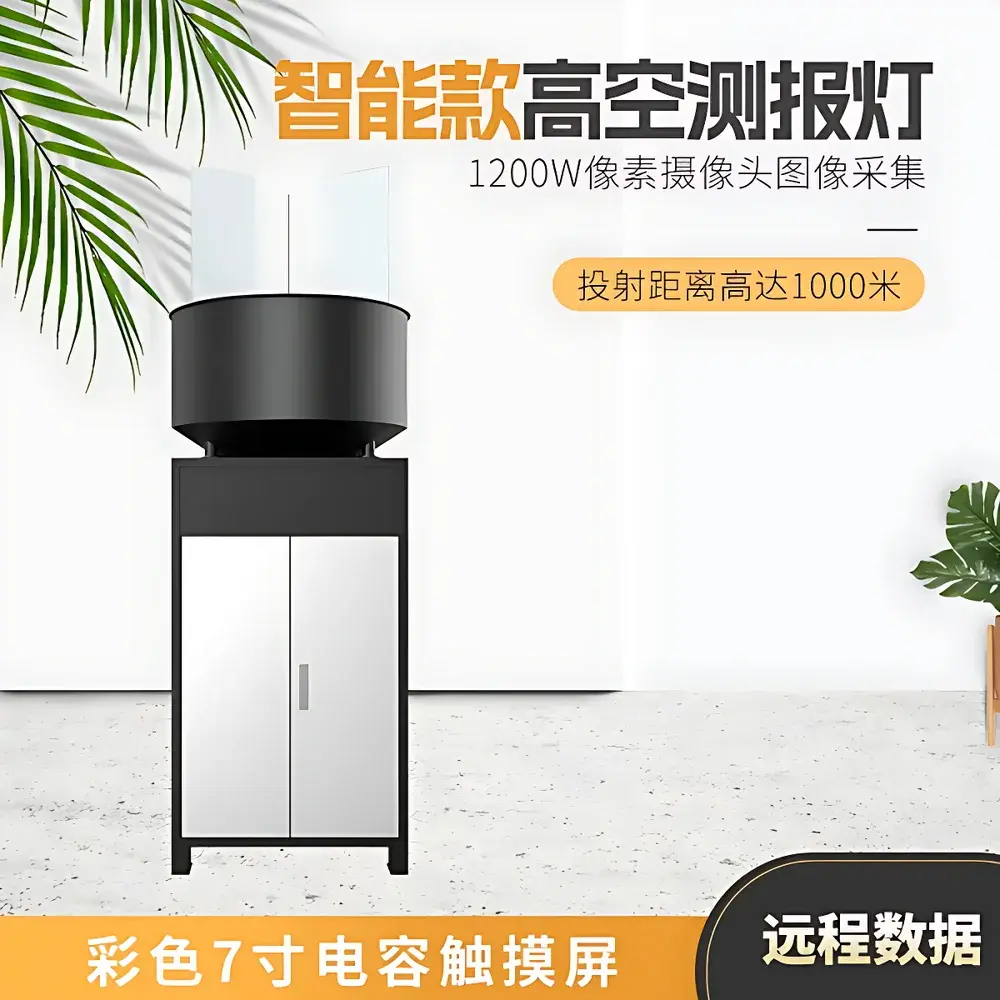
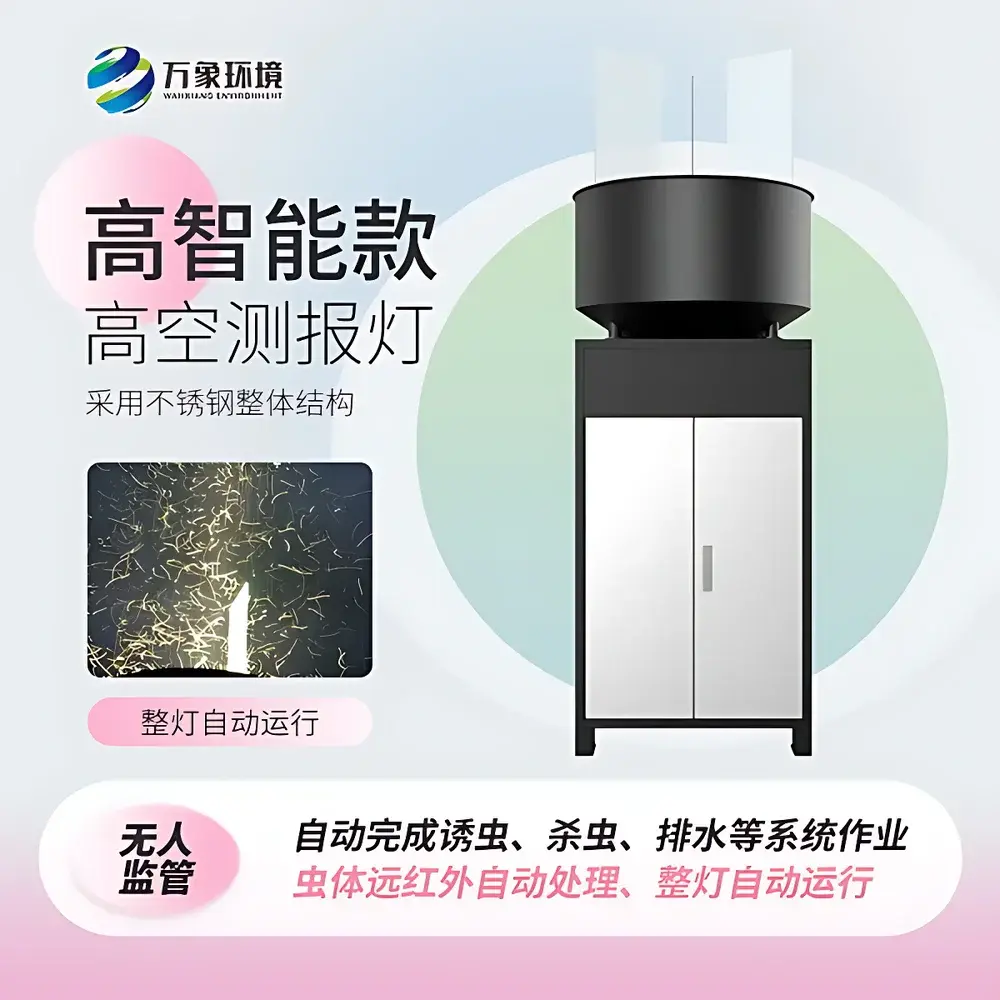
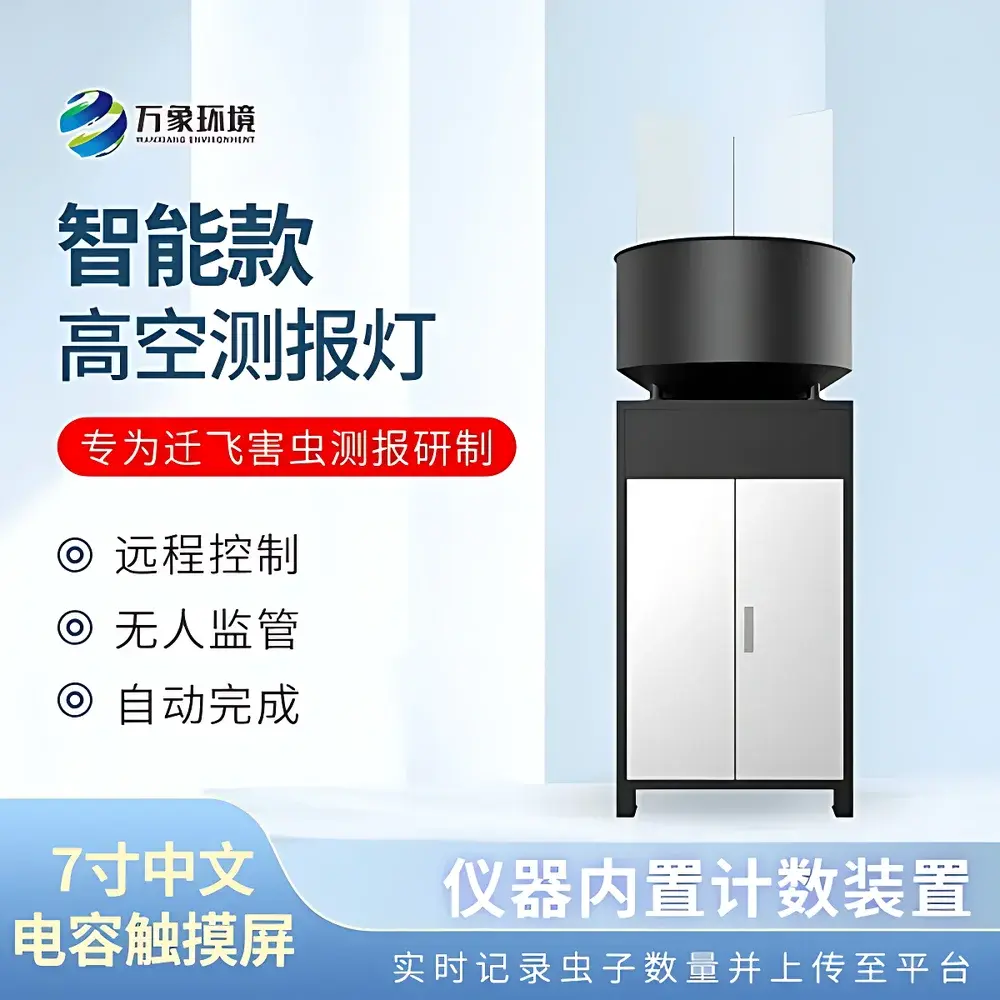
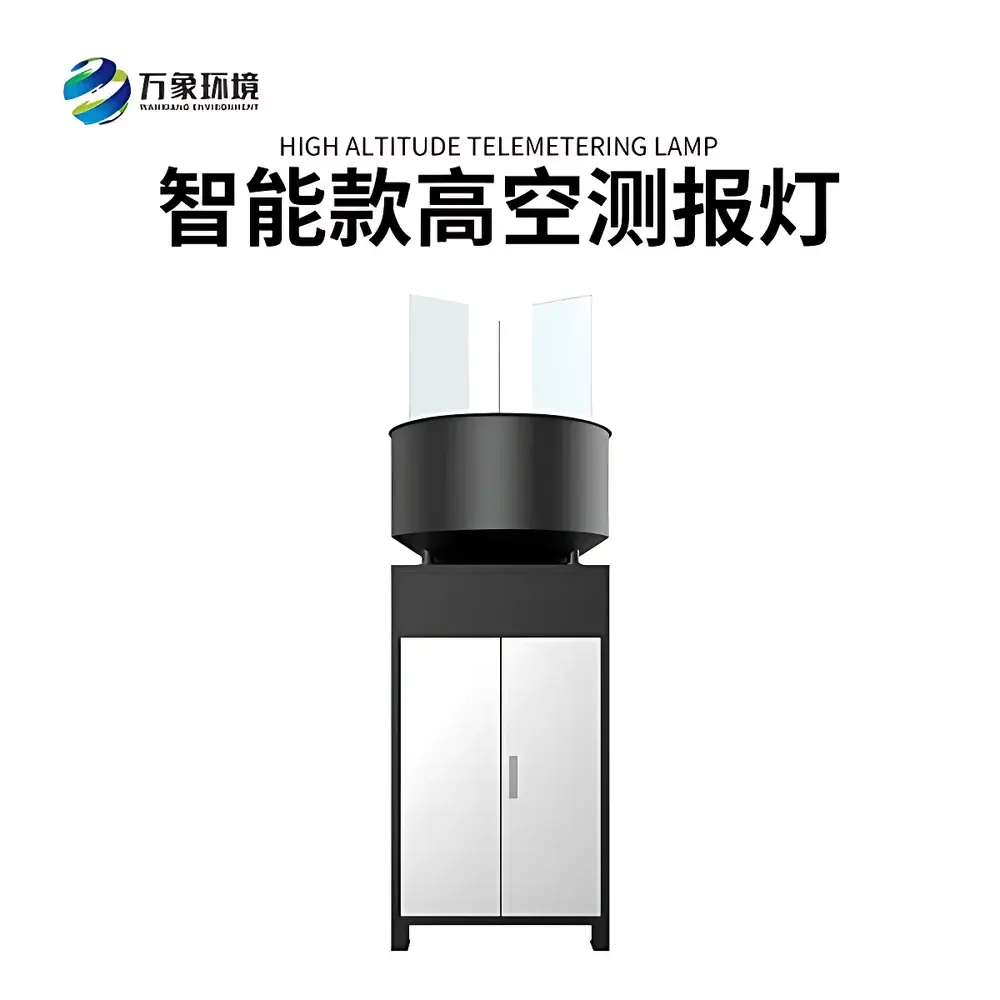
Vientiane Environment WX-GK2 Intelligent High-Altitude Pest Surveillance Lamp
| Brand | Vientiane Environment |
|---|---|
| Origin | Shandong, China |
| Manufacturer Type | Direct Manufacturer |
| Country of Origin | China |
| Model | WX-GK2 |
| Instrument Type | Migratory Pest Monitoring System |
| Light Source | 1000 W Halogen Searchlight |
| IR Chamber Temp | 85 ± 5 °C (reached within 15 min) |
| Camera Resolution | 1200 MP |
| Display | 7-inch Capacitive Touch LCD (Android OS) |
| Power Input | AC 220 V ± 60 V |
| Standby Power | ≤30 W |
| Max Operational Power | ≤1200 W |
| Dimensions | 650 × 650 × 2100 mm |
| Insect Collection Capacity | 1.5 L (8-day segmented storage) |
| Connectivity | 4G / Wi-Fi / Ethernet |
| Environmental Sensor Interfaces | Wind Speed/Direction, Ambient Temp/RH, Illuminance, Rainfall, Soil Temp/Moisture |
| IP Rating | IP65 (with integrated rain drainage & lightning protection) |
| Insulation Resistance | ≥2.5 MΩ |
Overview
The Vientiane Environment WX-GK2 Intelligent High-Altitude Pest Surveillance Lamp is an automated, field-deployable monitoring system engineered for the detection, capture, and digital documentation of migratory nocturnal insects—particularly lepidopteran and coleopteran species exhibiting long-range aerial dispersal behavior. Unlike conventional light-trap systems limited by short-range attraction (<100 m), the WX-GK2 employs a high-intensity 1000 W halogen searchlight with optical collimation capable of effective phototactic stimulation up to 1000 meters. Its operational principle integrates entomological trapping logic with industrial-grade automation: insects drawn to the beam impact a triple-panel impact surface (120° angular configuration), fall onto a vibration-assisted conveyor belt, and are uniformly distributed for high-fidelity imaging under controlled illumination. Real-time image acquisition, AI-ready metadata tagging (time, temperature, humidity, wind vector), and GPRS/4G-enabled data transmission enable longitudinal analysis of pest phenology in relation to microclimatic variables—supporting predictive modeling aligned with FAO’s Global Desert Locust Information Service (DLIS) frameworks and national plant protection organization (NPPO) surveillance protocols.
Key Features
- Automated multi-stage workflow: phototactic attraction → mechanical impact → vibratory dispersion → high-resolution imaging → count registration → thermal inactivation → segmented storage.
- Dual far-infrared insect processing chambers (upper/lower), each independently controllable, achieving stable 85 ± 5 °C within 15 minutes; adjustable dwell time ensures complete desiccation without chitin degradation.
- 1200-megapixel industrial CMOS camera mounted above a precision-engineered conveyor belt; synchronized LED fill lighting eliminates motion blur and shadow artifacts, delivering taxonomically diagnostic image quality for species-level identification by trained entomologists or machine-learning classifiers.
- Eight-compartment segmented collection bottle (1.5 L total volume), motorized carousel indexing per 24-hour cycle—enabling temporal resolution of population dynamics and migration pulses.
- Integrated environmental sensing suite: configurable I²C/RS485 interfaces support plug-and-play integration of anemometers, hygrothermographs, pyranometers, tipping-bucket rain gauges, and soil moisture probes—facilitating multivariate correlation studies per ISO 22000 and IPPC ISPM 39 guidelines.
- Robust outdoor-rated architecture: IP65 enclosure with dedicated gravity-fed rain drainage channel, Class II lightning surge protection, and wide-input AC power conditioning (220 V ± 60 V) with built-in RCD protection.
- Embedded Android-based control unit with 7-inch capacitive touchscreen; supports both scheduled operation (e.g., 20:00–04:00) and manual override of all subsystems—including lamp activation, IR chamber purge, conveyor start/stop, and vibration intensity calibration.
Sample Compatibility & Compliance
The WX-GK2 is validated for continuous unattended operation across temperate, subtropical, and arid agroecosystems. It captures intact adult specimens of economically significant migratory pests including Spodoptera frugiperda, Helicoverpa armigera, Locusta migratoria, and Mythimna separata, preserving morphological integrity required for morphometric validation. All electrical components comply with GB/T 19001–2016 (ISO 9001 equivalent) and GB 4706.1–2005 (IEC 60335-1). Data logging meets GLP-aligned traceability requirements: timestamped images, sensor readings, and actuator status logs are cryptographically signed and stored locally (microSD) prior to encrypted TLS 1.2 upload to cloud platforms. Optional audit trail modules support 21 CFR Part 11-compliant electronic records for regulatory submissions.
Software & Data Management
The device operates on a custom Android 11-based firmware with local edge-processing capability—on-device image compression, background subtraction, and preliminary blob detection reduce upstream bandwidth demand. Raw data streams (JPEG + JSON metadata) are transmitted via MQTT or HTTPS to Vientiane’s secure cloud platform or user-specified MQTT brokers (e.g., AWS IoT Core, Azure IoT Hub). APIs support RESTful integration with GIS platforms (QGIS, ArcGIS Online) and statistical environments (R, Python pandas). Role-based access control (RBAC), multi-site dashboard views, automated anomaly alerts (e.g., sudden count spikes >3σ), and CSV/NetCDF export ensure interoperability with national pest forecasting systems such as China’s National Crop Pest Monitoring Network (NCPMN) and the EU’s EPPO Global Database infrastructure.
Applications
- Regional-scale early warning of migratory pest incursions along ecological corridors (e.g., East Asian-Australasian Flyway).
- Validation of satellite-derived vegetation stress indices against ground-truthed insect abundance metrics.
- Temporal calibration of pheromone trap networks using light-trap catch baselines.
- Long-term monitoring of climate-driven range shifts in pest species distribution (IPCC AR6 Annex I indicators).
- Field evaluation of biocontrol agent efficacy through differential capture rates pre/post-release.
- Training dataset generation for convolutional neural networks targeting automated species classification (e.g., ResNet-50 fine-tuning on labeled WX-GK2 archives).
FAQ
What is the maximum effective detection radius of the WX-GK2 under clear atmospheric conditions?
Under optimal meteorological conditions (low humidity, no fog or dust), the 1000 W halogen searchlight achieves reliable phototactic response from moths at distances up to 1000 m—validated via mark-recapture trials conducted across Shandong Province maize-growing zones.
Can the system operate autonomously during extended power outages?
The WX-GK2 requires continuous AC mains supply; it does not include battery backup. However, its ultra-low standby consumption (≤30 W) allows seamless integration with solar + lithium-iron-phosphate hybrid power stations rated ≥1.5 kWp.
How is image quality maintained during high-wind or rainy conditions?
The impact plate geometry and rain-diverting chassis design prevent water ingress into the imaging zone; the conveyor belt operates only during dry intervals (rain sensor–gated), and the camera housing includes anti-fog coated optics with active thermal dehumidification.
Is raw image data accessible for third-party algorithm development?
Yes—full-resolution JPEGs with embedded EXIF tags (GPS, UTC timestamp, sensor values) are available via SFTP or direct microSD extraction; no proprietary compression or watermarking is applied.
Does the system support integration with national agricultural IoT platforms?
It complies with China’s “Agricultural IoT Data Interface Specification” (NY/T 3722–2020) and offers optional OPC UA gateway firmware for compatibility with EU AgriIoT middleware stacks.





