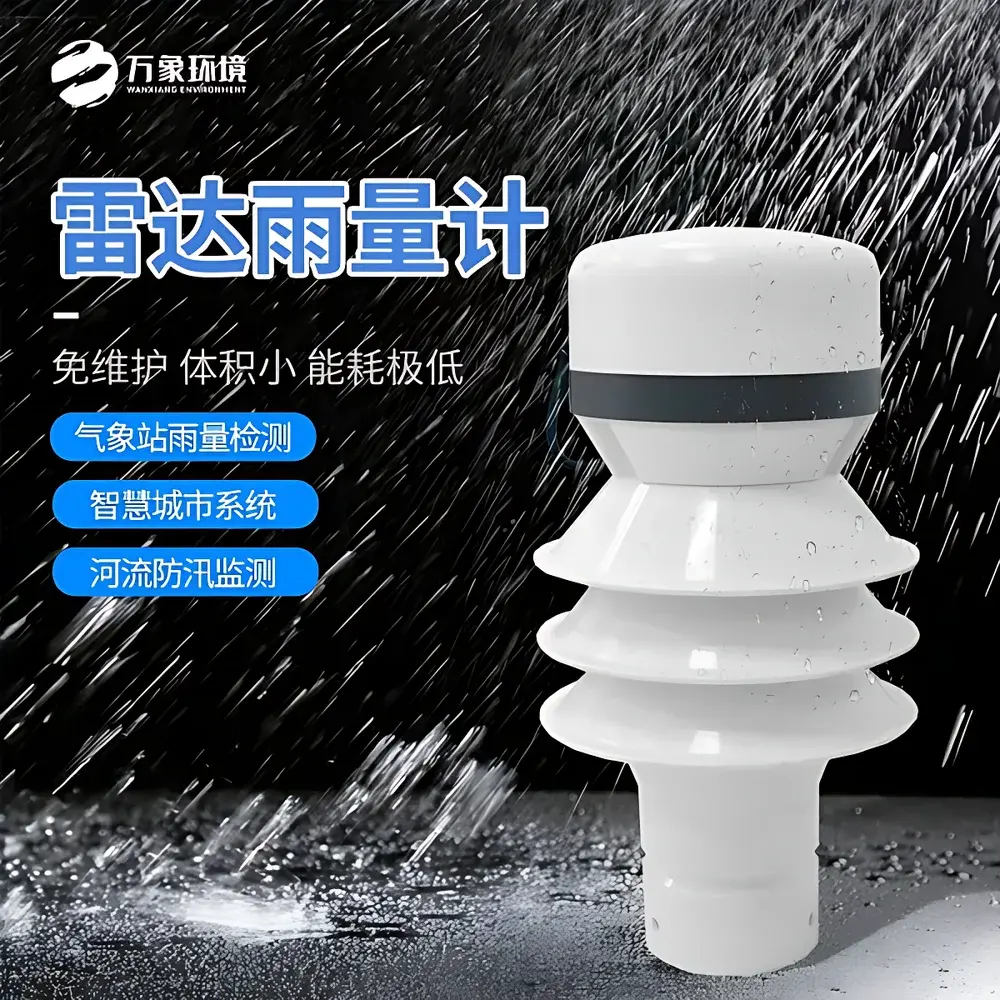
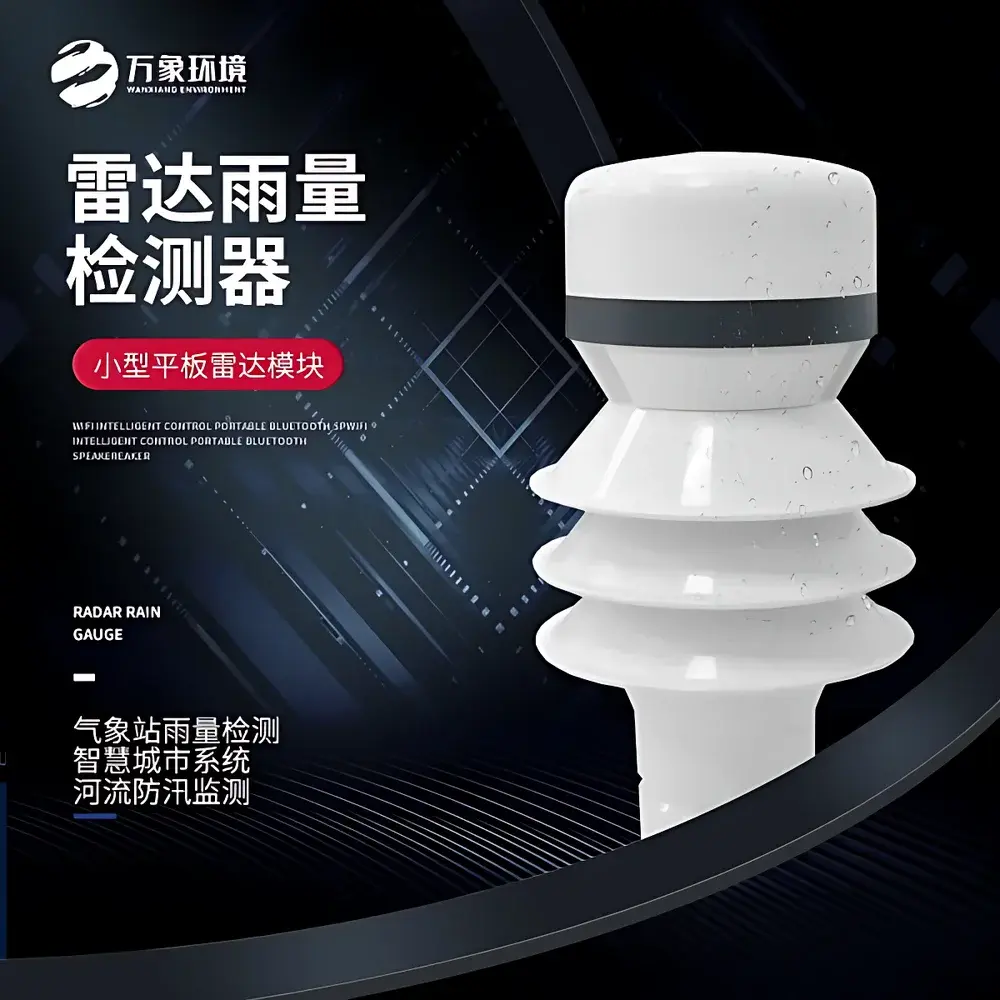
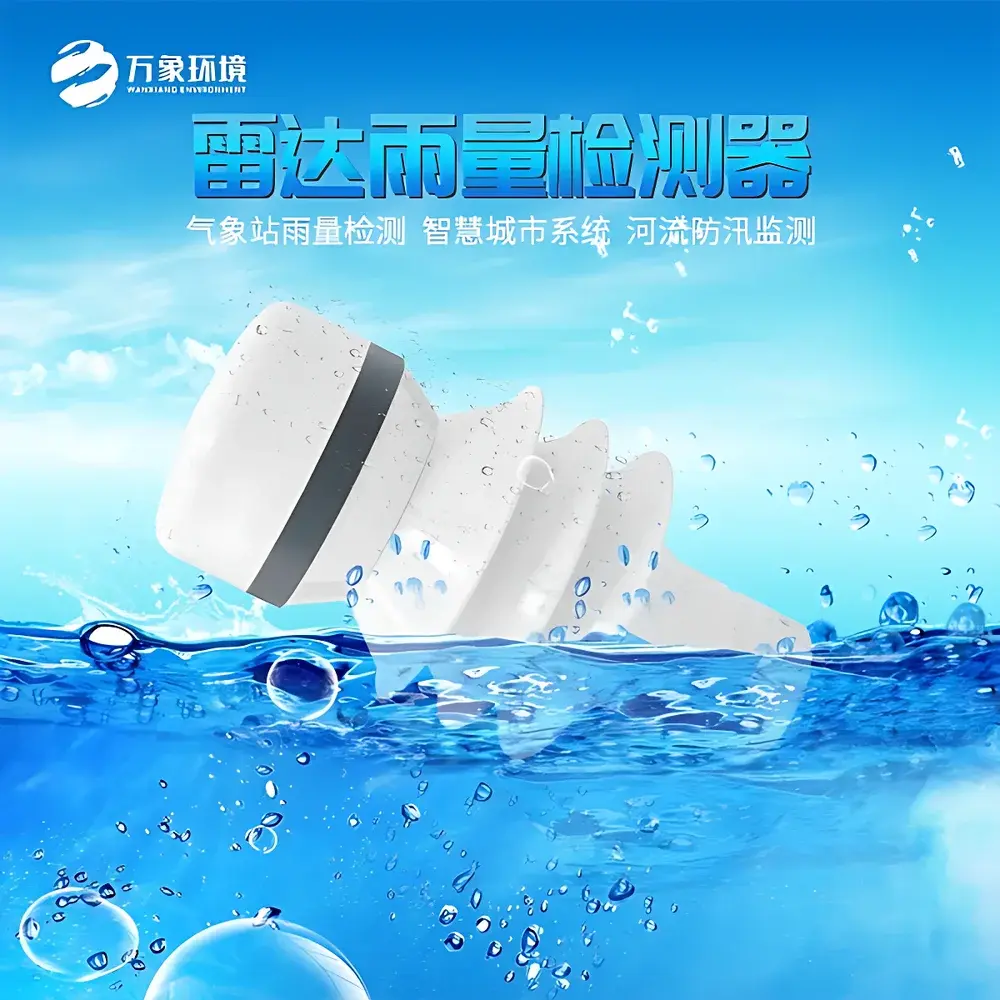
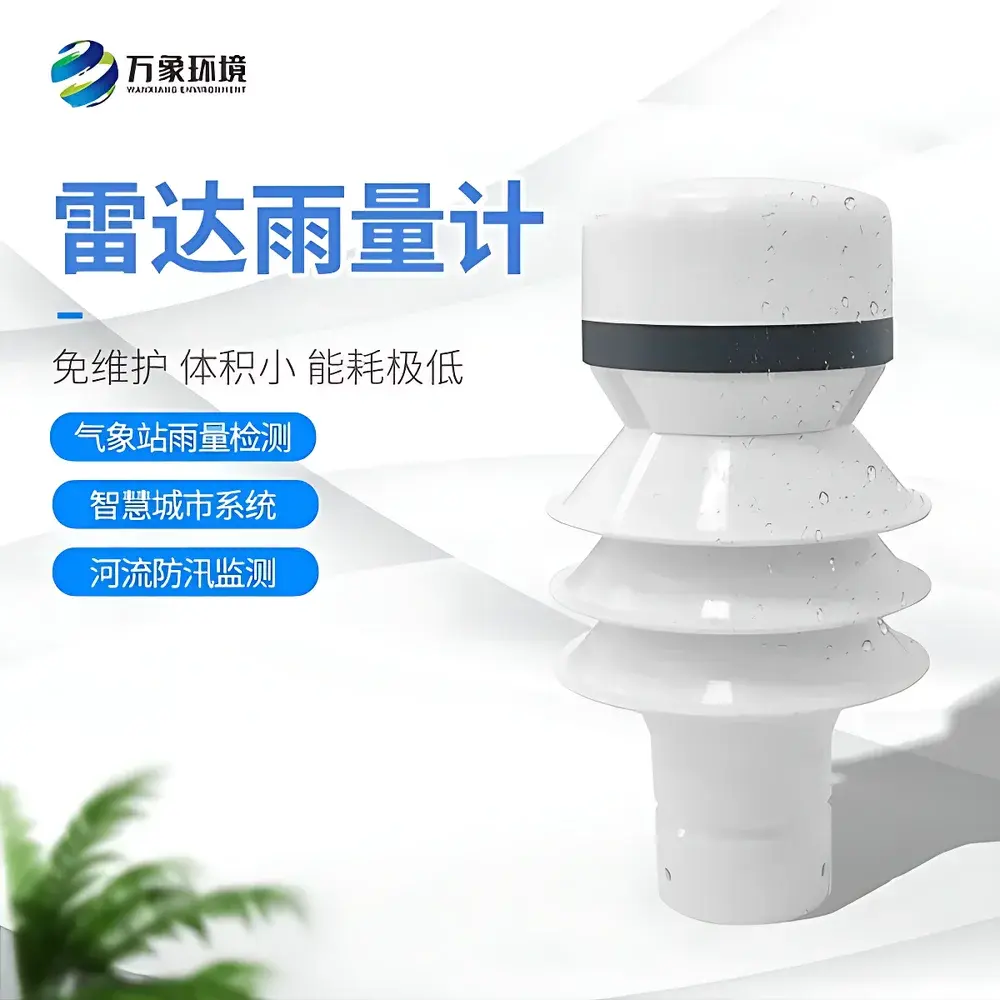
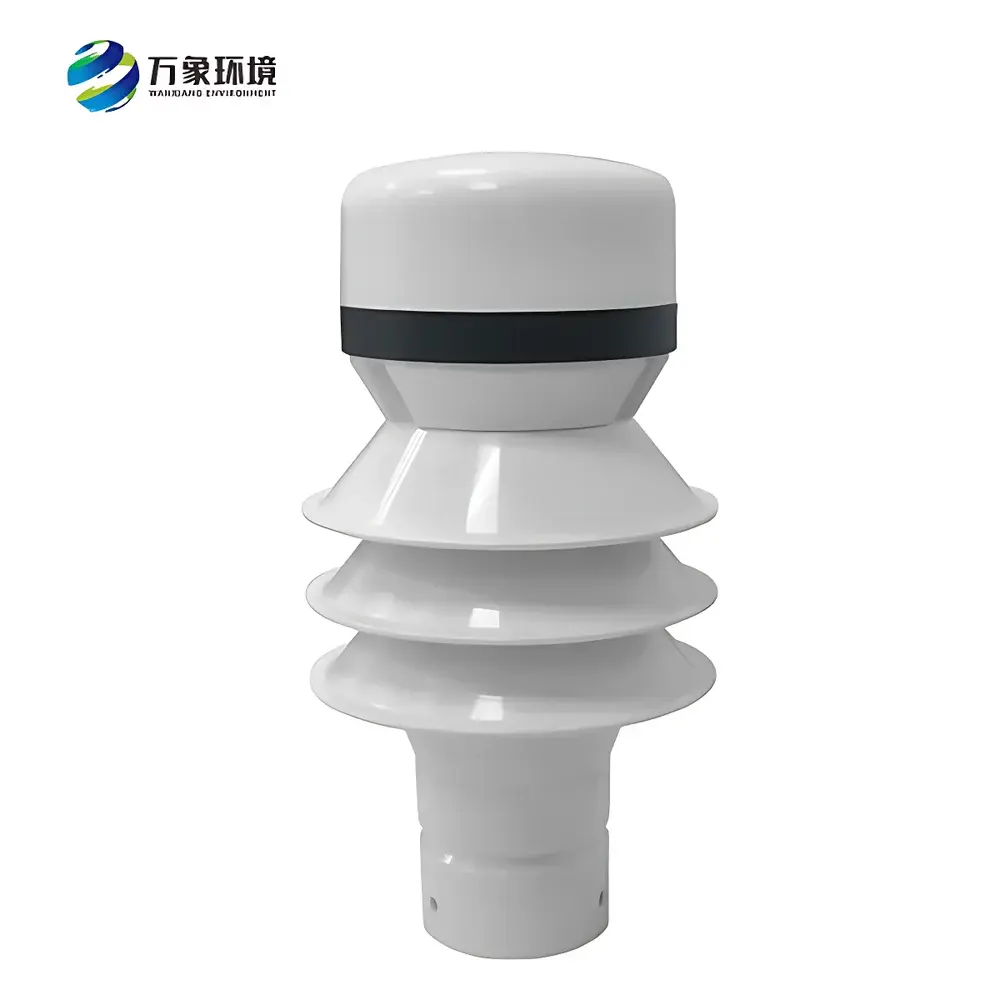
Vientiane Environment WX-YL4 24 GHz Doppler Radar Precipitation Sensor
| Brand | Vientiane Environment |
|---|---|
| Origin | Shandong, China |
| Manufacturer Type | OEM/ODM Producer |
| Country of Origin | China |
| Model | WX-YL4 |
| Price | USD 420 (FOB) |
| Measurement Principle | 24 GHz Continuous-Wave Doppler Radar |
| Output Resolution | 0.1 mm |
| Rainfall Range | 0–200 mm/h |
| Accuracy | ±5% (at wind speed < 5 m/s) |
| Particle Size Detection Range | 0.5–5.0 mm |
| Sampling Interval | 1 s |
| Communication Interfaces | RS-485, RS-232 |
| Protocol | Modbus RTU |
| Power Supply | 12–24 VDC |
| Power Consumption | < 2 W |
| Operating Temperature | −30 °C to +70 °C |
| Operating Humidity | 0–100% RH (non-condensing) |
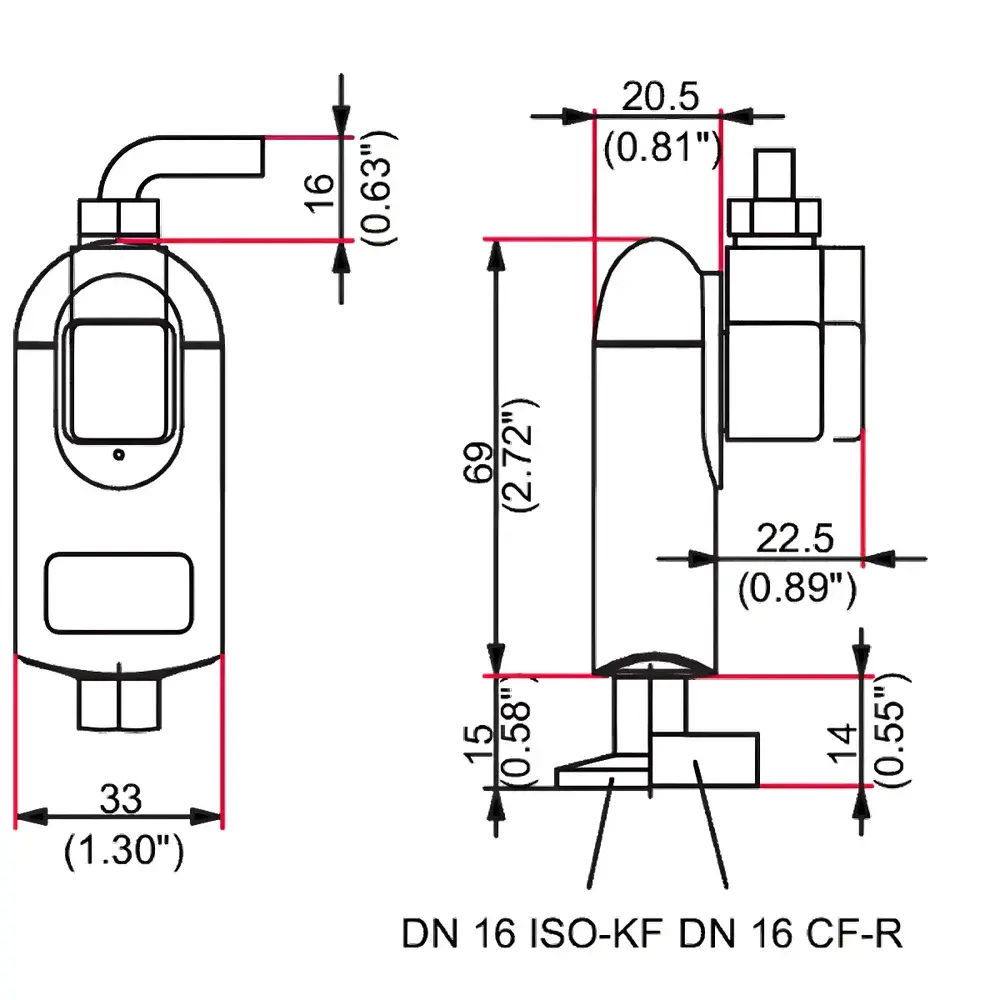
| Dimensions | Ø82 × 195 mm |
| Housing Material | Anodized Aluminum Alloy + ABS |
| Weight | 0.65 kg (with mounting bracket), 0.38 kg (sensor only) |
Overview
The Vientiane Environment WX-YL4 is a solid-state, non-mechanical precipitation sensor engineered for continuous, all-weather detection and classification of rainfall, snowfall, and hail using 24 GHz continuous-wave (CW) Doppler radar technology. Unlike tipping-bucket or weighing-type rain gauges, the WX-YL4 operates on the principle of velocity-resolved particle scattering: it transmits a low-power microwave signal toward the precipitation volume below and analyzes the frequency shift (Doppler shift) and backscatter amplitude of returned echoes. This enables real-time discrimination of hydrometeor type based on terminal fall velocity and estimated equivalent spherical diameter—parameters intrinsically linked to phase (liquid vs. frozen), density, and aerodynamic behavior. The absence of moving parts eliminates mechanical wear, freezing-induced blockage, or debris-related false negatives—making the WX-YL4 particularly suitable for unattended, long-term deployments in remote meteorological stations, flood-prone river basins, and integrated urban environmental monitoring networks.
Key Features
- 24 GHz Doppler radar core with high immunity to environmental occlusion—operates reliably under leaf cover, dust accumulation, or light snow deposition without requiring heating elements or physical cleaning.
- Multi-phase precipitation classification: distinguishes rain, wet snow, dry snow, and hail using dual-parameter analysis (fall velocity + radar cross-section).
- High temporal resolution: 1-second sampling interval supports rapid onset/cessation detection critical for flash flood warning systems and hydrological modeling.
- Low-power architecture: consumes less than 2 W at 12–24 VDC, enabling solar-battery operation in off-grid installations.
- Robust industrial enclosure: IP66-rated housing fabricated from anodized aluminum alloy and UV-stabilized ABS ensures structural integrity and thermal stability across −30 °C to +70 °C ambient conditions.
- No calibration drift due to mechanical hysteresis—factory-calibrated traceable to NIST-traceable reference standards; field verification supported via built-in diagnostic mode.
Sample Compatibility & Compliance
The WX-YL4 is designed for open-air outdoor deployment and complies with IEC 60529 (IP66), EN 61326-1 (EMC for industrial environments), and RoHS Directive 2011/65/EU. Its measurement methodology aligns with the physical principles outlined in WMO Guide to Instruments and Methods of Observation (CIMO Guide, Chapter 12) for solid-state precipitation sensing. While not certified to ISO/IEC 17025 as a standalone metrological standard, its ±5% accuracy specification (validated under controlled wind conditions ≤5 m/s per WMO TR-132 test protocol) meets operational requirements for Class II hydrometeorological networks. Data output conforms to Modbus RTU over RS-485/RS-232, supporting integration into SCADA, IoT gateways, and national weather service telemetry infrastructure.
Software & Data Management
The WX-YL4 outputs time-synchronized precipitation event metadata—including intensity (mm/h), accumulated depth (mm), hydrometeor type flag, and confidence index—via ASCII or binary Modbus registers. It supports configurable reporting intervals (1 s to 300 s) and includes internal timestamping with millisecond precision. When deployed with compatible data loggers (e.g., Campbell Scientific CR1000X, HOBO RX3000), raw Doppler spectra can be archived for post-processing validation. Firmware updates are performed via serial command interface; configuration parameters (e.g., velocity thresholds, temperature compensation offsets) are stored in non-volatile memory. Audit trails and change logs are maintained in accordance with GLP-aligned data integrity practices where required by institutional policy.
Applications
- Meteorological observatories requiring autonomous, low-maintenance precipitation classification in alpine, coastal, or arid zones.
- Smart city environmental monitoring platforms integrating real-time rainfall data into traffic management, stormwater drainage control, and air quality correlation models.
- River basin flood forecasting systems—especially where rapid response to convective rainfall initiation is essential for upstream reservoir release scheduling.
- Hydrological research networks studying precipitation microphysics, including drop size distribution (DSD) inversion and phase transition dynamics during winter storms.
- Renewable energy sites (e.g., solar farms) needing site-specific soiling and icing risk assessment derived from precipitation phase and intensity history.
FAQ
Does the WX-YL4 require periodic recalibration?
No—its radar-based measurement principle is inherently stable over time. Factory calibration remains valid throughout the product lifecycle unless subjected to physical impact or extreme electromagnetic interference. Optional annual verification against reference disdrometer data is recommended for regulatory reporting contexts.
Can it operate accurately in high-wind conditions?
Accuracy is specified at ±5% for wind speeds below 5 m/s. Above this threshold, horizontal advection may affect vertical velocity estimation; users deploying in exposed locations should consider wind shielding per WMO guidance or apply empirical correction factors derived from co-located anemometer data.
Is Modbus TCP supported?
No—the WX-YL4 implements Modbus RTU exclusively over RS-485 or RS-232. Integration with Ethernet-based systems requires an external RS-485-to-TCP converter configured in bridge mode.
What is the minimum detectable rainfall rate?
The sensor reliably detects precipitation onset at rates ≥0.1 mm/h, corresponding to light drizzle or melting snow events, validated under laminar airflow conditions in climate chamber testing.
How is ice accumulation on the antenna window handled?
The radar’s 24 GHz wavelength penetrates thin frost layers (<0.5 mm); however, heavy rime or glaze ice must be manually removed. No active de-icing system is integrated, consistent with its ultra-low-power design philosophy.