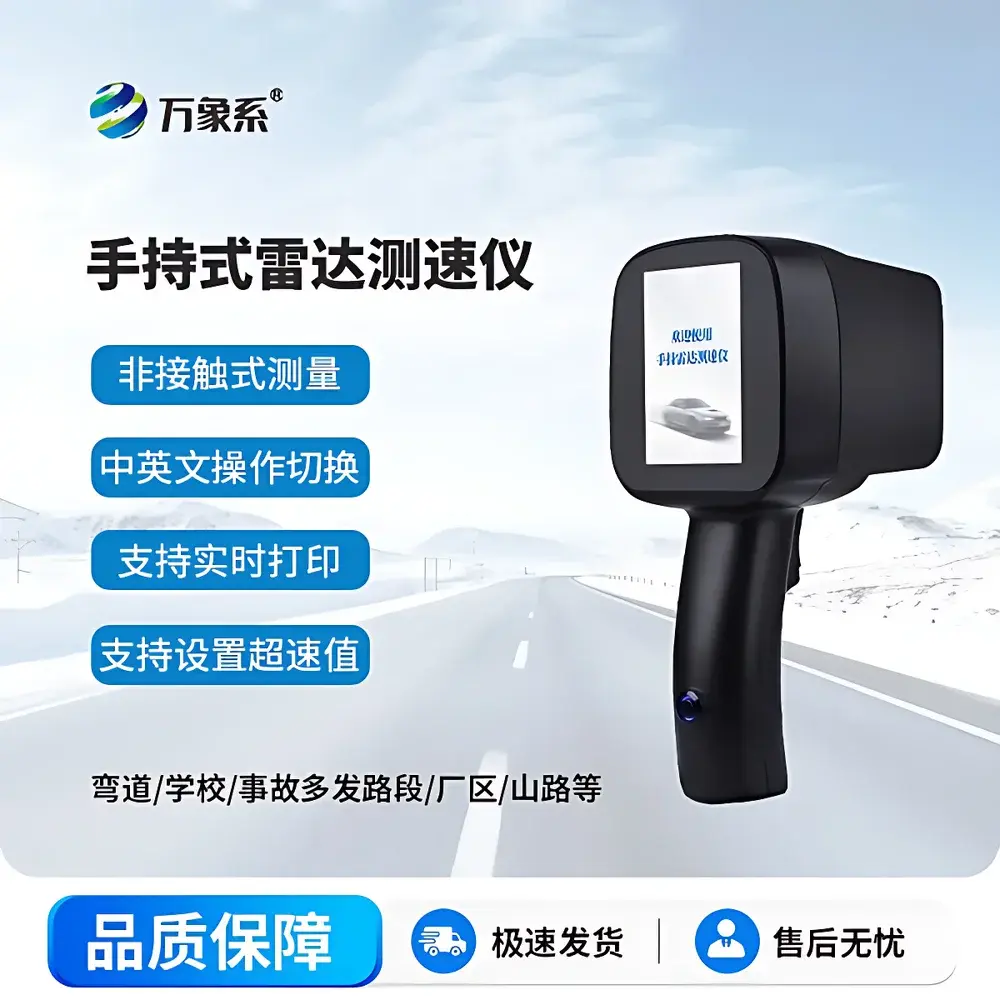
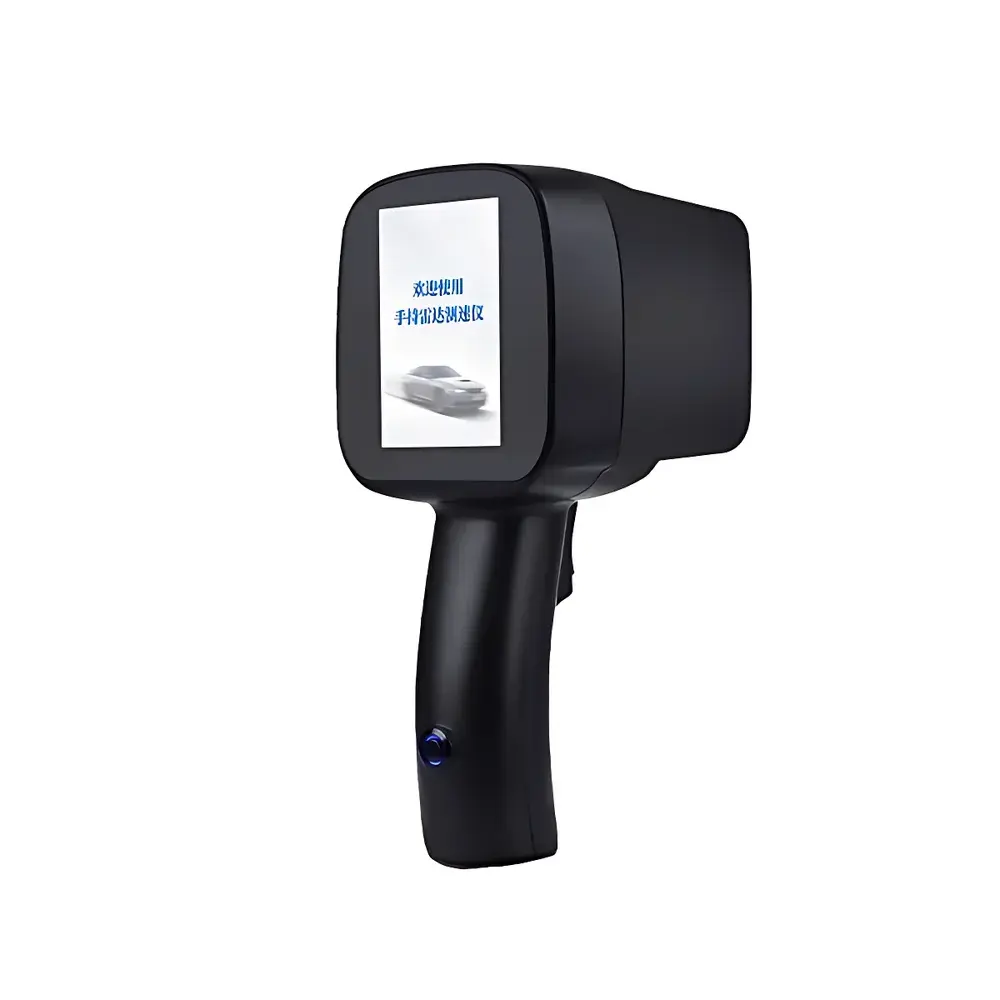
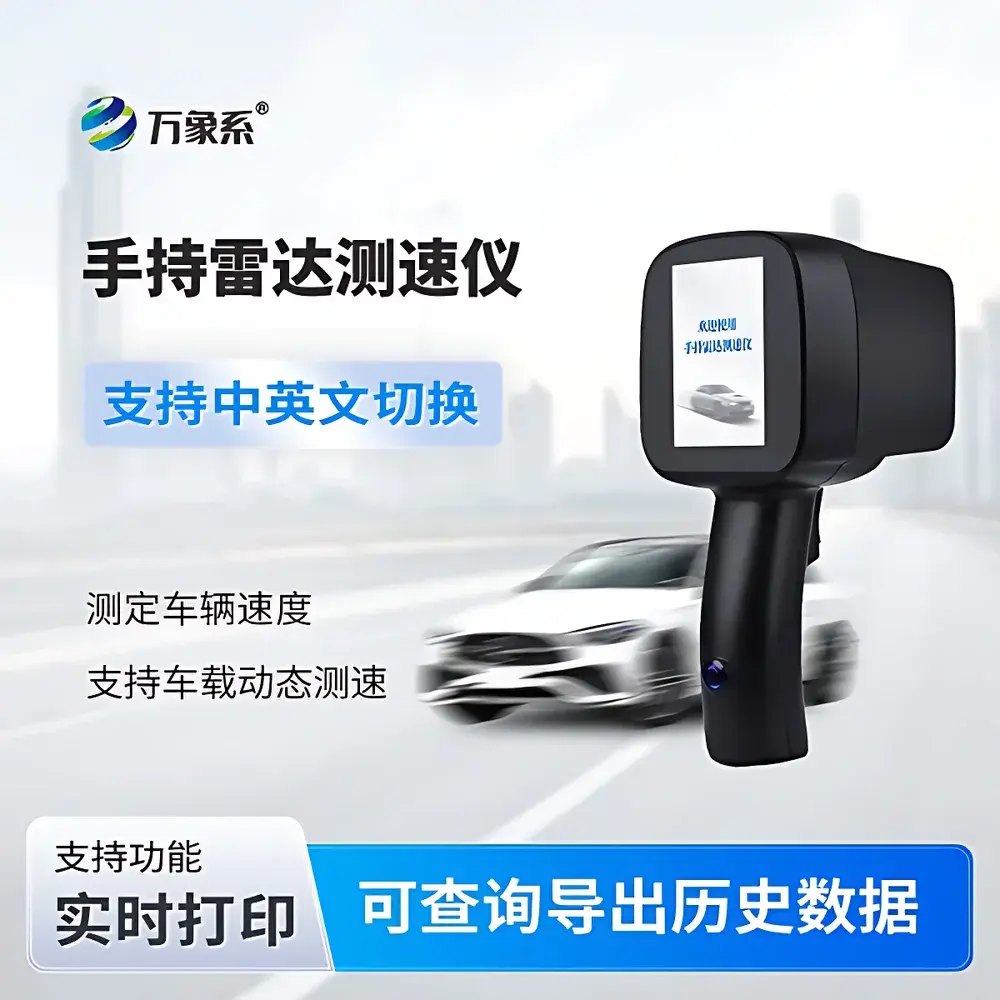
Vientiane WX-LDS2 Handheld Doppler Radar Speed Meter
| Brand | Vientiane Environment |
|---|---|
| Origin | Shandong, China |
| Manufacturer Type | Manufacturer |
| Country of Origin | Domestic (China) |
| Model | WX-LDS2 |
| Price | USD 425 (approx.) |
| Measurement Principle | Doppler Effect |
| Frequency Band | 24 GHz |
| Transmit Power | ≤20 dBm (10 mW nominal) |
| Beam Angle | 22° × 8° |
| Speed Range | 1–240 km/h |
| Resolution | 0.1 km/h |
| Accuracy | ±1 km/h |
| Detection Direction | Positive = approaching, Negative = receding |
| Maximum Detection Distance | ≥200 m |
| Angle Compensation | Automatic vertical compensation |
| Charging Voltage Limit | 12.6 V |
| Battery Capacity | 3600 mAh |
| Operating Time | ≥10 hours |
| Housing Material | ABS resin |
| Weight | 504 g |
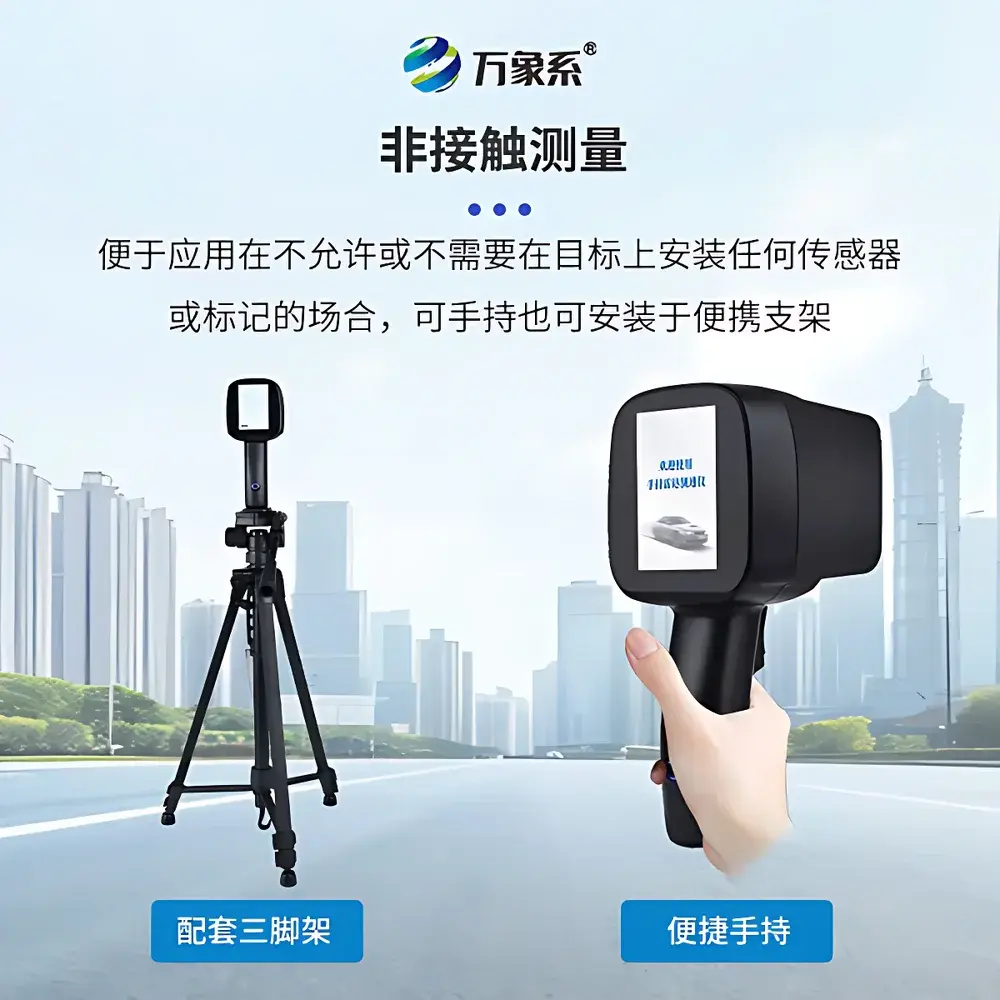
| Operation Mode | Handheld or tripod-mounted |
| User Interface | Dual-language (English/Chinese) |
| Data Storage | Local history logging with export capability |
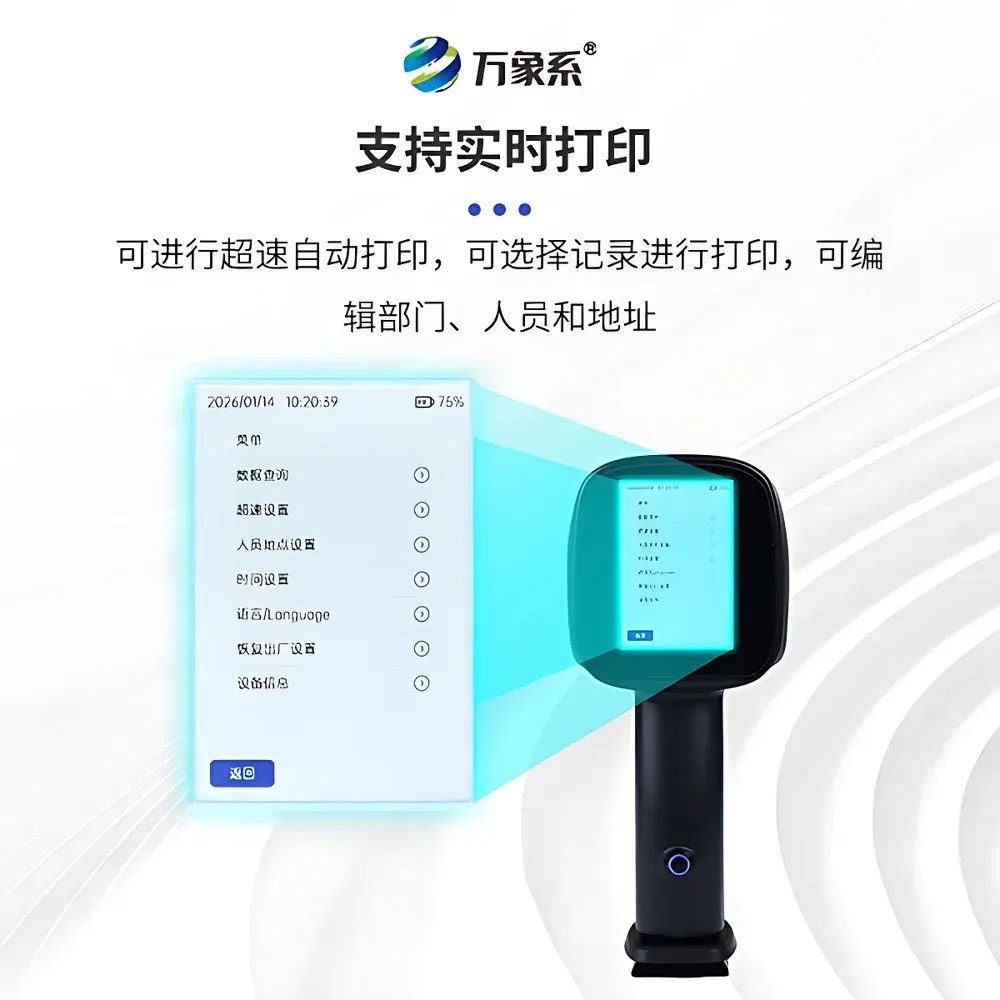
| Print Function | Thermal printer support (auto/manual print of up to 3 most recent overspeed events) |
| Overspeed Configuration | Configurable threshold, real-time overspeed ratio [(v − vₗᵢₘ)/vₗᵢₘ], max speed capture, and timestamped event logging |
Overview
The Vientiane WX-LDS2 Handheld Doppler Radar Speed Meter is a portable, battery-powered velocity measurement instrument engineered for rapid, non-contact speed assessment of moving vehicles and industrial equipment. It operates on the physical principle of the Doppler effect: a continuous-wave (CW) 24 GHz radar transmits electromagnetic energy toward a target; frequency shift in the reflected signal—proportional to radial velocity—is detected and converted into calibrated speed output (km/h). Its 24 GHz band offers improved atmospheric penetration compared to lower-frequency alternatives, maintaining operational reliability under light rain, fog, or dust—conditions that commonly degrade performance of 10.525 GHz or 25.25 GHz systems. Designed for field deployment rather than permanent installation, the WX-LDS2 delivers single-operator mobility, intuitive interface navigation, and immediate decision-support metrics without requiring vehicle instrumentation or line-of-sight obstruction.
Key Features
- Configurable speed threshold with real-time overspeed ratio calculation: (measured speed − preset limit) / preset limit, enabling quantitative compliance evaluation.
- Automatic detection and logging of maximum instantaneous speed during each measurement session.
- On-device storage of the three most recent overspeed events, each timestamped with speed value and directional sign (±).
- Integrated thermal printing capability supporting both automatic print-on-overspeed and selective manual print of stored records.
- Dual-language UI (English/Chinese) with editable operator metadata fields—including department, personnel ID, and location descriptor—for audit-ready documentation.
- Automatic vertical angle compensation algorithm mitigates cosine error when the device is not perfectly aligned perpendicular to motion trajectory.
- Robust ABS resin housing rated for field use, weighing only 504 g and compatible with standard photographic tripods for stabilized long-range targeting.
- Rechargeable lithium-ion battery (3600 mAh) sustaining ≥10 hours of continuous operation at ambient temperatures between −10 °C and +50 °C.
Sample Compatibility & Compliance
The WX-LDS2 is validated for reflective targets with radar cross-sections typical of motor vehicles (e.g., automobiles, trucks, motorcycles), construction machinery (forklifts, cranes, winches), and large industrial conveyors. It is unsuitable for non-metallic or low-RCS targets (e.g., bicycles, pedestrians, plastic containers) or environments exhibiting multipath interference (e.g., narrow urban canyons, tunnel exits, or closely spaced parallel lanes). While not certified to ISO/IEC 17025 for metrological traceability, its ±1 km/h accuracy conforms to common enforcement-grade tolerances referenced in national traffic regulation frameworks (e.g., China’s GA/T 832–2014, EU Directive 2015/1535 Annex I). The device supports GLP-aligned data integrity practices via timestamped event logs and exportable CSV files—compatible with basic QA review workflows but not FDA 21 CFR Part 11-compliant electronic signatures.
Software & Data Management
No proprietary desktop software is required. All configuration, data review, and export functions are executed directly on-device via a backlit LCD interface. Historical measurements—including date/time stamp, speed value, direction indicator, and overspeed status—are retained in non-volatile memory. Users may export full log files via USB-C connection to a host PC in comma-separated values (CSV) format, preserving UTF-8 encoding for multilingual metadata fields. No cloud synchronization, remote firmware updates, or API access is provided—ensuring data sovereignty and eliminating network dependency in offline or secure-site deployments.
Applications
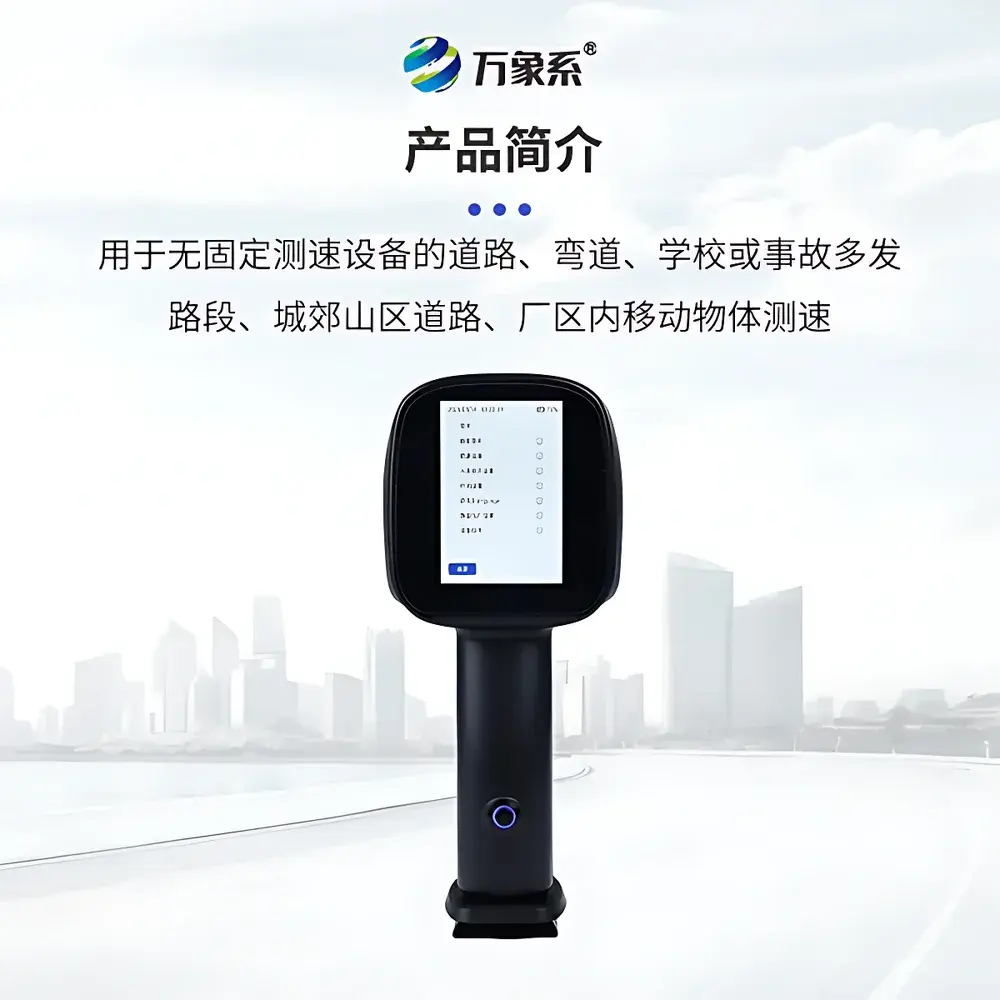
- Road safety enforcement: Temporary speed monitoring at accident-prone curves, school zones, rural intersections, and mountainous road segments lacking fixed infrastructure.
- Industrial site safety: Monitoring material handling equipment speeds within factory perimeters, warehouse aisles, or loading docks to enforce internal speed policies.
- Transportation engineering surveys: Short-duration spot-speed studies for traffic flow analysis, intersection capacity modeling, or before/after evaluations of signage or pavement treatments.
- Logistics fleet management: Quick verification of delivery vehicle speeds during yard ingress/egress or dock approach protocols.
- Training and calibration support: Used alongside certified reference speed sources (e.g., calibrated GPS speedometers) to verify operator technique and environmental influence on radar readings.
FAQ
What is the effective operational range under adverse weather conditions?
The 24 GHz frequency enables reliable detection at ≥200 m in light precipitation or fog; however, heavy rain (>5 mm/h) or dense snowfall may reduce effective range by up to 40%.
Can the device distinguish between multiple vehicles in adjacent lanes?
No. The WX-LDS2 lacks beam-forming or pulse-Doppler discrimination and is intended for single-target acquisition. Overlapping returns from closely spaced or similarly moving objects will produce ambiguous or averaged velocity outputs.
Is tripod mounting supported, and what interface standard does it use?
Yes—standard 1/4″-20 UNC threaded mount located at the device’s center of gravity ensures compatibility with all common photographic and survey tripods.
Does the unit require annual recalibration?
While no mandatory recalibration interval is specified, users operating in regulatory enforcement contexts should verify accuracy against a traceable speed source at least quarterly per internal QA procedures.
How is battery health monitored during operation?
A four-segment LED indicator displays remaining charge level; low-battery warning activates at ≤15% capacity, with graceful shutdown initiated at ≤5% to preserve log file integrity.