
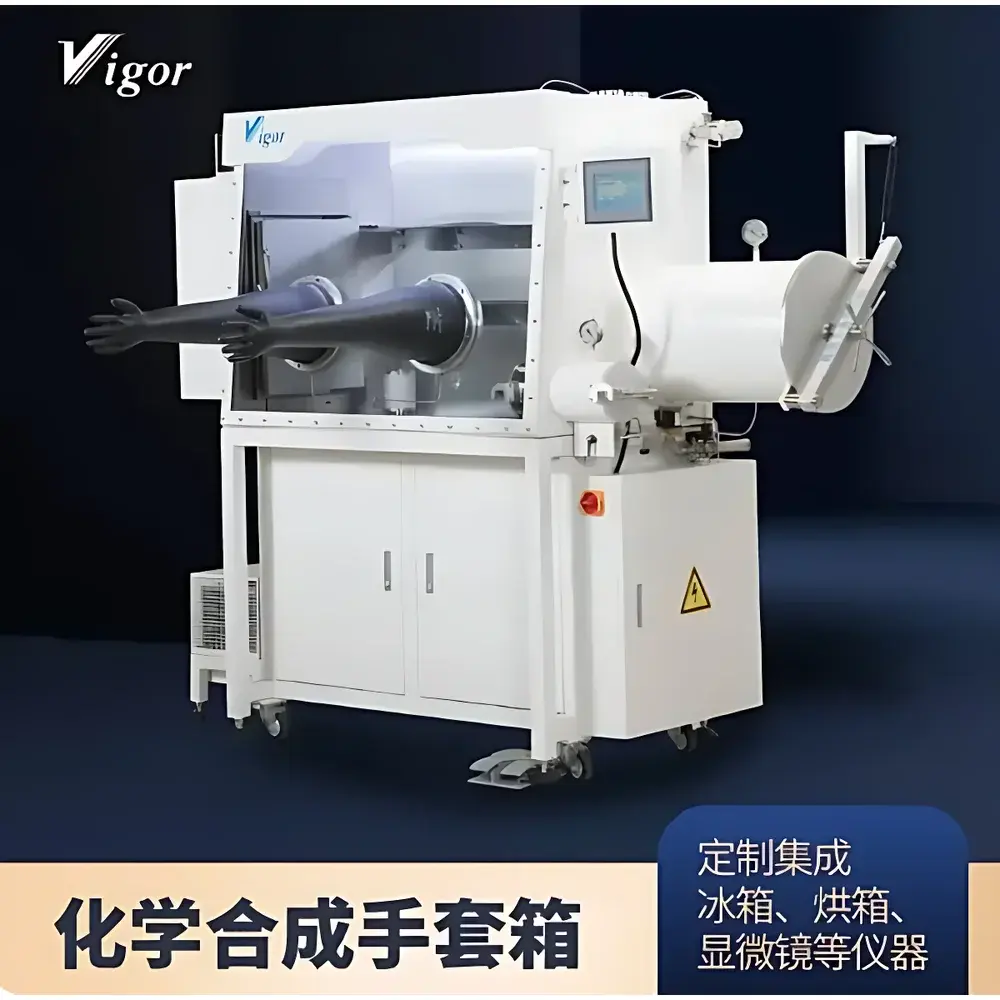
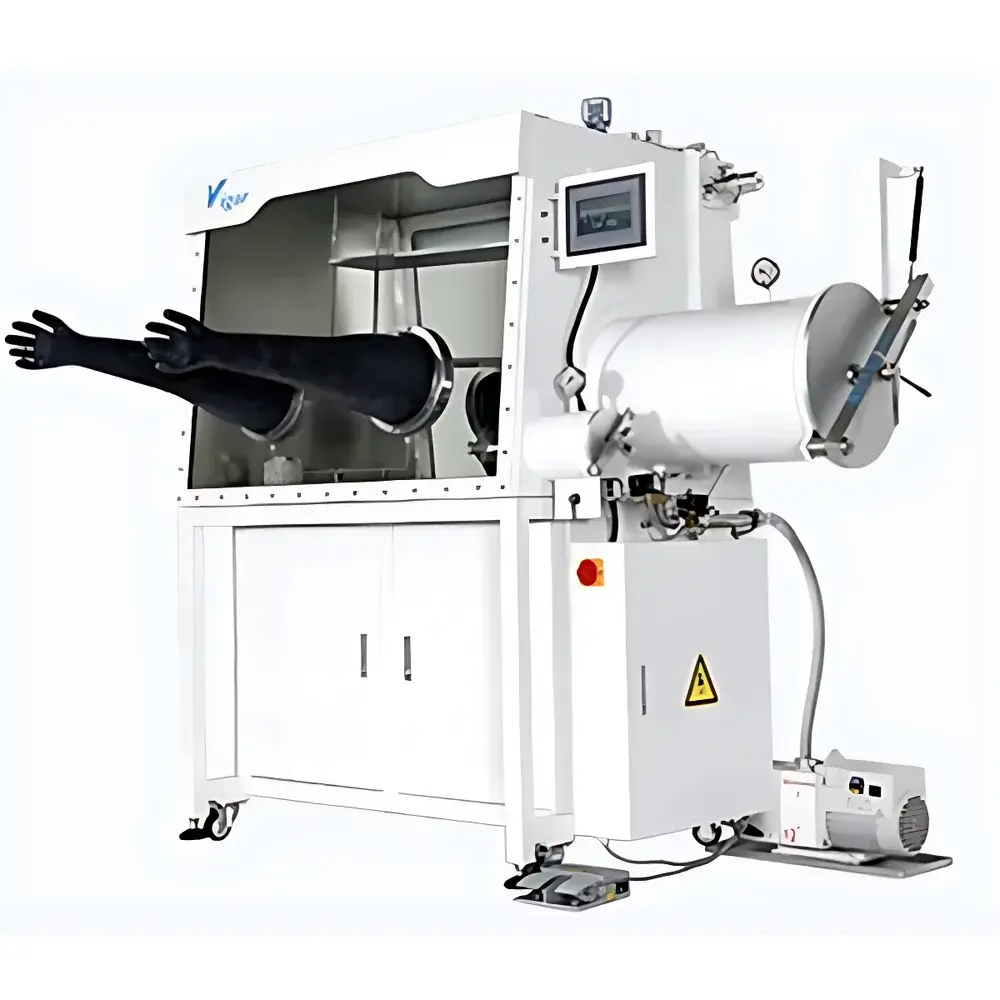
Vigor Vigor Single-Station Vacuum Glove Box
| Brand | Vigor |
|---|---|
| Origin | Jiangsu, China |
| Manufacturer Type | Direct Manufacturer |
| Product Category | Domestic |
| Model | Vigor Single-Station Vacuum Glove Box |
| Instrument Classification | Vacuum Glove Box |
| Filtration Class | ISO Class 2 (≤0.05 vol%/h leakage rate) |
| FFU Configuration | Integrated Fan + H14 HEPA Filter + Dual-Layer Perforated Floor + Rear Gas Return Duct |
| Airflow Pattern | Unidirectional Downward Flow (UDF) with Full-Volume Coverage via Top-Mounted Flow Distributor |
| Sealing System | Patented Multi-Point Dynamic Gasket Seal |
| Gas Purification | Integrated Catalytic Oxygen/H₂O Scrubbing Module (O₂ < 1 ppm, H₂O < 1 ppm after stabilization) |
| Control System | Embedded Industrial PLC with Touchscreen HMI, Real-Time Atmosphere Monitoring (O₂, H₂O, Pressure), and Audit-Trail-Enabled Logging |
Overview
The Vigor Single-Station Vacuum Glove Box is an engineered inert-atmosphere workstation designed for handling air-sensitive materials under ultra-low oxygen and moisture conditions. Built upon Couette-flow-optimized chamber geometry and vacuum-assisted purge protocols, it establishes and maintains a stable argon or nitrogen environment with residual O₂ and H₂O concentrations below 1 ppm following system equilibration. Its core architecture integrates vacuum evacuation capability (ultimate pressure ≤5 × 10⁻² mbar), dual-stage gas purification (catalytic deoxygenation + molecular sieve dehydration), and continuous recirculation through an ISO Class 2–compliant clean-air loop. This configuration meets the operational requirements of battery electrode fabrication, organometallic synthesis, perovskite solar cell processing, and lithium-metal anode characterization—where atmospheric contamination directly compromises reaction yield, interfacial stability, or electrochemical reproducibility.
Key Features
- Patented multi-point dynamic gasket sealing system ensuring long-term integrity at both ambient and sub-atmospheric operating pressures
- Integrated FFU module comprising an EC-controlled centrifugal fan, certified H14 HEPA filter (99.995% @ 0.1 µm), dual-layer perforated stainless steel floor, and rear-mounted gas return duct for laminar recirculation
- Unidirectional downward airflow (UDF) with uniform velocity distribution across full working volume, validated per ISO 14644-3 Annex B using tracer particle visualization
- Real-time atmosphere monitoring suite: electrochemical O₂ sensor (range 0–1000 ppm, ±5% FS), chilled-mirror dew point meter (H₂O range −70 to 20 °C DP, ±0.5 °C), and absolute pressure transducer (0–2000 mbar, ±0.1% FS)
- PLC-based control system compliant with IEC 61131-3 standards; supports configurable alarm thresholds, automated purge cycles, and event-triggered data capture
- Modular interface ports (ISO-KF 40 & CF 63 flanges) for integration with external vacuum pumps, mass spectrometers, or in-situ analytical tools
Sample Compatibility & Compliance
The glove box accommodates standard 200 mm–diameter glove ports (ISO/DIN 15883 compliant), supporting both butyl and Viton® glove materials for chemical resistance across pH 1–14 and solvent exposure (including THF, DMF, NMP, and acetonitrile). Chamber interior surfaces are electropolished 316L stainless steel (Ra ≤ 0.4 µm), passivated per ASTM A967, and certified non-particle-shedding under ISO 14644-1 Class 5 cleanroom protocols. All gas pathways comply with USP <1051> material compatibility guidelines for pharmaceutical R&D. The system’s data logging architecture satisfies FDA 21 CFR Part 11 requirements for electronic records and signatures when configured with user authentication, audit trail, and exportable CSV/CSV-GZ log formats.
Software & Data Management
The embedded HMI provides intuitive navigation through parameter configuration, manual/automatic mode selection, and historical trend review (72-hour buffer, extendable via USB export). Logged parameters include O₂ concentration, dew point, chamber pressure, FFU differential pressure, and purge cycle timestamps. Raw sensor outputs are timestamped with microsecond resolution and stored in a relational SQLite database with SHA-256 checksum integrity verification. Optional Ethernet/IP connectivity enables remote monitoring via Modbus TCP or OPC UA, supporting integration into centralized LIMS or MES platforms for GLP/GMP traceability.
Applications
- Electrode slurry preparation and coin-cell assembly for Li-ion, solid-state, and Na-ion battery research
- Synthesis and crystallization of pyrophoric organolithium reagents and transition metal catalysts
- Encapsulation and testing of moisture-sensitive optoelectronic devices (e.g., OLEDs, perovskites)
- Handling of alkali metals (Li, Na, K) and reactive hydrides (e.g., LiAlH₄, NaBH₄) in catalysis development
- Preparation of air-sensitive MOFs and covalent organic frameworks under controlled humidity
- Quality control sampling for high-purity semiconductor precursors (e.g., trimethylindium, tetrakis(dimethylamino)titanium)
FAQ
What vacuum level can the system achieve prior to inert gas purging?
The integrated two-stage rotary vane pump achieves an ultimate base pressure of ≤5 × 10⁻² mbar within 30 minutes from atmospheric conditions.
Is the gas purification system regenerable in situ?
Yes—the catalytic O₂ scrubber and molecular sieve H₂O trap support automatic thermal regeneration cycles triggered by sensor-defined saturation thresholds.
Does the glove box support integration with external analytical instruments?
Standard ISO-KF 40 and CF 63 vacuum feedthroughs allow direct coupling to Raman spectrometers, XRD stages, or SEM transfer systems without compromising chamber integrity.
How is compliance with ISO Class 2 cleanroom performance verified?
Certification includes particle counting per ISO 21501-4 using a calibrated 0.1 µm optical particle counter, conducted at nine defined spatial locations during steady-state UDF operation.
Can the control system be configured for 21 CFR Part 11 compliance?
Yes—when deployed with role-based user accounts, electronic signature prompts, and immutable audit logs, the system meets all technical controls specified in Subpart B of 21 CFR Part 11.



