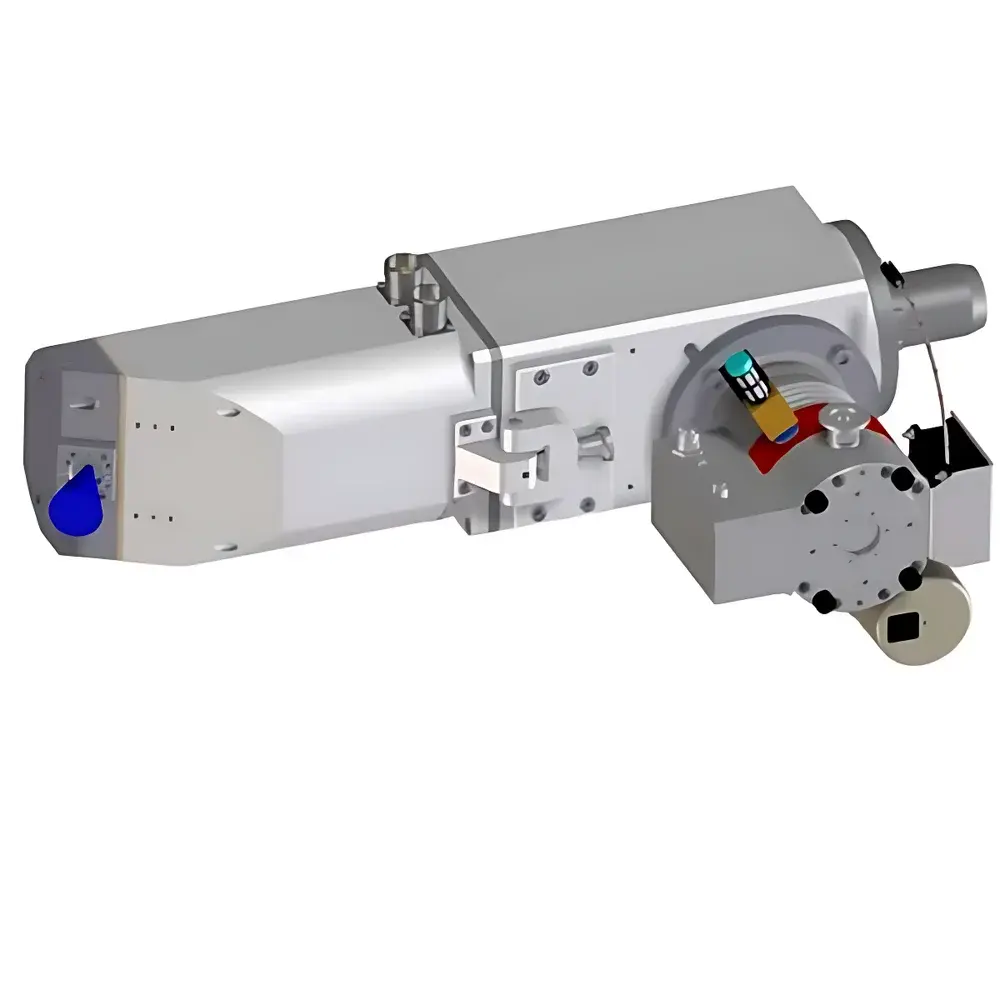
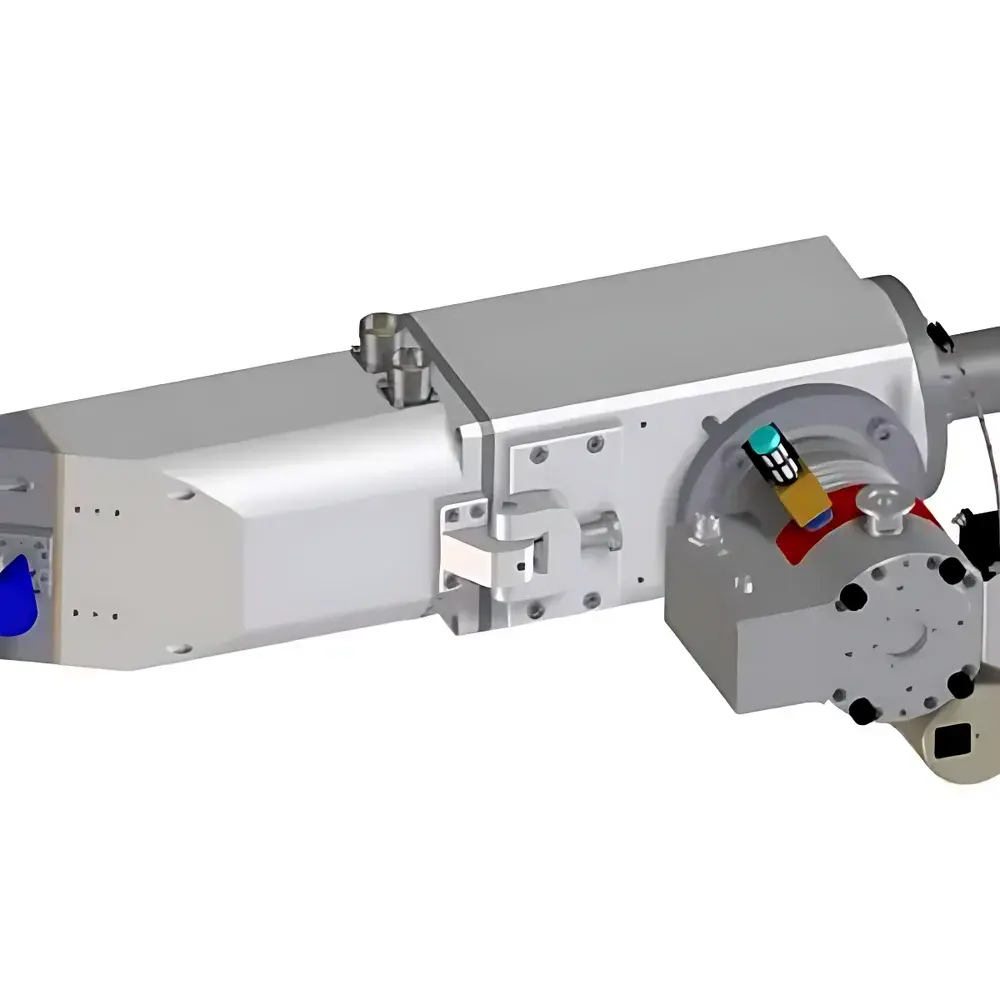
Vistron EUV-13.5 Laser oFab Compact Microfocus EUV Source
| Brand | Vistron |
|---|---|
| Manufacturer | Laser oFab GmbH |
| Origin | Germany |
| Model | Laser oFab EUV Tube |
| EUV Peak Wavelength | 13.5 nm |
| Spectral Bandwidth (FWHM) | ~1 nm |
| Power Output (2π, 2% BW @ 13.5 nm) | ≤20 µW |
| Long-Term Intensity Stability (72 h) | <1% RMS |
| Source Size (FWHM) | Adjustable from <10 µm to ≥100 µm |
| Vacuum Interface | DN 16 CF flange |
| Emission Cone | 30° full angle, centered on flange axis |
| Target Material | Solid-state (L2,3-transition optimized) |
| Operating Voltage/Current | Software-controlled |
| Compliance | Designed for UHV-compatible metrology environments |
Overview
The Vistron EUV-13.5 Laser oFab Compact Microfocus EUV Source is a high-stability, debris-free laboratory-scale extreme ultraviolet (EUV) radiation source engineered specifically for precision metrology in semiconductor lithography development and optical component characterization. Unlike plasma-based or laser-produced plasma (LPP) EUV sources, this device operates on a solid-target electron-impact principle—where accelerated electrons strike a stationary metal target, inducing L₂,₃-shell transitions that emit photons centered at 13.5 nm (92 eV). This mechanism eliminates plasma expansion, ion emission, and particulate contamination—critical advantages for cleanroom-integrated optical testing and long-duration calibration protocols. The source delivers stable, spectrally defined EUV radiation into a well-characterized 30° full-angle emission cone, with its origin positioned 15.4 mm behind the DN 16 CF vacuum flange plane. Its compact mechanical design, combined with fully software-controlled beam centering, focusing, and operating parameter adjustment (accelerating voltage, beam current, spot size), enables seamless integration into synchrotron-alternative metrology setups, including reflectometry stations, multilayer mirror qualification rigs, and EUV mask inspection testbeds.
Key Features
- Debris-free operation: No target ablation, no ion or particle emission—ensures contamination-sensitive optics remain unimpaired during extended exposure
- High spatiotemporal stability: <1% RMS intensity fluctuation over 72-hour continuous operation, validated under constant thermal and electrical conditions
- Adjustable microfocus source size: Electron beam spot diameter tunable from sub-10 µm to >100 µm (FWHM) via voltage/current control—enabling trade-offs between brightness and spatial coherence
- Well-defined spectral output: Primary emission peak at 13.5 nm (FWHM ≈1 nm); secondary lines at 8.3 nm (L₁) and 0.7 nm (Kα/Kβ) are physically separable using multilayer mirrors or Zr filters
- UHV-compatible mechanical interface: Standard DN 16 CF flange with coaxial 30° emission cone—facilitates direct coupling to existing vacuum chambers without custom adapters
- Modular orientation flexibility: Tube head supports four orthogonal mounting configurations (0°, 90°, 180°, 270° rotations), accommodating space-constrained optical layouts
- Low operational overhead: No consumables, no gas handling, no pulsed power supplies—reduces total cost of ownership versus plasma or discharge-based alternatives
Sample Compatibility & Compliance
This EUV source is designed for use with reflective optics operating in the 10–15 nm range, including Mo/Si multilayer-coated mirrors, EUV photomasks, broadband filters, and grazing-incidence spectrometers. Its emission profile and spectral purity meet the functional requirements for ISO 15737:2022 (optical instruments — terminology and definitions for EUV lithography systems) and support traceable calibration per ASTM E2710 (standard practice for calibration of EUV radiometers). While not certified to FDA 21 CFR Part 11, the embedded control firmware provides full audit trail logging (timestamped parameter changes, runtime logs, error flags), enabling GLP/GMP-aligned validation workflows when deployed in regulated R&D environments. All mechanical components conform to DIN 28403 and ISO-KF/CF vacuum standards; the solid-target architecture complies with SEMI F20-0218 (safety guidelines for EUV source handling).
Software & Data Management
The Laser oFab EUV Tube is operated via a Windows-based native application supporting USB 2.0 communication. The software provides real-time monitoring of tube voltage, emission current, filament temperature, and interlock status. Critical parameters—including beam centering offsets, focus tuning, and emission duration—are programmable and scriptable via ASCII command protocol (SCPI-compliant subset), enabling integration into LabVIEW, Python (PySerial), or MATLAB automation frameworks. All operational data—including timestamped intensity readings sampled at 10 Hz during stability tests—are exported in CSV format with metadata headers (e.g., “Timestamp [UTC], Voltage [kV], Current [µA], Photodiode Signal [V]”). Firmware updates are delivered as signed binary packages with SHA-256 verification, ensuring integrity in controlled lab networks.
Applications
- Characterization of EUV multilayer reflectivity vs. incidence angle and wavelength (θ–λ mapping)
- Calibration of EUV energy monitors, photodiodes, and CCD-based EUV cameras outside synchrotron beamlines
- Mask blank defect inspection system validation using high-resolution EUV projection microscopy
- Development and testing of EUV pellicles and thin-film transmission filters
- Alignment and focus verification of EUV interferometers and wavefront sensors
- Quantitative evaluation of carbon contamination kinetics on exposed optics under controlled EUV flux
FAQ
What is the typical lifetime of the solid target under continuous operation?
Target lifetime exceeds 5,000 hours under nominal operating conditions (≤1.5 kW/mm² power density). Localized thermal damage is confined to sub-100 µm zones; rotating the target by <5° accesses fresh surface area—extending usable life without hardware replacement.
Can the 13.5 nm output be spectrally narrowed further for high-resolution applications?
Yes. Using two sequential Mo/Si multilayer mirrors (each with ~15% peak reflectance and ~0.2 nm bandwidth at 13.5 nm), the effective bandwidth can be reduced to ≤2% (≈0.27 nm), achieving spectral purity suitable for monochromatic reflectometry.
Is magnetic shielding required to suppress electron scatter?
A low-field (<5 mT) permanent magnet array is integrated into the tube housing to deflect stray electrons away from the optical path—no external shielding is necessary for standard configurations.
How is thermal management handled during extended runs?
The anode block is actively water-cooled via integrated G1/8″ BSP ports (recommended flow rate: 0.8 L/min, ΔT <5°C). Thermal drift of the emission centroid remains <2 µm over 8-hour sessions when coolant temperature is stabilized to ±0.1°C.
Does the source comply with laser safety standards?
It is classified as Class 1M under IEC 60825-1:2014 when enclosed in a light-tight vacuum chamber with interlocked access doors—no EUV radiation escapes during normal operation. External alignment requires EUV-specific PPE (Zr-filtered goggles, gloves) per ANSI Z136.1-2022 Annex D.