
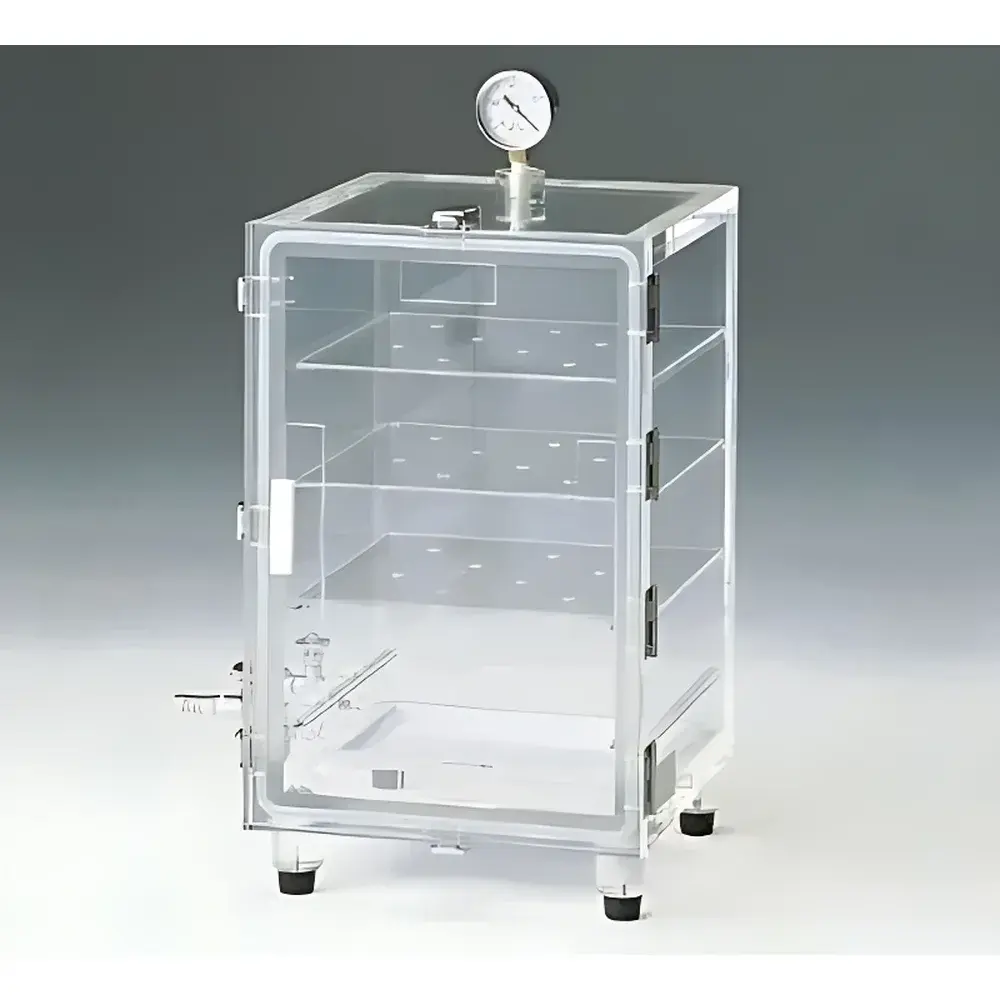
AS ONE VLH Series Vacuum Desiccator Cabinet
| Brand | AS ONE |
|---|---|
| Origin | Japan |
| Manufacturer | AS ONE Corporation |
| Model | 1-067-01 |
| Instrument Type | Vacuum Desiccator Cabinet |
| External Dimensions | 310 × 333 × 520 mm |
| Internal Dimensions | 260 × 280 × 410 mm |
| Chamber Capacity | 30 L |
| Maximum Vacuum Level | 1 Torr (≈133 Pa) |
| Construction Material | Main Body & Transparent Panel — 25 mm Thick Cast PMMA (Polymethyl Methacrylate) |
| Shelf Dimensions | 257 × 257 × 4 mm |
| Number of Shelves | 4 (Spacing: 85 mm) |
| Shelf Load Capacity | 2 kg (uniformly distributed) |
| Net Weight | 23 kg |
| Power Interface | None (no built-in socket) |
Overview
The AS ONE VLH Series Vacuum Desiccator Cabinet is an engineered solution for moisture-sensitive sample storage and low-humidity conditioning under controlled vacuum environments. Unlike conventional drying ovens or ambient desiccators, the VLH cabinet operates on a sealed vacuum principle—removing atmospheric moisture by evacuating air to a stable residual pressure of ≤1 Torr (≈133 Pa). This enables rapid dehumidification without thermal stress, making it ideal for preserving hygroscopic reagents, calibration standards, optical components, thin-film substrates, and electronic assemblies that degrade upon exposure to ambient humidity. The cabinet’s rigid, all-solid construction—featuring 25 mm thick cast PMMA viewing panels—provides structural integrity against vacuum collapse while maintaining optical clarity for real-time visual monitoring. Its compact footprint (310 × 333 × 520 mm) and 30 L internal volume are optimized for benchtop integration in analytical laboratories, QC rooms, and cleanroom-adjacent preparation areas.
Key Features
- Vacuum-rated chamber with validated sealing performance down to 1 Torr (133 Pa), ensuring consistent dew point suppression below −40 °C under stable conditions.
- Optically transparent front and side panels fabricated from 25 mm thick cast PMMA—resistant to crazing, UV degradation, and vacuum-induced deformation.
- Four adjustable stainless steel shelves (257 × 257 × 4 mm), spaced at fixed 85 mm intervals, each rated for 2 kg uniform load; shelf positions are non-modular but mechanically stabilized.
- Dedicated vacuum port with integrated brass valve and analog Bourdon-tube vacuum gauge—enabling manual evacuation via external vacuum pump (not included) and direct pressure readout without electrical dependency.
- No internal power socket or heating element—designed exclusively for passive vacuum desiccation, eliminating thermal gradients, condensation risks, and electromagnetic interference.
- PC-reinforced mounting zones for vacuum fittings and instrumentation ensure long-term mechanical stability under repeated vacuum cycling.
Sample Compatibility & Compliance
The VLH cabinet supports storage of ISO/IEC 17025-compliant reference materials, USP hygroscopic drug substances, ASTM E145 Class III hygrosensitive standards, and MIL-STD-883 moisture-sensitive devices (MSL 2a and above). Its non-porous PMMA chamber walls prevent outgassing of volatile organics, satisfying low-VOC requirements for semiconductor metrology prep environments. While not certified to IEC 61000-4-x or UL 61010-1 as a powered instrument, its passive design inherently complies with laboratory safety protocols requiring zero energy input during storage. The absence of heaters, fans, or controllers eliminates risk of thermal runaway or unintended chemical reactions—critical for storing lithium-based battery test samples, peroxide-forming solvents, or archival photographic emulsions.
Software & Data Management
The VLH Series is a purely mechanical vacuum enclosure with no embedded electronics, firmware, or digital interfaces. As such, it does not require software, drivers, or data logging capabilities. Vacuum status is monitored visually via the analog gauge; process documentation—including evacuation start time, final pressure reading, and duration—is maintained manually in lab notebooks or LIMS-integrated log sheets. For regulated environments operating under GLP or GMP, users may integrate external digital vacuum loggers (e.g., calibrated capacitance manometers with 4–20 mA output) via the standard 1/4″ NPT vacuum port. Such configurations support 21 CFR Part 11-compliant audit trails when paired with validated data acquisition systems.
Applications
- Precision storage of hygroscopic analytical standards (e.g., potassium hydrogen phthalate, sodium chloride reference humidity standards).
- Pre-conditioning of FTIR ATR crystals, Raman substrates, and XRD sample holders prior to spectral acquisition.
- Moisture stabilization of MEMS sensors, OLED test substrates, and photomask blanks prior to lithography or metrology.
- Long-term archival of museum-grade film negatives, archival paper samples, and cellulose acetate artifacts under inert vacuum.
- Controlled dehydration of gel electrophoresis gels and blot membranes without curling or cracking.
- Pre-vacuum equilibration of sorption isotherm samples for gravimetric vapor sorption (GVS) analysis.
FAQ
Does the VLH cabinet include a built-in vacuum pump?
No. It requires connection to an external oil-free or diaphragm vacuum pump capable of reaching ≤1 Torr (e.g., KNF NVP series or Vacuubrand PC 101).
Can the cabinet be used with inert gas purging?
Yes—after initial evacuation, the chamber can be backfilled with dry nitrogen or argon via the vacuum port using a precision regulator and flow meter.
Is the PMMA chamber resistant to common laboratory solvents?
PMMA exhibits good resistance to alcohols, dilute acids, and bases, but is incompatible with chlorinated hydrocarbons, ketones (e.g., acetone), and aromatic solvents. Consult AS ONE’s chemical compatibility chart before introducing volatile agents.
What maintenance is required for long-term vacuum integrity?
Inspect O-ring seals annually for compression set or microcracking; replace with AS ONE-specified EPDM or FKM gaskets (P/N VLH-SEAL-KIT). Clean PMMA surfaces only with deionized water and lint-free polyester wipes.
Is calibration of the analog vacuum gauge traceable to national standards?
The gauge is factory-calibrated but not supplied with NIST-traceable certification. Users requiring metrological traceability must perform periodic verification using a calibrated reference manometer.



