VPIphotonics VPItransmissionMaker™ Optical Systems
| Brand | VPIphotonics |
|---|---|
| Origin | Germany |
| Model | VPItransmissionMaker™ Optical Systems |
| Category | Optical Communication System Simulation Software |
| Compliance | ISO 9001-certified development environment, compatible with ITU-T G.698.x, G.694.1, G.957, IEEE 802.3, and IETF RFC standards |
| Integration | MATLAB, Python, C++, Keysight ADS, COM interfaces |
| Simulation Domains | Time-domain & frequency-domain optical field propagation, transient network dynamics, digital signal processing (DSP)-enabled coherent system analysis |
| Performance Metrics | BER, Q-factor, EVM, OSNR, EOP, third-order intercept point (IP3), spurious-free dynamic range (SFDR) |
| Architecture | GPU-accelerated, multi-threaded, modular simulation kernel |
| Example Library | 700+ validated application templates covering Raman gain, PMD, XPM, FWM, channel crosstalk, wavelength conversion, partial regeneration, and bandwidth-efficient modulation formats (QPSK, 16-QAM, 64-QAM, OFDM, PAM4) |
Overview
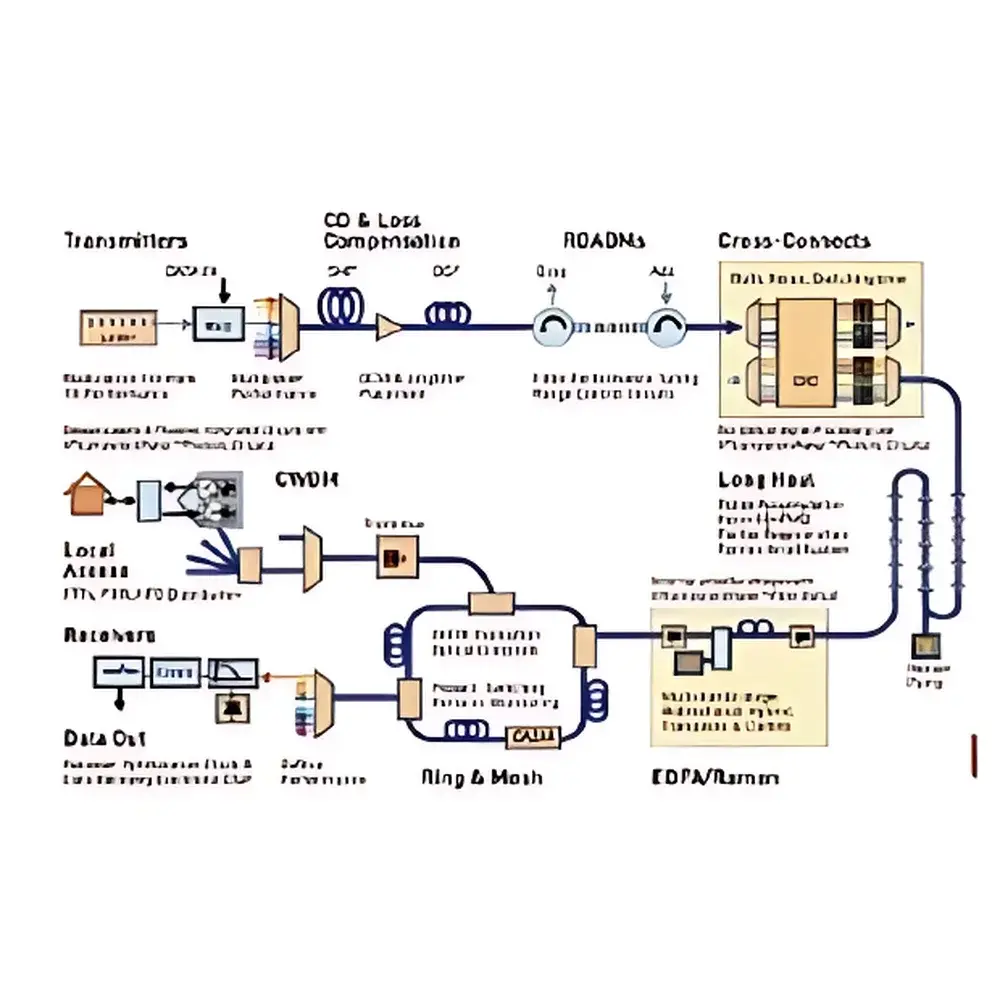
VPItransmissionMaker™ Optical Systems is a comprehensive photonic system simulation platform developed by VPIphotonics, a German engineering software company specializing in high-fidelity optical communication modeling. Built upon first-principles electromagnetic field solvers and physics-based component models, the software enables end-to-end time-domain and frequency-domain simulation of optical transmission systems—from short-reach interconnects and access networks (e.g., PON, XGS-PON, NG-PON2) to metro and long-haul coherent DWDM infrastructure. Its core architecture implements coupled-mode theory, nonlinear Schrödinger equation (NLSE) solvers, stochastic polarization evolution models, and statistical BER estimation frameworks compliant with ITU-T G.698.2 and IEEE 802.3cu specifications. Unlike black-box behavioral simulators, VPItransmissionMaker™ integrates parameterized physical models derived from laboratory measurements and manufacturer datasheets—ensuring traceable correlation between simulated performance and real-world device behavior under varying launch power, dispersion maps, and nonlinear regimes.
Key Features
- Modular library of 700+ validated photonic components—including lasers, modulators (MZM, IQ), photodiodes, EDFAs, Raman pumps, filters, multiplexers, and coherent receivers—with vendor-agnostic parameter import via CSV or XML datasheet ingestion.
- Interactive design workflows supporting parameter sweeps, automatic tuning, gradient-based optimization, macro scripting (Tcl/Python), and GUI-driven “Design Assistant” wizards for rapid prototyping of WDM channel plans, FEC overhead allocation, and dispersion compensation schemes.
- Full-field optical signal propagation modeling with adaptive step-size integration, enabling accurate prediction of nonlinear impairments such as SPM, XPM, FWM, SRS, and polarization-dependent loss under realistic fiber span configurations.
- Native co-simulation interfaces for MATLAB/Simulink, Python (NumPy/SciPy), C++ APIs, Keysight ADS, and Windows COM—allowing hybrid modeling where DSP algorithms (e.g., CMA, LMS equalization, MLSE) run externally while optical layer dynamics remain within VPI’s high-precision solver engine.
- Transient reconfigurable network analysis supporting dynamic add/drop, wavelength routing, and failure scenario replay—essential for evaluating control plane latency, protection switching timing, and optical-layer resilience per ITU-T G.808.1 and G.874 requirements.
- Standards-aligned performance evaluation suite computing bit error rate (BER) via Monte Carlo or semi-analytical Q-factor methods, EVM for higher-order QAM, OSNR with noise accumulation modeling, electrical/optical power (EOP), and RF-domain metrics including IP3 and SFDR for analog photonic links.
- Built-in DSP libraries implementing industry-standard coherent detection algorithms—including carrier recovery, polarization demultiplexing, chromatic dispersion compensation, and probabilistic constellation shaping—validated against OIF CEI-112G and IEEE 802.3bs reference implementations.
- Scalable compute architecture leveraging multi-core CPU threading and CUDA-enabled GPU acceleration—reducing simulation runtime for 100-Gbaud+ coherent systems by up to 8× compared to single-threaded execution without compromising numerical stability or convergence tolerance.
Sample Compatibility & Compliance
VPItransmissionMaker™ Optical Systems supports interoperability across international standardization frameworks critical for telecom equipment qualification and regulatory submissions. Component models are structured to comply with IEC 61290 series test methodologies for amplifier characterization, while system-level outputs align with ITU-T G.694.1 (grid definition), G.698.x (tunable transceiver specs), and G.957 (interface parameters). The software’s audit-ready logging framework records all simulation inputs, model versions, solver settings, and result metadata—enabling GLP-compliant documentation for R&D validation reports and pre-compliance testing toward FCC Part 15, CE RED Directive, and Telcordia GR-1089-CORE immunity requirements. All built-in examples undergo periodic verification against published measurement data from ECOC, OFC, and IEEE Photonics Technology Letters benchmark studies.
Software & Data Management
The platform employs a project-centric file structure (.vpi files) with embedded version control metadata, supporting collaborative design review via timestamped revision snapshots and change-diff visualization. Simulation results are exported in HDF5 format—preserving complex-valued electric field envelopes, spectral density matrices, and time-series eye diagrams for post-processing in third-party tools. For regulated environments, optional FDA 21 CFR Part 11 compliance modules provide electronic signature enforcement, role-based access control, and immutable audit trails of all parameter modifications and result exports. Integration with enterprise PLM systems (e.g., Siemens Teamcenter, PTC Windchill) is supported through RESTful API endpoints and standardized data exchange schemas (STEP AP242, ISO 10303-21).
Applications
- Design and verification of next-generation PON architectures (XGS-PON, 25G/50G-PON) under split-ratio stress and upstream burst-mode constraints.
- Coherent transceiver development for 400ZR, OpenZR+, and 800G-ZR applications—including nonlinearity-aware margin analysis and DSP algorithm co-design.
- Assessment of Raman/EDFA hybrid amplification schemes in ultra-long-haul submarine cables with distributed gain profiling and tilt compensation.
- Interference analysis in dense WDM grids subject to cross-phase modulation and four-wave mixing in heterogeneous fiber spans (SMF + NZDSF + LEAF).
- Evaluation of photonic integrated circuit (PIC) performance under thermal drift, fabrication tolerances, and packaging-induced polarization crosstalk.
- Education and training in optical communications curricula—leveraging 700+ annotated examples covering fundamental concepts (e.g., chirp, dispersion maps) and advanced topics (e.g., machine learning–assisted impairment mitigation).
FAQ
Does VPItransmissionMaker™ support custom component modeling using measured S-parameters or transfer functions?
Yes. Users can import touchstone (.s2p) files or define complex frequency responses via analytical expressions or tabulated data—enabling accurate representation of packaged modulators, AWGs, or silicon photonics devices.
Can simulations be executed in batch mode for automated design space exploration?
Yes. The command-line interface (vpiCLI.exe) supports headless execution, parameter sweeping via JSON configuration files, and integration into CI/CD pipelines for regression testing and design validation automation.
Is there native support for probabilistic modeling of manufacturing variations (e.g., waveguide width fluctuations)?
Yes. The Monte Carlo module allows statistical variation assignment to any physical parameter (e.g., coupling ratio, group delay ripple, laser linewidth), with output distributions generated for BER, Q-factor, and OSNR across thousands of virtual device instances.
How does the software handle polarization-mode dispersion (PMD) in dynamic network scenarios?
PMD is modeled stochastically using the DGD vector formalism with time-varying principal states of polarization (PSP), updated at user-defined intervals to reflect temperature-induced birefringence drift or mechanical vibration effects.
Are license options available for academic institutions and multi-user enterprise deployments?
Yes. Concurrent floating licenses, node-locked academic licenses, and cloud-hosted SaaS subscriptions (AWS/Azure) are offered—with usage telemetry and reporting dashboards for institutional license management.