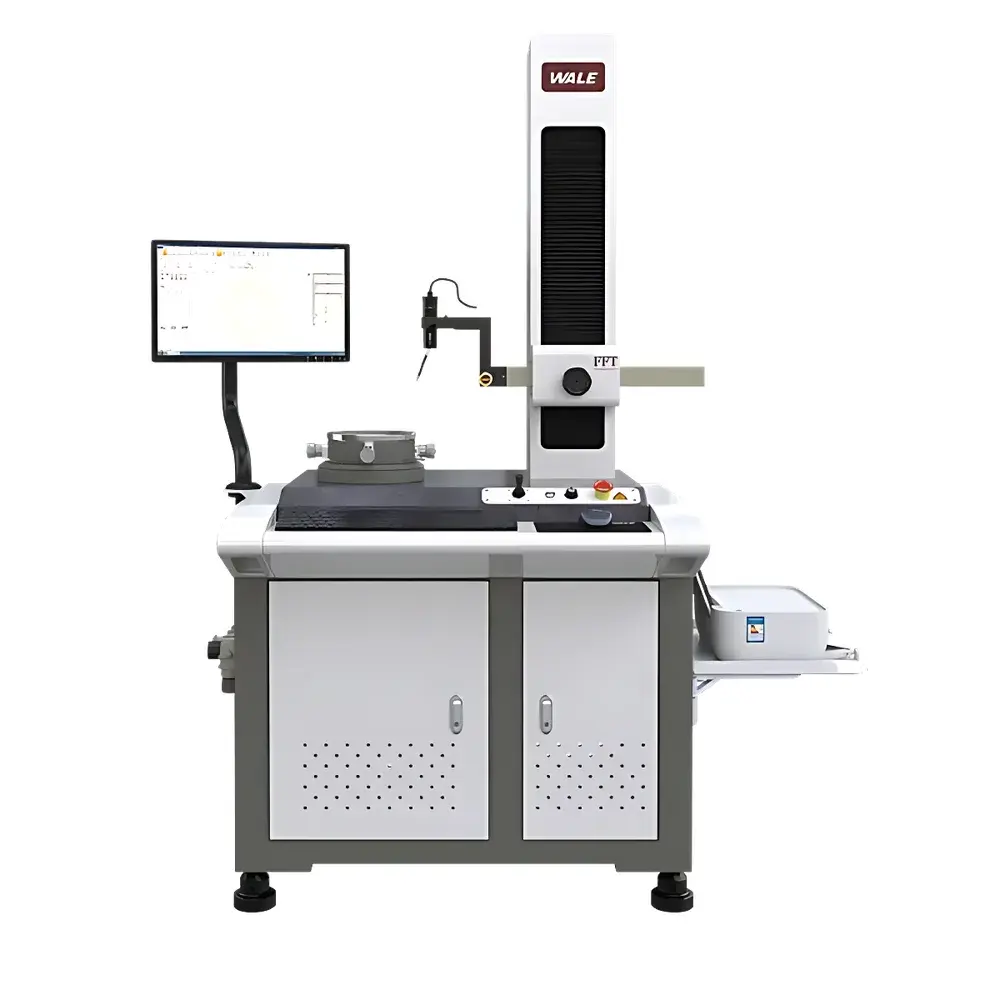
WALE FFT-RDM Series High-Precision Roundness and Harmonic Analysis Measuring Instrument
| Brand | WALE |
|---|---|
| Origin | Shaanxi, China |
| Manufacturer Type | Direct Manufacturer |
| Product Category | Domestic |
| Model | FFT-RDM Series |
| Instrument Type | Roundness Measuring Instrument |
| Harmonic Analysis Range | 1–150 UPR |
| Radial Error (FFT Max1) | ≤10.04 µm |
| Radial Error (FFT Max2) | ≤0.025 µm |
| Radial Error (FFT Max3) | ≤0.015 µm |
| Spindle Rotational Speed | 6 rpm |
| Max Measurable Diameter | 260 mm |
| Max Workpiece Diameter | 400 mm |
| Sensor Range | ±300 µm |
| Sensor Linearity Accuracy | 3 nm + 5% of reading |
| Sensor Resolution | 0.001 µm |
| Horizontal Arm Travel | 165 mm |
| Horizontal Overhang | 25 mm |
| Circumferential Sampling Points | 16,384 points/revolution |
| Angular Division Accuracy | 0.6 arcsec per 1000 divisions |
| Vibration Isolation | Rubber-Mounted Rigid Steel-Frame Base |
Overview
The WALE FFT-RDM Series Roundness and Harmonic Analysis Measuring Instrument is a high-precision metrology system engineered for deterministic geometric evaluation of rotational symmetric components. It operates on the principle of axisymmetric error separation using high-resolution angular sampling combined with fast Fourier transform (FFT)-based harmonic decomposition. The instrument employs a precision air-bearing or mechanical spindle (depending on configuration) rotating at a stable 6 rpm to minimize dynamic disturbance while enabling robust low-speed measurement stability. Its core function is to quantify radial deviation from ideal circularity across successive harmonics — from fundamental (1st order) up to the 150th undulation per revolution (UPR) — thereby distinguishing form errors (e.g., out-of-roundness, lobing, waviness) from mounting or fixture-induced artifacts. Designed for integration into ISO/IEC 17025-accredited calibration labs and Tier-1 automotive/aerospace manufacturing QC cells, the FFT-RDM delivers traceable roundness assessment compliant with ISO 1101, ISO 12181-1 (roundness), and ISO 12180-1 (cylindricity), supporting both single-section and multi-section cylindrical form analysis.
Key Features
- Precision harmonic decomposition engine supporting full-spectrum analysis from 1 to 150 UPR, enabling identification and quantification of individual harmonic contributors (e.g., 3-lobe, 8-lobe, gear-mesh-related orders).
- Sub-nanometer resolution sensor system with 0.001 µm digital resolution and linearity accuracy of 3 nm + 5% — calibrated per ISO 230-2 Annex B protocols.
- 16,384-point circumferential data acquisition per revolution ensures Nyquist-compliant sampling even for high-frequency form deviations up to 8,192 UPR equivalent spatial frequency.
- Rigid square-steel structural base with elastomeric vibration isolation provides <0.02 µm peak-to-valley environmental noise suppression under typical factory-floor conditions (ISO 25378 Class 3 compliant installation).
- Horizontal arm with 165 mm travel and 25 mm overhang accommodates complex part geometries including flanged shafts, bearing races, and stepped cylinders without re-fixturing.
- Dual-mode operation: static (single-revolution) for certification-grade reporting and dynamic (multi-revolution averaging) for process monitoring and repeatability validation.
Sample Compatibility & Compliance
The FFT-RDM Series accommodates workpieces up to 400 mm in external diameter and 260 mm in maximum measurable diameter, with vertical measurement height configurable via optional column extensions. It supports metallic, ceramic, and hardened polymer components with surface roughness down to Ra 0.02 µm. Fixturing is compatible with standard precision chucks, collets, and V-blocks meeting DIN 6499 and ANSI/ASME B5.62 specifications. All measurement reports include full uncertainty budgets calculated per GUM (JCGM 100:2008) and are structured to satisfy audit requirements under IATF 16949, AS9100, and FDA 21 CFR Part 820. Data integrity complies with ALCOA+ principles (Attributable, Legible, Contemporaneous, Original, Accurate), and raw harmonic spectra are stored in vendor-neutral HDF5 format for third-party verification.
Software & Data Management
The embedded WALE MetroSuite v4.x software provides real-time FFT visualization, harmonic amplitude/phase mapping, and automated pass/fail evaluation against user-defined GD&T tolerances. It supports export to CSV, XML, and STEP AP242 for integration with MES (e.g., Siemens Opcenter, PTC ThingWorx) and PLM platforms. Audit trail functionality logs all operator actions, parameter changes, and calibration events with timestamped digital signatures — fully compliant with 21 CFR Part 11 requirements when deployed with Windows OS in validated environments. Batch reporting includes statistical process control (SPC) charts (X̄-R, Cpk), trend analysis across harmonic orders, and comparative overlay of multiple parts or time-series measurements.
Applications
- Automotive: Crankshaft journals, camshaft lobes, brake rotors, and fuel injector nozzles requiring harmonic-specific tolerance verification per OEM engineering specs (e.g., GM GP-12, Ford Q1).
- Aerospace: Turbine blade root forms, bearing bores in gearbox housings, and hydraulic actuator pistons where 3rd- and 5th-order harmonics directly impact fatigue life and sealing performance.
- Medical Device Manufacturing: Orthopedic implant femoral heads, dental abutment interfaces, and surgical instrument hubs demanding conformity to ISO 14242-1 and ASTM F2777.
- Optics & Precision Mechanics: Mirror substrates, lens mounts, and encoder ring surfaces where sub-micron harmonic content influences optical alignment and motion fidelity.
- Research & Standards Laboratories: NMI-level roundness artifact characterization, inter-laboratory comparison studies, and development of new harmonic-based GD&T controls.
FAQ
What harmonic orders does the FFT-RDM Series resolve, and how is aliasing prevented?
The system resolves harmonics from 1st to 150th UPR using 16,384 angular samples per revolution, ensuring a Nyquist limit of 8,192 UPR — well above the analysis band. Anti-aliasing is enforced via hardware-triggered synchronous sampling locked to spindle encoder position.
Is the instrument suitable for in-process or shop-floor deployment?
Yes — its rigid steel frame, rubber-isolated base, and low-speed 6 rpm rotation minimize sensitivity to ambient vibration and thermal drift; it meets ISO 25378 Class 3 environmental requirements for controlled production areas.
How is traceability maintained for calibration and measurement uncertainty?
Each unit ships with a NIST-traceable calibration certificate covering spindle axis error, sensor linearity, and angular encoder accuracy. Uncertainty budgets follow ISO/IEC 17025 Clause 7.6.3 and incorporate contributions from environmental, equipment, operator, and algorithmic sources.
Can the system perform cylindricity analysis beyond single-section roundness?
Yes — optional vertical column extension and Z-axis probe positioning enable multi-section scanning (up to 100 sections), with full 3D harmonic reconstruction and ISO 12180-1-compliant cylindricity vector calculation.
Does the software support automated report generation for quality audits?
Yes — customizable PDF/HTML reports include GD&T callouts, harmonic spectrum plots, SPC summaries, operator ID, timestamp, and digital signature fields — all generated in accordance with ISO 17025 documentation requirements.