
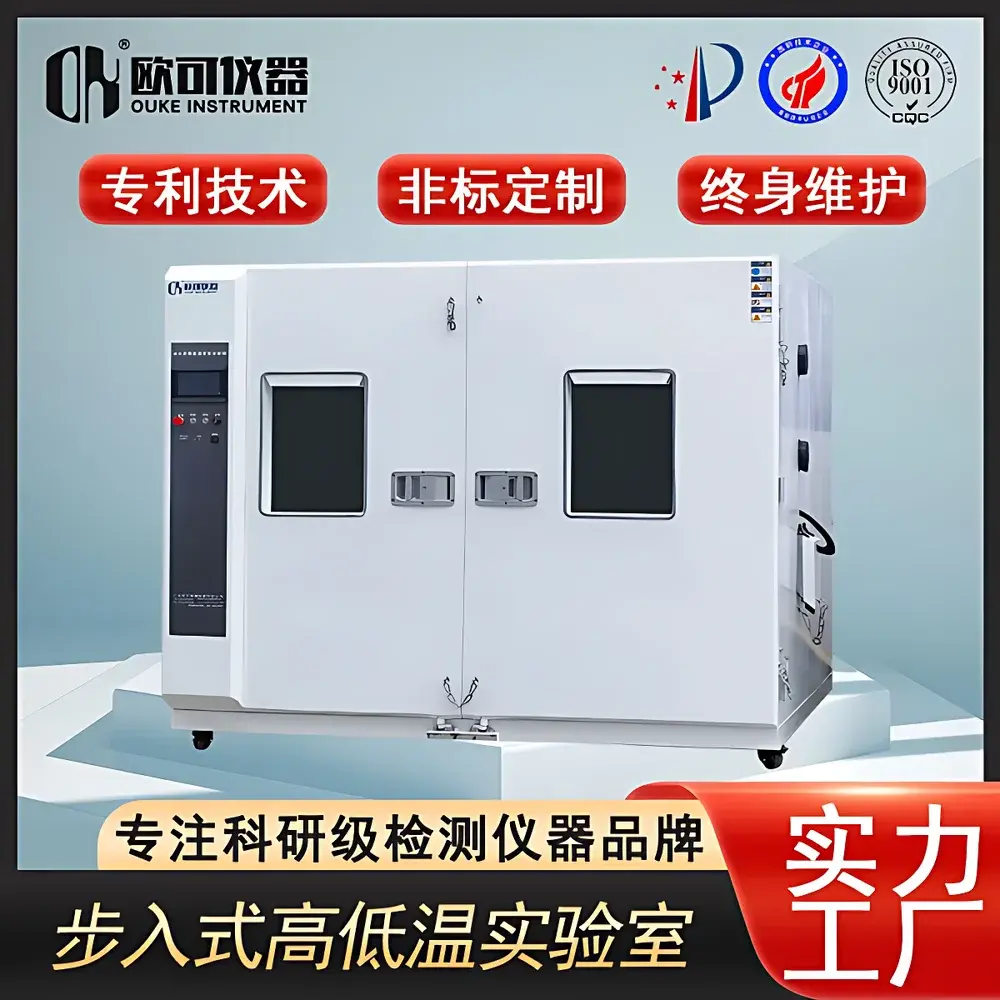
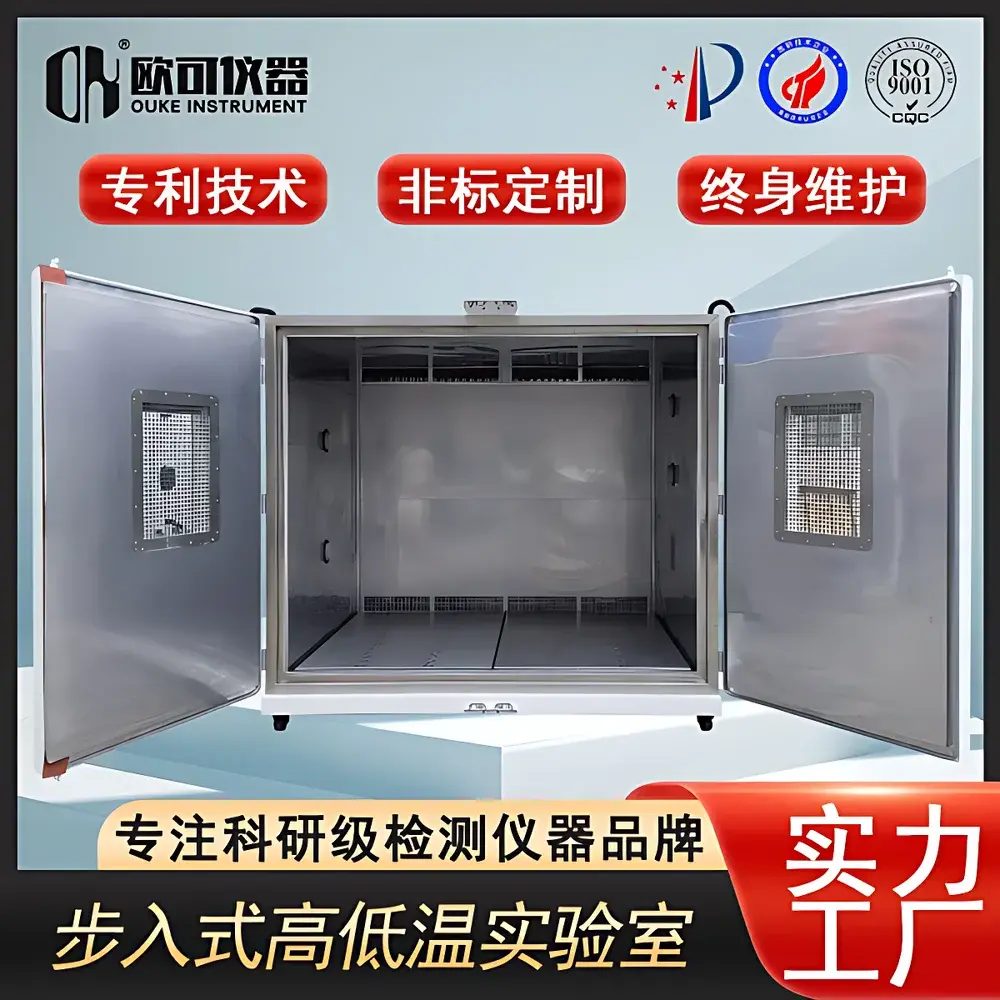
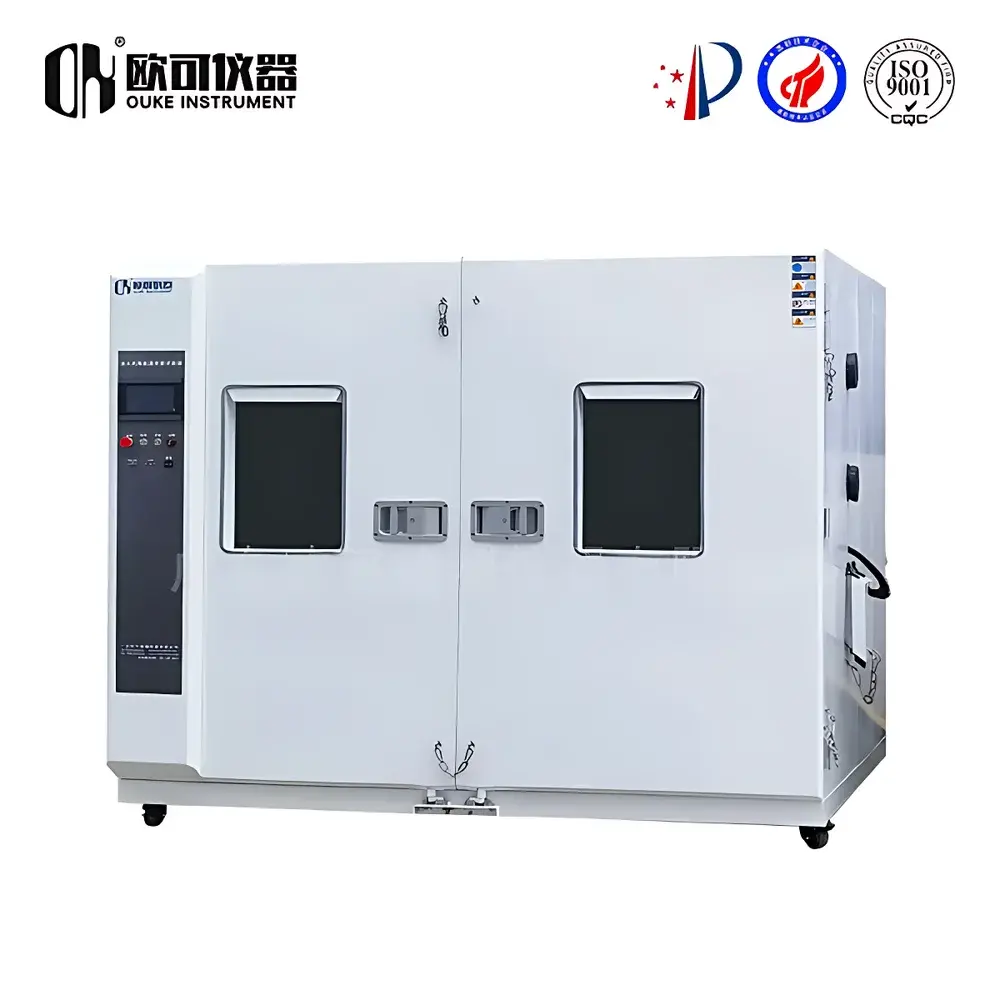
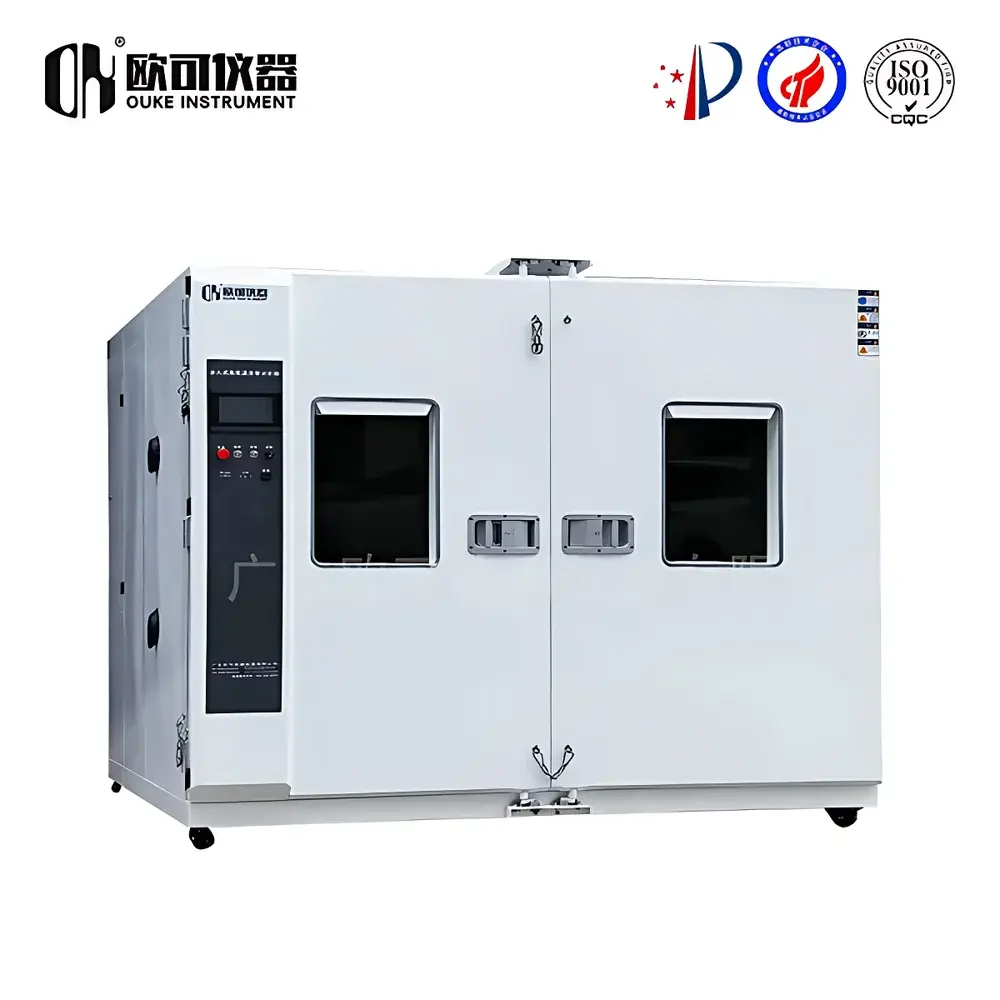
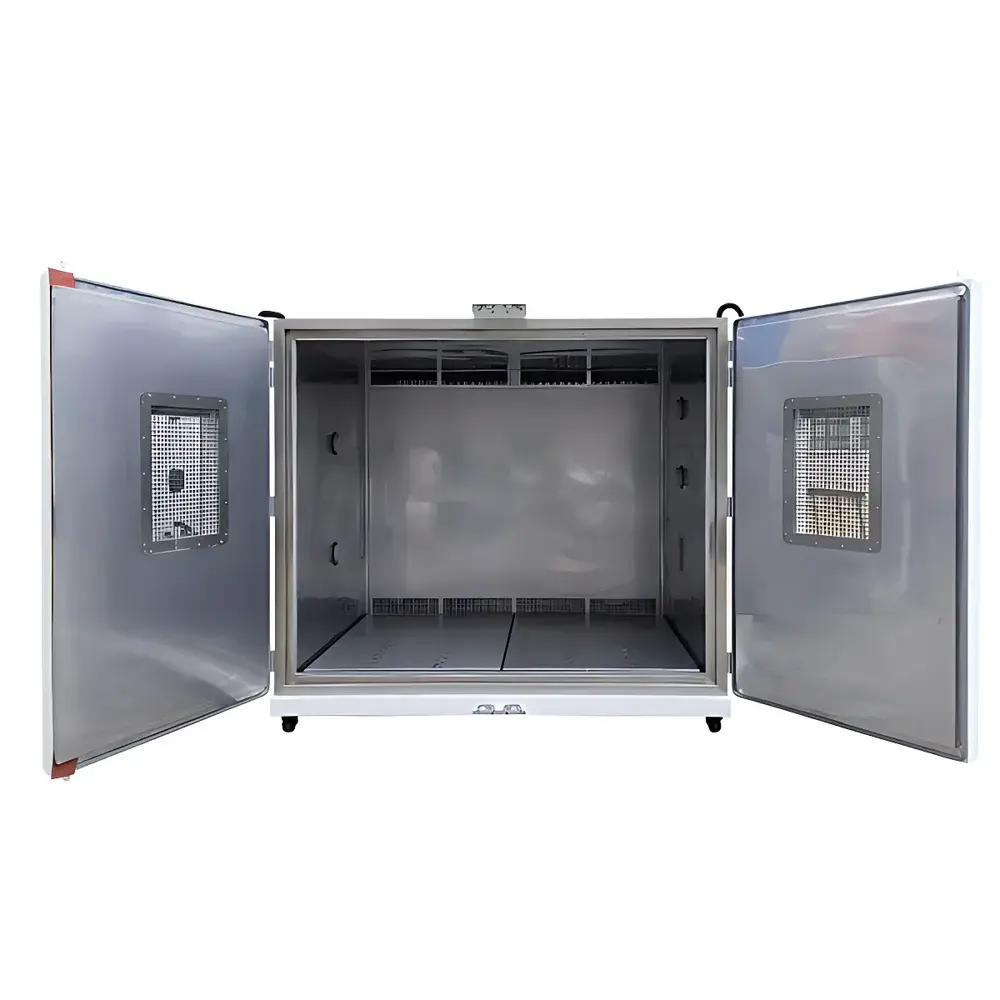
OK Walk-in Constant Temperature & Humidity Test Chamber OK-STH Series
| Brand | OK Instruments |
|---|---|
| Origin | Guangdong, China |
| Manufacturer Type | Direct Manufacturer |
| Product Category | Domestic |
| Model | OK-STH (Custom Volume) |
| Temperature Range | A: 0°C / B: −20°C / C: −40°C / D: −60°C / E: −70°C |
| Temperature Uniformity | ±3°C |
| Temperature Control Accuracy | ±1°C |
| Heating Rate | 1.0–4.0°C/min |
| Internal Dimensions | Custom-Designed per User Specification (D×W×H) |
| Pricing | USD 11,200 (FOB Guangdong) |
Overview
The OK Walk-in Constant Temperature & Humidity Test Chamber OK-STH Series is a large-volume environmental test system engineered for long-term, high-fidelity simulation of controlled thermal and hygrothermal conditions. Designed in accordance with ISO 16750-4, IEC 60068-2-1, IEC 60068-2-2, and GB/T 10586 standards, it employs a dual-loop PID + fuzzy adaptive control architecture to maintain stable setpoints across expansive internal volumes—enabling full-system validation of automotive ECUs, battery packs, medical devices, telecom infrastructure, and industrial control cabinets. Unlike benchtop chambers, the OK-STH allows operator ingress for real-time monitoring, manual intervention, and in-situ instrumentation setup. Its core measurement principle relies on high-stability platinum resistance temperature sensors (PT100 Class A) and capacitive humidity transducers traceable to NIST standards, integrated into a vertically stratified air distribution system featuring perforated plate diffusers and multi-stage recirculation fans. This architecture ensures minimal thermal gradient (<±3°C) and humidity deviation (<±3% RH) across the entire working volume—even under dynamic load conditions including personnel entry, sample power dissipation, and material moisture exchange.
Key Features
- Modular structural design with double-wall insulated panels (100–150 mm polyurethane foam, λ ≤ 0.022 W/m·K), stainless steel interior (SUS304), and electro-galvanized exterior
- Intelligent dual-stage refrigeration system with cascade compressors (for models down to −70°C), R404A/R23 mixed refrigerant, and oil return optimization for continuous 7×24 operation
- Steam-based humidification system with deionized water pretreatment, anti-scale boiler, and precision solenoid valve modulation (RH range: 20–95% RH at 25°C)
- Integrated dew point suppression and condensate management to prevent frost accumulation during low-temperature/humidity cycling
- Standard 300 mm observation window (tempered double-glazed, electrically heated anti-fog), two 100 mm cable ports with silicone gaskets, LED interior lighting, and 220 V AC/30 A internal power outlets
- Optional features include Ethernet-based remote monitoring (Modbus TCP), GLP/GMP-compliant audit trail logging, USB data export, and optional CO₂ sensor integration for chamber atmosphere verification
Sample Compatibility & Compliance
The OK-STH accommodates full-size end products—including EV traction inverters (up to 1.5 m × 1.2 m × 1.8 m), server racks, aerospace avionics enclosures, and pharmaceutical stability storage units. All configurations comply with essential safety and electromagnetic compatibility requirements per GB 4793.1, IEC 61000-6-3, and UL 61010-1. For regulated industries, the system supports 21 CFR Part 11-compliant electronic signatures when paired with OK-LogPro v4.2 software (optional). Calibration certificates for temperature and humidity sensors are provided with NIST-traceable documentation, and optional third-party verification per ISO/IEC 17025 is available upon request. The chamber meets the environmental stress screening (ESS) requirements defined in MIL-STD-810H Method 502.7 (Temperature) and Method 507.6 (Humidity), as well as automotive OEM specifications such as GMW16261 and Ford CETP 00.00-L-467.
Software & Data Management
Control and data acquisition are managed via the OK-TCM2000 touchscreen HMI (7″ TFT, IP65 front rating) running embedded Linux. The interface provides real-time graphing of up to 16 channels (temperature, RH, dew point, compressor status, alarm history), programmable multi-step profiles (up to 99 segments), and event-triggered logging (e.g., door open detection, power interruption). Data is stored locally on a 16 GB industrial-grade SD card with automatic rollover and time-stamped CSV export. Optional OK-LogPro v4.2 PC software enables centralized fleet management, automated report generation (PDF/Excel), trend analysis with statistical process control (SPC) overlays, and secure cloud synchronization via TLS 1.2–encrypted HTTPS. All user actions—including setpoint changes, profile uploads, and calibration adjustments—are recorded with timestamp, operator ID, and reason code to satisfy GLP and GMP audit requirements.
Applications
- Accelerated life testing of lithium-ion battery modules under combined thermal-hygric stress (per UN 38.3, UL 1642, and GB/T 31485)
- Environmental stress screening (ESS) of automotive ADAS controllers prior to field deployment
- Stability studies for Class II/III medical devices under ICH Q1A(R2) and ISO 14971 frameworks
- Validation of HVAC system performance in simulated tropical or arctic ambient conditions
- Long-duration burn-in of 5G baseband units and optical transceivers at elevated temperature/humidity
- Qualification testing of military-grade connectors and cabling assemblies per MIL-DTL-38999
FAQ
What is the standard lead time for a custom OK-STH chamber?
Typical manufacturing and factory acceptance testing (FAT) require 10–12 weeks from confirmed order and final dimensional approval.
Can the chamber be validated for IQ/OQ/PQ protocols?
Yes—OK Instruments provides IQ/OQ templates compliant with ASTM E2500 and Annex 15; PQ support requires site-specific load characterization and is delivered by certified field application engineers.
Is remote firmware update supported?
Firmware updates are performed via secure USB media only; network-based updates are disabled by default to ensure cybersecurity compliance per IEC 62443-3-3.
How is temperature uniformity verified during commissioning?
Uniformity is verified using a 9-point sensor grid (per ISO 16750-4 Annex B), with measurements taken at center and eight corner locations over a 2-hour stabilization period at three representative setpoints (e.g., −40°C, 25°C, 70°C).
Does OK provide on-site installation supervision and SAT?
Yes—standard scope includes foundation verification, utility connection guidance, mechanical/electrical commissioning, and Site Acceptance Testing (SAT) with signed performance report.



