
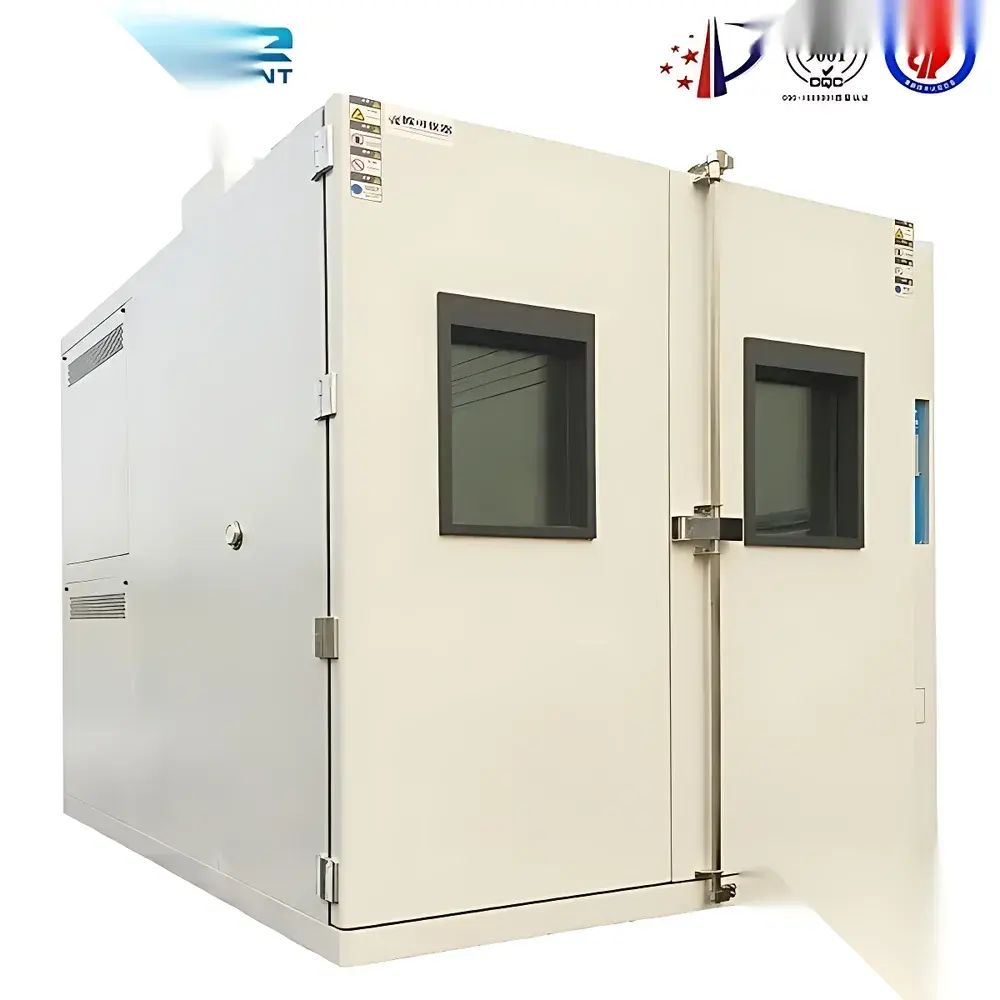
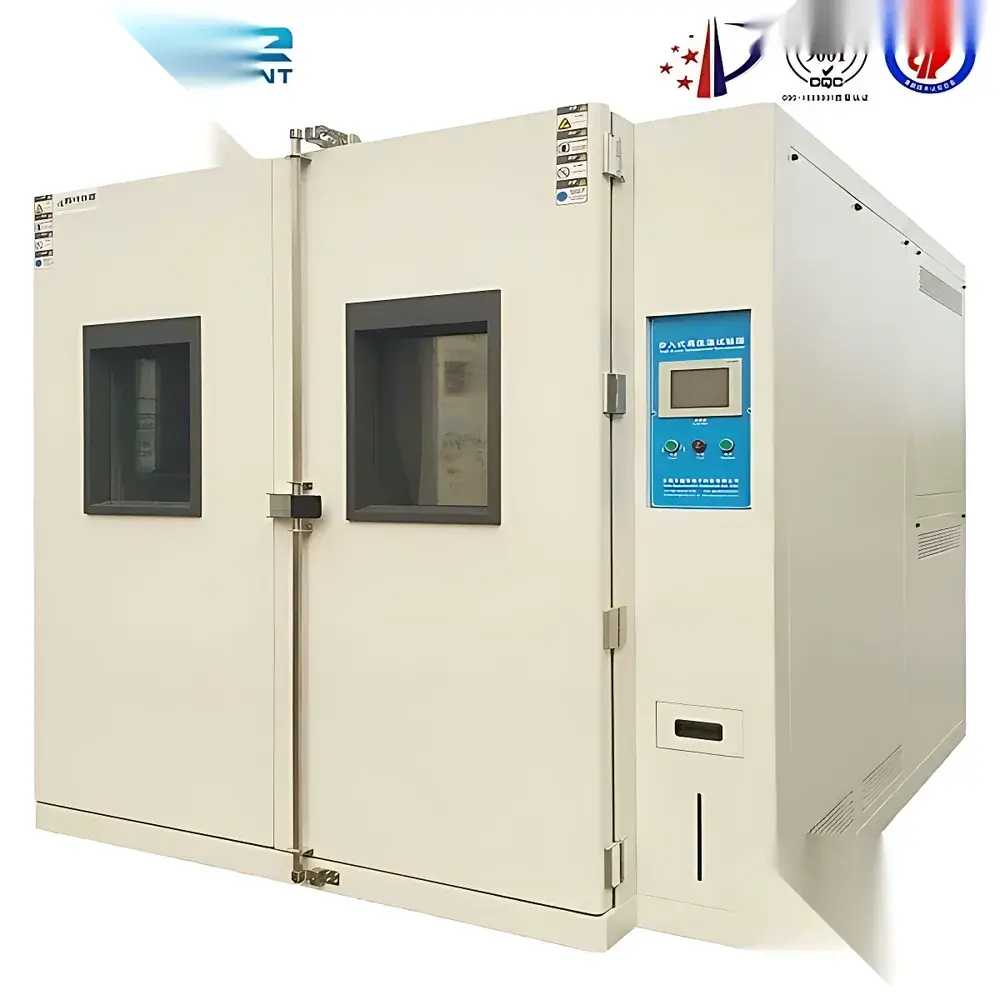
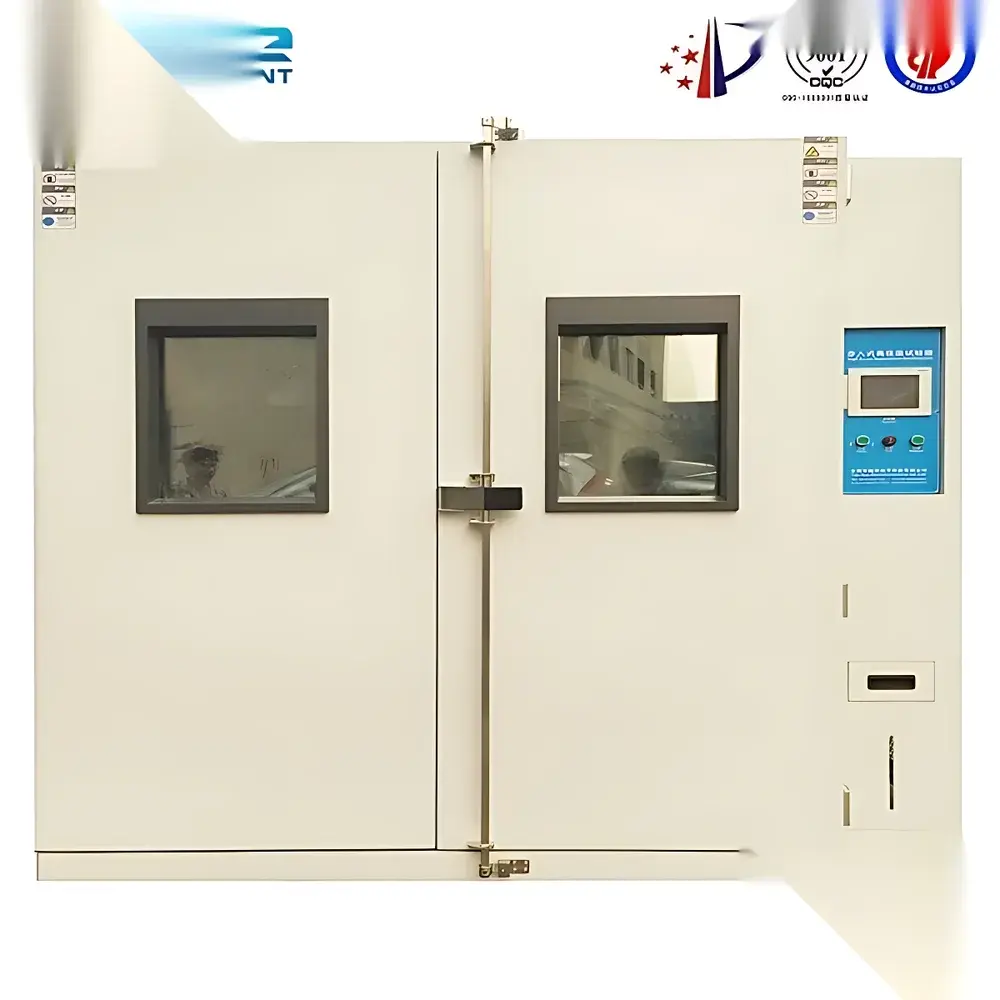
Walk-in Environmental Reliability Test Chamber – Custom-Built for Large-Scale Climate Simulation
| Key | Brand: Other Brands |
|---|---|
| Origin | Imported |
| Manufacturer Type | Authorized Distributor |
| Temperature Range | −70 °C to +120 °C |
| Humidity Range | 10–98% RH |
| Control System | PLC-based with LCD touch interface (English/Chinese) |
| Sensor | Platinum RTD (PT-100, Class A) |
| Interface | RS-232C / RS-485 |
| Construction | Sandwich-panel design with pre-painted outer skin, SUS304 stainless steel inner chamber, and high-efficiency glass fiber insulation |
| Door Options | Hinged, sliding, swing, or motorized |
| Compliance | Designed to support ASTM D4332, ISO 6270, IEC 60068-2 series, and GLP/GMP-aligned validation protocols |
Overview
The Walk-in Environmental Reliability Test Chamber is a fully customizable, large-volume climatic test system engineered for rigorous environmental stress screening of oversized equipment and assemblies—including automotive powertrains, commercial refrigeration units, server racks, telecom infrastructure, and aerospace avionics subsystems. Unlike standard reach-in chambers, this walk-in platform operates on a robust air-handling architecture that enables precise, repeatable simulation of real-world thermal and hygrothermal exposure profiles. Its core measurement principle relies on closed-loop feedback control of conditioned air mass flow, regulated via high-stability platinum resistance thermometers (PT-100, Class A) and capacitive humidity sensors traceable to NIST standards. The chamber’s thermal envelope utilizes vacuum-deposited aerogel-enhanced glass fiber insulation within a triple-layer sandwich panel structure—combining pre-finished coated carbon steel exterior, structural reinforcement framing, and electropolished SUS304 stainless steel interior surfaces—to minimize thermal bridging and ensure long-term dimensional stability under cyclic thermal loading.
Key Features
- Temperature range: −70 °C to +120 °C; humidity range: 10–98% RH, with ramp rates configurable per IEC 60068-3-5 and -3-6
- Modular air treatment options: base-level ambient-air recirculation, external air handling unit (AHU) integration for standardized cycling, internal high-velocity air distribution for rapid thermal transitions, and explosion-proof configuration for hazardous-area humidity-critical testing
- “Sandwich” insulated chamber walls: outer layer — pre-painted cold-rolled steel; core — ultra-low-conductivity glass fiber matting (λ ≤ 0.032 W/m·K); inner liner — mirror-finish SUS304 stainless steel (electropolished, weld-seam passivated)
- Multi-mode access systems: single-leaf hinged door with magnetic gasket seal, bi-parting sliding track system, counterbalanced swing door, or servo-controlled motorized entry with safety interlock and pressure differential monitoring
- Digital barometric pressure display integrated into main control panel; auto-drain condensate collection sump with level sensor and fail-safe overflow detection
- Programmable logic controller (PLC) platform featuring dual-language (English/Chinese) capacitive touchscreen HMI, multi-zone PID tuning, and embedded data logging at user-defined intervals (min. 1 sec resolution)
Sample Compatibility & Compliance
This chamber accommodates physical footprints up to 6 m (L) × 3 m (W) × 3 m (H), supporting full-system functional testing under controlled environmental stress. Internal airflow uniformity meets ±1.5 °C and ±3% RH tolerance across the working volume per ISO 16750-4 Annex C and MIL-STD-810H Method 502.5. Structural integrity complies with ASME BPVC Section VIII Div. 1 for pressure-retaining components where applicable. All electrical subsystems conform to IEC 61000-6-2 (immunity) and IEC 61000-6-4 (emissions). Optional IQ/OQ documentation packages are available to support FDA 21 CFR Part 11-compliant electronic records, audit trails, and user role-based access control in regulated pharmaceutical and medical device manufacturing environments.
Software & Data Management
The integrated control software supports both point-set operation and multi-segment programmable profiles—including step, ramp-soak, and looping sequences—with up to 1,000 segments per program. Real-time data visualization includes dual-axis trend plots (temperature vs. time, humidity vs. time), deviation alarms with configurable thresholds, and automatic event tagging (door open, power interruption, sensor fault). Raw measurement logs export in CSV format compatible with JMP, MATLAB, and Minitab. Remote supervision is enabled via Ethernet TCP/IP using Modbus TCP or optional OPC UA server module. Full system calibration history, maintenance logs, and operator action timestamps are retained locally with tamper-evident digital signatures aligned with GLP and GMP documentation requirements.
Applications
- Automotive component validation per ISO 16750-4 (road vehicle environmental conditions) and SAE J2412 (accelerated aging)
- Reliability growth testing (RGT) of consumer electronics enclosures, battery packs, and display modules under combined thermal-humidity stress
- Pre-compliance screening for MIL-STD-810H environmental test methods including Method 502.5 (low temperature), Method 503.5 (high temperature), and Method 507.6 (humidity)
- Stability studies of industrial control cabinets, UPS systems, and outdoor telecom shelters operating across global climate zones
- Accelerated life testing (ALT) of hermetic seals, potting compounds, and conformal coatings used in aerospace-grade electronics
FAQ
What is the typical lead time for a custom walk-in chamber?
Lead time ranges from 14–20 weeks depending on chamber dimensions, performance specifications, and selected air-handling configuration.
Can the chamber be validated for GxP-regulated use?
Yes—optional IQ/OQ/PQ protocol packages, 3Q traceable calibration certificates, and 21 CFR Part 11-compliant software add-ons are available upon request.
Is remote monitoring supported without third-party middleware?
Yes—the built-in Ethernet interface supports native Modbus TCP communication and includes an embedded web server for browser-based status viewing and basic parameter adjustment.
What maintenance intervals are recommended for long-term reliability?
Compressor oil and refrigerant filter replacement every 12 months; humidity sensor recalibration annually; full system verification every 24 months per ISO/IEC 17025 guidelines.
Are seismic or vibration isolation options available?
Yes—optional inertial mass base plates and active/passive damping mounts can be integrated during factory assembly to meet IBC 2018 and IEEE 693 seismic performance criteria.



