
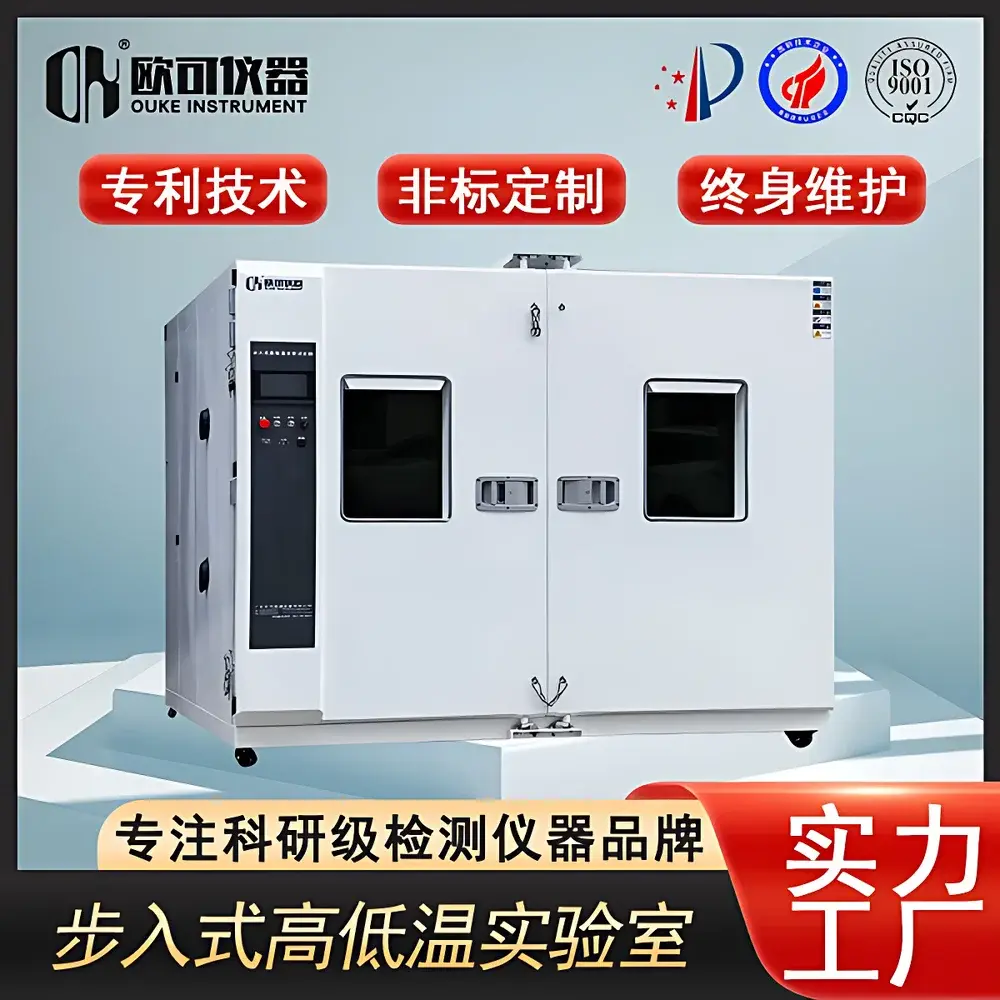
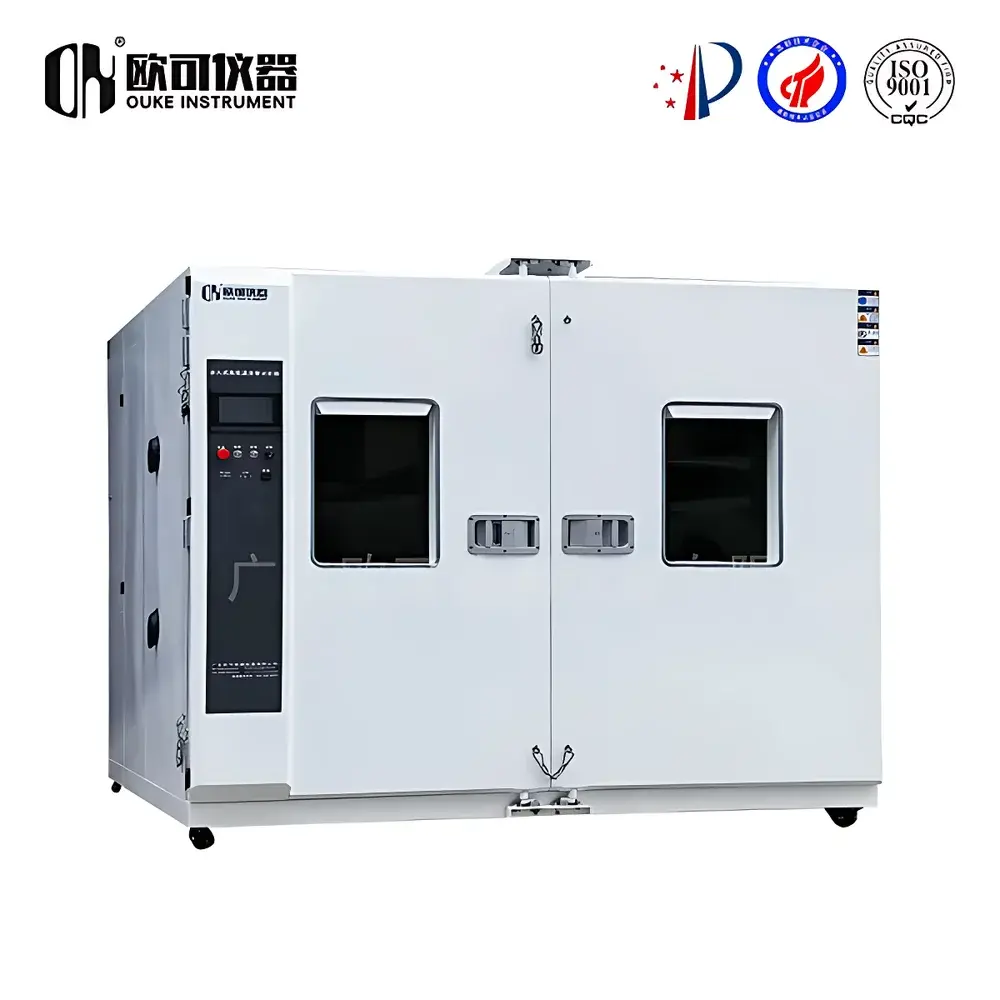
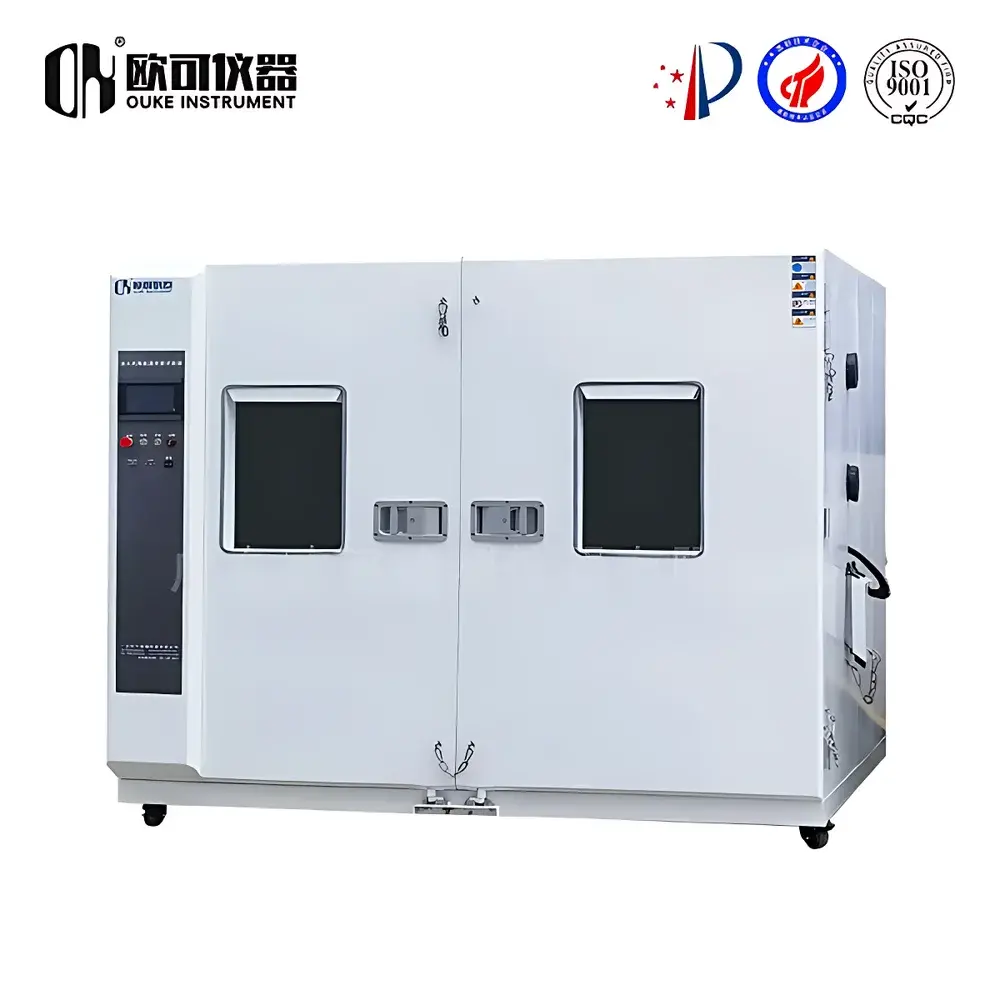
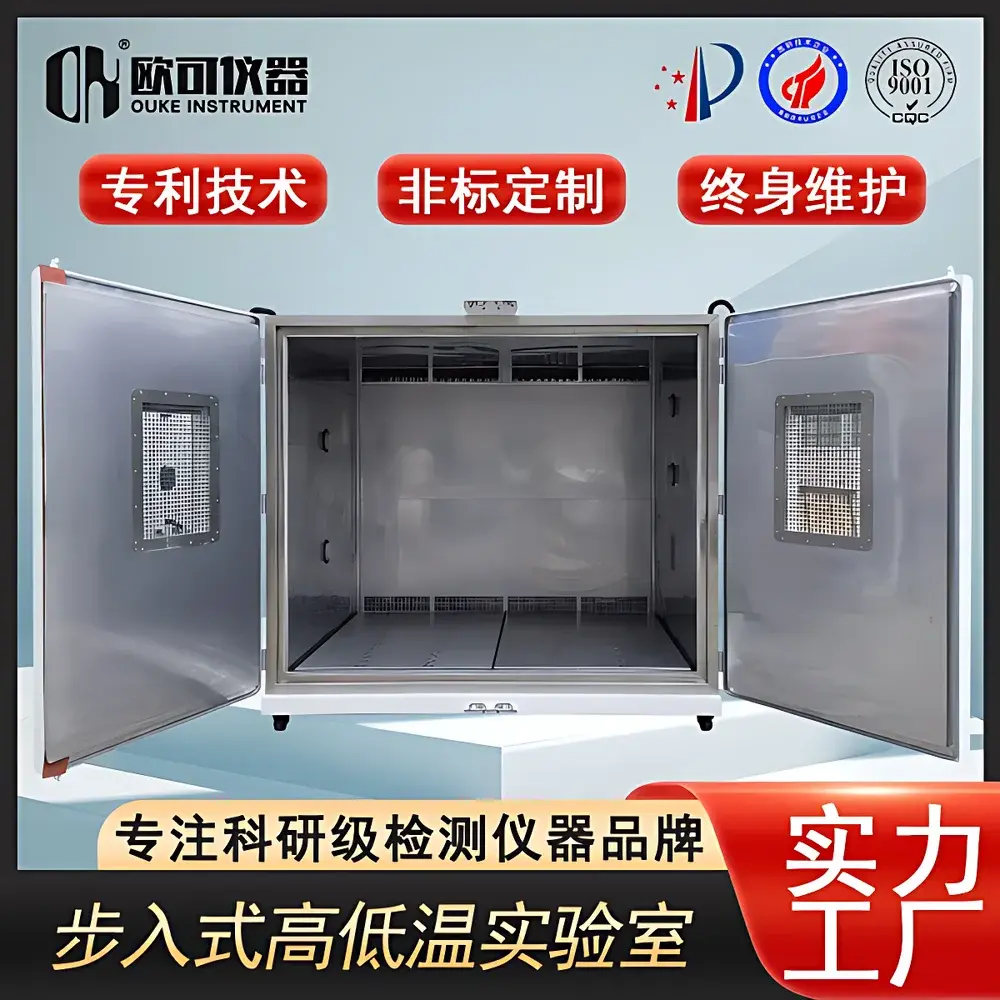
OK Walk-in Environmental Test Chamber OK-STH-12.0000m²
| Brand | OK Instruments |
|---|---|
| Origin | Guangdong, China |
| Manufacturer Type | Direct Manufacturer |
| Product Origin | Domestic (China) |
| Model | OK-STH-12.0000m² |
| Internal Dimensions (W×D×H) | 2000 × 3000 × 2000 mm |
| Temperature Range Options | A: 0°C to +85°C |
| B | −20°C to +85°C |
| C | −40°C to +85°C |
| D | −60°C to +85°C |
| E | −70°C to +85°C |
| Temperature Uniformity | ±3°C |
| Temperature Control Accuracy | ±1°C |
| Heating Rate | 1.0–4.0°C/min |
| Construction | Modular PU-insulated sandwich panels with steel frame, walk-in sealed door with anti-frost heating, integrated air circulation ducting and centrifugal fans |
| Refrigeration System | Cascade refrigeration (dual-stage compressors), evaporator and heater arrays distributed for uniform thermal field |
| Control System | Industrial PLC-based controller with programmable multi-step temperature profiles, real-time data logging, remote monitoring interface, and safety interlocks |
Overview
The OK Walk-in Environmental Test Chamber OK-STH-12.0000m² is a large-volume, floor-standing environmental simulation system engineered for system-level reliability validation under controlled thermal stress conditions. Designed around the principle of forced-air convection within a thermally isolated chamber, it employs a cascade refrigeration architecture—comprising high-temperature and low-temperature compressor stages—to achieve stable operation across extended temperature ranges from −70°C to +85°C. Its 12 m² internal footprint (2000 mm W × 3000 mm D × 2000 mm H) enables direct human access for installation, instrumentation, and real-time intervention during testing—making it uniquely suited for whole-unit evaluation where sample size, connectivity, or operational complexity precludes use of benchtop or upright chambers. Unlike compact environmental chambers, this walk-in platform integrates structural reinforcement, multi-zone airflow management, and scalable thermal load compensation—critical for testing active devices such as energized battery energy storage systems (BESS), electric vehicle powertrains, avionics racks, and telecom server cabinets.
Key Features
- Modular insulated panel construction: Double-skinned galvanized steel or stainless-steel cladding with ≥150 mm thick high-density polyurethane (PU) core (thermal conductivity ≤0.022 W/m·K), enabling long-term insulation integrity and structural rigidity.
- Walk-in sealed access door: 1200 mm wide × 2000 mm high, equipped with electrothermal anti-frost heating, magnetic safety lock, and double-glazed observation window for continuous visual monitoring without thermal leakage.
- Cascade refrigeration system: Dual independent refrigerant circuits (R404A/R23 or R507/R23) optimized for deep-cold stability; optional LN₂ assist available for enhanced cooling ramp rates in qualification-grade thermal shock protocols.
- Uniform air distribution: Four vertically staged centrifugal blowers (total airflow ≥12,000 m³/h) coupled with precision-engineered ductwork ensure temperature deviation ≤±3°C across the full test volume per IEC 60068-3-5.
- Industrial-grade control architecture: Siemens S7-1200 PLC with 10.4″ color touchscreen HMI; supports up to 99 programmable steps, 1000+ segment cycles, ramp/soak profiles, and real-time deviation alarms with configurable relay outputs.
- Comprehensive safety system: Includes over-temperature cut-off, refrigerant pressure monitoring, door-open interlock, phase failure protection, and emergency stop circuit compliant with EN 61000-6-2/6-4 EMC standards.
Sample Compatibility & Compliance
This chamber accommodates physically integrated systems—including complete EV powertrains, 48V/800V battery modules, aerospace flight control units, photovoltaic inverters, and rack-mounted data center infrastructure—without disassembly. Its open interior layout allows routing of high-current cables, fiber-optic telemetry lines, and sensor harnesses via multiple sealed feedthrough ports (Φ50–Φ100 mm). The unit conforms to key international environmental testing standards including ISO 16750-4 (road vehicles), MIL-STD-810H Method 501.7/502.7 (temperature storage/operational), IEC 60068-2-1 (cold), IEC 60068-2-2 (dry heat), and ASTM D4332 (conditioning of plastics). Optional validation packages support IQ/OQ documentation aligned with GLP and GMP requirements, including traceable calibration certificates (NIST-traceable RTDs), uncertainty budgets, and 21 CFR Part 11-compliant audit trails when paired with OK’s optional data acquisition module.
Software & Data Management
The embedded controller logs time-stamped temperature readings at user-defined intervals (1 s to 60 min resolution) with automatic CSV export via USB or Ethernet. An optional PC-based OK-EnviroLog software suite provides synchronized multi-channel trending (up to 16 external thermocouple inputs), statistical process control (SPC) charts, alarm history filtering, and PDF report generation with digital signature capability. All logged data are stored redundantly on internal flash memory and external SD card. Remote access is supported via Modbus TCP or OPC UA protocols, enabling integration into centralized MES or LIMS environments. Audit trail functionality records operator login/logout events, profile edits, manual overrides, and system error codes—fully compliant with FDA 21 CFR Part 11 requirements when configured with electronic signature authentication.
Applications
- Automotive: Whole-vehicle cold-start validation at −40°C; HVAC performance mapping; battery thermal runaway propagation studies under dynamic cycling; ADAS sensor drift characterization across thermal transients.
- Aerospace & Defense: Ground-based environmental screening of UAV airframes, radar subsystems, and satellite payload electronics per DO-160G Section 4.
- Energy Storage: Accelerated life testing of grid-scale BESS cabinets under combined thermal cycling and charge/discharge load profiles.
- Telecommunications: Thermal stress validation of 5G baseband units and edge computing nodes operating at elevated ambient temperatures (e.g., +65°C).
- Industrial Electronics: HALT/HASS pre-screening of industrial PLCs, motor drives, and power converters using programmable extreme temperature excursions.
- Materials Science: Batch aging of polymer composites, adhesives, and conformal coatings under sustained thermal exposure per ASTM G151/G155 protocols.
FAQ
What is the maximum thermal load this chamber can offset during operation?
The OK-STH-12.0000m² is rated for continuous internal heat dissipation up to 8 kW (configurable up to 15 kW with auxiliary cooling options), accommodating powered devices such as running inverters or battery discharge systems.
Can humidity control be added retroactively?
No—humidity capability requires dedicated steam generator, dehumidification coil, and moisture-resistant chamber lining. Humidity-enabled variants (OK-STH-H series) must be specified at time of order.
Is on-site assembly required?
Yes. Due to dimensional constraints, the chamber ships in modular panels and requires certified field technicians for mechanical assembly, refrigerant charging, and system commissioning—including thermal uniformity mapping and control loop tuning.
Does the system support automated test sequencing with external equipment?
Yes. Digital I/O ports and Modbus TCP enable synchronization with external power supplies, data loggers, or robotic handlers for unattended multi-stage reliability campaigns.
What maintenance intervals are recommended for the cascade refrigeration system?
Compressor oil analysis and filter dryer replacement every 24 months; annual inspection of refrigerant charge, fan belt tension, and electrical contact integrity per OK Maintenance Manual Rev. 3.2.



