
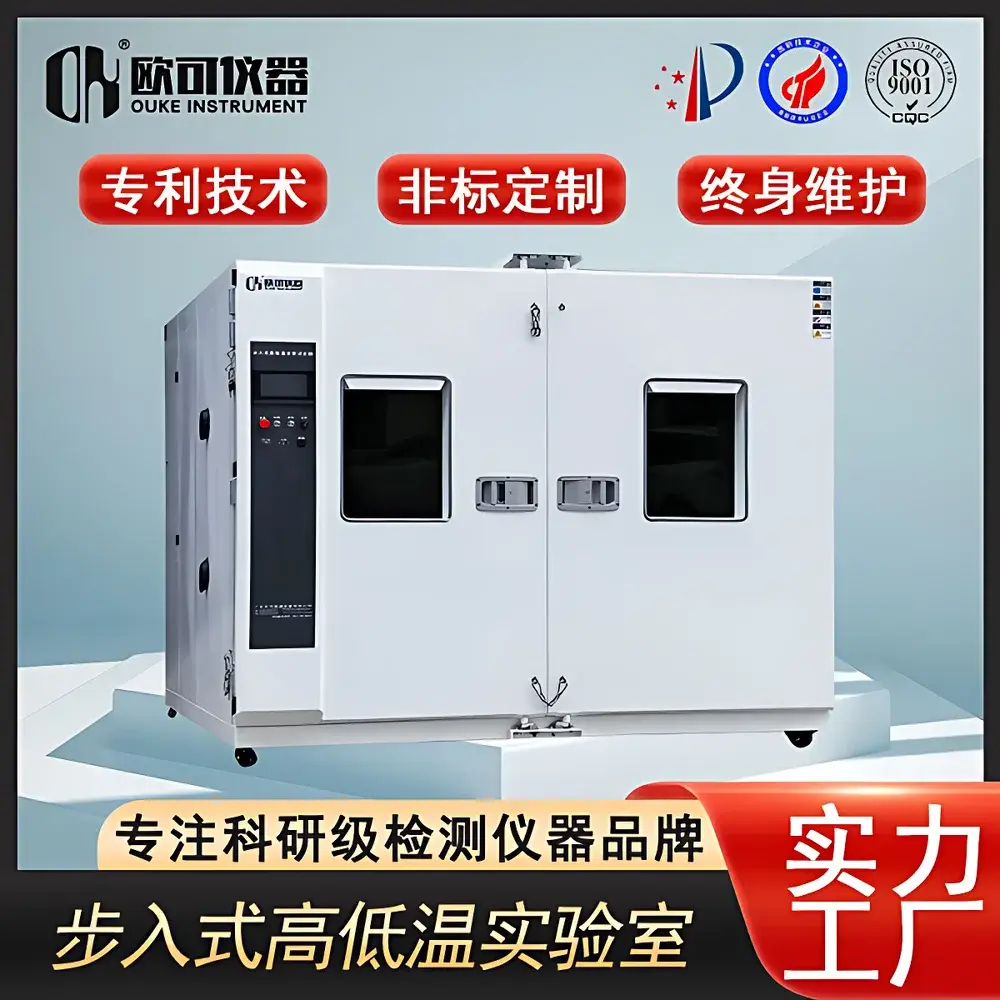
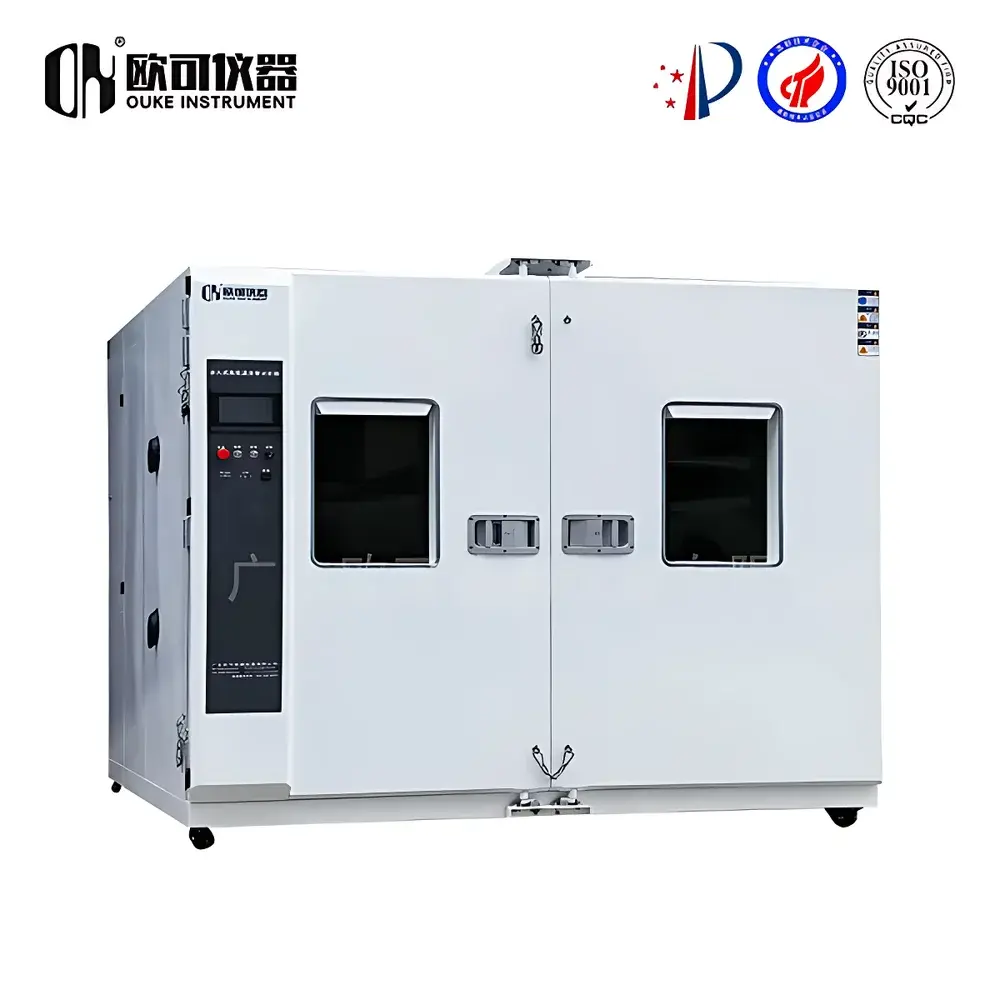
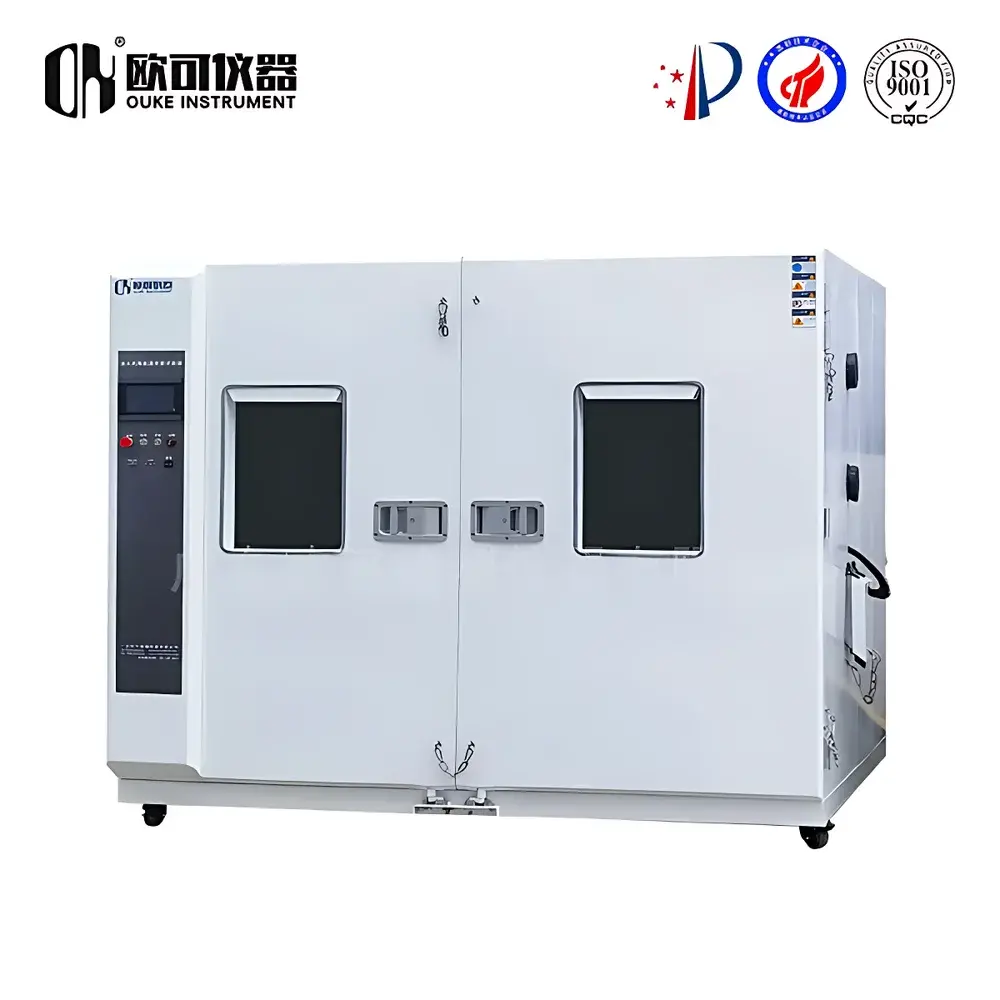
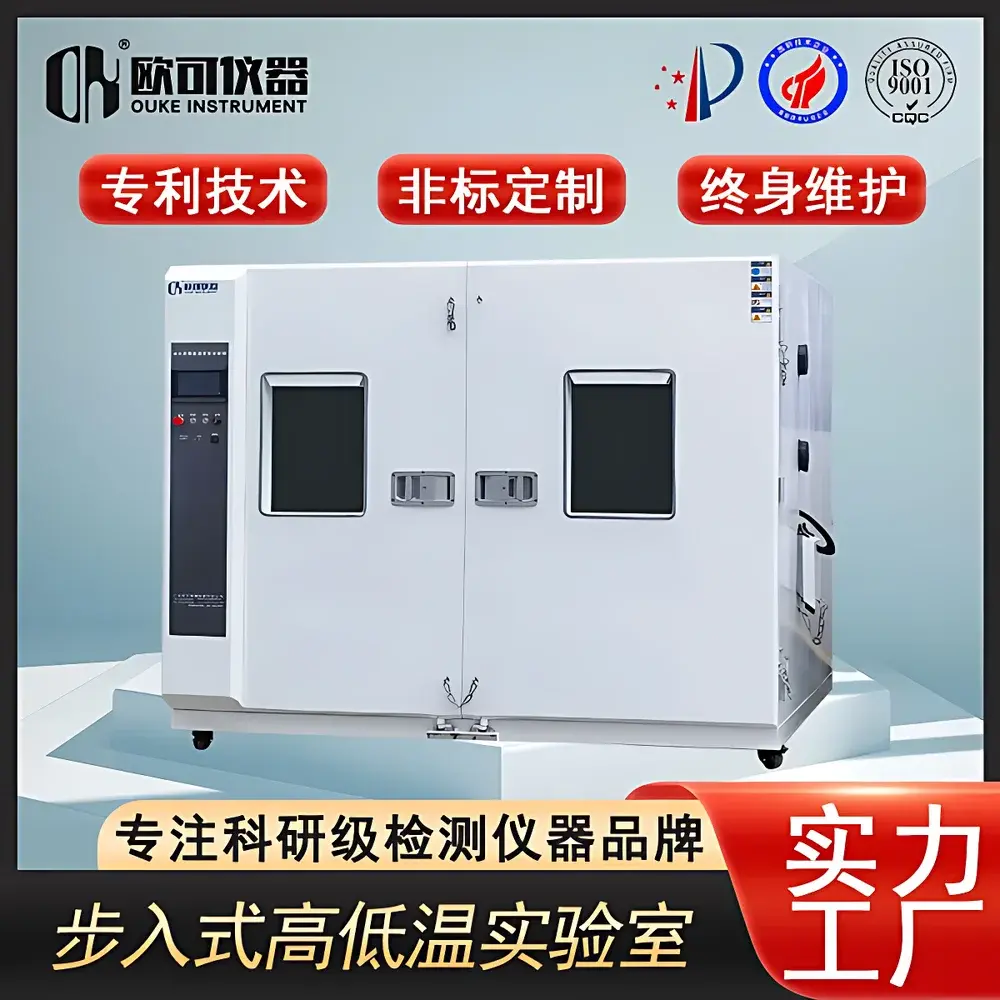
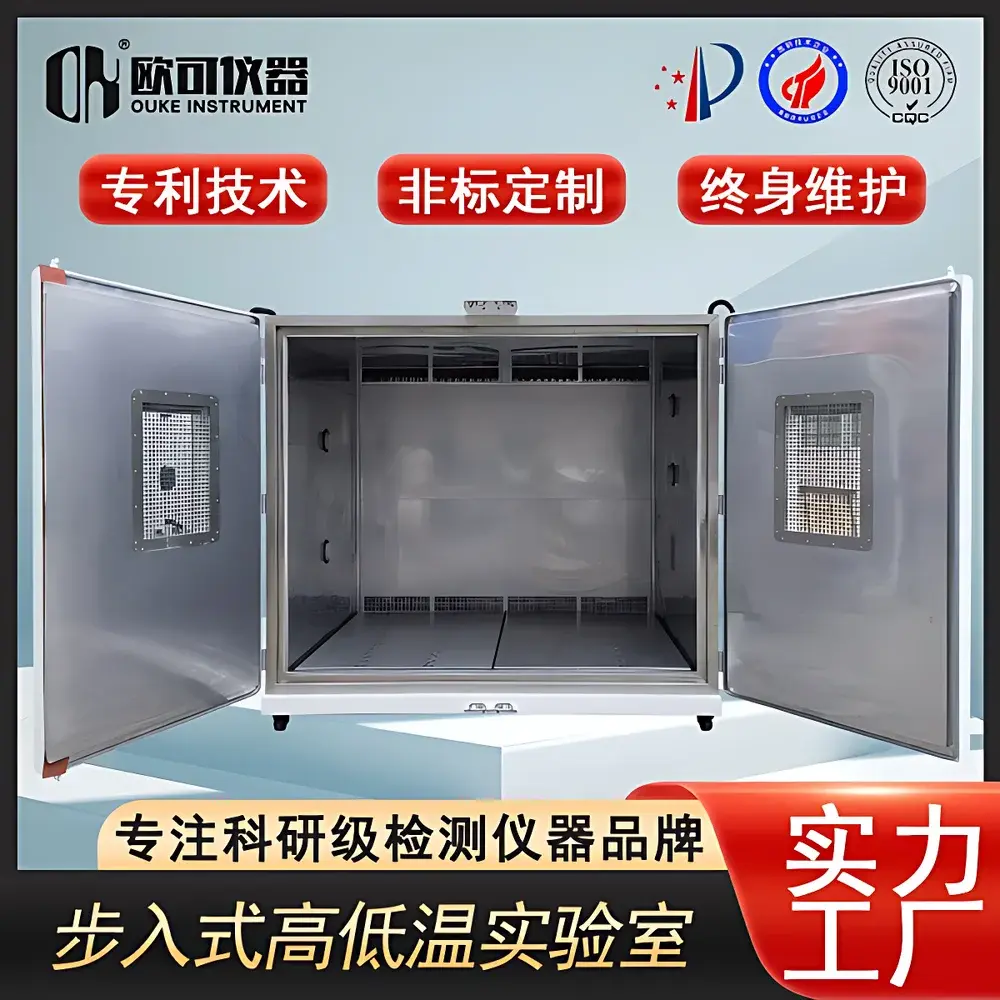
OK Walk-in Environmental Test Chamber OK-STH-12.0100m²
| Brand | OK Instruments |
|---|---|
| Origin | Guangdong, China |
| Manufacturer Type | Direct Manufacturer |
| Product Origin | Domestic (China) |
| Model | OK-STH-12.0100m² |
| Temperature Range | Selectable Options — A: 0°C to +150°C |
| B | −20°C to +150°C |
| C | −40°C to +150°C |
| D | −60°C to +150°C |
| E | −70°C to +150°C |
| Temperature Uniformity | ±3°C (within working volume) |
| Temperature Control Accuracy | ±1°C |
| Heating Rate | 1.0–4.0°C/min (average, under no-load conditions) |
| Working Volume | Custom-engineered per client specification (minimum base footprint: 12.0 m² floor area) |
Overview
The OK Walk-in Environmental Test Chamber OK-STH-12.0100m² is a fully enclosed, human-accessible climatic simulation system engineered for high-fidelity replication of temperature and humidity stress profiles in accordance with international environmental testing standards—including IEC 60068-2-1 (cold), IEC 60068-2-2 (dry heat), IEC 60068-2-30 (damp heat, cyclic), ISO 16750-4 (road vehicles), and GB/T 2423.4 (Chinese national standard for damp heat cycling). Unlike benchtop or reach-in chambers, this walk-in platform enables full-system validation of large-scale equipment—such as electric vehicle battery packs, aerospace avionics enclosures, industrial control cabinets, and photovoltaic inverters—under programmable, multi-step thermal-hygrometric sequences. Its core operational principle relies on coupled thermodynamic control: independent yet synchronized regulation of refrigeration capacity, resistive heating output, steam-based humidification, and forced-air circulation to maintain spatially uniform and temporally stable environmental conditions across the entire test volume.
Key Features
- Modular structural design using high-density polyurethane (PU) insulated panels with stainless steel or pre-painted galvanized steel cladding—ensuring thermal resistance ≥0.85 W/m²·K and long-term dimensional stability.
- Multi-stage refrigeration system incorporating scroll or semi-hermetic piston compressors, copper-aluminum finned condensers, and precision expansion valves—capable of achieving −70°C operating lows with continuous dehumidification down to 10% RH at elevated temperatures.
- High-efficiency nickel-chromium alloy heating elements integrated into the air handling unit (AHU), enabling precise ramp-rate control from 1.0 to 4.0°C/min under no-load conditions, compliant with IEC 60068-2-11 acceleration requirements.
- Steam-type humidification system utilizing electrode or boiler-type generators fed by reverse-osmosis (RO) purified water—minimizing mineral deposition and ensuring traceable RH reproducibility between 10% and 98% RH across the operational temperature range.
- Optimized air distribution architecture featuring forward-curved centrifugal fans and a top-down, bottom-return airflow pattern—validated via CFD modeling to achieve ≤±3°C temperature uniformity and ≤±3% RH uniformity across the defined working volume.
- Industrial-grade programmable logic controller (PLC)-based touch interface with real-time data logging, alarm event history, and configurable user access levels—designed for integration into GLP/GMP-compliant laboratories requiring audit-ready operation records.
Sample Compatibility & Compliance
This chamber accommodates physically large or thermally massive test specimens—including assembled automotive ECUs, 48V/800V battery modules, telecom base station cabinets, and military-grade electronics enclosures—without compromising environmental fidelity. Internal dimensions are fully customizable; minimum floor area starts at 12.0 m² (e.g., 4.0 m × 3.0 m), with height options ranging from 2.2 m to 3.5 m. All configurations meet CE marking requirements and incorporate dual-redundant safety systems: independent high-limit temperature cutouts, phase-loss protection, refrigerant pressure monitoring, low-water-level interlocks for humidifiers, and ground-fault circuit interrupters (GFCIs). The system supports compliance documentation packages aligned with ISO/IEC 17025 accreditation, including factory calibration certificates for Pt100 temperature sensors and capacitive RH transducers traceable to NIM (National Institute of Metrology, China).
Software & Data Management
The embedded control software provides ISO/IEC 17025-compatible data integrity features: time-stamped parameter logging at user-defined intervals (1 s to 60 min), encrypted binary file storage, and export to CSV or PDF formats. Optional Ethernet or RS-485 connectivity enables remote monitoring via Modbus TCP or OPC UA protocols. For regulated environments, an optional FDA 21 CFR Part 11-compliant software package is available—featuring electronic signatures, role-based permissions, audit trails covering all setpoint changes and manual overrides, and immutable record archiving. Calibration logs, maintenance histories, and sensor drift reports are automatically appended to each test session’s metadata, facilitating internal quality audits and third-party certification reviews.
Applications
- Automotive & Mobility: Validation of ADAS sensor housings, powertrain inverters, and cabin HVAC controllers under combined thermal shock and condensation cycles per ISO 16750-4 and LV-124.
- Energy Storage: Accelerated life testing of lithium-ion battery modules under IEC 62660-2 thermal cycling and IEC 60068-2-30 damp heat exposure.
- Electronics Manufacturing: Burn-in screening of server racks, 5G radio units, and industrial PLCs per JEDEC JESD22-A108 and Telcordia GR-63-CORE.
- Aerospace & Defense: Environmental qualification of flight-critical components per MIL-STD-810H Method 502.7 (low temperature), Method 507.6 (humidity), and Method 508.7 (temperature shock).
- Academic & Certification Labs: Reference-grade environmental conditioning for material aging studies, polymer degradation analysis, and ISO/IEC 17025-accredited test service delivery.
FAQ
What is the standard warranty coverage for the OK-STH-12.0100m² chamber?
Standard warranty includes 24 months parts-and-labor coverage for all mechanical, electrical, and control subsystems—excluding consumables such as RO membranes, humidifier electrodes, and calibration gases.
Can the chamber be validated per IQ/OQ protocols?
Yes. OK Instruments provides vendor-supported Installation Qualification (IQ) and Operational Qualification (OQ) documentation templates aligned with GAMP5 and Annex 11 guidelines, along with on-site commissioning support.
Is external vibration isolation required when integrating with shakers or load frames?
Not inherently—but if concurrent mechanical stress testing is planned, structural decoupling via spring-mounted subframes or inertia bases is recommended to prevent cross-coupling of vibrational energy into the chamber’s thermal control loop.
How is temperature/humidity uniformity verified during factory acceptance testing (FAT)?
A 9-point sensor grid (per IEC 60068-3-5) is deployed across the working volume; measurements are recorded over 3 consecutive hours at three representative setpoints (e.g., −40°C/10% RH, 25°C/60% RH, +85°C/85% RH) to confirm compliance with stated uniformity specifications.
Does the system support custom programming of non-linear ramp/soak profiles?
Yes. The controller accepts up to 99 segments per program, including variable ramp rates, dwell times, and conditional branching based on real-time sensor feedback—enabling implementation of complex standards like IEC 60068-2-30 Test Db.



