
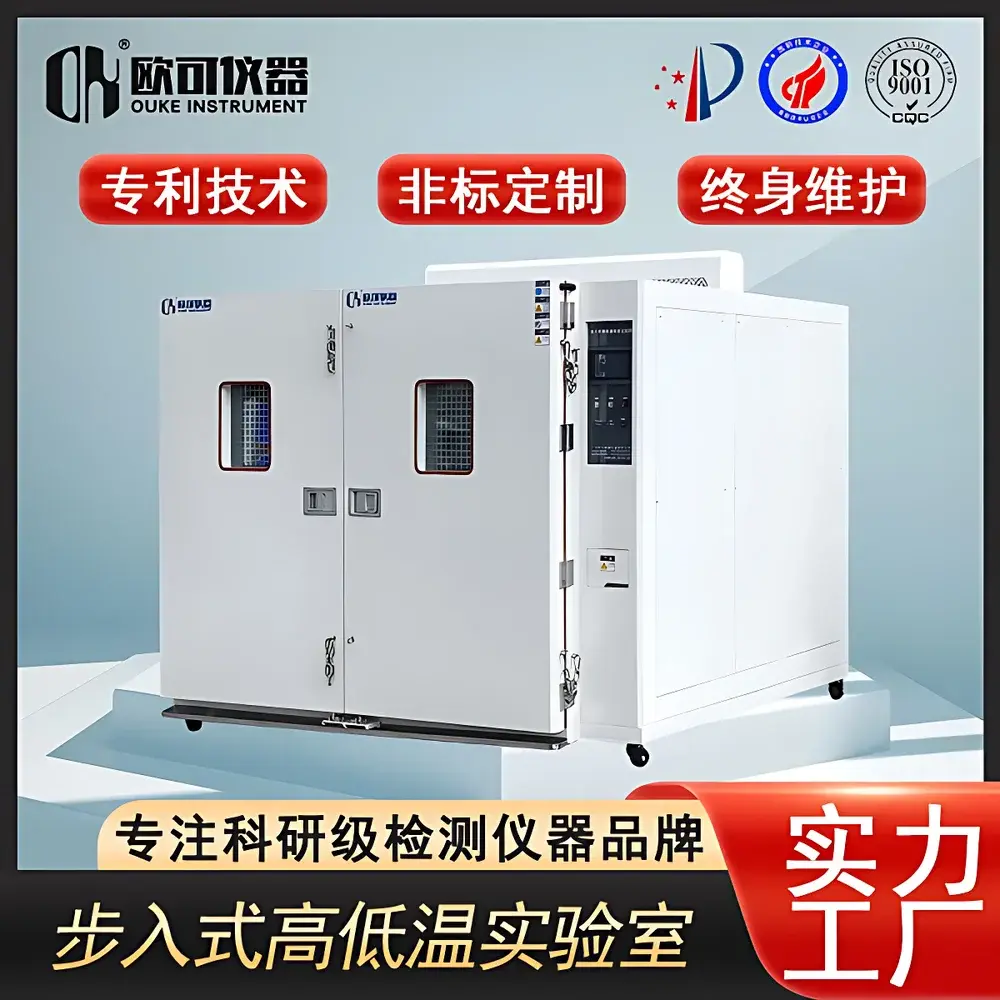
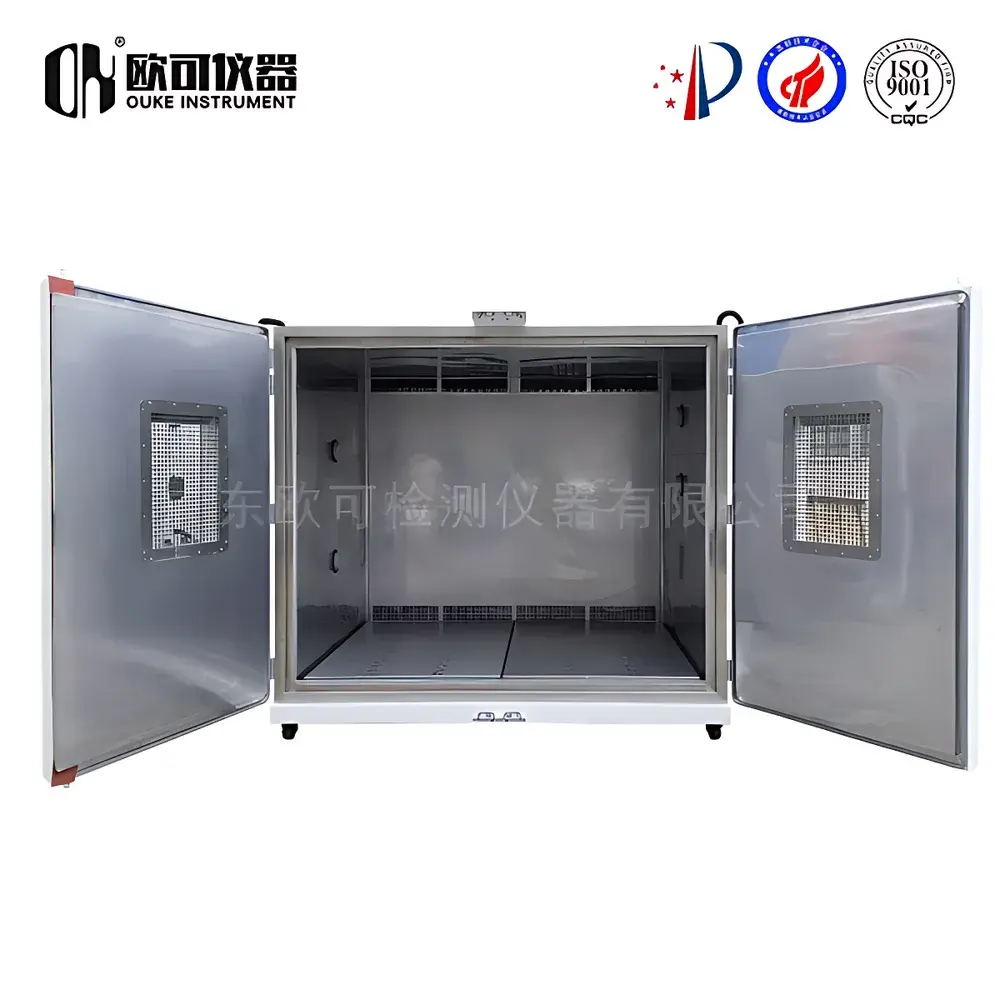
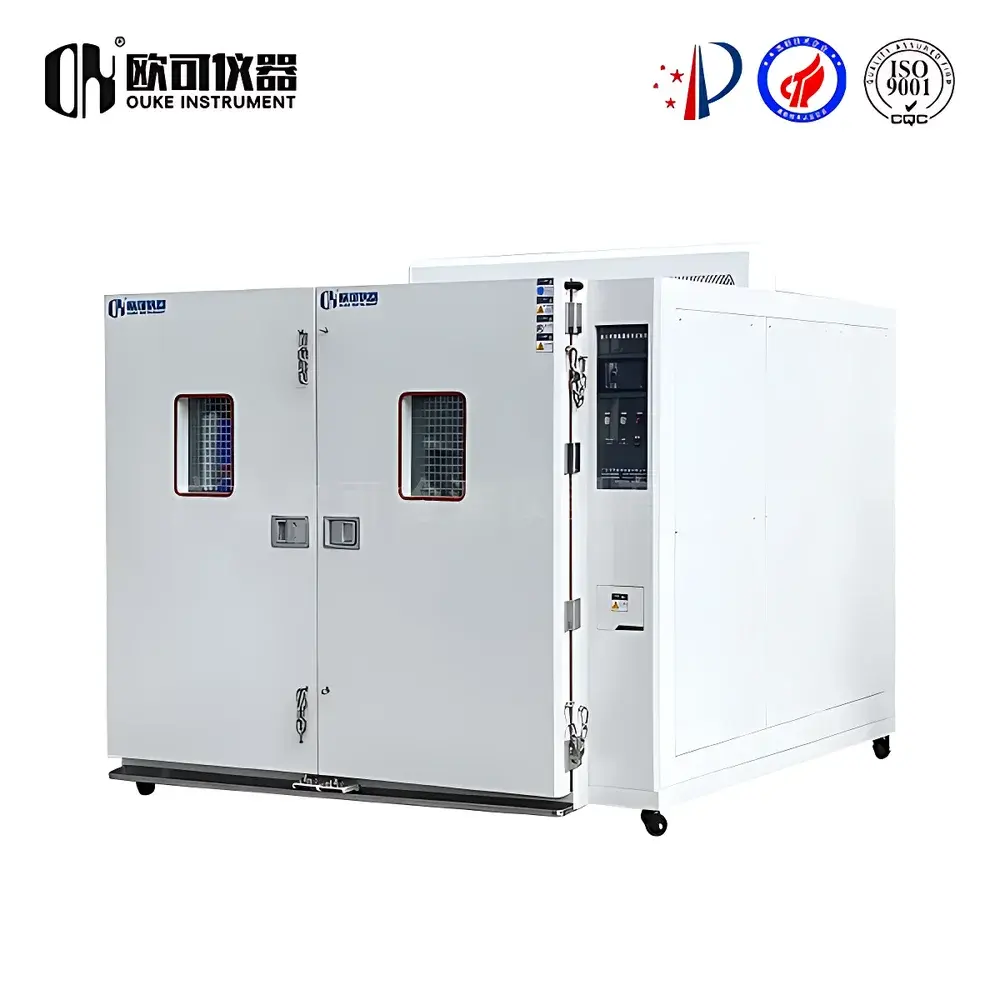
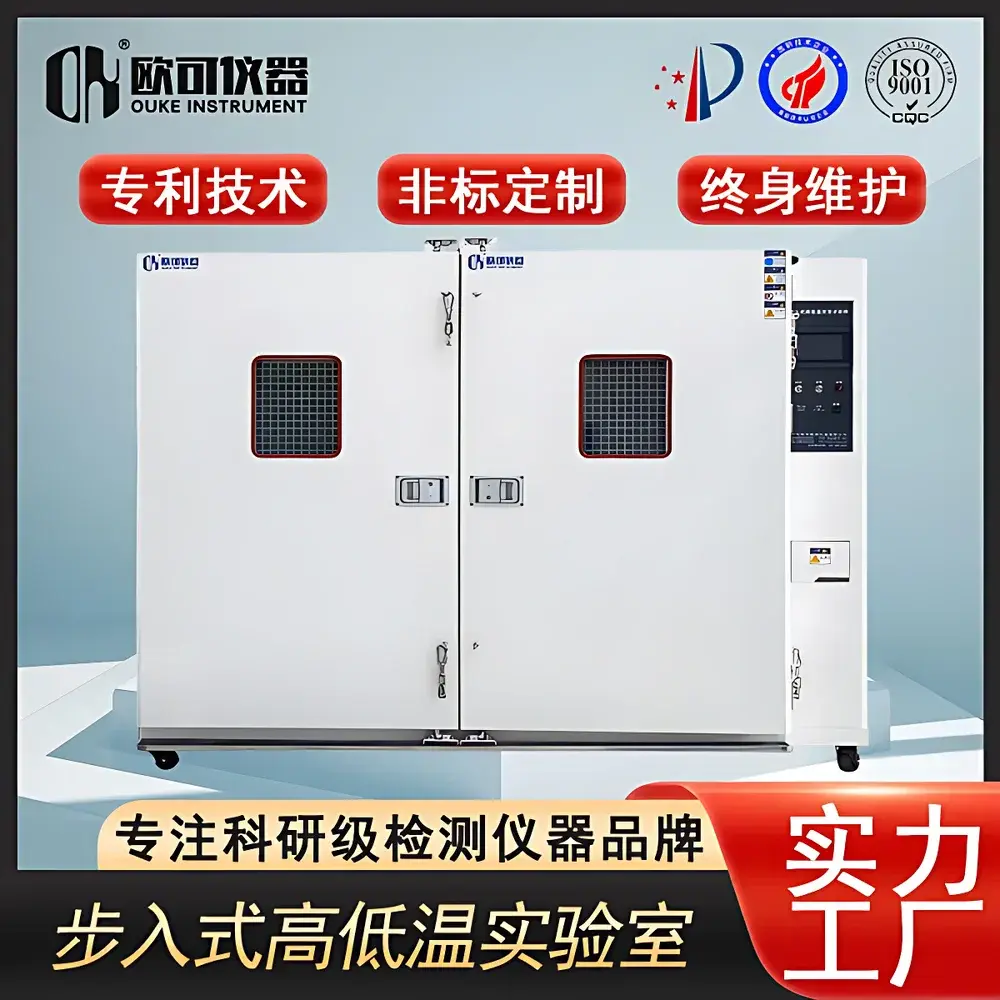
OK Walk-in Environmental Test Chamber OK-STH-8.1m²
| Brand | OK Instruments |
|---|---|
| Origin | Guangdong, China |
| Manufacturer Type | Direct Manufacturer |
| Country of Origin | China |
| Model | OK-STH-8.1m² |
| Internal Dimensions (D×W×H) | 2000 × 2000 × 2000 mm |
| Temperature Range Options | A: 0°C to +85°C |
| B | −20°C to +85°C |
| C | −40°C to +85°C |
| D | −60°C to +85°C |
| E | −70°C to +85°C |
| Temperature Uniformity | ±3°C |
| Temperature Control Accuracy | ±1°C |
| Heating Rate | 1.0–4.0°C/min |
| Construction Type | Modular Walk-in Chamber with Structural Steel Frame |
| Refrigeration System | Cascade Dual-Stage Compressor System (for models ≤ −40°C) |
| Air Circulation | High-Capacity Centrifugal Blowers with Optimized Ductwork for Uniform Thermal Distribution |
| Insulation | 150 mm Thick PU Foam-Core Sandwich Panels (Thermal Conductivity ≤ 0.022 W/m·K) |
| Door | Reinforced Sealed Walk-in Door with Double-Glazed Observation Window, Anti-Frost Heating, and Interlocked Safety Latch |
| Electrical Supply | 380 VAC, 3-Phase, 50/60 Hz |
| Compliance | Designed per IEC 60068-2-1 (Cold), IEC 60068-2-2 (Dry Heat), ISO 16750-4 (Road Vehicles), and ASTM D4332 (Conditioning of Packaging) |
Overview
The OK Walk-in Environmental Test Chamber OK-STH-8.1m² is a modular, structural-grade climate simulation system engineered for full-scale environmental qualification of large-format or system-level products. Unlike benchtop or upright chambers, this walk-in chamber provides an internal test volume of 8.1 m³ (2000 × 2000 × 2000 mm), enabling direct human access for instrument cabling, sensor placement, real-time diagnostics, and operational intervention during testing. Its core thermal architecture employs a cascade refrigeration cycle—comprising high-temperature and low-temperature compressor stages—to achieve stable operation across extended temperature ranges from −70°C to +85°C. The chamber’s thermal performance is validated against IEC 60068-2 series standards, ensuring reproducible and traceable environmental stress profiles required for reliability validation in automotive, aerospace, energy storage, and telecommunications applications.
Key Features
- Modular panel construction using 150 mm thick polyurethane (PU) insulated sandwich panels with thermal conductivity ≤ 0.022 W/m·K, enabling rapid thermal stabilization and minimal heat leakage.
- Structural steel frame with reinforced floor loading capacity (≥ 500 kg/m²), designed to support heavy-duty test articles including electric vehicle battery packs, server racks, and avionics enclosures.
- Dual-stage cascade refrigeration system with redundant compressors, oil management, and automatic defrost cycles—optimized for sustained operation at sub-zero temperatures without performance degradation.
- High-volume air circulation system featuring variable-speed centrifugal blowers and aerodynamically profiled ductwork, delivering uniform temperature distribution (±3°C) throughout the entire working volume.
- Walk-in door assembly with double-glazed tempered glass viewport, electric anti-frost heating, mechanical interlock, and emergency egress release—meeting ISO 13857 safety clearance requirements.
- Programmable PLC-based controller with Ethernet interface, supporting up to 99 programmable test segments, ramp/soak profiles, and real-time deviation alarms with event logging.
Sample Compatibility & Compliance
The OK-STH-8.1m² accommodates physically integrated systems that cannot be disassembled for component-level testing—including complete electric vehicles, photovoltaic inverters, BESS cabinets, UAV platforms, and telecom base station cabinets. Its open interior layout allows for flexible fixture mounting, multi-point thermocouple routing via standardized feedthrough ports (IP65-rated), and integration with external power supplies and data acquisition systems. The chamber is configured to meet regulatory expectations for environmental qualification under ISO 16750-4 (road vehicle electrical loads), MIL-STD-810H Method 502.7 (low temperature), and ASTM D4332 (standard conditioning for packaging). Optional audit-ready data logging supports GLP/GMP-aligned validation protocols, including 21 CFR Part 11-compliant electronic signatures and tamper-proof record retention.
Software & Data Management
The embedded control system runs on a real-time Linux OS with a 10.1″ capacitive touchscreen HMI. It supports native export of test logs in CSV and PDF formats, with timestamped temperature, humidity (if equipped), alarm events, and setpoint deviations. Remote monitoring is enabled via Modbus TCP or OPC UA, allowing integration into centralized MES or SCADA platforms. All configuration changes and manual overrides are logged with user ID, timestamp, and reason code—providing full traceability for internal audits or third-party certification reviews. Optional cloud-enabled firmware updates ensure long-term maintainability without onsite technician visits.
Applications
- Automotive: Cold-start validation of EV powertrains, HVAC performance mapping across ambient extremes, and thermal cycling of ADAS sensor housings.
- Aerospace: Pre-flight thermal soak testing of satellite payloads, thermal vacuum pre-screening of avionics bays, and environmental stress screening (ESS) of flight-critical subsystems.
- Energy Storage: Cycle-life evaluation of grid-scale lithium-ion battery cabinets under dynamic thermal load conditions, including charge/discharge-induced self-heating compensation.
- Data Infrastructure: Thermal boundary validation of edge computing nodes and 5G baseband units operating within enclosed rack environments.
- Industrial Electronics: HALT/HASS readiness testing for industrial PLCs, motor drives, and robotic controllers subjected to accelerated thermal gradients.
FAQ
What is the maximum allowable internal heat load for sustained operation at −70°C?
Sustained operation at −70°C assumes a net internal heat load ≤ 3 kW. Higher loads require customized refrigeration sizing and must be declared during quotation.
Can the chamber be configured for humidity control?
Yes—optional steam-based humidification and dehumidification modules are available to extend functionality to walk-in thermal-hygric testing per IEC 60068-2-30.
Is field installation and commissioning included?
Standard delivery includes on-site mechanical assembly, refrigerant charging, electrical termination, and IQ/OQ documentation support. Final SAT execution requires customer-provided calibrated reference sensors.
How is temperature uniformity verified and maintained over time?
Uniformity is validated using a 9-point NIST-traceable sensor array per IEC 60068-3-5. Annual recalibration of the control sensor and periodic airflow mapping are recommended to maintain specification compliance.
Does the system support automated test sequencing with external equipment?
Yes—the controller provides dry-contact I/O and Modbus RTU/TCP interfaces for synchronized triggering of external power supplies, data loggers, or robotic handlers.



