
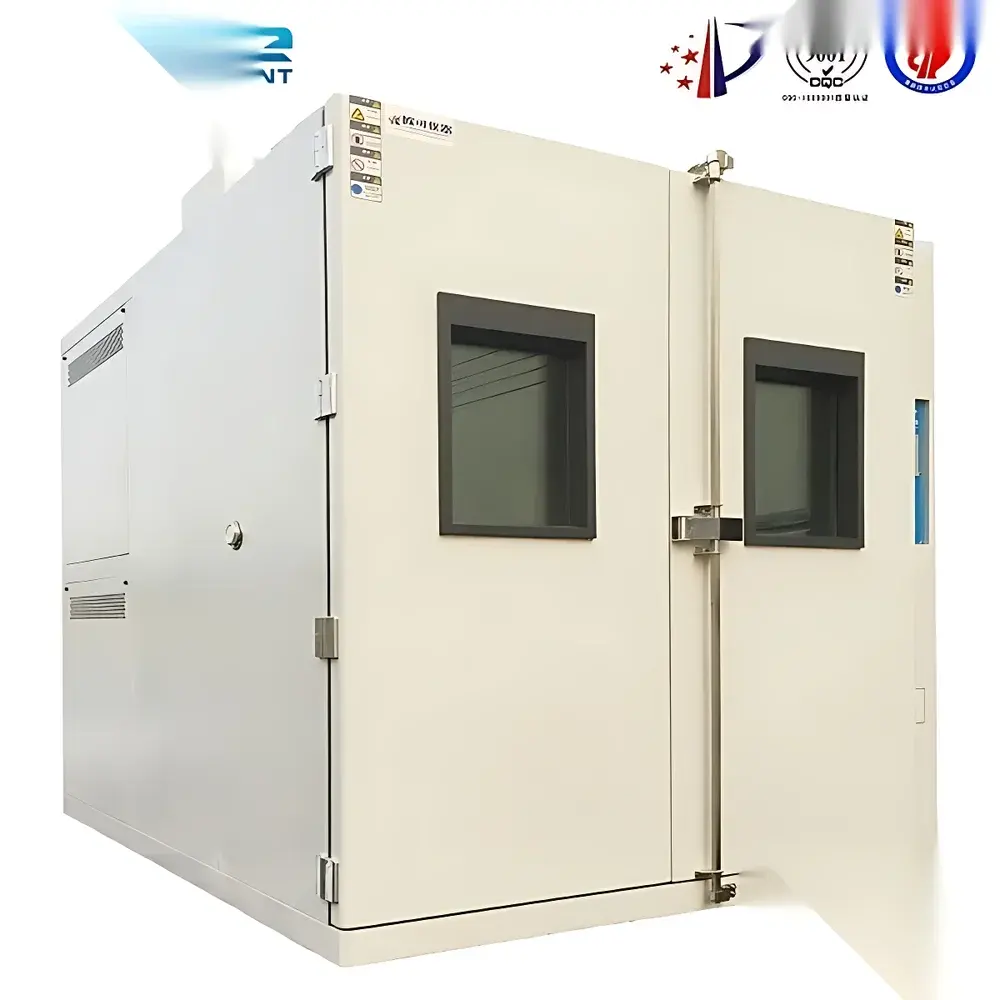
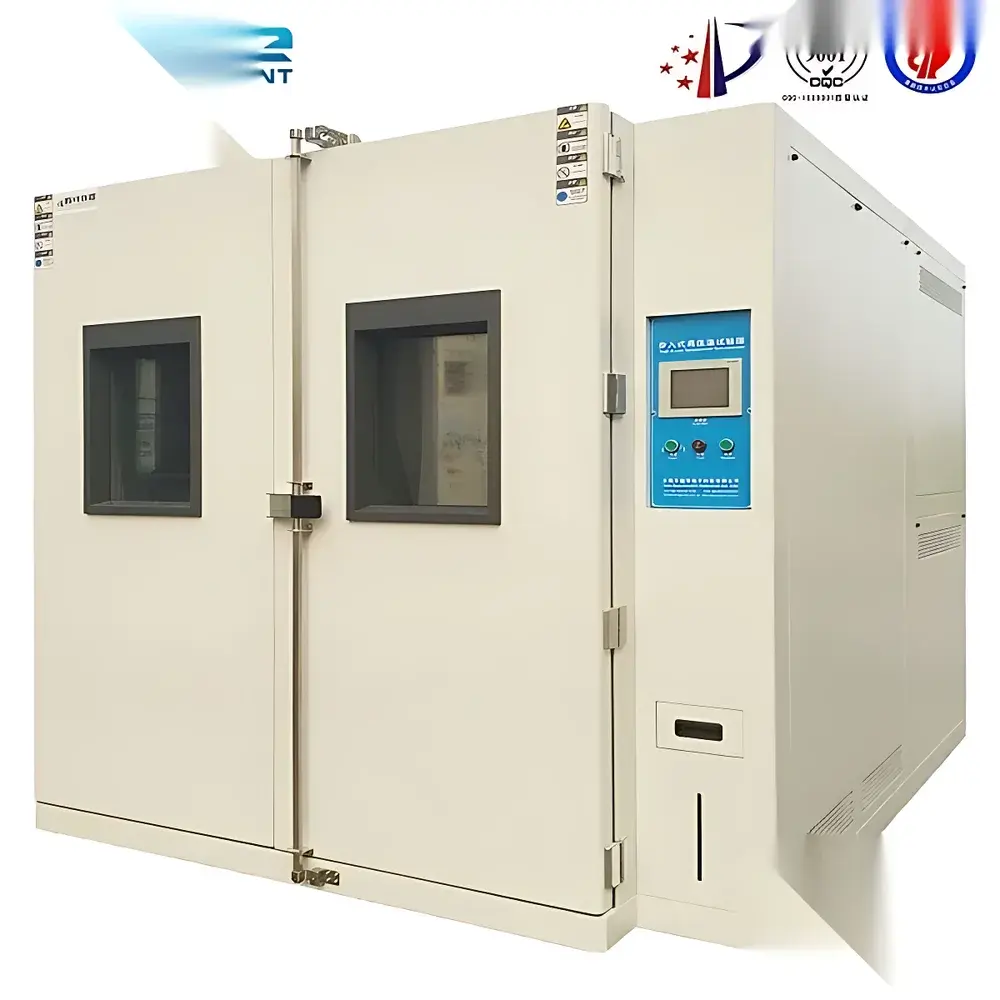
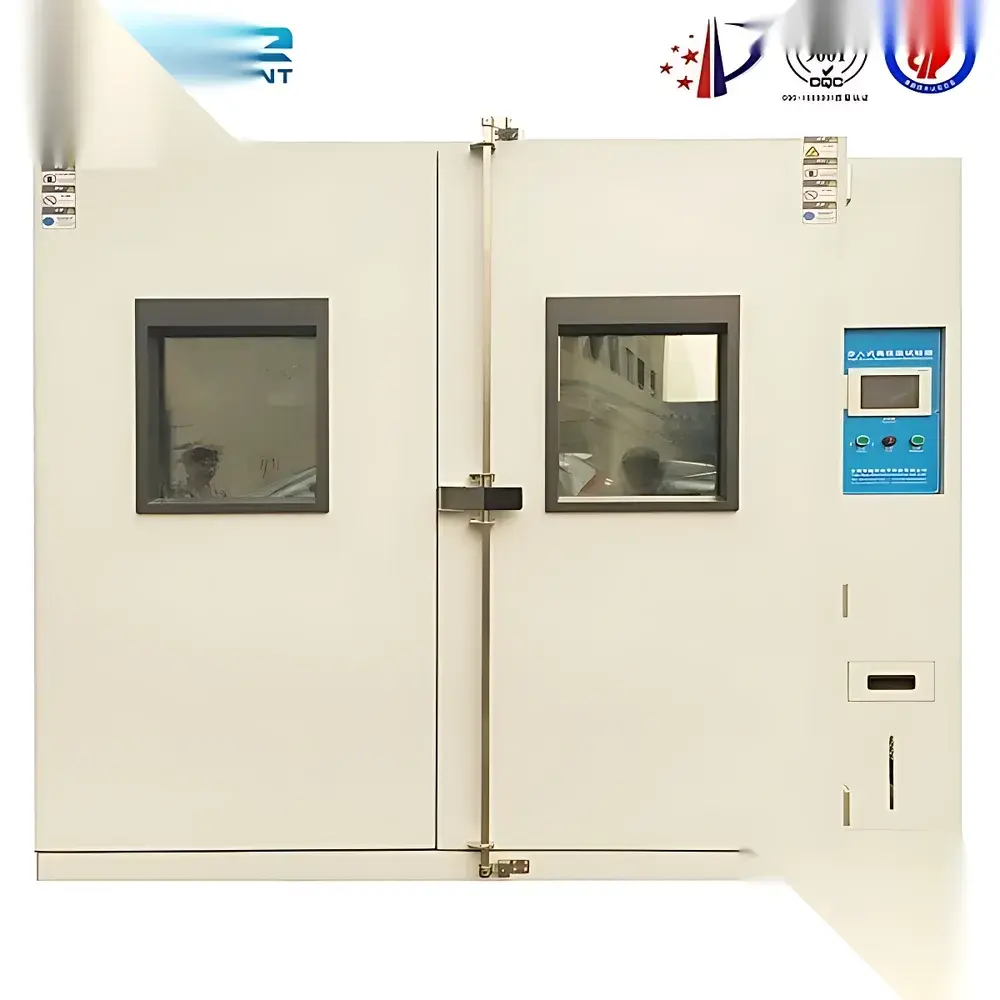
Walk-in High-Temperature Environmental Test Chamber
| Brand | Other Brands |
|---|---|
| Origin | Imported |
| Manufacturer Type | Authorized Distributor |
| Price | USD 11,200 (FOB) |
| Chamber Volume Options | 80 L / 150 L / 225 L / 408 L / 800 L / 1000 L |
| Internal Dimensions (W×D×H, mm) | 400×500×400 to 1000×1000×1000 |
| External Dimensions (W×D×H, mm) | 1200×1650×1150 to 1900×2100×1850 |
| Temperature Range | Ambient +10°C to +150°C (standard) |
| Humidity Range | 20–98% RH (with humidification system) |
| Control System | Korean-made 7-inch TFT LCD touchscreen controller with PID algorithm |
| Power Supply | 3-phase 380–400 V AC ±10%, 50 Hz |
| Total Rated Power | 4.5 kW |
| Standard Features | Double-layer electrically heated observation window (220×300 mm), stainless steel sample racks (2 pcs), desiccant-based anti-condensation duct, dry/wet bulb humidity sensing, RS232-C interface, solid-state relay heating, hermetic refrigeration circuit, left-side 50 mm diameter cable port with thermal isolation and silicone rubber gasket, safety interlock door latch mechanism |
Overview
The Walk-in High-Temperature Environmental Test Chamber is an industrial-grade climatic simulation system engineered for precise, repeatable, and long-duration thermal stress testing of electrical, electronic, automotive, aerospace, and materials science specimens. Operating on the principle of forced-air convection with dual-zone thermal regulation—separate heating and refrigeration circuits coupled with high-efficiency axial fans—the chamber maintains stable temperature profiles across its entire internal volume under dynamic load conditions. Unlike benchtop chambers, this walk-in configuration enables full-scale product evaluation: complete vehicle ECUs, HVAC assemblies, battery modules, or large composite panels can be subjected to standardized thermal cycling, steady-state high-temperature soak, or combined temperature/humidity profiles per IEC 60068-2-2, MIL-STD-810H Method 501.5, and ASTM D4332. Its structural architecture integrates insulated double-wall construction (100 mm polyurethane foam, λ ≤ 0.022 W/m·K), airtight gasketed access doors, and pressure-balanced ventilation to minimize thermal leakage and ensure compliance with ISO 17025-accredited laboratory requirements.
Key Features
- 7-inch Korean-manufactured TFT LCD touchscreen controller with intuitive GUI, real-time trend logging, and multi-segment programmable profiles (up to 99 cycles, 999 steps)
- Electrically heated, multi-layer low-emissivity observation window (220 × 300 mm) enabling continuous visual monitoring without thermal disturbance
- Fail-safe mechanical door interlock system compliant with EN 61000-6-4; maintains seal integrity even under internal overpressure up to 200 Pa
- Thermally isolated 50 mm cable port with replaceable silicone rubber gasket—designed to prevent heat bridging and condensation ingress
- Dual-sensor dry/wet bulb humidity measurement system with automatic dew-point compensation and NIST-traceable calibration support
- Stainless steel interior (SUS304, 2B finish) with radius-curved corners for cleanability and corrosion resistance
- RS232-C serial interface for external data acquisition and integration into centralized test management platforms (e.g., LabVIEW, TestStand)
- Energy-efficient refrigeration circuit using R404A/R134a mixed-refrigerant cascade design for rapid cooldown from +150°C to +25°C in <45 min (TH-408 model)
Sample Compatibility & Compliance
This chamber accommodates heterogeneous sample geometries—from single PCBs to fully assembled consumer appliances—via two adjustable 304 stainless steel sample racks (load capacity: 50 kg/rack, uniformly distributed). Optional configurations include reinforced floor plates (rated for 200 kg/m²), extended-height shelving, and inert gas purge ports (N₂ or dry air) for oxygen-sensitive applications. The system conforms to electromagnetic compatibility standards (EN 61326-1), safety directives (IEC 61010-1), and environmental test protocol frameworks including IEC 60068-2-1 (cold), IEC 60068-2-2 (dry heat), IEC 60068-2-30 (damp heat cyclic), and USP for pharmaceutical packaging validation. All control firmware supports audit trail generation and user-level access control—meeting foundational requirements for GLP and GMP environments under FDA 21 CFR Part 11 when deployed with validated software extensions.
Software & Data Management
Embedded controller firmware provides local data storage (≥10,000 hours of 1-second interval temperature/humidity logs), password-protected parameter editing, and alarm history with timestamped event codes (e.g., “THERMAL_OVERLOAD”, “HUMIDITY_SENSOR_FAULT”). Raw data export is supported via USB flash drive (CSV format) or RS232-C to PC-based analysis tools. Optional PC software (sold separately) adds remote monitoring, automated report generation (PDF/Excel), statistical process control (SPC) charting, and deviation alerting via email/SMS. All data structures are time-synchronized to UTC and support metadata tagging (operator ID, test ID, sample batch), facilitating traceability in regulated quality systems.
Applications
- Accelerated life testing of power electronics under sustained +125°C operation
- Thermal aging studies of polymer encapsulants and conformal coatings per IPC-9701
- Pre-conditioning of lithium-ion battery packs prior to safety validation (UN 38.3 T1–T5)
- Validation of automotive infotainment HMI responsiveness across -40°C to +85°C extremes
- Humidity-induced failure analysis of MEMS sensors and optical components
- Stability assessment of industrial catalysts and specialty chemical formulations
- Calibration verification of field-deployed temperature/humidity transmitters
FAQ
What is the maximum operating temperature for standard configuration?
The standard thermal range extends from ambient +10°C to +150°C. An optional high-temperature upgrade supports operation up to +200°C with upgraded insulation, heater elements, and door gasketing.
Is humidity control available on all models?
Yes—humidity capability (20–98% RH) is standard across all TH-series models. Humidification uses stainless steel steam generator technology; dehumidification leverages the primary refrigeration circuit with hot-gas bypass modulation.
Can the chamber be integrated into an existing MES or QMS platform?
Absolutely. RS232-C communication supports Modbus RTU protocol. Optional Ethernet gateway (TCP/IP) and OPC UA server modules enable seamless integration with Siemens SIMATIC IT, Rockwell FactoryTalk, or ETQ Reliance.
Does the system include calibration documentation?
Each unit ships with a factory-as-built certificate of conformance and NIST-traceable temperature sensor calibration report (at three points: 25°C, 85°C, 120°C). On-site IQ/OQ validation support is available upon request.
What maintenance intervals are recommended?
Compressor oil and refrigerant levels should be verified annually; air filters require cleaning every 3 months; door gaskets and observation window seals should be inspected quarterly for compression integrity and replaced per manufacturer service bulletin (typically every 24 months under continuous use).



