
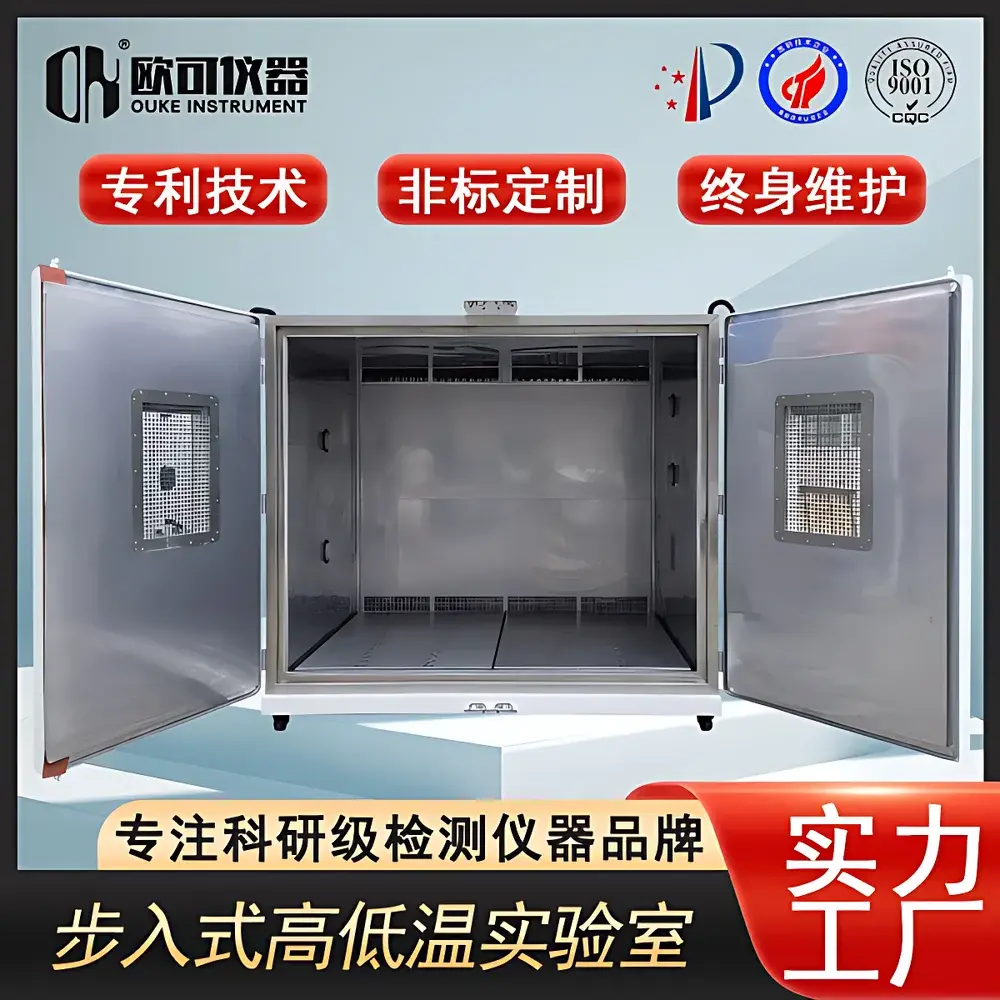
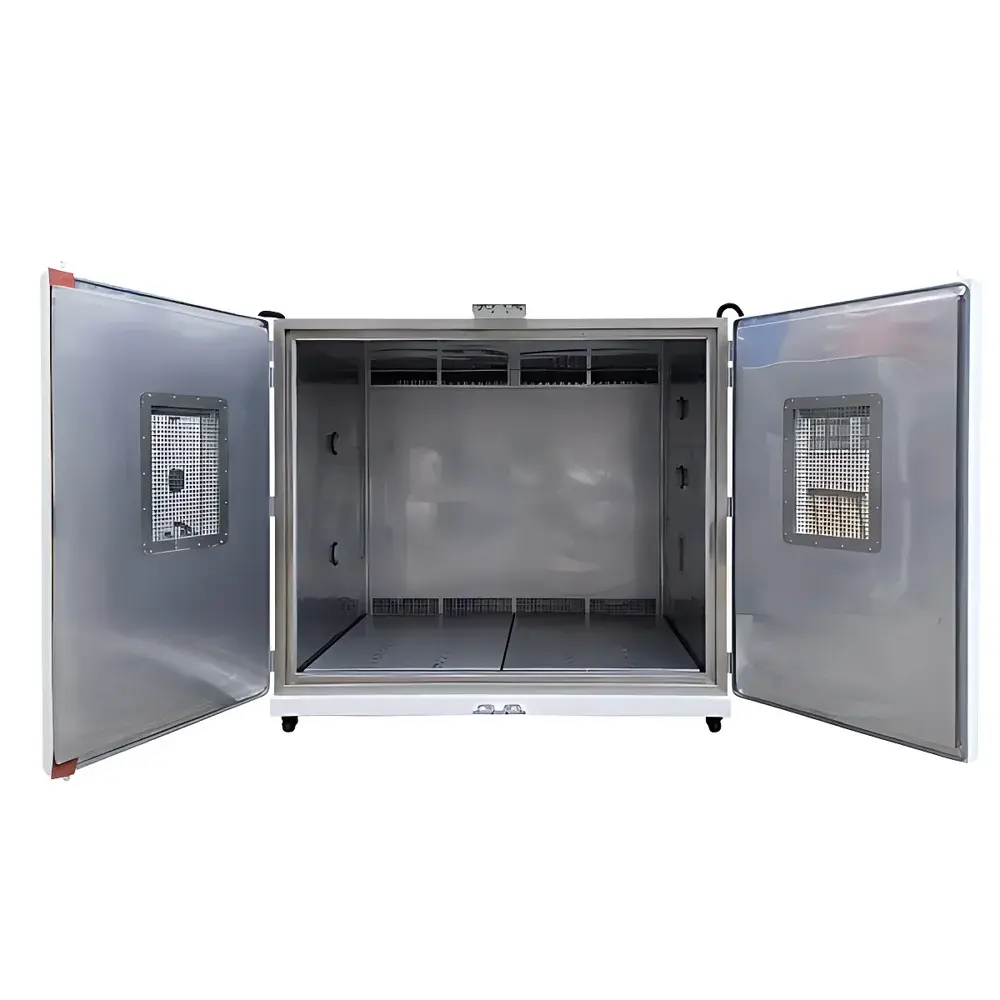
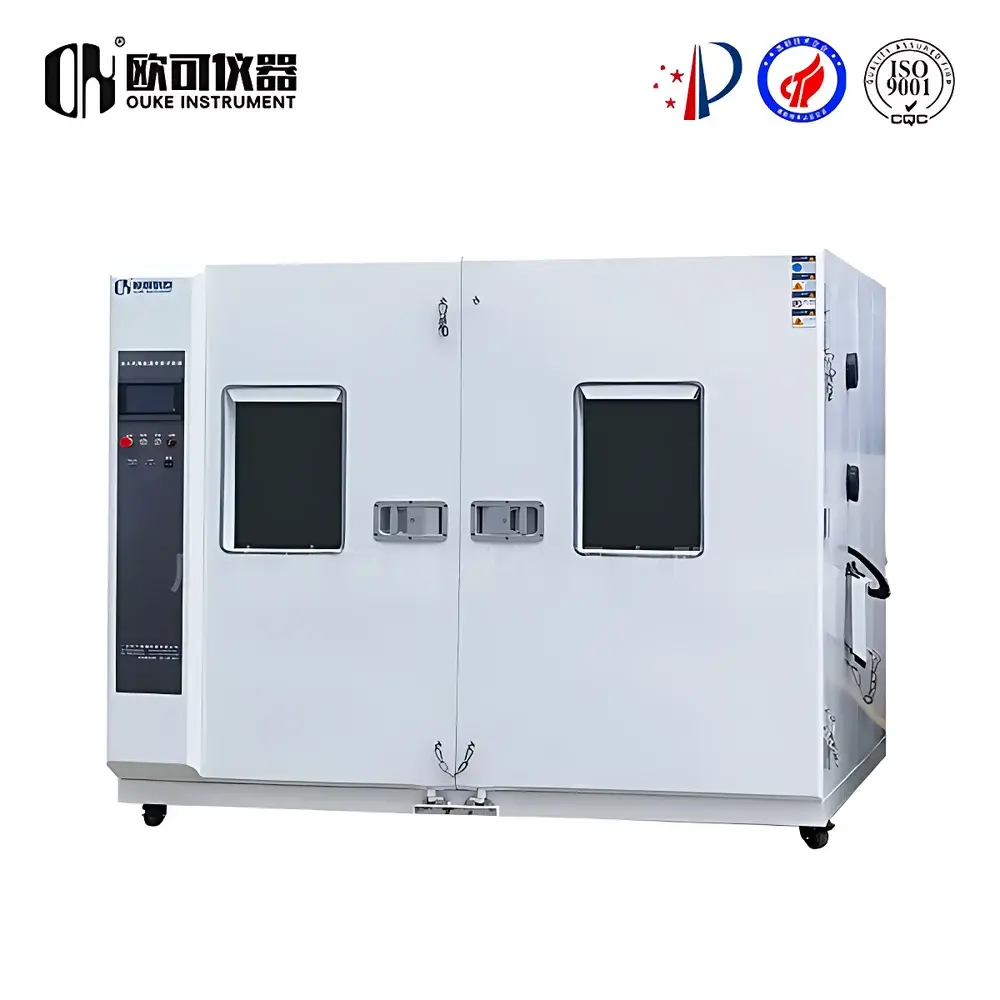
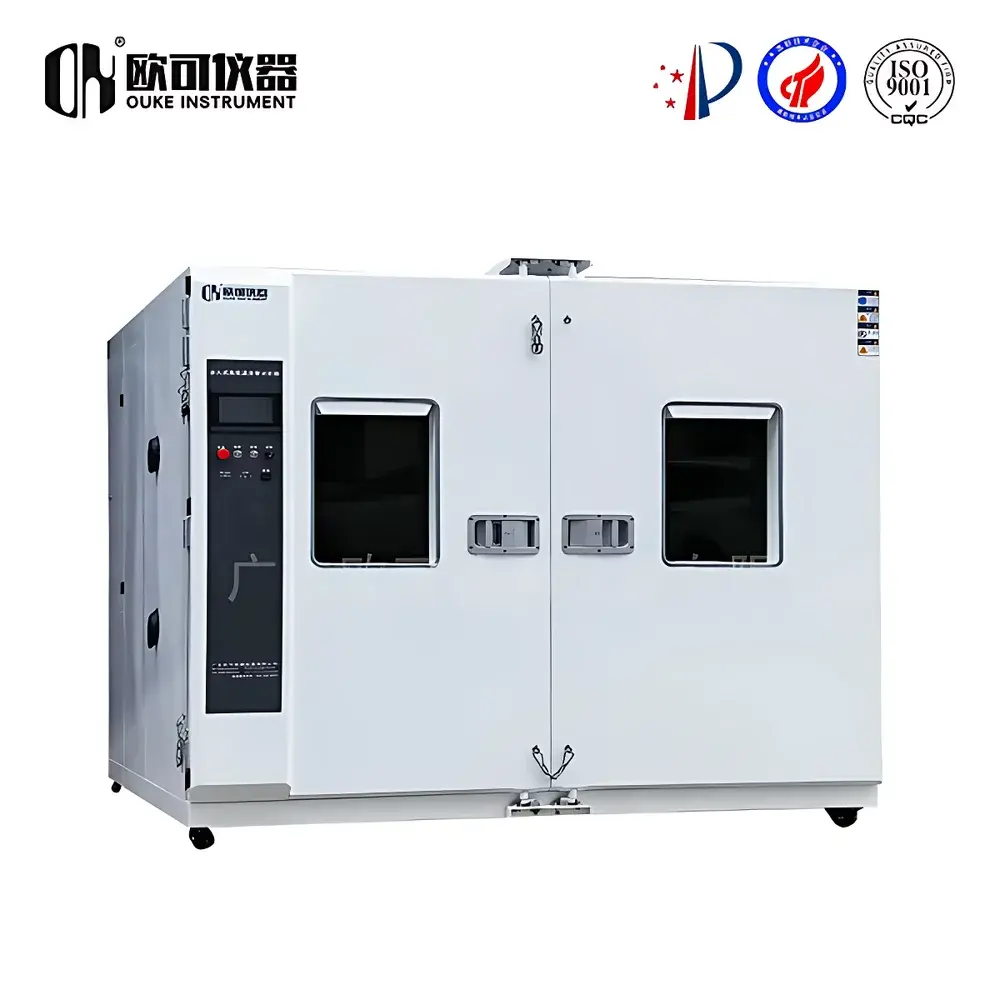
OK Walk-in Rapid Temperature Transition Chamber OK-STH-Series
| Brand | OK Instruments |
|---|---|
| Origin | Guangdong, China |
| Manufacturer Type | Direct Manufacturer |
| Product Origin | Domestic |
| Model | OK-STH-Custom Volume |
| Temperature Range Options | A: 0°C / B: −20°C / C: −40°C / D: −60°C / E: −70°C |
| Temperature Uniformity | ±3°C |
| Control Accuracy | ±1°C |
| Ramp Rate | 1.0–4.0°C/min |
| Internal Dimensions | Custom-engineered per client specifications (D×W×H) |
| Construction | High-strength polyurethane sandwich panels (100–150 mm thickness) |
| Refrigeration System | Cascade dual-stage compressor system (for −40°C to −70°C models) |
| Heating System | High-power tubular electric heaters |
| Air Circulation | Heavy-duty centrifugal blower with optimized ductwork and adjustable airflow distribution |
| Controller | Programmable multi-segment temperature profile controller with real-time logging and Ethernet/RS485 interface |
| Compliance | Designed to meet IEC 60068-2-1 (Cold), IEC 60068-2-2 (Dry Heat), MIL-STD-810H Method 502.7, GJB 150.4A & 150.5A |
Overview
The OK Walk-in Rapid Temperature Transition Chamber OK-STH-Series is a high-performance, large-volume environmental stress screening (ESS) and reliability validation system engineered for rigorous thermal cycling, rapid temperature transition, and sustained extreme-temperature exposure. Unlike standard thermal chambers, the OK-STH-Series is built on a robust walk-in architecture—enabling full-scale testing of assembled systems, vehicle components, avionics racks, battery modules, or production batches under dynamically controlled thermal conditions. Its operational principle relies on coordinated actuation of high-capacity refrigeration (cascade or LN₂-assisted), precision resistive heating, and high-mass airflow management to achieve repeatable, traceable thermal transients across defined profiles. The chamber’s structural integrity derives from load-bearing polyurethane-insulated panels (100–150 mm core thickness), hermetically sealed access doors with multi-point latching, and vibration-isolated mechanical mounting—all critical for maintaining thermal stability during aggressive ramping cycles.
Key Features
- Customizable internal volume: Engineered per client-defined dimensions (depth × width × height), supporting payloads up to 5,000 kg with integrated floor reinforcement options.
- Multi-tier temperature capability: Five standard low-temperature configurations (0°C to −70°C), each validated for sustained operation at specified extremes with ≤±1°C control accuracy and ≤±3°C uniformity (per IEC 60068-3-5).
- Controlled ramp rate performance: Achieves 1.0–4.0°C/min average transition rates (measured per ASTM E1545 Annex A1 methodology) under no-load conditions; rate derating curves provided for user-defined thermal mass and power dissipation loads.
- Dual-mode refrigeration architecture: Standard cascade compression system (R404A/R23) for −40°C to −70°C operation; optional liquid nitrogen (LN₂) injection module available for transient cooling enhancement beyond 5°C/min in select configurations.
- Intelligent thermal management: PID + fuzzy logic hybrid controller with adaptive gain scheduling ensures stable regulation during rapid transitions, minimizing overshoot and dwell deviation.
- Comprehensive safety integration: Redundant over-temperature cutoffs, refrigerant pressure monitoring, door interlock circuits, and emergency purge ventilation compliant with IEC 61000-6-4 EMC requirements.
Sample Compatibility & Compliance
The OK-STH-Series accommodates heterogeneous test articles—including fully assembled electronic enclosures, automotive ECUs, aerospace subassemblies, and energy storage systems—without requiring disassembly. Its open-floor layout, overhead cable management rails, and optional internal lighting facilitate in-situ instrumentation and real-time diagnostics. All models are designed and verified against internationally recognized environmental testing standards: IEC 60068-2-1 (cold), IEC 60068-2-2 (dry heat), MIL-STD-810H Method 502.7 (temperature shock), and GJB 150.4A/150.5A (Chinese military environmental test protocols). Calibration documentation supports ISO/IEC 17025 traceability when paired with accredited third-party verification. The system architecture permits seamless integration into GLP- and GMP-regulated validation workflows, including audit-ready electronic record retention (21 CFR Part 11-compliant data export via optional software package).
Software & Data Management
Built-in controller firmware supports up to 99 programmable test segments, each configurable with ramp rate, soak duration, setpoint, and tolerance band. Real-time data logging records chamber air temperature (multiple sensor inputs), refrigerant pressures, heater duty cycle, and fan speed at user-selectable intervals (1–60 sec). Export formats include CSV and PDF reports compatible with LIMS and MES platforms. Optional OK-EnviroLink™ software extends functionality with remote monitoring (HTTPS/SSL), automated report generation, alarm escalation (email/SMS), and comparative analysis across historical test runs. All logged data includes immutable timestamps, operator ID, and configuration checksums—ensuring full data integrity for regulatory submissions.
Applications
- High-accelerated stress screening (HASS) and highly accelerated life testing (HALT) of electronics and electromechanical assemblies.
- Thermal qualification of EV battery packs per UN ECE R100 and GB/T 31467.3 requirements.
- Environmental validation of defense-grade subsystems under MIL-STD-810H and DO-160G Section 4.
- Production line burn-in and lot acceptance testing for industrial control hardware.
- Material compatibility studies involving polymer aging, seal integrity, and solder joint fatigue under cyclic thermal strain.
- Research-grade thermal modeling correlation using physical chamber response data to refine FEA boundary conditions.
FAQ
What defines “rapid temperature transition” in this context, and how is it verified?
Rapid transition refers to the chamber’s ability to move between two temperature setpoints within a defined time envelope—typically quantified as average ramp rate (°C/min) across the full span. Verification follows ASTM E1545 Annex A1: measurements taken at nine standardized locations using NIST-traceable PT100 sensors, with rate calculated from 10% to 90% of the target delta-T.
Can the chamber operate continuously at −70°C with full load?
Yes—models equipped with the E-grade cascade refrigeration system are rated for continuous operation at −70°C ambient with up to 80% volumetric loading and ≤5 kW internal heat dissipation. Derating curves and thermal load modeling support are provided during quotation.
Is LN₂ consumption included in the base configuration?
No—LN₂ assist is an optional add-on requiring dedicated cryogenic plumbing, vaporizer, and safety interlocks. Its inclusion is evaluated case-by-case based on required cooling rate, duty cycle, and facility infrastructure.
How is temperature uniformity maintained during fast ramps?
Through synchronized modulation of evaporator superheat, heater duty cycle, and variable-frequency blower speed—governed by a multivariable control algorithm that prioritizes spatial uniformity over single-point setpoint fidelity during transients.
Does OK provide installation supervision and IQ/OQ documentation?
Yes—factory-trained engineers conduct on-site commissioning, including thermal mapping (per ISO 14644-3), alarm validation, and protocol execution. IQ/OQ templates aligned with ISO/IEC 17025 and FDA expectations are supplied as part of the delivery package.



