
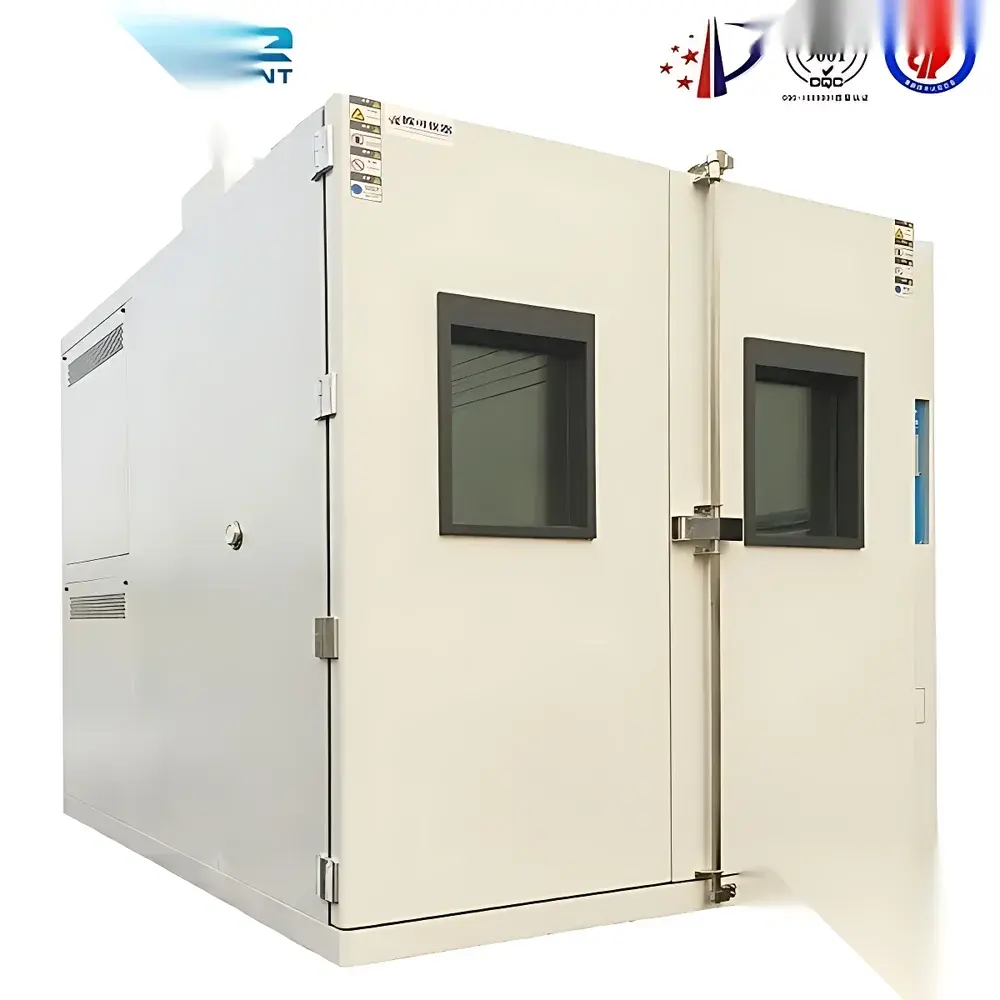
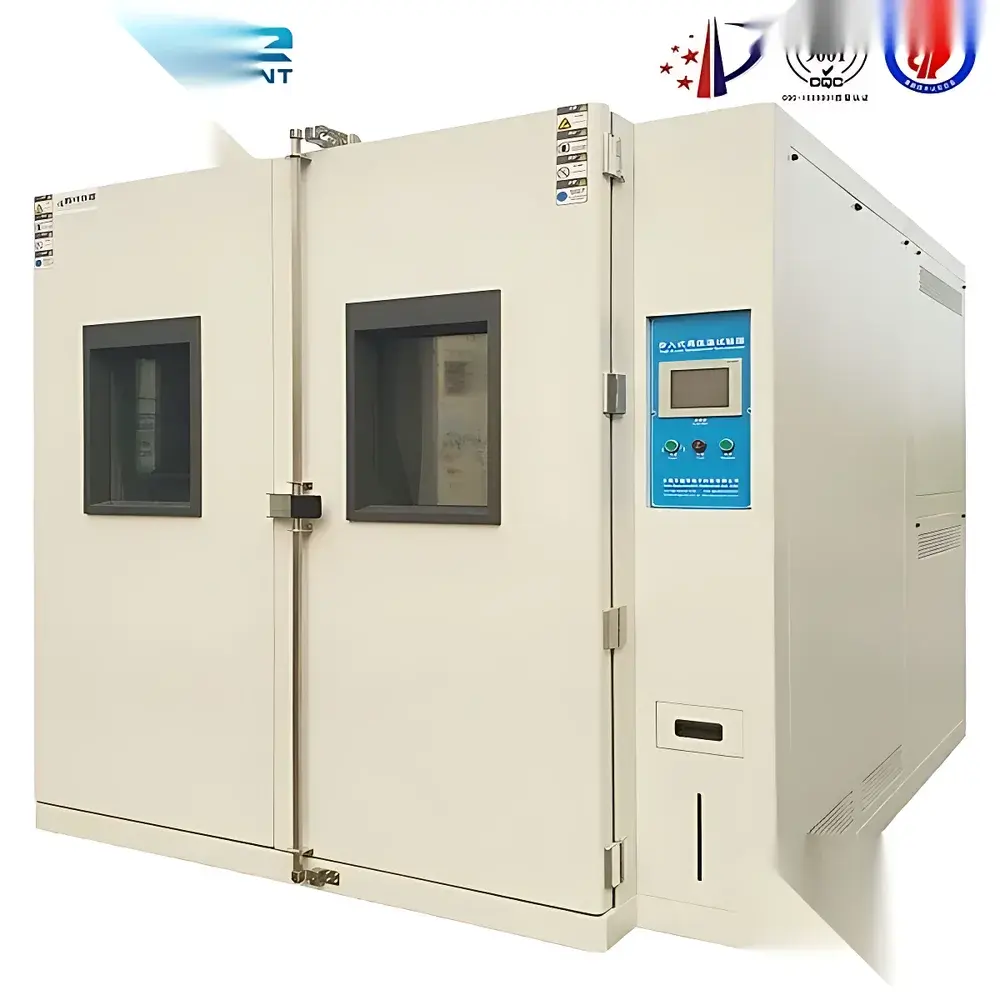
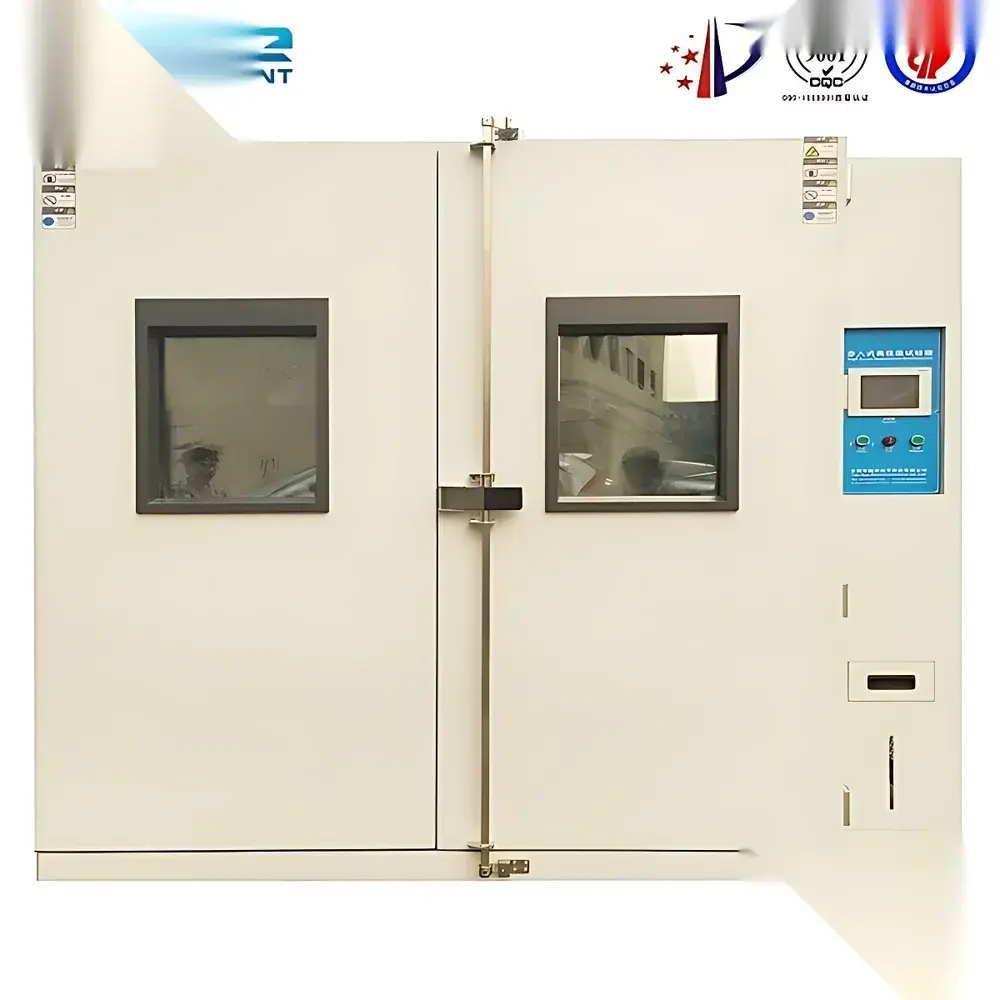
Walk-in Reliability Environmental Test Chamber
| Brand | OK Instrumentation |
|---|---|
| Model | OK-STH Series |
| Type | Walk-in Environmental Stress Screening (ESS) Chamber |
| Temperature Range | 0°C to +200°C |
| Humidity Range | 30–98% RH |
| Temp. Uniformity | ≤ ±2.0°C (empty chamber) |
| Humidity Uniformity | ≤ ±3.0% RH (empty chamber) |
| Temp. Stability | ≤ ±0.5°C |
| Humidity Stability | ≤ ±1.0% RH |
| Internal Dimensions (W×D×H) | 600 × 600 × 800 mm |
| Construction | Interior – AISI 304 mirror-finish stainless steel |
| Refrigeration System | Hermetically sealed Tecumseh (France) compressor, R502 refrigerant, Danfoss expansion valve, Alco filter-drier, Castel solenoid valve |
| Heating | Stainless steel finned-tube heaters |
| Humidification | Surface-evaporation shallow-tray system with stainless steel heating elements |
| Control System | uPLC-based controller with HMI interface (keyboard/display or PC/software options) |
| Compliance | GB/T 2423.1–2423.4, IEC 60068-2-1/2/3/30, MIL-STD-810D (GJB150.3/4/9), GJB 367.2, GB 10592, GB 10586, GB/T 5170.2/5 |
Overview
The OK-STH Series Walk-in Reliability Environmental Test Chamber is an engineered solution for accelerated environmental stress screening (ESS) and long-duration reliability validation of electronic components, automotive modules, aerospace subsystems, and industrial materials. Designed to replicate real-world climatic extremes—including sustained high-temperature, high-humidity exposure—the chamber operates on a dual-control principle: independent precision regulation of air temperature via forced convection and relative humidity via surface-evaporation humidification. Its walk-in configuration enables full-scale testing of large assemblies—such as control panels, battery packs, or prototype enclosures—without disassembly, preserving thermal mass integrity and enabling realistic thermal gradient analysis. The chamber’s architecture supports both steady-state conditioning (e.g., 85°C/85% RH for JEDEC JESD22-A101 qualification) and dynamic cycling per MIL-STD-810D Method 502.5 (temperature) and Method 507.5 (humidity), making it suitable for HALT/HASS pre-screening, failure mode identification, and conformance testing against IEC 60068-2 and GB/T 2423 standards.
Key Features
- Robust structural design featuring a double-wall construction: interior AISI 304 mirror-finish stainless steel liner and powder-coated cold-rolled steel exterior, ensuring corrosion resistance and long-term dimensional stability under cyclic thermal loading.
- Hybrid insulation system combining high-efficiency fiberglass wool and closed-cell polyurethane foam—optimized to minimize thermal bridging and maintain uniform internal conditions across the full operating range (0°C to +200°C / 30–98% RH).
- High-reliability refrigeration train using a hermetically sealed Tecumseh compressor, Danfoss thermostatic expansion valve, Alco filter-drier, and Castel solenoid valve—configured for stable low-temperature pull-down and repeatable humidity recovery.
- Surface-evaporation shallow-tray humidification system with stainless steel heating elements, delivering precise RH control without water carryover or mineral deposition—critical for extended tests exceeding 1,000 hours.
- uPLC-based control platform with optional HMI (touchscreen + keypad) or PC-integrated software interface, supporting programmable multi-step profiles, real-time data logging, alarm history, and audit-ready event tracking.
- Configurable access solutions—including manual swing doors, sliding doors, and motorized lift doors—with integrated digital barometric pressure monitoring and ACS automatic condensate drainage to prevent sump overflow during prolonged high-RH operation.
Sample Compatibility & Compliance
The OK-STH chamber accommodates full-system-level DUTs (devices under test) up to 600 mm (W) × 600 mm (D) × 800 mm (H), enabling evaluation of complete subassemblies rather than isolated components. It meets requirements for environmental qualification per multiple international and military specifications: GB/T 2423.1 (cold), GB/T 2423.2 (dry heat), GB/T 2423.3 (damp heat, steady state), GB/T 2423.4 (damp heat, cyclic), IEC 60068-2-1/2/3/30, MIL-STD-810D Methods 502.5, 507.5, and GJB150.3/4/9. While not inherently 21 CFR Part 11 compliant, its uPLC controller supports optional electronic signature modules and audit trail extensions for GLP/GMP-aligned laboratories conducting regulated product validation.
Software & Data Management
The standard uPLC controller provides non-volatile memory for up to 100 user-defined test programs, each supporting up to 99 segments with ramp/soak logic, conditional branching, and interlock-triggered safety shutdowns. Optional PC-based software enables remote monitoring, CSV export of time-stamped temperature/humidity datasets, statistical process control (SPC) charting, and automated report generation (PDF/Excel). All logged data includes timestamp, setpoint, actual reading, deviation, and system status flags—facilitating traceability in ISO/IEC 17025-accredited labs. Data retention complies with internal QA policies; no cloud storage or third-party telemetry is enabled by default.
Applications
- Electronics: Burn-in and moisture sensitivity level (MSL) testing per J-STD-020; solder joint reliability assessment under thermal-hygric cycling.
- Automotive: ECUs, infotainment units, and ADAS sensors subjected to climate chamber soak per ISO 16750-4 and SAE J2380.
- Aerospace: Avionics box qualification per DO-160 Section 4 (temperature) and Section 5 (humidity); composite material aging per ASTM D570.
- Materials Science: Polymer degradation kinetics, rubber swelling behavior, coating adhesion loss, and textile colorfastness evaluation at elevated RH/temperature.
- Quality Assurance: Final acceptance testing for medical device enclosures, industrial control cabinets, and outdoor-rated power electronics prior to field deployment.
FAQ
What is the maximum allowable load mass for thermal stability during a 100°C/85% RH test?
The chamber maintains specified uniformity and stability with up to 50 kg of thermally inert mass (e.g., aluminum dummy loads) placed centrally. Load distribution must avoid blocking airflow grilles.
Can the chamber operate continuously at 200°C without humidity?
Yes—dry heat operation up to +200°C is supported with humidification disabled; cooling capacity remains active to prevent controller overheating.
Is R502 refrigerant still serviceable given current environmental regulations?
R502 is phased out under Montreal Protocol Annex A Group II; OK Instrumentation offers retrofit kits to R404A or R513A upon request, with full performance validation documentation.
Does the controller support Modbus RTU or Ethernet/IP for integration into factory MES systems?
Standard uPLC includes RS-485 Modbus RTU output; optional Ethernet/IP gateway module is available for direct SCADA or MES linkage.
What maintenance intervals are recommended for the humidification system?
Shallow-tray cleaning and descaling every 200 operational hours; stainless heater inspection and water quality verification (deionized water required) every 500 hours.
Related Products



