
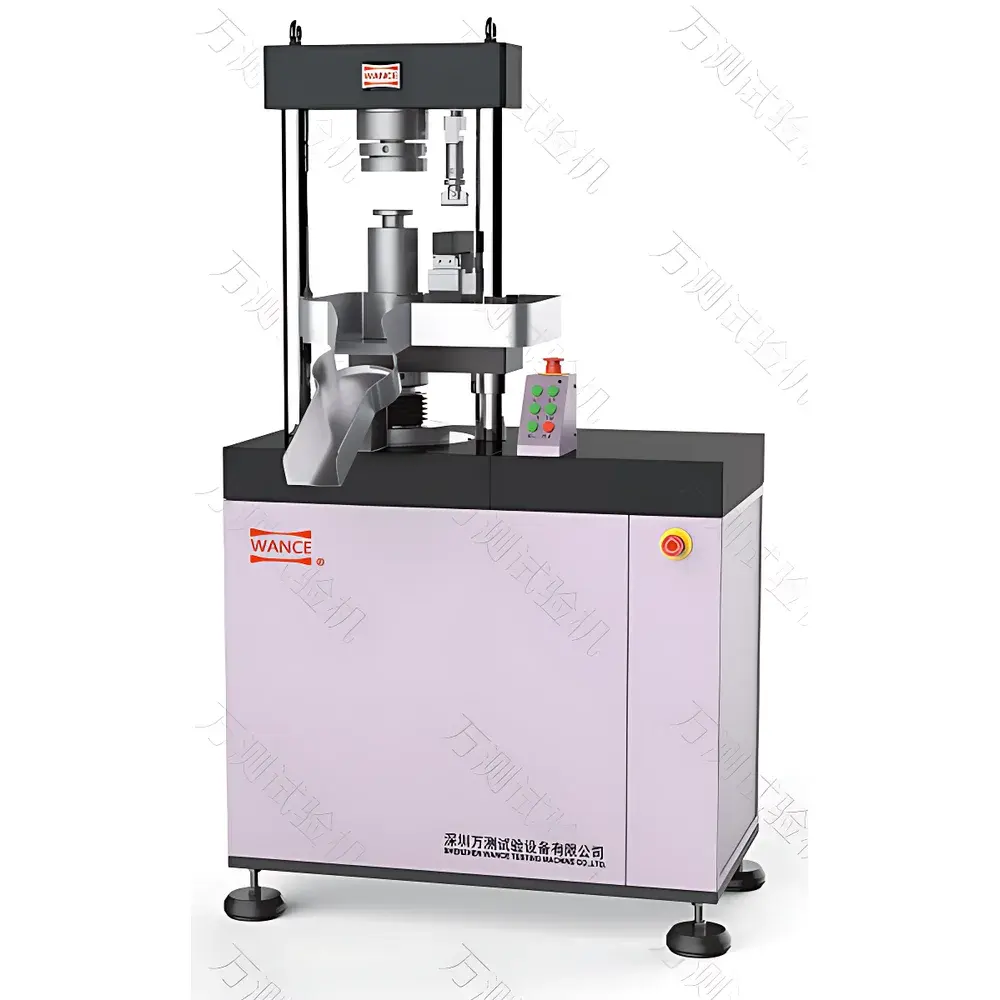
WANCE ETM-Z2 Series Computer-Controlled Compression and Flexural Testing Machine
| Brand | WANCE |
|---|---|
| Origin | Guangdong, China |
| Model | ETM-Z2 |
| Max. Compression Load | 300 kN |
| Max. Flexural Load | 5 kN |
| Accuracy Class | Class 1 (compression), Class 0.5 (flexure) |
| Force Measurement Range | 0.2–100% FS (compression), 0.4–100% FS (flexure) |
| Force Resolution | 1/350,000 of full scale |
| Force Indication Error | ±1% of reading (compression), ±0.5% of reading (flexure) |
| Loading Rate Adjustment | 0.02–5% FS/s |
| Crosshead Travel | 100 mm |
| Max. Crosshead Speed | 50 mm/min |
| Column Spacing (clear) | 300 mm |
| Compression Platen Diameter | Φ110 mm (upper), Φ118 mm (lower) |
| Flexural Support Roller Spacing | 100 mm |
| Roller Diameter | Φ10 mm |
| Roller Length | 60 mm |
| Motor Power | 1.5 kW |
| Power Supply | 380 V / 50 Hz |
| Dimensions (L×W×H) | 960 × 850 × 1560 mm |
| Weight | ~1000 kg |
Overview
The WANCE ETM-Z2 Series Computer-Controlled Compression and Flexural Testing Machine is a dual-function electromechanical testing system engineered for precision mechanical property evaluation of construction materials—specifically designed to perform standardized compression and flexural strength tests in a single, integrated platform. Based on closed-loop servo-controlled loading architecture, the machine applies controlled axial force via a high-rigidity two-column frame and measures load and displacement with traceable metrological integrity. Its operational principle relies on real-time feedback from high-resolution load cells and linear displacement transducers, enabling accurate implementation of ISO 7500-1, ASTM E4, and GB/T 17671-1999 compliant test protocols. Unlike conventional systems requiring manual fixture swaps between compression and flexure modes, the ETM-Z2 features a mechanically unified fixture interface—eliminating reconfiguration downtime and minimizing operator-induced variability. The system is calibrated to Class 1 accuracy per ISO 7500-1 for compressive testing and Class 0.5 for flexural applications, ensuring suitability for accredited laboratory environments engaged in quality assurance, regulatory conformance, and R&D validation.
Key Features
- Integrated dual-mode mechanical design: Single-frame architecture accommodates both compression (up to 300 kN) and three-point flexural (up to 5 kN) testing without fixture replacement or mechanical recalibration.
- High-performance DSP-based control platform: Delivers deterministic real-time control loop execution, supporting constant-rate loading, constant-rate displacement, and load/position hold functions with sub-millisecond response latency.
- 24-bit high-fidelity data acquisition system: Provides force resolution up to 1 part in 350,000 of full scale and supports scalable analog input expansion (up to 8 channels) for future sensor integration (e.g., strain gauges, extensometers).
- USB 1.1 full-speed interface (12 Mb/s): Enables robust, hot-pluggable communication with host PCs; all peripheral interfaces—including load cell, encoder, and safety I/O—are standardized to USB-type connectors with software-configurable electrical characteristics.
- Four-layer PCB control board with optimized RF shielding layout: Engineered to suppress electromagnetic interference in industrial lab environments, ensuring signal stability during long-duration creep or fatigue-relevant quasi-static tests.
- Comprehensive hardware safety architecture: Includes mechanical limit switches, overload cut-off relays, emergency stop circuitry compliant with IEC 60204-1, and software-enforced load/displacement bounds synchronized with real-time control firmware.
Sample Compatibility & Compliance
The ETM-Z2 is validated for standardized mechanical testing of cementitious composites, concrete specimens, mortar prisms, ceramic tiles, and structural mortars per major international and national standards. It fully supports GB/T 17671-1999 (Cement Mortar Strength Testing), GB/T 2542-2012 (Brick Compressive Strength), and GB/T 3810.4-2016 (Ceramic Tile Flexural Strength). While primarily deployed in construction materials QA/QC labs, its modular load train and configurable test parameters permit adaptation to ASTM C109/C348/C78 and EN 196-1 protocols with appropriate calibration documentation and traceable reference standards. All force and displacement measurements are traceable to national metrology institutes via factory-certified calibration certificates (ISO/IEC 17025-accredited calibration optional upon request). The system meets general requirements for GLP-compliant operation when paired with audit-trail-enabled software configuration.
Software & Data Management
The ETM-Z2 operates under a native Windows-based application with bilingual UI support (English/Chinese), offering full test sequence programming, real-time multi-channel waveform visualization, and post-test analytical tools. Software functions include automatic curve replay, differential curve overlay, statistical reporting (mean, SD, CV%), and customizable report templates exportable as PDF, Excel, or XML. Raw data files are stored in structured binary format with embedded metadata (operator ID, timestamp, environmental conditions, calibration status). Audit trail functionality records all user actions—including method edits, result overrides, and calibration events—with immutable timestamps and user authentication logs. Optional FDA 21 CFR Part 11 compliance packages provide electronic signature support, role-based access control, and encrypted database storage for regulated pharmaceutical or biomedical material testing applications.
Applications
- Compressive strength verification of Portland cement mortar cubes (40×40×160 mm) per GB/T 17671-1999 and ISO 679.
- Flexural strength determination of concrete beams (40×40×160 mm) using third-point loading configuration per GB/T 2542-2012 and ASTM C78.
- Quality control screening of fired clay bricks, autoclaved aerated concrete (AAC) blocks, and gypsum board panels.
- Research-grade mechanical characterization of novel binders, geopolymer formulations, and fiber-reinforced cement composites.
- Third-party certification testing for CE marking, CCC, and other construction product conformity assessment schemes.
FAQ
Does the ETM-Z2 require separate calibration for compression and flexural modes?
No—calibration is performed at the transducer level and remains valid across both modes; however, independent verification using certified reference standards is recommended before first use in each configuration.
Can the system be integrated into a LIMS or enterprise QA database?
Yes—via optional OPC UA or TCP/IP API modules, enabling automated result transfer to LabVantage, Thermo Fisher SampleManager, or custom SQL-based platforms.
Is the software compliant with FDA 21 CFR Part 11 out-of-the-box?
Base software includes audit trail and user management; full Part 11 compliance requires activation of the validated e-signature module and documented IQ/OQ/PQ protocols.
What is the typical recalibration interval for routine QC use?
Annual recalibration is recommended per ISO/IEC 17025 guidelines; more frequent verification (e.g., daily zero-check, weekly standard load checks) is advised in high-throughput production labs.
Are protective enclosures available as factory-installed options?
Yes—interlocked polycarbonate safety guards meeting EN 954-1 Category 3 requirements are offered as configurable accessories, including light-curtain integration for enhanced operator protection.
Related Products



