
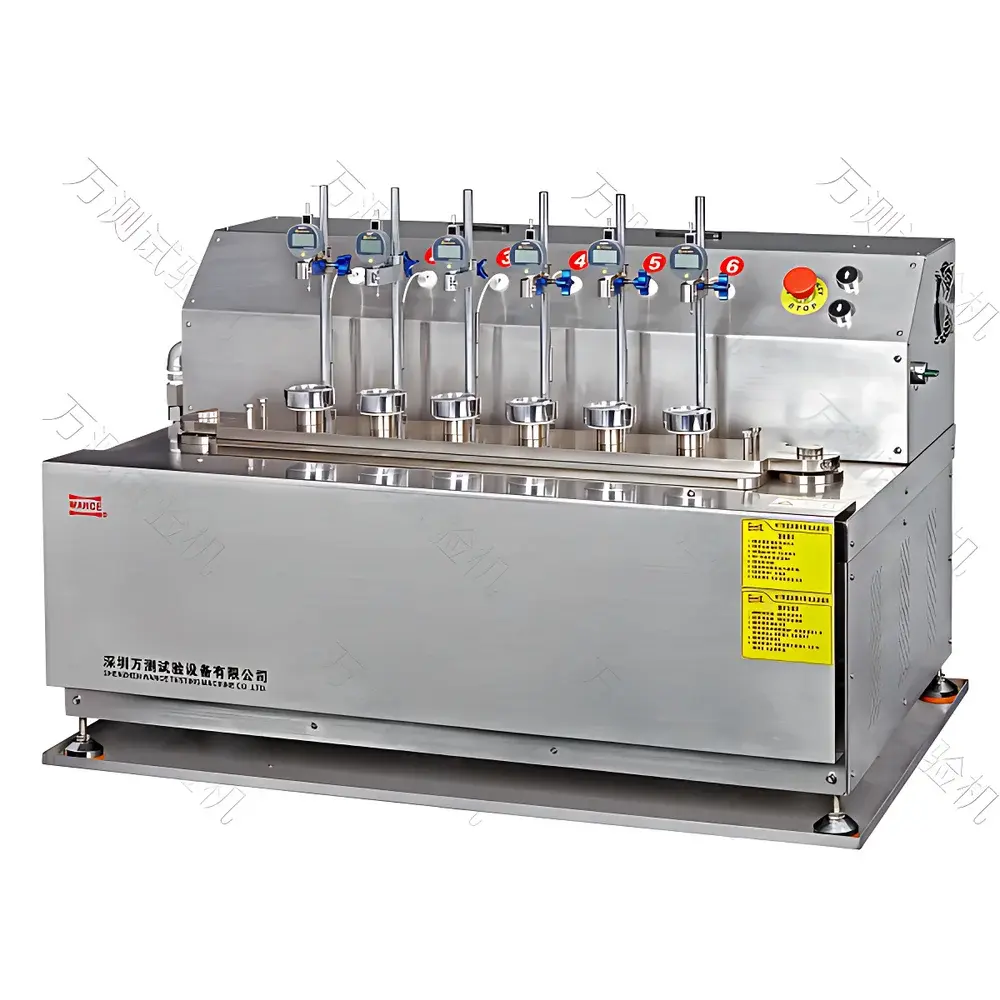
WANCE HVT Series (6-Station) Heat Deflection Temperature and Vicat Softening Point Tester
| Brand | WANCE |
|---|---|
| Origin | Guangdong, China |
| Manufacturer Type | Authorized Distributor |
| Country of Origin | China |
| Model | HVT Series (6-Station) |
| Quotation | Available Upon Request |
| Max Test Stations | 6 |
| Control Mode | PC-Based |
| Software | TestPilot_HVT |
| Temperature Range | Ambient to 300 °C |
| Temp. Accuracy | ±0.5 °C |
| Heating Rates | 5 ±0.5 °C/6 min or 12 ±1 °C/6 min |
| Thermal Medium | Silicone Oil or Transformer Oil |
| Deformation Range | >10 mm |
| Deformation Resolution | 0.001 mm |
| Deformation Accuracy | ±0.003 µm |
| Vicat Loads | GA = 10 N ±0.2 N |
| Cooling Options | Natural Air or Water (≤200 °C) |
| Power Supply | 380 V ±10%, 50 Hz, 5 kW |
| Dimensions (HVT302C) | 835 × 670 × 1450 mm |
| Weight (HVT302C) | ~280 kg |
Overview
The WANCE HVT Series (6-Station) Heat Deflection Temperature and Vicat Softening Point Tester is a precision-engineered instrument designed for standardized determination of two critical thermomechanical properties of thermoplastic polymers: the Heat Deflection Temperature (HDT, ASTM D648 / ISO 75) and the Vicat Softening Temperature (VST, ASTM D1525 / ISO 306). The system operates on the principle of controlled thermal loading under defined bending stress (for HDT) or needle penetration under constant load (for VST), with real-time monitoring of specimen deformation versus temperature. Its dual-test capability—simultaneous execution of both HDT and VST protocols within a single thermal bath—enables efficient batch evaluation of raw materials, extruded profiles, injection-molded parts, and pipe/fittings used in construction, automotive, and industrial applications. The instrument complies with core regulatory and quality framework requirements for physical property testing, including traceable calibration paths, audit-ready data logging, and deterministic thermal response characteristics essential for GLP-compliant laboratories and ISO/IEC 17025-accredited testing facilities.
Key Features
- Six independent test stations with synchronized thermal control and individual deformation measurement, enabling high-throughput validation of material lots or comparative studies across formulations.
- Low-expansion alloy construction for both specimen support rods and loading columns—minimizing parasitic thermal expansion and ensuring <0.003 µm deformation accuracy per station.
- Motorized, vibration-damped vertical actuation system for automated specimen rack elevation and immersion, eliminating manual handling errors and improving repeatability (RSD <1.2% across six replicates).
- Dual-mode heating profile control: programmable ramp rates of 5 ±0.5 °C/6 min (standard) or 12 ±1 °C/6 min (accelerated), both independently validated against NIST-traceable platinum resistance thermometers (Pt100).
- Integrated upper-temperature safety cutoff with configurable setpoint and hardware-level thermal override, preventing overheating during unattended operation.
- High-stability temperature regulation via imported Japanese digital PID controller, coupled with silicone oil or transformer oil as heat transfer medium for uniform thermal conduction and minimal temperature gradient (<0.8 °C across bath volume at 250 °C).
Sample Compatibility & Compliance
The HVT Series accommodates standard rectangular specimens (e.g., 80 × 10 × 4 mm per ASTM D648) and cylindrical specimens (e.g., Ø10 mm × 10 mm per ISO 306) without modification. Specimen holders are interchangeable between HDT and VST configurations, supporting both GA (10 N) and GB (50 N) load classes per ISO 306 Annex A. All mechanical and thermal components meet CE machinery directive requirements (2006/42/EC) and electromagnetic compatibility standards (2014/30/EU). Data acquisition and reporting functions align with FDA 21 CFR Part 11 expectations for electronic records—including user authentication, audit trails for parameter changes, and immutable timestamped result export. Calibration certificates for deformation sensors (Swiss-made digital micrometers) and temperature probes are provided with each unit and conform to ISO/IEC 17025 traceability chains.
Software & Data Management
TestPilot_HVT is a modular, Windows-based application engineered for laboratory-grade data integrity and operational flexibility. Core modules include Role-Based Access Control (RBAC), test method configuration (ASTM/ISO templates preloaded), real-time dual-axis plotting (temperature vs. time; temperature vs. deformation), and automated endpoint detection per standard-defined criteria (e.g., 0.25 mm deflection for HDT, 1 mm needle penetration for VST). All raw sensor data—including 10 Hz temperature and deformation sampling—are stored in encrypted SQLite databases with SHA-256 checksums. Curve analysis supports zoom, overlay comparison of up to eight tests, and derivative calculation (dδ/dT) for transition onset identification. Export options include PDF test reports with digital signatures, Excel-compatible .csv files, and secure FTP/SFTP transmission. Software updates are delivered via signed installer packages with version-controlled release notes compliant with ICH Q9 risk management principles.
Applications
- Quality assurance of polypropylene (PP), polyethylene (PE), ABS, polycarbonate (PC), and PEEK resin batches prior to extrusion or molding.
- Validation of thermal stability in PVC pipe compounds subjected to long-term service temperatures per ASTM F441/F441M.
- Comparative assessment of flame-retardant additives’ impact on softening behavior in engineering thermoplastics.
- Supporting technical documentation for CE marking dossiers under Construction Products Regulation (CPR) for plastic building products.
- Research into crystallinity–softening relationships using sequential HDT/VST measurements on annealed vs. quenched specimens.
FAQ
What standards does this instrument fully support?
ASTM D648 (HDT), ASTM D1525 (VST), ISO 75-1/2/3, ISO 306, GB/T 1634, and JIS K 7207—all implemented with default test parameters aligned to clause-specified tolerances.
Can the system operate unattended overnight?
Yes—equipped with thermal runaway protection, automatic shutdown after test completion, and battery-backed real-time clock for scheduled start times; all events logged with timestamps.
Is remote monitoring or control possible?
TestPilot_HVT supports TCP/IP-based client-server architecture; authorized users may view live curves and initiate tests from networked workstations via role-limited access.
How is calibration maintained over time?
The system includes built-in calibration routines for deformation sensors and temperature channels; annual third-party verification is recommended, with full calibration kits (reference weights, certified thermocouples) available as optional accessories.
What maintenance intervals are recommended?
Thermal bath fluid replacement every 12 months (or after 500 test cycles), periodic inspection of load train alignment per ISO 75 Annex C, and quarterly verification of zero-point drift in displacement transducers.



