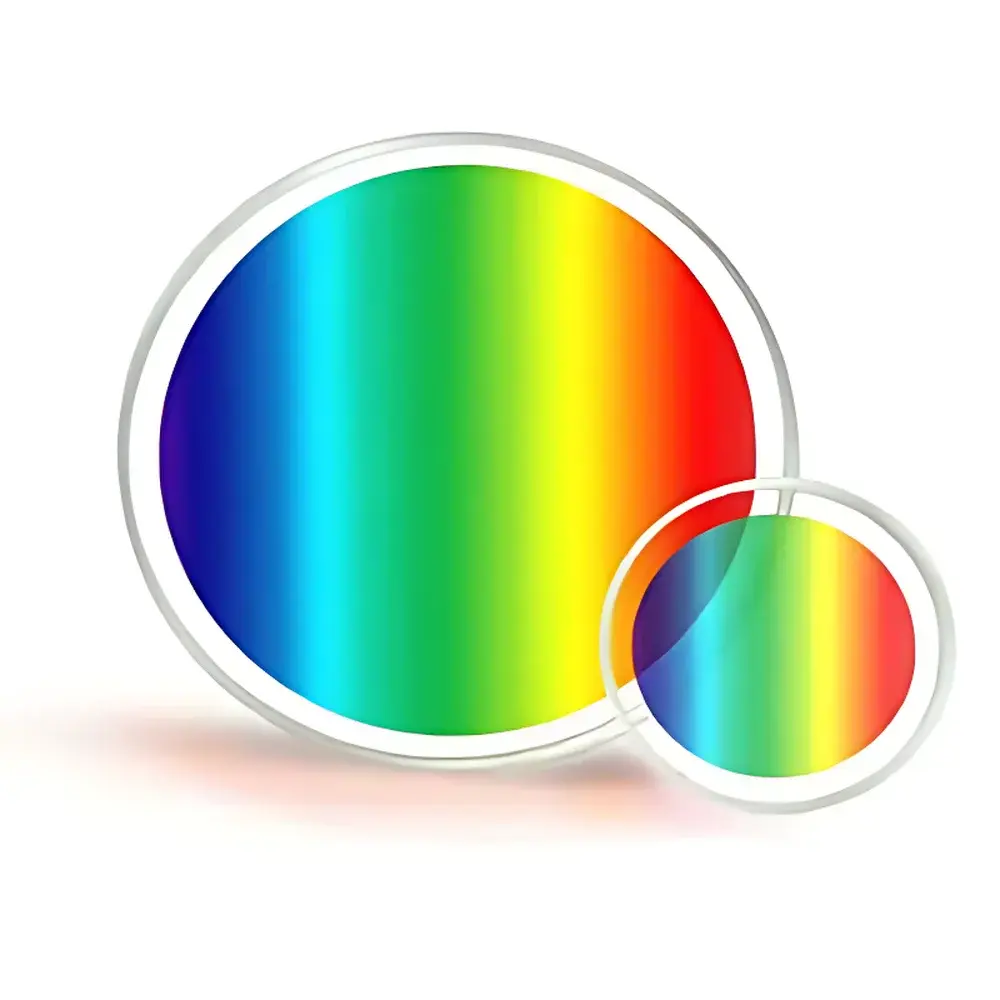
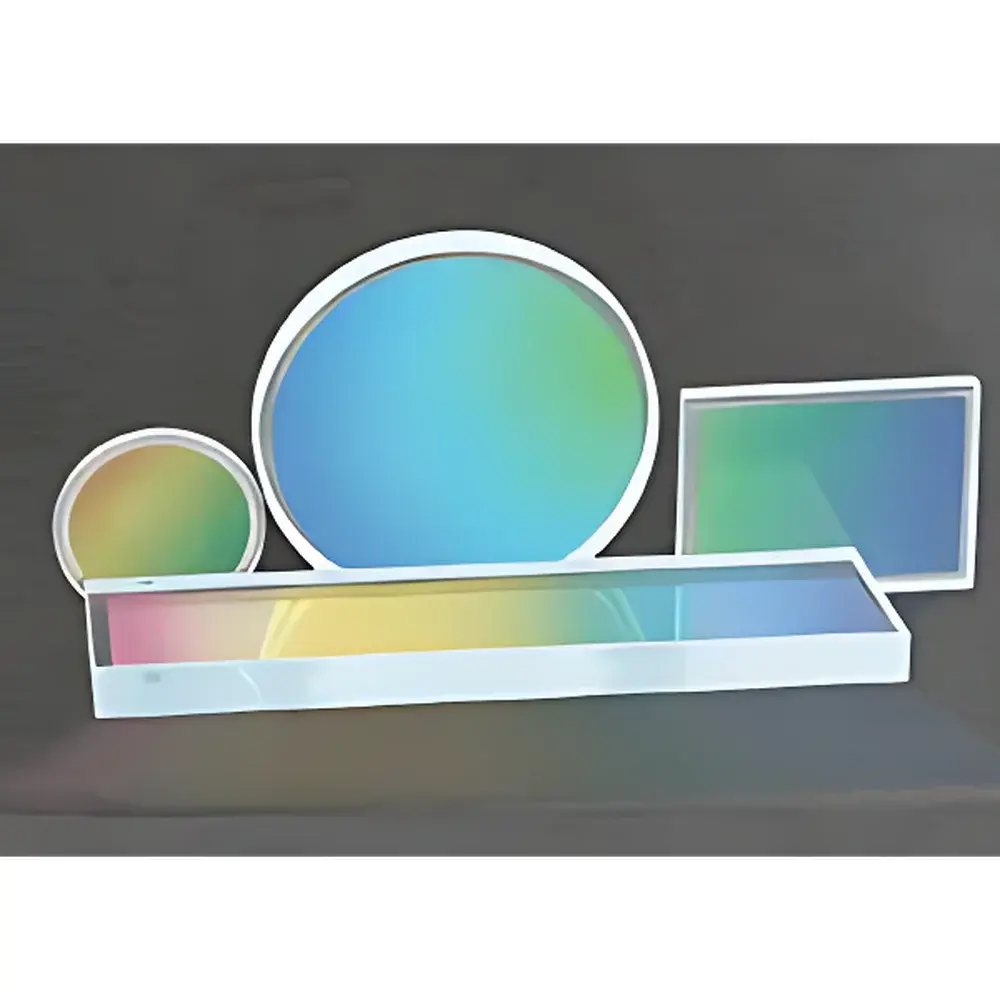
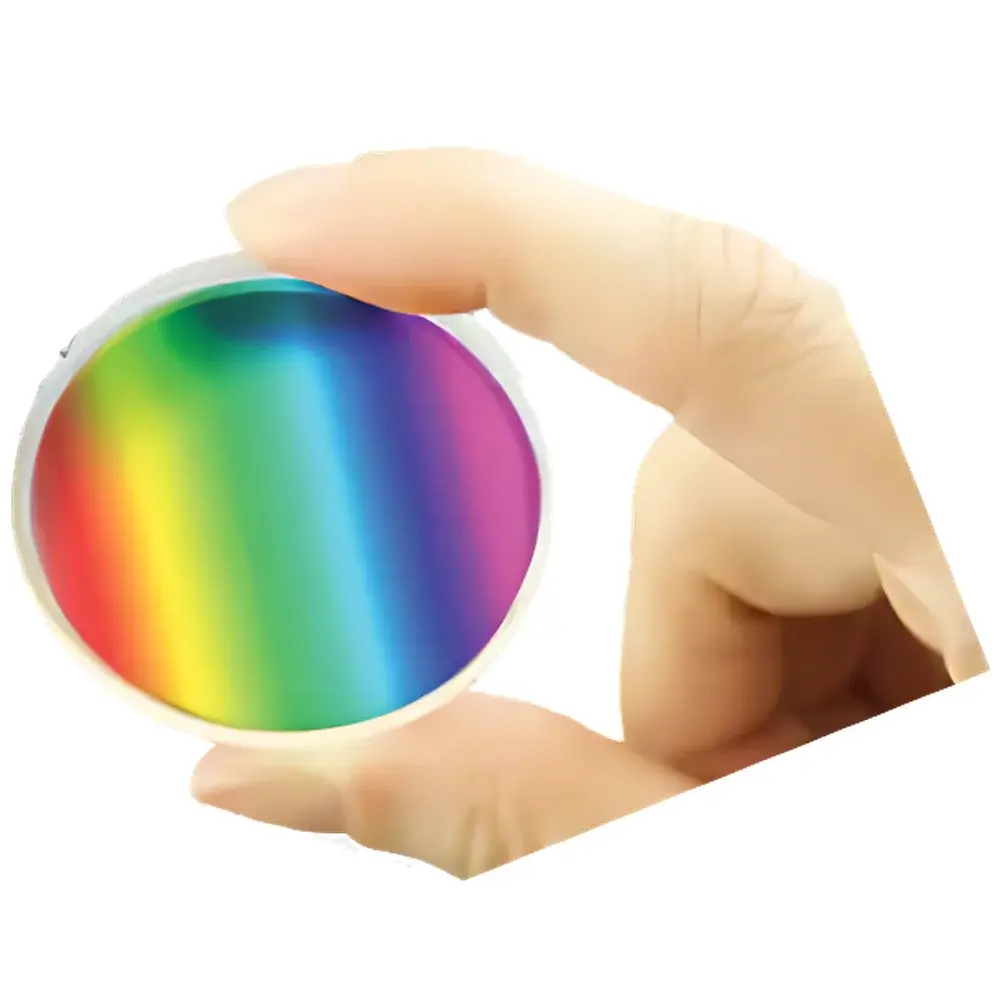
Wasatch Photonics WP-HD1624/871-25.4 High-Definition Volume Phase Holographic Grating
| Brand | Wasatch Photonics |
|---|---|
| Origin | USA |
| Manufacturer Type | Authorized Distributor |
| Origin Category | Imported |
| Model | WP-HD1624/871-25.4 |
| Dimensions | Dia. 25.4 mm |
| Groove Density | 1624 lines/mm |
| Center Wavelength | 871 nm |
| Thickness | 3 mm |
| Coating | Broadband AR (350–2500 nm) |
Overview
The Wasatch Photonics WP-HD1624/871-25.4 is a high-definition volume phase holographic (VPH) diffraction grating engineered for demanding optical coherence tomography (OCT), Raman spectroscopy, and fluorescence detection systems. Unlike ruled or surface-relief gratings, VPH gratings operate on Bragg diffraction principles within a photosensitive gelatin or dichromated gelatin (DCG) medium, enabling exceptional spectral resolution, minimal wavefront distortion, and intrinsic polarization insensitivity. This specific grating—featuring 1624 grooves per millimeter and optimized for a 871 nm center wavelength—is fabricated using proprietary holographic recording and thermal stabilization processes to ensure long-term environmental stability and repeatability across production lots. Its 25.4 mm clear aperture supports integration into compact spectrometer designs and OCT interferometers where spatial coherence, throughput efficiency, and low stray light are critical performance criteria.
Key Features
- High diffraction efficiency (>85% typical across design band, measured at Littrow configuration)
- Ultra-low wavefront error (<λ/10 RMS over 25.4 mm aperture, verified via interferometric testing)
- Negligible polarization-dependent loss (PDL < 0.5% across 800–950 nm range)
- Broadband anti-reflection coating (350–2500 nm), reducing ghost reflections and enhancing signal-to-noise ratio in multi-wavelength applications
- Robust mechanical architecture: fused silica substrate with thermally matched DCG layer, resistant to humidity, temperature cycling (−20 °C to +70 °C), and moderate laser fluence (up to 500 mJ/cm² at 10 ns, 10 Hz)
- HD-series design incorporating Dickson grating geometry for improved blaze uniformity and reduced higher-order diffraction artifacts
Sample Compatibility & Compliance
This grating is compatible with standard kinematic mounts (e.g., Thorlabs KM100, Newport UMB1) and custom optomechanical interfaces requiring Ø25.4 mm round substrates. It meets material traceability requirements per ISO 10110-7 for optical component certification and conforms to RoHS 2015/863/EU directives. While not a medical device itself, its use in FDA-cleared OCT systems (e.g., swept-source or spectral-domain platforms) aligns with design controls under 21 CFR Part 820. When integrated into analytical instrumentation for pharmaceutical or clinical research, the grating’s batch-specific test reports—including diffraction efficiency maps, wavefront measurements, and spectral response curves—support GLP-compliant documentation and audit readiness per ICH-GCP and ISO/IEC 17025 standards.
Software & Data Management
Wasatch Photonics provides full spectral calibration datasets for each grating lot, including calibrated groove density deviation (±0.05 lines/mm), angular dispersion (dθ/dλ), and absolute efficiency vs. wavelength curves. These data are delivered in standardized ASCII format compatible with common optical design software (Zemax OpticStudio, CODE V, FRED) and spectral analysis toolkits (Python SciPy, MATLAB Spectral Toolbox). For OEM integration, grating metadata (model, serial number, coating ID, test date) can be embedded into instrument firmware via XML schema, enabling automated configuration validation and traceable calibration history per FDA 21 CFR Part 11 electronic record requirements.
Applications
- Optical Coherence Tomography (OCT): Used as the dispersive element in high-speed spectral-domain OCT systems operating near 870 nm, enabling axial resolutions < 6 µm in tissue and >100 kHz line rates with minimal spectral roll-off.
- Raman Spectroscopy: Integrated into compact Czerny–Turner or transmission-based spectrometers for 830–910 nm excitation, delivering flat spectral response and high stray-light rejection (optical density >6 beyond ±100 cm⁻¹ from Rayleigh line).
- Fluorescence Lifetime Imaging (FLIM): Paired with time-correlated single-photon counting (TCSPC) modules to resolve emission spectra from quantum dots or NIR-II fluorophores with sub-nanometer channel spacing.
- Ultrafast Pulse Compression: Employed in grating-based stretcher-compressor pairs for Ti:sapphire and Yb-doped fiber lasers, leveraging low group delay dispersion (GDD) variation across the 850–890 nm bandwidth.
- Astronomical Instrumentation: Qualified for use in ground-based integral field units (IFUs) and multi-object spectrographs requiring stable diffraction performance under vacuum and cryogenic conditions.
FAQ
What is the damage threshold for this grating under continuous-wave (CW) illumination?
The grating exhibits a CW laser-induced damage threshold (LIDT) of ≥5 MW/cm² at 871 nm (measured per ISO 21254-1), limited primarily by coating absorption rather than bulk material failure.
Can this grating be cleaned using standard optics protocols?
Yes—surface cleaning is supported using acetone followed by IPA rinse and dry nitrogen purge; avoid ultrasonic baths or abrasive wipes due to the delicate DCG layer.
Is there batch-to-batch performance variation in diffraction efficiency?
Typical efficiency variation across production lots is ≤1.2% RMS, verified by NIST-traceable spectrophotometric measurement at three spatial positions across the aperture.
Does Wasatch provide mounting hardware or kinematic adapters?
Standard unmounted gratings are supplied; optional kinematic mounts (e.g., SM1-threaded cell with adjustable tip/tilt) are available upon request with lead-time confirmation.
How does the HD-series differ from conventional VPH gratings?
HD-series gratings incorporate optimized holographic exposure geometry and post-processing thermal annealing to reduce higher-order diffraction, improve broadband flatness (±0.8% efficiency variation over 50 nm bandwidth), and suppress ghost orders by >30 dB relative to primary diffraction peak.