
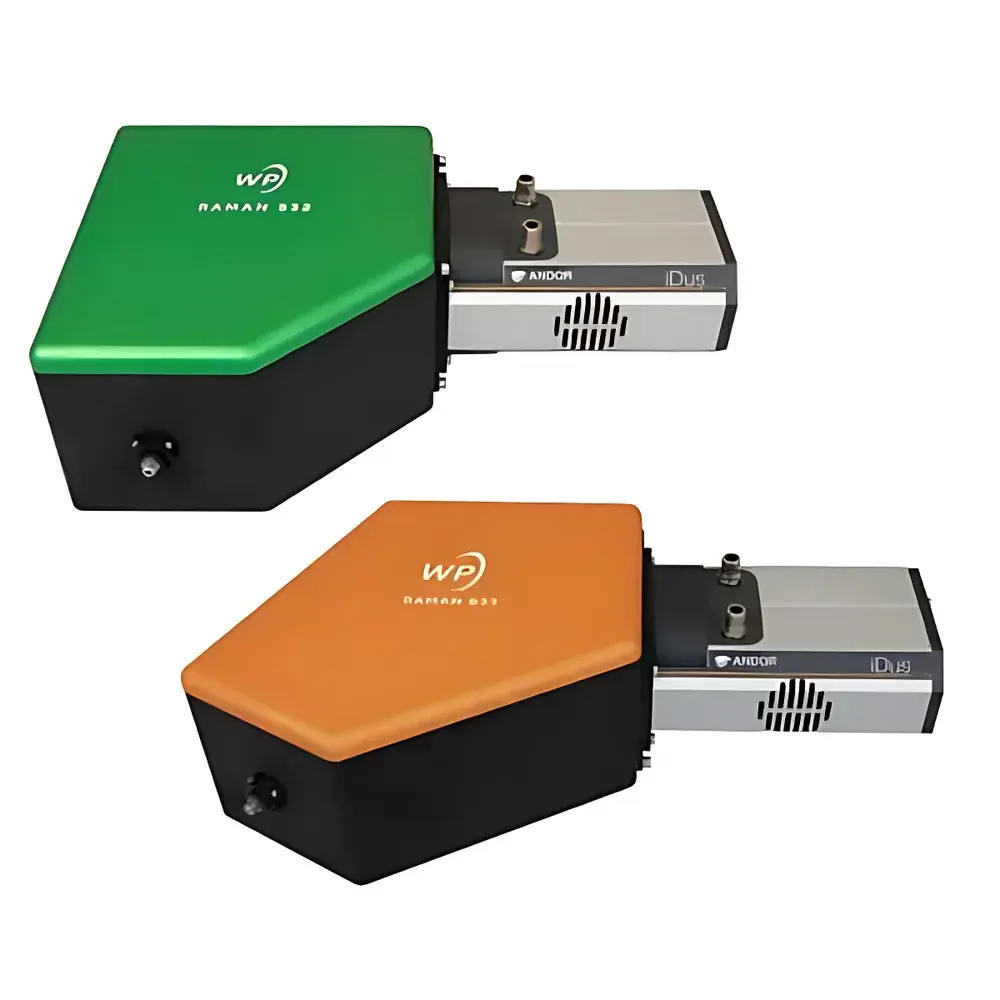
Wasatch Photonics WP Raman XL Portable Raman Spectrometer
| Brand | Auniontech (distributor) |
|---|---|
| Origin | Shanghai, China |
| Manufacturer Type | Authorized Distributor |
| Product Category | Domestic (PRC-manufactured) |
| Model Series | WP Raman XL |
| Form Factor | Portable / Handheld Raman Spectrometer |
| Excitation Wavelength Options | 532 nm, 633 nm, 785 nm, 830 nm, 1064 nm |
| Detector | Ultra-cooled scientific CMOS/CCD camera |
| Optical Architecture | High-throughput Czerny–Turner spectrometer with optimized f/# and stray-light suppression |
| Probe Interface | Interchangeable fiber-coupled probe tips (standard, industrial spherical, microscope-coupled lens adapters) |
| OEM Integration | Embedded modular Raman engine available (785/830/1064 nm variants) |
Overview
The Wasatch Photonics WP Raman XL Portable Raman Spectrometer is a high-performance, field-deployable analytical instrument engineered for quantitative and qualitative molecular identification via inelastic laser scattering. Based on spontaneous Raman scattering principles, the system illuminates a sample with monochromatic laser light and measures the energy-shifted photons resulting from vibrational mode excitations—yielding a chemically specific spectral fingerprint with sub-wavenumber resolution. Unlike benchtop systems constrained by optical tables and environmental controls, the WP Raman XL integrates thermally stabilized optics, ultra-cooled scientific-grade detectors, and high-efficiency volume phase holographic (VPH) gratings into a ruggedized, battery-operated chassis. Its design adheres to fundamental spectroscopic requirements for signal-to-noise ratio (SNR), spectral fidelity, and photometric linearity—enabling reliable operation in laboratories, manufacturing floors, customs checkpoints, and outdoor field environments without sacrificing laboratory-grade data quality.
Key Features
- High-throughput optical architecture with f/2.0 throughput and VPH grating technology for >85% diffraction efficiency across visible–NIR bands
- Ultra-cooled scientific CMOS or back-illuminated CCD detector (−20 °C to −60 °C stabilization) enabling low-dark-current acquisition for weak Raman signals
- Modular excitation flexibility: interchangeable laser modules supporting 532 nm, 633 nm, 785 nm, 830 nm, and 1064 nm wavelengths—optimized for fluorescence suppression and penetration depth control
- Interchangeable fiber-optic Raman probes with user-replaceable tips: standard collimated probe (WD = 7.5 mm), IP67-rated industrial spherical probe, and microscope-compatible lens couplers
- Embedded FPGA-based real-time spectral processing including cosmic ray removal, dark subtraction, and intensity calibration traceable to NIST-traceable standards
- Compact footprint (≤280 × 180 × 95 mm) and <2.5 kg mass; compatible with external 12 V DC power or integrated Li-ion battery (≥4 h continuous operation)
Sample Compatibility & Compliance
The WP Raman XL accommodates solid, liquid, gel, and powder samples—including opaque, highly scattering, or thermally sensitive materials—without requiring extensive preparation. Its non-destructive, non-contact measurement modality meets ISO/IEC 17025 requirements for method validation in accredited testing labs. When configured with 785 nm or 1064 nm excitation, the system complies with IEC 60825-1:2014 Class 1/Class 3R laser safety standards depending on probe configuration. Data integrity protocols support audit-ready workflows aligned with FDA 21 CFR Part 11 (electronic signatures, operator access logs, immutable raw-data archiving) when deployed with Wasatch’s SpectraWiz™ software suite. All optical components are RoHS-compliant and calibrated per ASTM E1840-22 (Standard Practice for Calibration of Raman Spectrometers).
Software & Data Management
Controlled via SpectraWiz™ v5.x—a cross-platform application built on Qt and Python—users access real-time spectral acquisition, multivariate analysis (PCA, PLS-DA), library matching (with >15,000 reference spectra), and automated peak fitting using Levenberg–Marquardt algorithms. The SDK includes C/C++, Python, and MATLAB APIs for integration into custom LIMS, MES, or process analytical technology (PAT) frameworks. Raw spectral data is stored in HDF5 format with embedded metadata (excitation wavelength, integration time, detector temperature, calibration coefficients), ensuring full traceability. Batch processing scripts support GLP/GMP-aligned reporting, including uncertainty estimation per GUM (JCGM 100:2008) guidelines.
Applications
- Pharmaceutical QC: Polymorph screening, API-excipient interaction analysis, counterfeit drug detection per USP
- Materials science: Carbon nanotube chirality mapping, graphene layer counting, stress/strain characterization in composites
- Forensics & security: Explosives residue identification (e.g., TNT, RDX), illicit drug classification (fentanyl analogs, synthetic cannabinoids)
- Geology & mining: Mineral phase identification (e.g., quartz polymorphs, carbonates) in core samples or field outcrops
- Food safety: Adulterant detection (melamine in milk, Sudan dyes in spices), authenticity verification (olive oil, honey, wine)
- Academic research: Time-resolved reaction monitoring, in situ electrochemical Raman, catalytic surface studies
FAQ
What excitation wavelengths are supported, and how do I select the optimal one for my sample?
The WP Raman XL supports 532 nm (high sensitivity, risk of fluorescence), 633 nm (balanced SNR/fluorescence), 785 nm (standard for organics/pharmaceuticals), 830 nm (reduced water absorption), and 1064 nm (minimal fluorescence, ideal for biological tissues). Selection depends on sample fluorescence background, absorption characteristics, and required spatial resolution.
Is the system suitable for regulated environments such as pharmaceutical manufacturing?
Yes—when paired with SpectraWiz™ and configured with electronic signature, audit trail, and calibration management modules, it satisfies FDA 21 CFR Part 11 and EU Annex 11 requirements for computerized systems in GMP settings.
Can I integrate the spectrometer into an automated production line?
Absolutely—the OEM module variant provides TTL-triggered acquisition, GigE Vision-compliant image streaming, and deterministic latency (<10 ms) for real-time closed-loop feedback in PAT applications.
Does the system require routine recalibration?
No—factory-performed wavelength and intensity calibration is stable over ±5 °C ambient variation; optional daily automated check using internal Ne/Ar lamp reference ensures long-term metrological confidence.
What level of technical support and documentation is provided?
Auniontech offers localized engineering support in China, including application-specific method development, IQ/OQ documentation templates, and on-site training. Wasatch Photonics provides global firmware updates, spectral library curation services, and ISO/IEC 17025-compliant calibration certificates upon request.




