
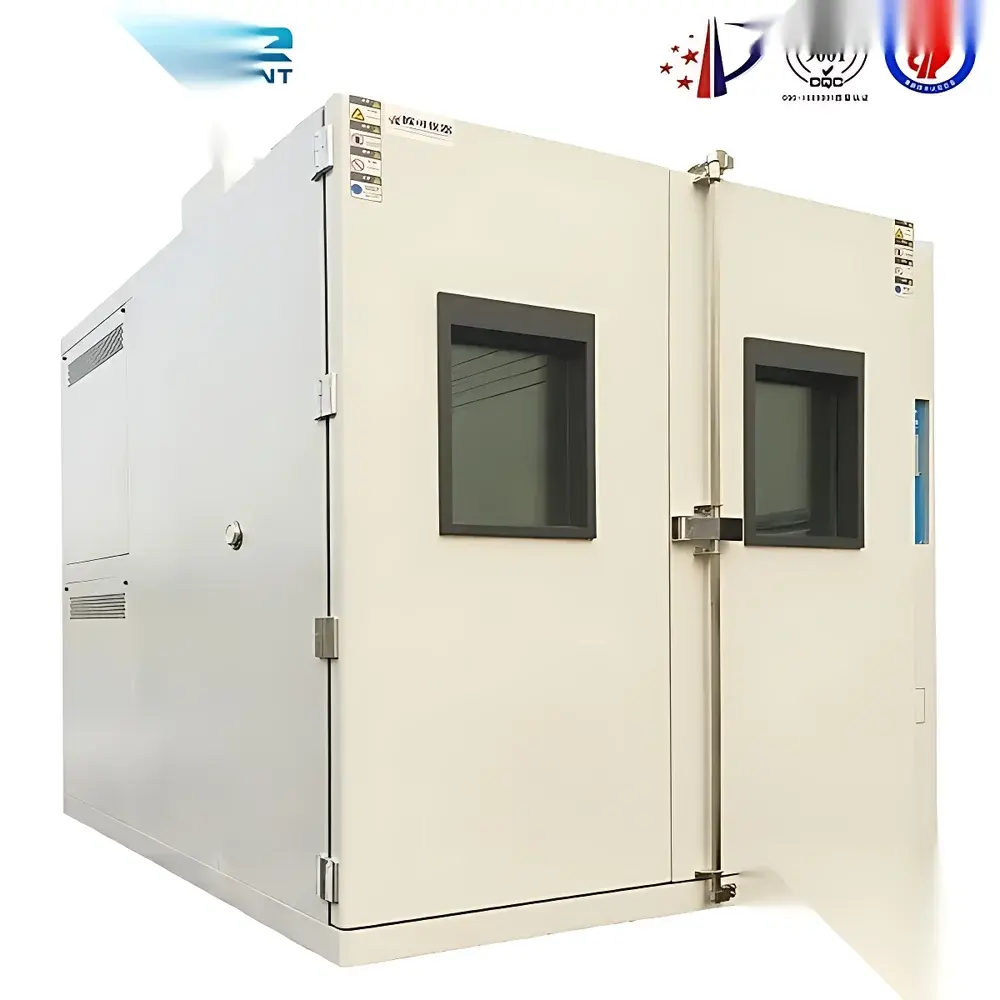
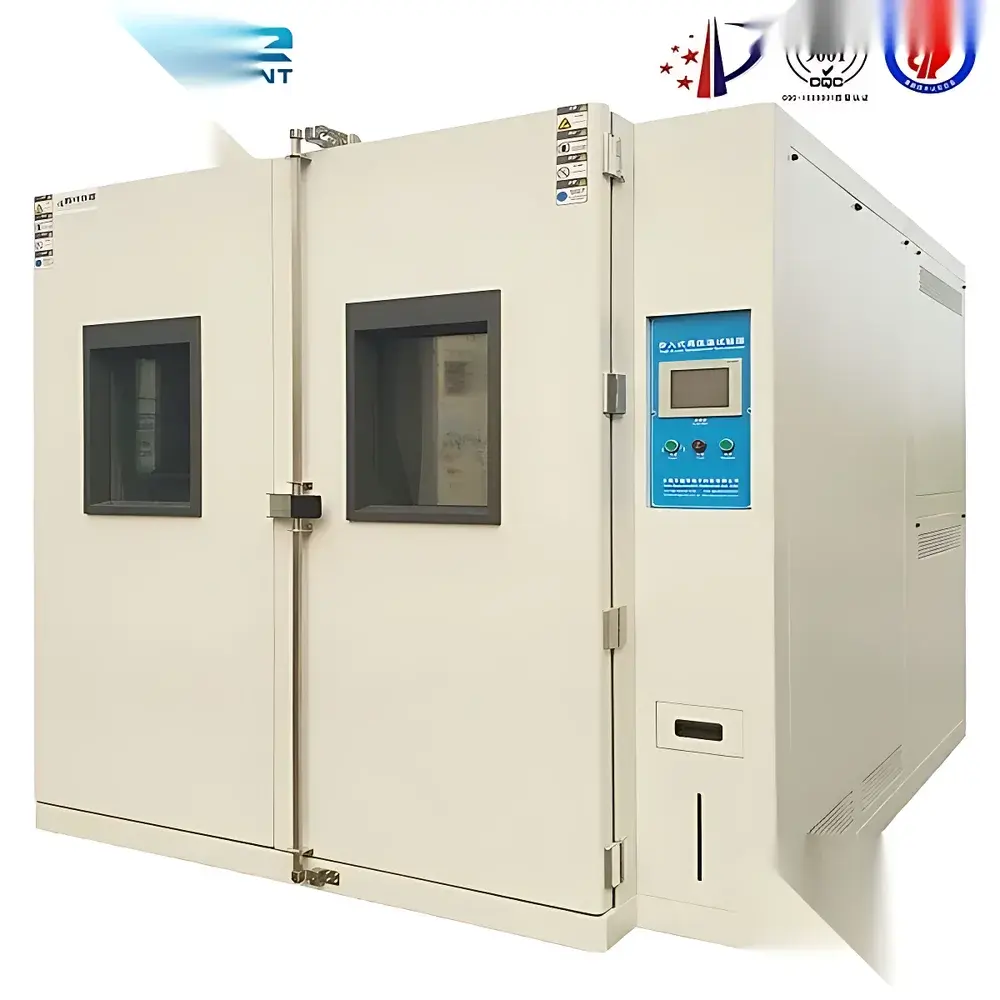
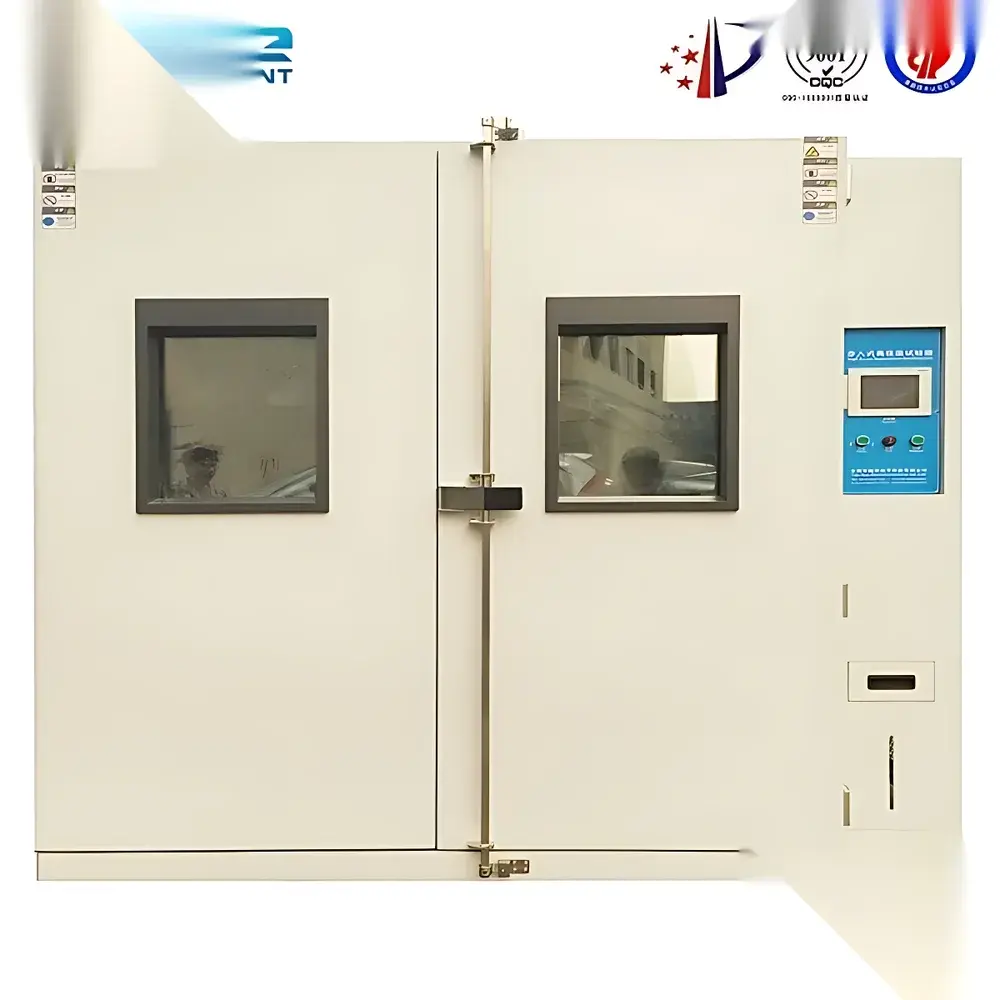
Water-Cooled Walk-In Environmental Chamber for Temperature and Humidity Testing
| Key | Temperature Range: 0°C to 100°C |
|---|---|
| Humidity Range | 30–98% RH |
| Temperature Uniformity | ±0.1°C |
| Humidity Uniformity | ±1% RH |
| Chamber Volume | 2 m³ to 300 m³ |
| Power Supply | AC 380 V (±10%), 50 Hz, 3-phase 5-wire |
| Total Power Consumption | 12 kW |
| Ambient Operating Conditions | 5°C–28°C (24-hr avg ≤28°C), RH ≤85% |
| Compliance | GB/T 10592–2008, GB/T 10586–2012, GB/T 2423.1–2022, GB/T 2423.2–2022, GB/T 2423.3–2016, GB/T 2423.4–2016 |
Overview
The Water-Cooled Walk-In Environmental Chamber for Temperature and Humidity Testing is an engineered precision system designed to replicate controlled climatic conditions across extended operational volumes—from 2 m³ to 300 m³—enabling full-scale evaluation of large components, subsystems, or multi-unit assemblies under rigorously defined thermal and hygrothermal stress profiles. Unlike compact benchtop chambers, this walk-in platform employs a water-cooled refrigeration architecture to sustain stable, high-capacity cooling performance without dependency on ambient air exchange, making it suitable for installation in temperature-sensitive facilities or locations with limited ventilation capacity. Its core operating principle integrates forced-air convection, PID-driven thermal/hygrometric regulation, and dual-sensor feedback loops (PT100 platinum resistance thermometers and capacitive RH sensors) to maintain uniformity within ±0.1°C (temperature) and ±1% RH (humidity) across the entire working volume. The chamber is purpose-built for long-duration environmental stress screening (ESS), accelerated life testing (ALT), qualification per MIL-STD-810 and IEC 60068, and pre-compliance verification of aerospace avionics, automotive ECUs, telecom infrastructure hardware, and industrial control systems.
Key Features
- Robust structural framework fabricated from 6# channel steel grid base, rated for static load capacity of 200 kg/cm²—ensuring dimensional stability under combined weight of personnel, test specimens, and internal fixtures.
- Modular double-wall construction: exterior color-coated steel panels, interior galvanized steel cladding, and high-density polyurethane foam insulation (≥30 mm thickness) providing thermal resistance (R-value) exceeding 2.5 m²·K/W and minimizing thermal bridging.
- Large access portal (1500 mm × 1600 mm) fitted with marine-grade container latch mechanism and magnetic gasket seal to preserve chamber integrity during frequent entry/exit cycles.
- Dedicated air handling unit (AHU) housing centrifugal circulation fan, stainless-steel finned-tube electric heaters, direct-expansion water-cooled refrigerant coils, and steam-based humidification system with deionized water feed.
- Industrial-grade RKC (Japan) digital PID controller with touch-screen HMI interface, real-time data logging, auto-tuning capability, and programmable ramp-soak profiles supporting up to 99 segments per test cycle.
- Comprehensive safety architecture including over-temperature cutoff, refrigerant high-pressure shutdown, door interlock circuit, and audible/visual fault alerting via integrated alarm relay outputs.
Sample Compatibility & Compliance
This chamber accommodates full-size test articles—including flight hardware mockups, server racks, battery modules, and embedded electronic enclosures—without requiring disassembly or spatial compromise. Its volumetric scalability supports both single-article qualification and batch-level reliability assessment. The system complies with national and international environmental testing standards, including GB/T 10592–2008 (Low-Temperature Test Chambers), GB/T 10586–2012 (Damp Heat Test Chambers), and the full suite of GB/T 2423 series (equivalent to IEC 60068-2). While not certified to ISO/IEC 17025 as a calibration laboratory, its instrumentation traceability aligns with JIS Z 8401 and NIST-referenced PT100 sensor calibration protocols. Optional validation packages support IQ/OQ documentation per GMP Annex 15 and FDA 21 CFR Part 11 requirements when paired with audit-trail-enabled software.
Software & Data Management
The embedded controller provides native RS-232 and RS-485 serial interfaces compliant with Modbus RTU protocol, enabling seamless integration into centralized facility monitoring systems (e.g., Siemens Desigo, Schneider EcoStruxure). PC-based configuration and remote supervision are supported via dedicated Windows-compatible software, allowing users to define complex multi-step test sequences, export timestamped CSV reports, generate PDF summary certificates, and trigger automated email alerts upon deviation events. All logged parameters—including chamber setpoint, actual temperature/RH, compressor status, heater duty cycle, and alarm history—are time-stamped with millisecond resolution and stored onboard for ≥30 days (configurable). Data export conforms to ASTM E2918 and ISO 17025 reporting conventions, including uncertainty estimation for critical measurement points.
Applications
- Aerospace: Thermal vacuum pre-screening of satellite subsystems; thermal cycling validation of launch vehicle avionics under simulated ascent/descent profiles.
- Automotive: End-of-line environmental soak testing of ADAS ECUs; battery thermal management system validation at extreme SoC states.
- Electronics Manufacturing: Burn-in testing of PCBAs prior to final assembly; humidity-induced leakage current analysis on high-voltage power modules.
- Energy Storage: Cycle-life assessment of lithium-ion battery packs under combined temperature-humidity stress (e.g., 45°C/95% RH hold + thermal ramp).
- Research & Development: Material aging studies on polymer composites, conformal coatings, and encapsulants exposed to cyclic condensation environments.
FAQ
What is the minimum recommended ambient room temperature for stable operation?
The chamber requires an ambient environment between 5°C and 28°C, with a 24-hour average not exceeding 28°C. Cooling efficiency declines significantly above this threshold due to reduced condenser heat rejection capacity.
Is the humidification system compatible with continuous operation at 98% RH?
Yes—the steam generator uses deionized water and features automatic level control, anti-scaling drainage cycles, and redundant dry-run protection to ensure uninterrupted high-RH operation for durations exceeding 1,000 hours.
Can the chamber be upgraded to support sub-zero temperatures?
No—this model is configured exclusively for 0°C to 100°C operation. Sub-zero capability requires alternative refrigerant circuits, cryogenic compressors, and enhanced insulation, available only in dedicated low-temperature variants.
Does the controller support third-party SCADA integration?
Yes—Modbus RTU implementation enables bidirectional communication with Allen-Bradley ControlLogix, Siemens S7 PLCs, and Ignition SCADA platforms using standard function codes (03h, 06h, 10h).
What maintenance intervals are recommended for the water-cooling circuit?
Closed-loop chiller fluid should be tested quarterly for pH, conductivity, and biocide concentration; filter cartridges replaced every 6 months; and heat exchanger surfaces inspected annually for fouling or corrosion.



