
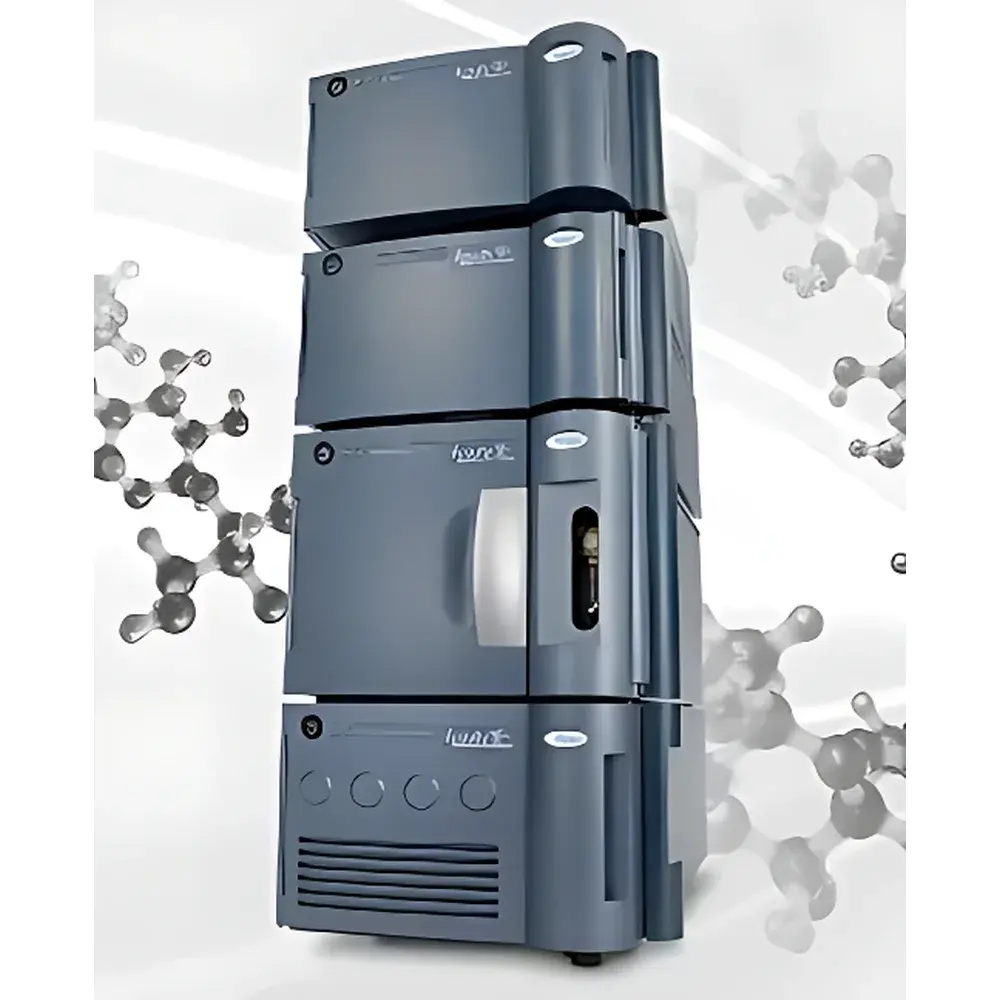
Waters ACQUITY APC Advanced Polymer Chromatography System
| Brand | Waters |
|---|---|
| Origin | USA |
| Manufacturer Type | Authorized Distributor |
| Origin Category | Imported |
| Model | ACQUITY APC |
| Instrument Type | High-Temperature GPC/SEC System |
| Column Technology | Sub-2-µm Ethylene-Bridged Hybrid (EBH) Particles with Macroporous Structure |
| Detector Configuration | Optimized Refractive Index Detector (RID) with Low-Drift, Low-Diffusion Flow Cell |
| Solvent Delivery | Precision Isocratic Solvent Manager |
| Column Oven | Thermally Stable, ±0.1 °C Temperature Uniformity |
| Software Platform | Empower 3 with GPC Module |
| Compliance | Designed for GLP/GMP environments |
Overview
The Waters ACQUITY APC (Advanced Polymer Chromatography) System is a purpose-built, high-temperature gel permeation chromatography (GPC) and size-exclusion chromatography (SEC) platform engineered for the precise, high-resolution molecular weight distribution (MWD) characterization of synthetic polymers, oligomers, and macromolecules. Unlike conventional GPC systems relying on 5–10 µm packing materials and low-pressure flow regimes, the ACQUITY APC leverages sub-2 µm ethylene-bridged hybrid (EBH) particles with engineered macroporosity to achieve superior resolution across broad molar mass ranges — from 106 Da industrial resins — under elevated temperature conditions (up to 150 °C). Its core architecture adheres strictly to the fundamental principles of SEC: separation based solely on hydrodynamic volume in solution, independent of chemical interaction with the stationary phase. This enables absolute calibration using narrow-standard polystyrene or universal calibration via intrinsic viscosity detection — critical for accurate polydispersity index (Đ), branching ratio, and long-chain branching analysis in R&D and QC laboratories serving polymer synthesis, compounding, and recycling innovation.
Key Features
- Sub-2 µm Macroporous EBH Columns: Chemically robust, thermally stable columns packed with ethylene-bridged hybrid silica particles featuring bimodal pore architecture — optimized for high-efficiency mass transfer and minimal backpressure at elevated temperatures.
- Low-Drift Refractive Index Detection: A thermally insulated, low-diffusion flow cell design minimizes thermal noise and baseline drift, delivering reproducible response even at polymer concentrations as low as 0.1 mg/mL — essential for trace oligomer quantification.
- Precision Isocratic Solvent Manager: Delivers highly stable, pulse-free flow across variable solvent viscosities (e.g., THF, oDCB, TCB), ensuring retention time repeatability <0.05% RSD over multi-day sequences.
- Thermally Uniform Column Compartment: Maintains setpoint stability within ±0.1 °C across all column positions, enabling rigorous method transfer and inter-laboratory comparability per ISO 16014 and ASTM D5296 protocols.
- Empower 3 GPC Module: Fully integrated data acquisition, calibration curve generation (linear, cubic spline, or universal), batch processing, and automated report generation compliant with FDA 21 CFR Part 11 requirements including full audit trail, electronic signatures, and user role-based access control.
Sample Compatibility & Compliance
The ACQUITY APC system accommodates a wide range of thermoplastic and thermoset polymers, including but not limited to polystyrene (PS), polyethylene (PE), polypropylene (PP), poly(methyl methacrylate) (PMMA), poly(ethylene terephthalate) (PET), poly(lactic acid) (PLA), and styrenic block copolymers. It supports both ambient and high-temperature SEC solvents — tetrahydrofuran (THF), trichlorobenzene (TCB), ortho-dichlorobenzene (oDCB), and 1,2,4-trichlorobenzene — with full compatibility for chlorinated and aromatic solvent handling per OSHA and CLP hazard communication standards. The system meets mechanical and electrical safety requirements per IEC 61010-1 and is validated for use in GLP-compliant laboratories conducting polymer characterization per ISO/IEC 17025:2017. All firmware and software modules undergo periodic security patching and version-controlled release management.
Software & Data Management
Empower 3 GPC software provides end-to-end workflow automation: from sequence setup and real-time chromatogram monitoring to automatic peak integration, calibration model selection, and comparative MWD overlay. Raw data files (.raw) are stored in a secure, timestamped database with immutable metadata (instrument configuration, column lot, detector settings, temperature logs). The system supports export to ASTM E1947-compliant .csv and .xml formats for third-party statistical analysis (e.g., JMP, MATLAB), as well as direct integration with LIMS platforms via ODBC or RESTful API. Audit trails record every user action — method modification, result reprocessing, report approval — with full traceability to individual login credentials and system timestamps, satisfying regulatory expectations for data integrity under ALCOA+ principles.
Applications
- Rapid MWD profiling of polyolefin catalyst screening batches (cycle time reduction from hours to minutes)
- Quantification of low-MW cyclic oligomers in PET bottle-grade resin for food-contact compliance (FDA 21 CFR 177.1630)
- Branching analysis of linear low-density polyethylene (LLDPE) via triple-detection SEC (RI + UV + viscometer)
- Stability assessment of biodegradable polymers (e.g., PHA, PCL) during accelerated aging studies
- Quality control of polymer additives (e.g., stabilizers, plasticizers) by SEC-coupled UV detection
- Supporting circular economy initiatives through precise characterization of recycled polymer streams containing mixed MW contaminants
FAQ
What temperature range does the column oven support?
The ACQUITY APC column compartment operates from ambient to 150 °C with ±0.1 °C setpoint accuracy and uniformity across all installed columns.
Is the system compatible with universal calibration using viscometry detection?
Yes — the platform supports integration with differential viscometer and light scattering detectors via standard analog/digital I/O interfaces for advanced conformational analysis.
Can Empower 3 GPC generate reports compliant with ISO 16014-4?
Yes — built-in report templates include all mandatory parameters: Mn, Mw, Mz, Đ, calibration curve statistics, and system suitability metrics as defined in ISO 16014-4:2019.
Does the system require gradient capability for polymer analysis?
No — isocratic elution is standard and preferred for SEC/GPC; gradient operation is neither required nor recommended due to potential column overloading and calibration instability.
How is solvent consumption reduced compared to conventional GPC?
By operating at higher efficiency with narrower-bore columns (7.8 mm × 300 mm) and lower flow rates (0.2–0.5 mL/min), the ACQUITY APC reduces solvent usage by ≥70% per run versus traditional 7.8 mm × 600 mm columns at 1.0 mL/min.





