
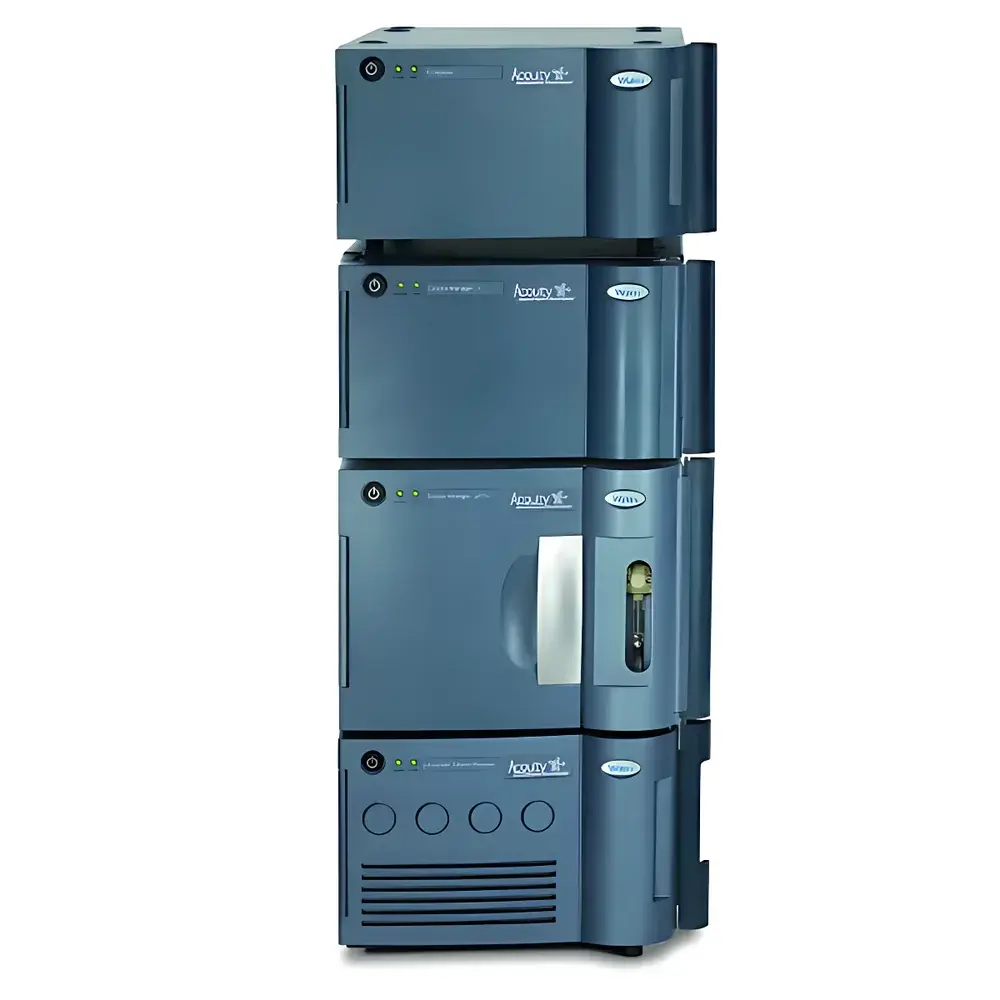
Waters ACQUITY APC Ultra-High-Performance Polymer Chromatography System
| Brand | Waters |
|---|---|
| Origin | USA |
| Model | ACQUITY APC System |
| Instrument Type | Ultra-High-Performance Liquid Chromatograph (UHPLC) for Polymer Analysis |
| Sample Introduction | Automated, Dual-Column Switching Capability |
| Solvent Management | Polymer-Optimized Quaternary Solvent Manager (p-QSM) with Six-Solvent Selection |
| Temperature Control | Column Compartment with Precise Thermal Stability |
| Detection Compatibility | RI, UV/PDA, MALS, dRI, Viscometry, and Third-Party Detectors |
| Software Integration | WinGPC UniChrom™ (PSS), Empower™ (Waters), 21 CFR Part 11–Compliant Audit Trail Support |
| Calibration | Pre-qualified APC Calibration Kits for Sub-10-min Runs and Daily Column Re-Calibration |
| Column Technology | BEH (Bridged Ethyl Hybrid) Particles with Rigid Macroporous Structure |
| Regulatory Alignment | Designed for GLP/GMP Environments |
Overview
The Waters ACQUITY APC Ultra-High-Performance Polymer Chromatography System is an engineered platform dedicated to the high-resolution, high-throughput characterization of synthetic and natural polymers via size-exclusion chromatography (SEC), also known as gel permeation chromatography (GPC). Unlike conventional SEC systems constrained by diffusion-limited kinetics and column packing limitations, the ACQUITY APC leverages sub-3 µm rigid macroporous BEH particles and ultra-low system dispersion hydraulics to deliver true UHPLC performance in polymer analysis. Its core architecture enables separation efficiency exceeding 100,000 plates/m under optimized flow conditions—achieving molecular weight distributions (MWD) with enhanced resolution, reproducibility, and speed. The system operates on a volume-exclusion principle where analytes are separated based on hydrodynamic volume in solution, enabling accurate determination of *Mn*, *Mw*, *Mz*, dispersity (*Đ*), and branching ratios when coupled with multi-detector configurations.
Key Features
- Sub-3 µm BEH-based APC columns with chemically stable, rigid macroporous structure—designed for high-pressure operation (>15,000 psi) and extended lifetime across aggressive solvents (e.g., THF, DMF, chloroform, HFIP)
- Polymer-optimized Quaternary Solvent Manager (p-QSM) supporting automated selection and precise blending of up to six solvents—including rapid solvent switching for gradient polymer elution chromatography (GPEC) and orthogonal LC-SEC methods
- Automated dual-column switching module enabling seamless selection between two parallel APC column sets or hybrid configurations integrating traditional GPC columns—all housed in a thermally stabilized column compartment (±0.1 °C)
- Integrated low-diffusion fluidic path minimizing band broadening—critical for preserving resolution of narrow MWD samples and detecting low-abundance oligomeric species
- Dedicated APC calibration kits with certified narrow- and broad-distribution standards matched to specific column pore ranges; full 10-point calibration achievable within 30 minutes using sub-10-minute runs
- Native compatibility with third-party detectors including differential refractometry (dRI), UV/Vis PDA, multi-angle light scattering (MALS), viscometry, and evaporative light scattering (ELSD)
Sample Compatibility & Compliance
The ACQUITY APC system supports a broad spectrum of polymer classes: linear and branched polyolefins, polystyrenes, polyacrylates, polyethers, polyesters, polysaccharides, and synthetic biopolymers. It accommodates both volatile and non-volatile solvents, including tetrahydrofuran (THF), *N,N*-dimethylformamide (DMF), dichlorobenzene (DCB), and hexafluoroisopropanol (HFIP)—enabling method transfer across legacy GPC platforms while extending analytical scope. All hardware and software components comply with internationally recognized standards for polymer characterization: ASTM D5296 (standard test method for molecular weight averages of polystyrene by SEC), ISO 16014 (plastics—determination of average molecular parameters of polymers by SEC), USP (chromatography), and ICH Q5E (comparability of biotechnological/biological products). Data integrity is assured through 21 CFR Part 11–compliant electronic records and audit trails when used with Empower™ Chromatography Data System.
Software & Data Management
The ACQUITY APC integrates natively with Waters Empower™ CDS for acquisition, processing, and reporting—supporting role-based access control, electronic signatures, and full audit trail functionality required for regulated environments. When paired with WinGPC UniChrom™ from PSS Polymer Standards Service GmbH, the system unlocks multidimensional chromatographic workflows, including two-dimensional SEC × SEC and SEC × LC configurations. These approaches increase peak capacity by orthogonalizing retention mechanisms—separating co-eluting species that share similar hydrodynamic volumes but differ in polarity, charge, or conformation. Batch processing, automated calibration curve generation, and statistical comparison tools facilitate routine QC and long-term stability monitoring across multiple instruments and laboratories.
Applications
- Rapid MWD profiling of polyolefin catalyst screening libraries—reducing cycle time from days to hours
- Characterization of functionalized copolymers and block architectures via combined SEC–UV and SEC–MALS analysis
- Batch-to-batch consistency assessment for pharmaceutical excipients (e.g., PEG, PLGA) under GMP-compliant workflows
- Structural elucidation of hyperbranched polymers and dendrimers using universal calibration with viscometric detection
- Method development for complex additive packages in engineering resins—leveraging p-QSM–enabled solvent gradient optimization
- Stability studies of biodegradable polyesters under accelerated aging conditions, tracking degradation-induced shifts in *Mn* and dispersity
FAQ
What distinguishes APC from conventional GPC systems?
The ACQUITY APC employs sub-3 µm rigid BEH particles and ultra-low dispersion fluidics to achieve 5–20× faster run times than traditional GPC—without sacrificing resolution or accuracy.
Can APC be used for non-SEC applications?
Yes. With its p-QSM and column switching capability, the system supports reversed-phase LC, HILIC, and gradient polymer elution chromatography (GPEC) on the same platform.
Is method transfer from legacy GPC possible?
Absolutely. APC columns are available in equivalent pore sizes to common GPC media, and solvent compatibility ensures straightforward migration of existing methods.
How does APC support regulatory compliance?
It supports 21 CFR Part 11–compliant data handling via Empower™, and its performance aligns with ASTM, ISO, USP, and ICH guidelines for polymer characterization.
What detector configurations are validated for APC?
Waters provides integrated support for dRI, UV/PDA, and optional MALS and viscometry detectors; third-party detectors with analog/digital output interfaces are fully compatible.
Does APC require specialized training for operation?
While intuitive for experienced chromatographers, Waters offers application-specific training modules covering method development, multidimensional workflows, and regulatory documentation practices.





