
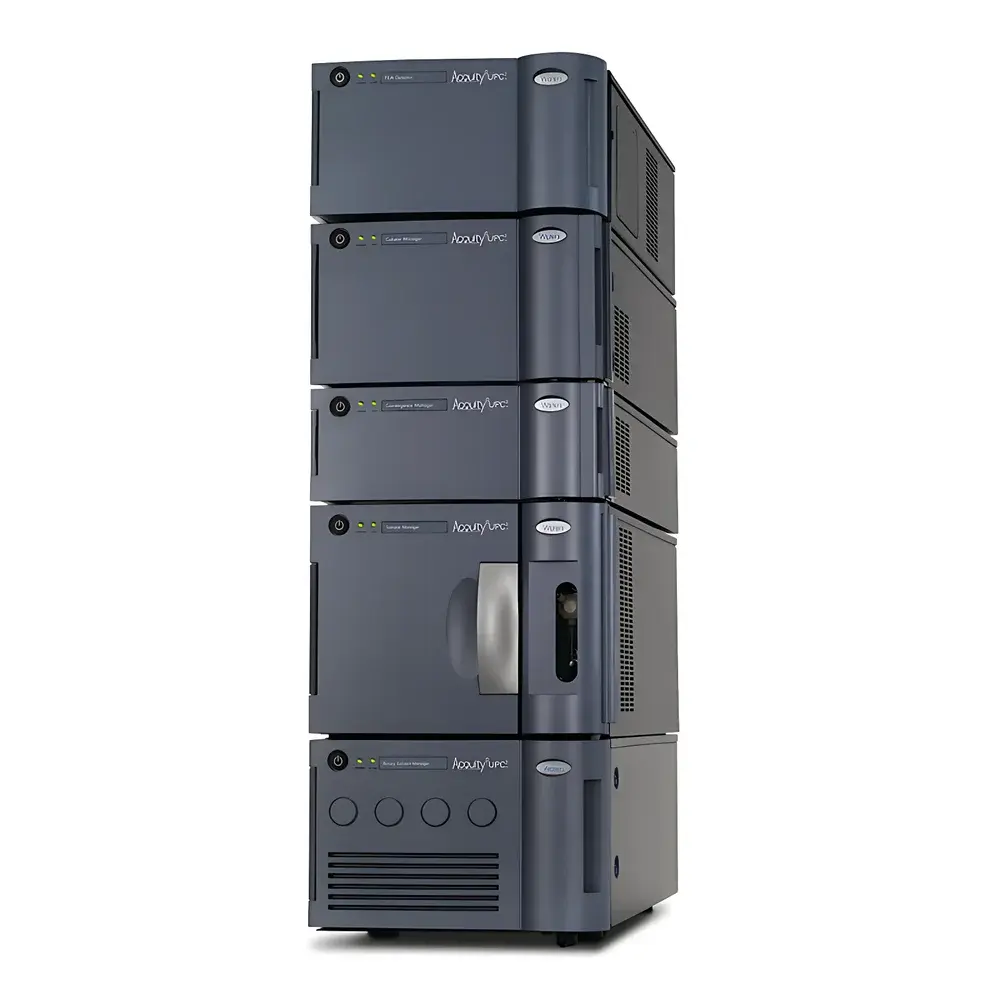
Waters ACQUITY UPC² UltraPerformance Convergence Chromatography System
| Brand | Waters |
|---|---|
| Origin | USA |
| Model | ACQUITY UPC² |
| Instrument Type | Convergence Chromatography System |
| Primary Mobile Phase | Compressed Carbon Dioxide (CO₂) |
| Compatible Detectors | UV/Vis, PDA, MS (via dedicated interfaces) |
| Injection Volume Range | 0.5–10 µL |
| Column Temperature Control | Ambient to 85 °C |
| System Pressure Range | Up to 15,000 psi (103 MPa) |
| Gradient Composition Accuracy | ≤0.2% RSD |
| Data System Compliance | FDA 21 CFR Part 11, GLP/GMP-ready |
Overview
The Waters ACQUITY UPC² UltraPerformance Convergence Chromatography System represents a paradigm shift in separation science—bridging the operational advantages of supercritical fluid chromatography (SFC) with the robustness, precision, and scalability of ultra-high-performance liquid chromatography (UPLC®) architecture. Unlike conventional HPLC or GC systems, UPC² employs compressed carbon dioxide as the primary mobile phase, modulated with organic co-solvents (e.g., methanol, ethanol, isopropanol) to tune selectivity across a broad polarity spectrum. This convergence of fluid-state physics and chromatographic engineering enables high-efficiency separations of analytes that are poorly resolved—or entirely unretained—under reversed-phase LC or thermally labile under GC conditions. The system operates within a precisely controlled pressure-temperature domain where CO₂ exhibits tunable solvent strength, low viscosity, and high diffusivity—resulting in rapid mass transfer, narrow peak widths ( 4.0 for critical pairs). Designed from the ground up for method robustness and cross-platform interoperability, the ACQUITY UPC² delivers reproducible retention time stability (≤0.05 min RSD, n=50) and seamless integration into regulated laboratory environments.
Key Features
- Patented dual-piston CO₂ delivery module with active back-pressure regulation ensures ±0.2 bar pressure stability across gradients—even during rapid solvent composition changes.
- Integrated column oven with forced-air convection and real-time thermal monitoring maintains temperature uniformity ±0.3 °C over 20–85 °C range—critical for retention time reproducibility in CO₂-based separations.
- Modular autosampler with selectable injection loops (0.5–10 µL) and needle-wash protocol minimizes carryover (<0.005%) and supports both quantitative and trace-level analysis without hardware reconfiguration.
- Intelligent column switching valve enables automated co-solvent and column screening—reducing method development time by up to 70% compared to manual SFC optimization.
- Rapid column re-equilibration (<60 seconds post-gradient) enabled by dynamic flow-path purging and pressure-controlled solvent displacement—maximizing throughput for high-sample-volume workflows.
- Hardware-level synchronization with Waters Mass Spectrometry platforms (Xevo®, Vion®, SELECT SERIES™ Cyclic IMS) via proprietary ESI/SFC interface ensures duty-cycle alignment, ion transmission efficiency >85%, and native support for MRM, MSE, and HDMSE acquisition modes.
Sample Compatibility & Compliance
The ACQUITY UPC² excels in resolving structurally diverse, challenging analytes—including chiral pharmaceuticals (e.g., enantiomeric excess determination per USP ), lipids (phospholipids, glycerides), synthetic polymers (polyacrylates, polyesters), and thermally labile natural products (terpenoids, alkaloids). Its low-heat, low-solvent-consumption operation (typical CO₂ consumption: 15–25 g/min; organic modifier: 90% versus traditional normal-phase LC. System validation adheres to ASTM E260, ISO 17025, and ICH Q2(R2) guidelines. All instrument control, data acquisition, and audit trail functions comply with FDA 21 CFR Part 11 requirements—including electronic signatures, immutable metadata logging, and role-based access control—supporting GLP and GMP-regulated submissions.
Software & Data Management
UNIFI Scientific Information System serves as the unified software platform for method design, acquisition, processing, and reporting. It includes embedded chemometric tools (PCA, hierarchical clustering) for multi-dimensional method optimization, automated peak tracking across variable CO₂ density conditions, and built-in compliance modules for electronic lab notebook (ELN) integration. Raw data files (.raw) retain full pressure, temperature, and flow metadata at 10 Hz sampling frequency—enabling retrospective parameter correlation and root-cause analysis. UNIFI’s MS-centric workflow engine supports direct spectral library searching (NIST, Waters Fragmentation Library), isotopic pattern deconvolution, and batch-processed quantitation with internal standard normalization—all traceable to original chromatographic conditions.
Applications
- Chiral purity assessment of APIs per ICH Q5A and Q6A specifications—achieving baseline separation of enantiomers with resolution >3.0 in <8 minutes.
- Lipidomics profiling of biological extracts using HILIC-UPC² hyphenation—resolving >200 lipid species across 12 classes in a single 15-minute run.
- Polymer molecular weight distribution analysis without derivatization—complementing SEC/GPC for branched architectures and low-MW oligomers.
- Green analytical method development for QC release testing—replacing hexane/isopropanol mixtures with CO₂/methanol gradients while maintaining system suitability (tailing factor 50,000).
- Impurity profiling of heat-sensitive biologics intermediates—avoiding thermal degradation observed in GC-MS or high-temperature LC methods.
FAQ
What distinguishes UPC² from traditional SFC systems?
UPC² integrates UPLC-grade fluidic precision, real-time pressure/temperature feedback control, and software-defined gradient programming—features absent in legacy SFC instrumentation. This yields superior retention time reproducibility, lower detection limits, and compatibility with modern mass spectrometers.
Can ACQUITY UPC² be used for regulatory submissions?
Yes—the system is validated for 21 CFR Part 11 compliance, supports electronic signatures, and generates audit-trail-enabled data packages meeting ICH, FDA, and EMA requirements for IND, NDA, and MAA dossiers.
Is column equilibration faster than in HPLC?
Yes—due to CO₂’s low viscosity and high diffusivity, column re-equilibration typically requires <60 seconds, enabling high-throughput screening and short-cycle method development.
Which mass spectrometers are natively supported?
Waters Xevo TQ-S micro, Vion IMS QTof, and SELECT SERIES Cyclic IMS—with hardware-synchronized timing, optimized ion source gas flows, and vendor-validated acquisition methods preloaded in UNIFI.
How does UPC² reduce environmental impact?
By substituting >90% of organic solvent with recyclable CO₂, the system lowers VOC emissions, eliminates halogenated solvent disposal costs, and aligns with EPA Safer Choice and EU REACH criteria for green chemistry adoption.



