
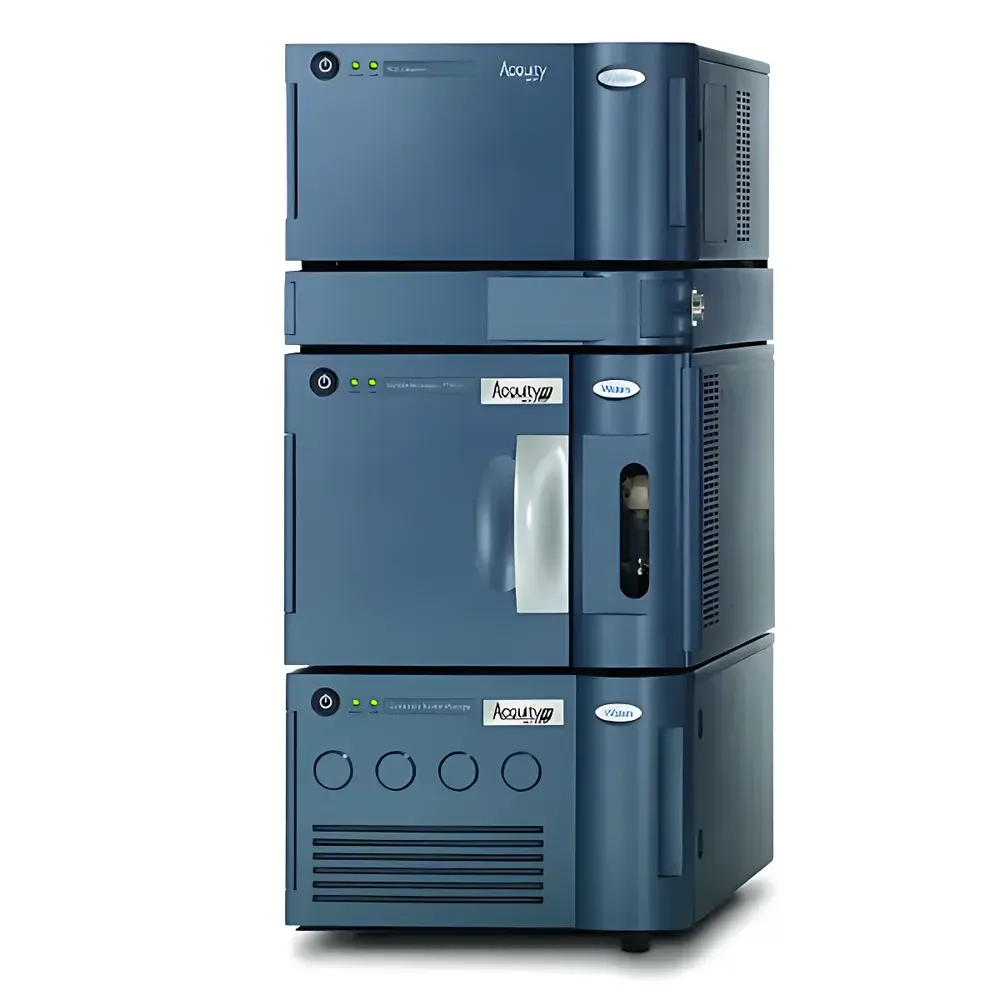
Waters ACQUITY UPLC H-Class PLUS System
| Brand | Waters |
|---|---|
| Origin | USA |
| Model | ACQUITY UPLC H-Class PLUS |
| Instrument Type | Ultra-High Performance Liquid Chromatograph (UHPLC/UPLC) |
| Application Scope | General-purpose LC platform supporting both legacy HPLC and modern UPLC methods |
| Compliance | Designed for GLP/GMP environments |
Overview
The Waters ACQUITY UPLC H-Class PLUS System is an engineered ultra-high performance liquid chromatography platform built on Waters’ proprietary low-diffusion fluidic architecture. It operates on the core principle of minimizing extra-column band broadening—critical for preserving the narrow peak widths generated by sub-2 µm particle-packed columns. Unlike conventional high-pressure LC systems that merely withstand elevated backpressures, the H-Class PLUS delivers true UPLC performance through rigorously controlled dwell volume (< 100 µL), sub-microliter injection precision, thermally stabilized flow paths, and detector cell volumes optimized for < 1 µL peak elution volumes. This system serves as a validated bridge between legacy HPLC infrastructure and next-generation UPLC methodology—enabling laboratories to retain existing method libraries while progressively adopting higher-resolution, faster, and more sensitive separations without hardware obsolescence.
Key Features
- Quaternary Solvent Manager (QSM) with integrated Solvent Selection Valve (SSV): Supports up to nine solvents via automated valve switching; enables precise gradient formation across diverse mobile phase chemistries including aqueous/organic, ion-pairing, and SEC-compatible buffers.
- Low-Diffusion Flow Path Architecture: Total system dispersion < 15 µL, ensuring retention of chromatographic efficiency from column to detector—even at flow rates up to 2.0 mL/min and pressures up to 15,000 psi.
- Column Manager with Independent Temperature Control: Accommodates 1–6 columns in individually heated zones (4–90 °C); each zone includes active pre-heating to eliminate thermal mismatch and ensure consistent retention time stability.
- Direct-Inject Autosampler with流通 Needle Design: Injection volume range 0.1 µL–1000 µL; carryover < 0.005% (verified with caffeine standard); needle seal integrity maintained under full system pressure.
- Auto•Blend Plus Technology: Dynamically prepares mobile phases from stock solutions or pure solvents—automating pH and ionic strength adjustment without manual buffer preparation; validated for reversed-phase, ion-exchange (IEX), and size-exclusion (SEC) applications.
- Intelligent Gradient Start: Compensates for system volume differences during method transfer from other LC platforms—preserving gradient timing integrity without manual recalibration of time programs.
- Multi-Detector Compatibility: Optimized for integration with ACQUITY QDa Mass Detector, UV/Vis PDA, and fluorescence detectors—all featuring UPLC-optimized flow cells and minimized optical path lengths.
Sample Compatibility & Compliance
The H-Class PLUS supports a broad range of analyte classes—including small molecules, peptides, oligonucleotides, and synthetic polymers—across reversed-phase, hydrophilic interaction (HILIC), ion-exchange, and aqueous normal-phase modes. Its solvent compatibility extends to aggressive modifiers (e.g., TFA, HFIP, ammonium acetate/formate up to 1 M) and high-pH mobile phases (pH 12). The system meets essential regulatory requirements for analytical instrument qualification: IQ/OQ/PQ protocols are supported via Waters’ System Suitability Test (SST) packages and Empower’s audit-trail-enabled workflow management. It is routinely deployed in laboratories operating under GLP, GMP, and ISO/IEC 17025 frameworks—and its method transfer capabilities align with ICH Q5A(R2), Q2(R2), and USP guidelines.
Software & Data Management
Native control and data acquisition are delivered through Waters Empower Chromatography Data System (CDS) v3 or later—fully compliant with FDA 21 CFR Part 11 for electronic records and signatures. Optional UNIFI Scientific Information System provides unified data handling for LC-MS, LC-UV, and multidimensional workflows. MassLynx integration enables direct control of ACQUITY QDa and Xevo mass spectrometers. All software modules support automated sequence generation, real-time system suitability monitoring, and metadata-rich result reporting—including peak purity assessment, mass-based peak tracking, and gradient deviation alerts. Raw data files adhere to open-standard formats (e.g., .raw, .cdf) for third-party reprocessing and long-term archival.
Applications
The H-Class PLUS is routinely applied in pharmaceutical QC/QA (e.g., assay, related substances, dissolution testing), biopharmaceutical characterization (monoclonal antibody charge variant profiling, peptide mapping), environmental analysis (PAHs, PFAS, pesticides), and food safety (mycotoxin quantitation, vitamin profiling). Its method flexibility makes it ideal for forced degradation studies, stability-indicating assays, and orthogonal method development where robustness across pH, temperature, and gradient slope must be empirically established. The Auto•Blend Plus capability significantly accelerates screening of ion-pairing conditions for basic drugs and facilitates rapid optimization of SEC separation for protein aggregates.
FAQ
Can the H-Class PLUS run traditional HPLC methods without modification?
Yes—the system maintains full backward compatibility with isocratic and gradient HPLC methods using 3–5 µm particles, including legacy USP and Ph. Eur. monographs.
Is method transfer from other UHPLC platforms supported?
Yes—integrated system volume compensation, dwell time calibration tools, and Empower’s Method Transfer Assistant enable reproducible migration of methods from Agilent 1290, Thermo Vanquish, or Shimadzu Nexera systems.
What is the maximum operating pressure and flow rate?
Rated for continuous operation up to 15,000 psi (1034 bar) and flow rates from 0.001 to 2.0 mL/min, with programmable pulse dampening for stable baselines at low flows.
Does it support 2D-LC configurations?
Yes—via optional heart-cutting or comprehensive 2D-LC modules with dual-column switching valves and synchronized gradient control.
How is detector cell volume optimized for UPLC peaks?
UV/Vis and PDA detectors feature 0.6 µL flow cells with laminar-flow design and minimized optical path length—reducing dispersion while maintaining > 0.001 AU noise specification at 254 nm.





