
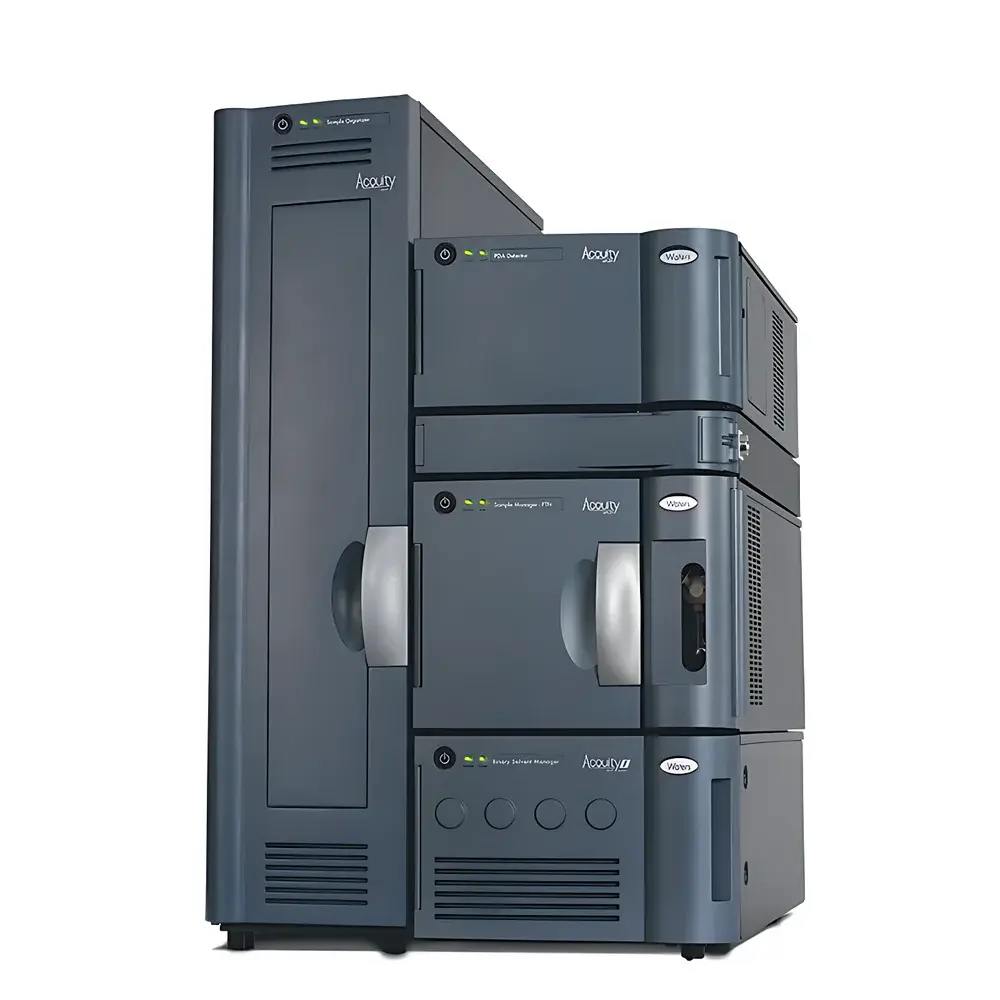
Waters ACQUITY UPLC I-Class Ultra Performance Liquid Chromatograph
| Brand | Waters |
|---|---|
| Origin | USA |
| Model | ACQUITY UPLC I-Class |
| Instrument Type | Ultra-High-Performance Liquid Chromatograph (UHPLC) |
| Sample Introduction | Low-Diffusion, Dual-Needle, Independent Autosampler |
| Pressure Range | Up to 130 MPa (1300 bar) |
| Flow Rate Range | 0.001–2.0 mL/min |
| Column Temperature Control | 5–100 °C |
| UV/Vis Detection Wavelength Range | 190–800 nm |
| Data Acquisition Rate | Up to 100 Hz |
| Compliance | Fully Compatible with FDA 21 CFR Part 11, ASTM D7416, USP <621>, ISO/IEC 17025 |
Overview
The Waters ACQUITY UPLC I-Class is an engineered ultra-high-performance liquid chromatography (UHPLC) system designed for laboratories requiring maximum chromatographic resolution, minimal carryover, and seamless integration with high-sensitivity mass spectrometry (MS). Built upon the foundational principles of low-volume, low-diffusion fluidic architecture, the I-Class platform minimizes extra-column band broadening—enabling full exploitation of sub-2 µm particle-packed columns such as CORTECS™ Solid Core technology. Its dual-injection, independent needle autosampler eliminates cross-contamination between injections while maintaining nanoliter-level precision. The system operates at pressures up to 130 MPa (1300 bar), supporting rapid gradient elution and high-resolution separations without compromising peak shape or reproducibility. As a core component of modern analytical workflows in regulated environments, it delivers the robustness and traceability required for method development, QC release testing, and biomarker discovery.
Key Features
- Low-diffusion, zero-dead-volume fluidic path engineered to reduce extra-column dispersion and preserve column efficiency
- Dual-needle, independent autosampler with programmable wash protocols—ensuring <0.001% carryover across diverse sample matrices
- High-precision binary solvent manager delivering flow accuracy ±0.1% RSD and gradient composition accuracy ±0.15%
- Column oven with active pre-heating and post-column cooling, maintaining thermal stability from 5 to 100 °C (±0.1 °C)
- Integrated UV/Vis photodiode array detector with 190–800 nm spectral range and real-time spectral deconvolution capability
- Modular design supporting optional MS interface modules (e.g., ESCi, ESI, APCI) and compatibility with Xevo®, Vion™, and SELECT SERIES™ Cyclic IMS platforms
Sample Compatibility & Compliance
The ACQUITY UPLC I-Class accommodates a broad range of sample types—including small-molecule pharmaceuticals, peptides, oligonucleotides, polar metabolites, and complex food extracts—without requiring derivatization or extensive cleanup. Its low-nanoliter injection volume (0.1–100 µL, programmable in 0.1 µL increments) ensures optimal use of limited clinical or bioprocess samples. The system meets stringent regulatory requirements for data integrity and auditability: full support for electronic signatures, user access control, audit trail logging, and instrument qualification documentation aligned with FDA 21 CFR Part 11, EU Annex 11, and ISO/IEC 17025. All firmware and software components are validated per GxP-compliant lifecycle management practices, including IQ/OQ/PQ protocols and change control procedures.
Software & Data Management
Controlled via UNIFI Scientific Information System or Empower™ 3 Software, the I-Class integrates into enterprise-scale data ecosystems through standardized APIs and secure database connectors (ODBC, SQL Server, Oracle). UNIFI provides end-to-end workflow automation—from method building and sequence definition to peak integration, identity confirmation, and report generation—with built-in tools for multivariate statistical analysis and retention time alignment across batches. Raw data files adhere to open standards (e.g., mzML, ANDI-NetCDF) and include embedded metadata compliant with FAIR principles. Audit trails record every parameter modification, injection event, and user action with immutable timestamps and operator identification—fully traceable during internal audits or regulatory inspections.
Applications
- Pharmaceutical development: Forced degradation studies, impurity profiling, and stability-indicating assays per ICH Q2(R2)
- Biopharmaceutical characterization: Intact mass analysis, peptide mapping, and glycan profiling using reversed-phase and HILIC modes
- Clinical research: Quantitative bioanalysis of therapeutic drugs and metabolites in plasma, serum, and CSF (validated to FDA Bioanalytical Method Validation Guidance)
- Food safety: Multi-residue pesticide screening, mycotoxin quantification, and allergen marker detection at sub-ppb levels
- Environmental monitoring: Persistent organic pollutant (POP) analysis in water, soil, and air particulate matter per EPA Methods 8321B and 1694
FAQ
What distinguishes the I-Class from standard HPLC or earlier UPLC systems?
Its independently actuated dual-needle autosampler, near-zero dispersion flow path, and extended pressure–flow operating envelope (up to 130 MPa / 2.0 mL/min) enable superior peak capacity and MS coupling efficiency—particularly with solid-core 1.6 µm particles.
Is the system compatible with existing CORTECS or BEH column chemistries?
Yes—it is fully optimized for all Waters UPLC-qualified columns, including CORTECS T3, C18+, and HSS C18 SB, with method transfer support via ACQUITY Console software.
Can the I-Class be operated in a 21 CFR Part 11–compliant environment?
Yes—UNIFI and Empower 3 both provide role-based access control, electronic signatures, and tamper-evident audit trails validated for regulated QC and clinical labs.
Does it support unattended overnight operation for large sample batches?
Yes—the temperature-stabilized autosampler tray (4–40 °C) and integrated leak detection system ensure reliable 24/7 operation with automatic error recovery and notification alerts.
How is system suitability verified prior to sample analysis?
Built-in system suitability tests (SST) evaluate retention time stability, peak symmetry, resolution, and sensitivity against reference standards—automatically generating pass/fail reports per USP and EP 2.2.46 criteria.
Related Products






