
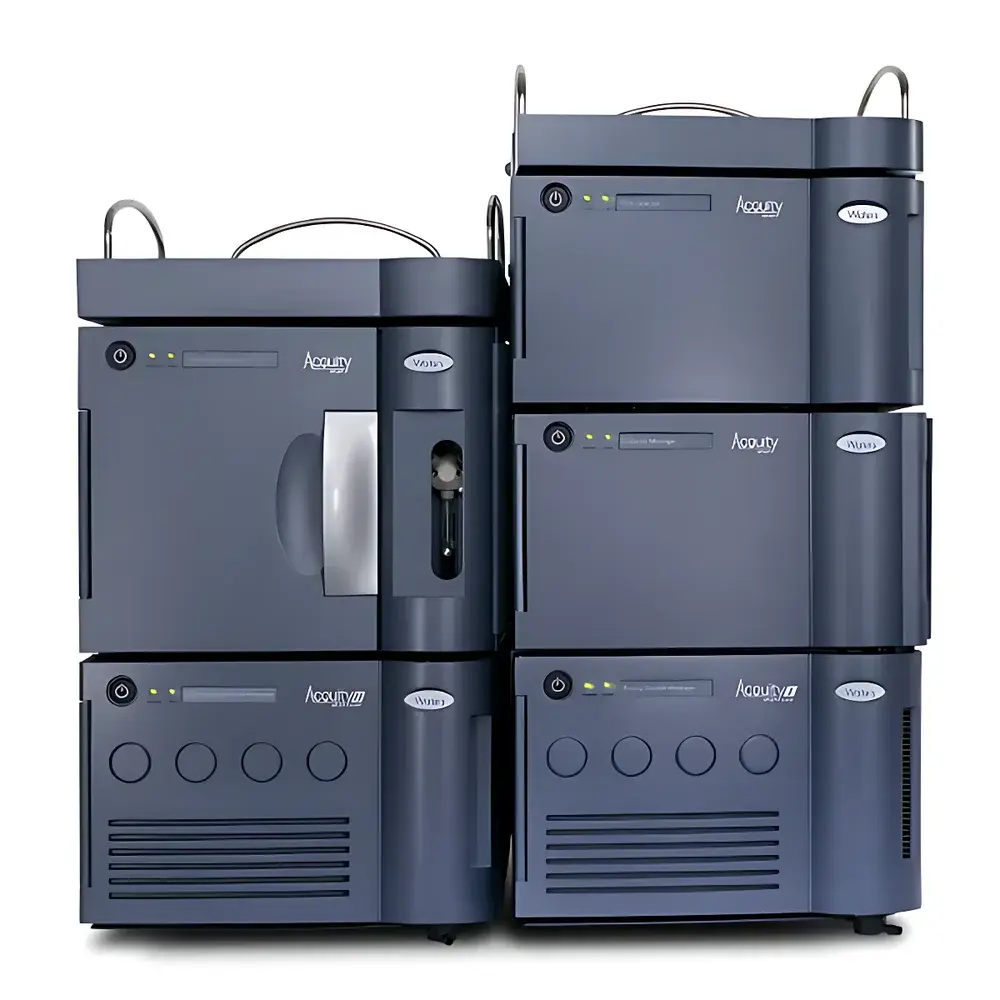
Waters ACQUITY UPLC Two-Dimensional Liquid Chromatography System
| Brand | Waters |
|---|---|
| Origin | USA |
| Model | ACQUITY UPLC |
| Instrument Type | Comprehensive Two-Dimensional Liquid Chromatography (2D-LC) System |
| Configuration | Modular, valve-driven, pump-synchronized dual-gradient platform |
| Software Integration | Empower 3 / UNIFI with dedicated 2D-LC method templates |
| Compliance Framework | Designed for GLP/GMP environments |
| Column Compatibility | Fully compatible with sub-2-µm particle UPLC columns (e.g., BEH, CSH, HSS series) |
| System Architecture | Dual binary solvent manager (BSM) or quaternary solvent manager (QSM) configurations with high-pressure switching valves (e.g., 10-port/2-position, 6-port/2-position) |
| Flow Rate Range | 0.001–2.000 mL/min (per dimension, programmable independently) |
| Maximum System Pressure | 15,000 psi (103 MPa) |
| Injection Volume Range | 0.1–100 µL (with precision loop or needle-wash-enabled autosampler) |
| Column Oven Temperature Range | 4–90 °C (±0.1 °C stability) |
| UV/Vis Detection Wavelength Range | 190–800 nm (with TUV or PDA detectors) |
| Data Acquisition Rate | Up to 100 Hz (for high-resolution 2D contour plot generation) |
Overview
The Waters ACQUITY UPLC Two-Dimensional Liquid Chromatography System is an engineered platform for comprehensive two-dimensional liquid chromatography (LC×LC), designed to address analytical challenges requiring enhanced peak capacity, orthogonality, sensitivity, and reproducibility in complex sample matrices. Unlike conventional one-dimensional HPLC or even single-dimension UPLC, this system implements a fully synchronized, valve-mediated heart-cutting or comprehensive (LC×LC) architecture—leveraging the core principles of high-pressure liquid separation kinetics, precise gradient timing, and real-time fraction transfer between first-dimension (¹D) and second-dimension (²D) columns. Built upon the proven ACQUITY UPLC platform—including ACQUITY UPLC, ACQUITY UPLC H-Class, and ACQUITY UPLC H-Class Bio variants—the system integrates dual solvent delivery, thermally stabilized column management, low-dead-volume valving, and detector synchronization to deliver robust, scalable 2D separations. Its foundation in ultra-high-pressure liquid chromatography (UHPLC) enables sub-2-µm particle column operation at pressures up to 15,000 psi, directly translating into higher resolution, faster analysis cycles, and improved signal-to-noise ratios—critical for proteomics, biopharmaceutical characterization, natural product profiling, and impurity mapping.
Key Features
- Modular 2D-LC architecture supporting both heart-cutting (LC-LC) and comprehensive (LC×LC) modes via software-configurable valve sequences
- Dual independent gradient capability: Each dimension operates with its own binary or quaternary solvent manager, enabling orthogonal mobile phase chemistries (e.g., reversed-phase × hydrophilic interaction, or size exclusion × reversed-phase)
- High-precision, low-diffusion switching valves (e.g., 10-port/2-position) with <100 nL internal volume and <10 ms actuation time for minimal band broadening during fraction transfer
- Integrated column oven with active pre-heating and post-cooling zones to ensure thermal equilibration across both dimensions
- Autosampler with needle wash, injection precision ≤0.25% RSD, and programmable loop or flow-through injection for optimal carryover control
- Real-time synchronization of detector acquisition, valve actuation, and gradient events via hardware-triggered timing protocols
- Factory-validated method transfer pathways from 1D to 2D workflows, reducing method development time and inter-system variability
Sample Compatibility & Compliance
The system accommodates a broad range of sample types—from small-molecule pharmaceuticals and synthetic polymers to intact monoclonal antibodies, glycopeptides, and crude biological extracts—without modification to fluidic architecture. It supports standard 2.1 mm and 3.0 mm ID analytical columns, as well as microbore and capillary formats when paired with appropriate interface kits. All hardware components meet ISO 9001 manufacturing standards; system validation packages include IQ/OQ/PQ documentation templates aligned with ASTM E2656, USP , and ICH Q2(R2) guidelines. When operated under UNIFI or Empower 3 with enabled security settings, the platform complies with FDA 21 CFR Part 11 requirements for electronic records and signatures—including full audit trail logging, user access controls, and electronic signature workflows validated per GAMP 5 principles.
Software & Data Management
Data acquisition, method development, and result interpretation are unified within Waters’ UNIFI Scientific Information System or Empower 3 Chromatography Data Software. Both platforms provide dedicated 2D-LC modules featuring contour plot visualization, peak tracking across retention planes, automated peak correspondence assignment, and orthogonal selectivity scoring. Raw data files (.raw) retain complete timing metadata for each valve event, gradient step, and detector channel—enabling retrospective reprocessing and method optimization. Batch processing supports parallel analysis of multiple 2D datasets with consistent integration parameters. All software installations undergo periodic security patching and are qualified for use in regulated environments where data integrity, traceability, and long-term archival compliance (e.g., ISO/IEC 17025) are mandatory.
Applications
- Biopharmaceutical characterization: Resolving charge variants, deamidation products, and glycoforms in mAbs using SCX × RP or HILIC × RP configurations
- Pharmaceutical impurity profiling: Isolating and identifying low-abundance genotoxic impurities in API batches via orthogonal 2D separation prior to MS detection
- Metabolomics and lipidomics: Achieving >10,000 peak capacity in human plasma extracts through comprehensive RPLC × HILIC workflows
- Environmental analysis: Quantifying structurally similar PFAS compounds with co-elution challenges using mixed-mode × reversed-phase LC×LC
- Food authenticity testing: Differentiating adulterated olive oil blends by coupling size-exclusion (¹D) with chiral reversed-phase (²D) separation
FAQ
What distinguishes comprehensive 2D-LC (LC×LC) from heart-cutting 2D-LC (LC-LC)?
Comprehensive 2D-LC samples the entire ¹D effluent in discrete fractions transferred to the ²D column, generating a full retention plane (contour plot); heart-cutting isolates only selected ¹D peaks for further ²D analysis—ideal for targeted quantitation.
Can existing ACQUITY UPLC systems be upgraded to support 2D functionality?
Yes—retrofit kits include dual solvent managers, high-pressure switching valves, updated firmware, and software licenses; qualification must be performed per system-specific OQ protocols.
Is method transfer between different ACQUITY UPLC platforms (e.g., H-Class to H-Class Bio) supported in 2D mode?
Method portability is maintained when column dimensions, particle chemistry, and gradient dwell volumes are matched; UNIFI’s method translation tool provides automated dwell volume compensation and retention time alignment.
Does the system support coupling to high-resolution mass spectrometers?
Yes—standard ESI and APCI interfaces are compatible; the system’s low flow rate stability and minimal delay volume ensure optimal ionization efficiency and duty cycle utilization for TOF, Orbitrap, and Q-TOF platforms.
How is data integrity ensured during extended 2D runs (e.g., >60 min)?
Empower 3 and UNIFI implement continuous file writing with cyclic backup, instrument status monitoring, and automatic recovery points; all raw data files are checksum-verified upon acquisition completion.
Related Products






